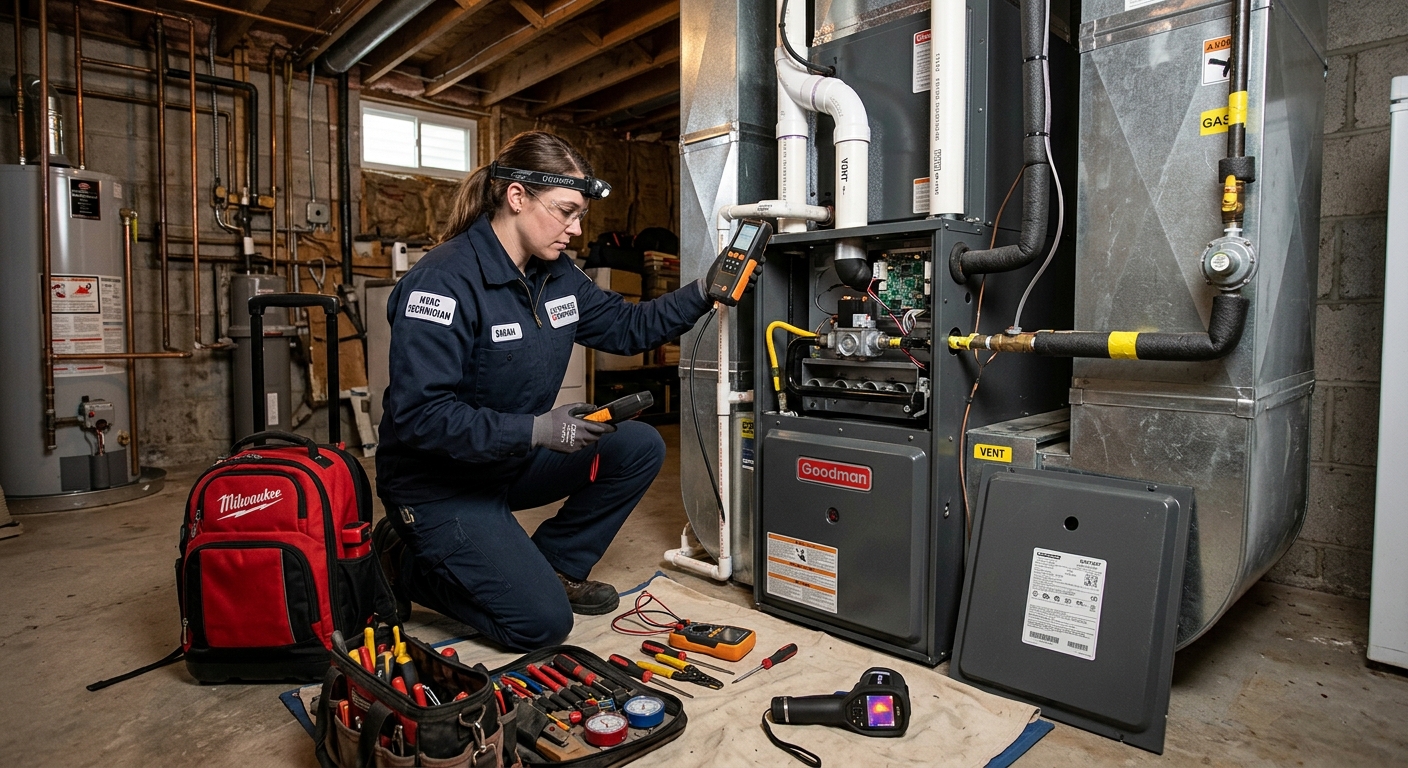
HVAC costs in Archbald — 2026
HVAC system pricing in Archbald depends heavily on the age and style of your home. With a homeownership rate of 73.2% and nearly two-thirds of homes built before 1980 (U.S. Census Bureau, ACS 2024), most residents face either retrofits or replacement—not simple swaps. While Scranton and Old Forge feature many pre-1940 rowhouses and duplexes that require custom ductwork solutions, Archbald itself skews toward single-family homes, but duct conditions still vary widely.
The northeastern Pennsylvania climate is heating-dominated, with 6,100 heating degree days and only 850 cooling degree days per year. That means most homes here prioritize reliable heat in winter, and decisions about air conditioning often depend on the existing ductwork—or the lack thereof. In older homes without central AC, installation typically requires new ducts or going with ductless mini-splits. Existing heating systems may be boilers, oil furnaces, or baseboard units, and many lack ductwork entirely, raising the cost of retrofitting for air conditioning or heat pumps.
| System |
Best for |
Efficiency |
Price range (installed) |
| Central AC replacement (existing ducts) |
homes with sound ductwork |
16–20 SEER2 |
$4,900–$12,000 |
| Air source heat pump (ducted) |
year-round heating and cooling |
8–10 HSPF2 |
$7,800–$16,500 |
| Cold-climate heat pump (ducted) |
heat pump as primary heat |
9–11 HSPF2 |
$12,500–$16,500 |
| Ductless mini-split (single zone) |
additions, rooms without ducts |
20–30 SEER2 |
$3,100–$6,900 |
| Full duct system installation |
homes with no existing ducts |
— |
$8,800–$17,500 |
Installed estimates for a typical Archbald home. Equipment tonnage, duct condition and electrical capacity move these more than brand.
Mechanical permits for HVAC work in Archbald
Pennsylvania does not issue a statewide HVAC trade license for residential work. Instead, for residential projects in Archbald, regulation happens at the local municipal level. Each borough or township in Lackawanna County—including Archbald—enforces the Pennsylvania Uniform Construction Code (UCC), based on the IRC. Contractors don't need a state HVAC license, but they must hold a Home Improvement Contractor (HIC) registration from the Pennsylvania Office of Attorney General for any contract exceeding $500. You can verify this registration at hic.attorneygeneral.gov.
For jobs that handle refrigerant—like AC or heat pump installation—federal law requires EPA Section 608 certification. This certification is mandatory nationwide, not just in Pennsylvania, and it ensures the technician is qualified to handle refrigerants safely and legally.
Mechanical permits and inspections are administered by the local code office in each municipality. Always confirm with the Archbald code office whether a permit is required for your HVAC project; it almost always is for replacements, new installations, or major alterations. To protect yourself, verify insurance and workers’ compensation coverage before work begins—Pennsylvania’s WCAIS system at wcais.pa.gov is the state portal for this. Don’t skip these steps, as it’s your main leverage for safe and code-compliant work in a market as crowded as ours.
The refrigerant change and what it means for repairs
As of 2025, new residential air conditioning and heat pump systems for Archbald homes are being built for lower-GWP refrigerants like R-454B and R-32, in compliance with ongoing federal HFC phase-downs. If you’re living with a system using R-410A—which remains common—it can still be legally serviced and recharged. There is no law requiring you to replace working R-410A equipment, so don’t be pressured into a premature swap.
What will change over the coming years is refrigerant cost and, eventually, part availability. With the supply of R-410A set to gradually tighten, topping off or repairing a leaky older system will get more expensive. If your system has a slow leak or develops a refrigerant issue after 10–15 years, the repair-versus-replacement decision will tilt more toward replacement because the price of R-410A is likely to rise significantly as stocks dwindle. But as long as your equipment is running and not leaking, you aren’t required to make any move now.
Expect future repairs on old refrigerants to be judged less on legality and more on parts and recharge cost. Your contractor should be upfront about these economics, especially as the supply landscape continues to change through the late 2020s.
Heat pump or furnace: what makes sense in Archbald
In Archbald, it’s primarily a heating market: we see winter design temperatures down to 4 °F and 6,100 heating degree days over the season. Modern cold-climate heat pumps do keep supplying heat well below freezing, so the old belief that “heat pumps don’t work here” is mostly out of date. That said, heat pump capacity drops as the mercury dips—meaning, in the harshest weeks, a heat pump alone may not keep up without auxiliary heat (electric or gas). This is why dual-fuel systems are an option, especially in older or draftier homes.
Natural gas is widely available in the valley cities but less so in rural northern townships, where many still use propane or oil. If you have gas on-site, a high-efficiency furnace is hard to beat for upfront and operating cost. Where gas isn’t available, heat pumps usually win hands down versus propane or oil for year-round efficiency, especially if you plan weatherization upgrades or want to move toward an all-electric future.
A furnace remains the best call for homes with existing gas service, especially where deep cold is common, or the house has older windows and insulation. But with recent advances in heat pumps, most newer or upgraded homes in Archbald can use a cold-climate heat pump as the main system and see only minimal use from backup heat.
| Option |
Installed cost |
Operating cost here |
Best when |
Incentive eligible |
| Gas furnace + central AC |
$4,900–$12,000 |
lowest with existing gas |
existing gas service, coldest zones |
select utility & federal rebates |
| Ducted heat pump (cold climate) |
$7,800–$16,500 |
moderate, high efficiency |
good envelope, all-electric goal |
most state and federal rebates |
| Dual fuel (heat pump + gas backup) |
$12,500–$16,500 |
lowest in deep cold |
gas on site, deep cold spells |
some utility/federal |
| Ductless multi-zone |
$8,800–$17,500 |
lower for zoned use |
no ductwork, zone control |
state and federal rebates |
Mini-splits and zoning in Archbald homes
Ductless mini-splits are the goto solution in Archbald when you need to heat or cool an addition, finish an attic or basement, or fix a stubborn room that just never stays comfortable. They also shine in older homes where putting in new ductwork would destroy original plaster, trim, or finishes—very common in the pre-1940 rowhouses and duplexes in Scranton and Old Forge, but also true of some older neighborhoods in Archbald.
A single-zone mini-split is usually the most efficient approach when serving just one area, such as a renovated attic. If you need to serve multiple rooms, a multi-zone system (several indoor heads off one outdoor unit) seems appealing, but each added zone means less output per head and can hurt efficiency. In many cases, several single-zone systems perform better than one oversize multi-zone, but at a higher initial price. Head placement also matters—aesthetics can be a sticking point, as the heads are visible on the wall and require a drain route for condensate, which sometimes limits your layout options.
For homes that predate central air, mini-splits avoid the hassle of tearing into existing walls for ducts. If your house never had central AC and you’re tired of window units, mini-splits are often the cleanest and quietest solution available.
The decision point on an aging system
Homeowners in Archbald shouldn’t rush to replace an older HVAC system just because it isn’t the latest unit on the block. Start with age: most systems last 15–20 years, but a well-maintained furnace or AC can go longer. If your system is under 10 years old and needs a relatively inexpensive repair, fixing it is usually the best call. As systems hit the 10–15 year range, you’ll want to compare the cost of repairs to replacement—as a rule of thumb, if a repair will run more than a third of a new system, start weighing a full replacement.
Next, consider the failure type. Single components (like fan motors or contactors) aren't cause for alarm, but a failed compressor or cracked heat exchanger means it’s time for a new system, regardless of age or efficiency. Also, check which refrigerant your AC or heat pump uses—older refrigerants cost more to service and raise the odds that replacement makes sense.
Efficiency upgrades rarely pay back fast enough in our cold-dominated region to warrant replacement on their own. For high bills in a working system, test ducts and your building envelope first—often, it’s air leaks or poorly sealed ductwork causing the problem, not the equipment.
| Situation |
Recommendation |
Typical cost |
Reasoning |
| Under 10 years, single component failure |
Repair |
$300–$1,200 |
Most parts are still available and repairs are cost-effective |
| 10–15 years, repair over a third of replacement |
Consider replacing |
$4,900–$12,000 |
Cost/benefit starts to favor replacement over frequent major repairs |
| 15+ years, any major failure |
Replace |
$4,900–$12,000 |
End of expected service life—new system is rarely more expensive long-term |
| Cracked heat exchanger, any age |
Replace immediately |
$4,900–$12,000 |
Carbon monoxide risk—this isn’t repairable or safe to ignore |
| Compressor failure past warranty |
Replace |
$7,800–$16,500 |
Cost of compressor and labor is often near or above a new system |
| Working system, high bills |
Test ducts and envelope first |
$300–$800 |
Most high bills are due to air leaks or poor duct sealing, not the unit |
Retrofit versus replacement in Archbald
Archbald’s housing stock is solidly older, with 64.8% of homes built before 1980 (U.S. Census Bureau, ACS 2024). That means a large share of houses were designed before central air was common. Ductwork may either be absent, undersized, or meant only for heating—if it exists at all. If you’re considering a replacement, inspect your current duct system: older ducts may not handle cooling loads, and leaky or uninsulated ducts waste money year-round.
Insulation levels and window quality in these homes are all over the map, which has major consequences for load calculation and sizing. Electrical panels, too, are often underpowered for a full electric conversion (heat pump plus heat strips), sometimes requiring an upgrade for all-electric projects. For gas systems, check your chimney or flue—the liner may need code upgrades, especially after swapping out an old furnace or boiler.
If you’re in a newer subdivision—one of the rare post-1990 builds in Archbald—the discussion changes. Original “builder-grade” systems can reach end-of-life after 20+ years, and those systems were often oversized for heating but never ideal for cooling. Replacement at this point is no longer optional and is your chance to right-size the system and upgrade ductwork if comfort has been an issue.
Frequently asked questions — HVAC installation in Archbald
How long should an HVAC system last in Archbald?
In Archbald, most modern HVAC systems—whether a furnace, heat pump, or central air—last 15 to 20 years with proper maintenance. Our northeastern Pennsylvania winters are long and cold, so heating equipment can face more cycles and wear than in milder climates, which may trim a couple years off maximum life compared to states further south. Air conditioning components often last on the longer end of that range, while older oil burners or baseboard boiler systems sometimes exceed 30 years, though usually at the expense of efficiency. As repairs approach a third of replacement—say, when a compressor or heat exchanger fails on a 16-year-old system—replacement is usually the sound investment. For a new central AC replacement in Archbald, expect a typical range of $4,900–$12,000 installed.
Is a high-efficiency system worth the extra cost here?
In Archbald, the value of a high-efficiency HVAC system depends heavily on your fuel type and insulation levels. With 6,100 heating degree days and most homes built before 1980, heating is where most of your money goes. If you heat with propane, oil, or electric resistance, the upgrade to a high-efficiency heat pump can pay for itself in as little as 7–10 years. With natural gas, the difference is smaller, but a high-efficiency furnace (95%+) does trim bills in late winter cold snaps. However, if your ducts are leaky or your insulation is poor, those efficiency gains won’t show up on your bill. For reference, a ducted air-source heat pump in our area falls in the $7,800–$16,500 range installed—make sure your home is air-sealed before investing in that step.
What is a Manual J load calculation?
A Manual J load calculation is the industry-standard method for sizing HVAC systems based on the unique characteristics of your home. In Archbald, this process takes into account the square footage, insulation quality, window and door types, orientation, and even your household’s typical use. Old homes—of which there are many here—often have drastically different heat loss or gain than newer builds, and getting the size wrong can mean comfort and efficiency problems that last decades. A new central AC system sized solely by square footage, without Manual J, can easily be over- or undersized. Proper load calculation can be the difference between a comfortable, cost-effective system and one that never quite keeps up. Expect to see this step included in any reputable proposal—especially with quotes in the $4,900–$12,000 range.
Is natural gas available throughout Lackawanna County?
Natural gas is common in much of the Lackawanna Valley—including Archbald, Scranton, and most nearby boroughs. However, rural northern townships in the county do not always have natural gas lines. In those areas, homeowners still rely on propane or fuel oil for heat. If you’re planning a major HVAC upgrade here, check with your utility or local code office to confirm availability. For houses off the gas grid, cold-climate heat pumps offer an increasingly competitive replacement, especially given the price of delivered fuels. As an example, a ducted heat pump installation here typically runs $7,800–$16,500 installed—including equipment sized for our 4 °F winter design temperatures.
Should I repair or replace my HVAC system in Archbald?
The decision in Archbald comes down to age, repair type, and what’s failed. If your system is under 10 years old and the repair falls under $1,200, a fix is usually sensible. As systems age past 15 years, especially those running on older refrigerants or showing major part failures (like heat exchangers or compressors), replacement makes more and more sense. This is doubly true for systems that use R-410A, as refrigerant supply tightens and repair prices increase. For context, a typical replacement cost for a central AC or furnace in our area is $4,900–$12,000. Always check insulation and ducts first—sometimes comfort issues are building-related, not equipment-related.
Are duct sealing and insulation eligible for incentives?
Yes—many utility and federal programs in Pennsylvania offer incentives for duct sealing, insulation upgrades, and weatherization. In Archbald, these improvements make a measurable difference because so many homes predate modern building standards. Sealing ducts in older homes can cut energy waste by 20% or more, sometimes solving comfort complaints before you ever need new equipment. While the biggest rebates are often reserved for new heat pumps or high-efficiency system swaps (often $7,800–$16,500 here), check with your utility or local agencies for weatherization incentives. Good contractors should be able to help identify and document what qualifies.
Who inspects HVAC work in Archbald?
All permitted residential HVAC work in Archbald is inspected by your local municipal code office, not by a statewide agency. Pennsylvania’s rules—set through the Uniform Construction Code based on the IRC—are enforced town by town. If you live in Archbald, contact your borough’s code office before scheduling a project; they will clarify exactly what permits and inspections are required. Most replacements and new installations need at least one inspection before sign-off. For any contractor you hire—especially for jobs over $4,900—verify HIC registration and check proof of insurance and workers’ comp via the state-run WCAIS system. This local oversight is your first defense against poor workmanship in our crowded market.
How far ahead should I schedule in Archbald?
In Archbald and the greater Scranton–Wilkes-Barre area, HVAC contractors get busiest in the weeks before the first major cold snap or during the hottest stretch in July. For most equipment replacements—like central AC, furnace, or heat pump—expect a typical lead time of 2 to 4 weeks in spring or fall, but as long as 6 weeks during summer and deep winter peaks. For complex retrofits, such as full duct system installation (which runs $8,800–$17,500 here), schedule even further ahead. If your current system is fading, don’t wait for a failure during the busiest season. Book your estimate and financing discussion in advance to avoid premium rates and delays.
How much does a new HVAC system cost in Archbald?
The cost depends on your house’s age, ductwork condition, and what fuel is available. In Archbald, most central AC replacements for homes with sound ducts run from $4,900–$12,000 installed. For air-source heat pumps or new ducted systems, especially those sized for cold northeast Pennsylvania winters, price bands rise to $7,800–$16,500. Full duct system installations in houses that never had central air are at the higher end, about $8,800–$17,500 including all labor and new ducting. Always insist on a detailed estimate—including permit fees and system sizing—for your specific home. Equipment tonnage, duct conditions, and electrical upgrades move these numbers more than brand chosen.