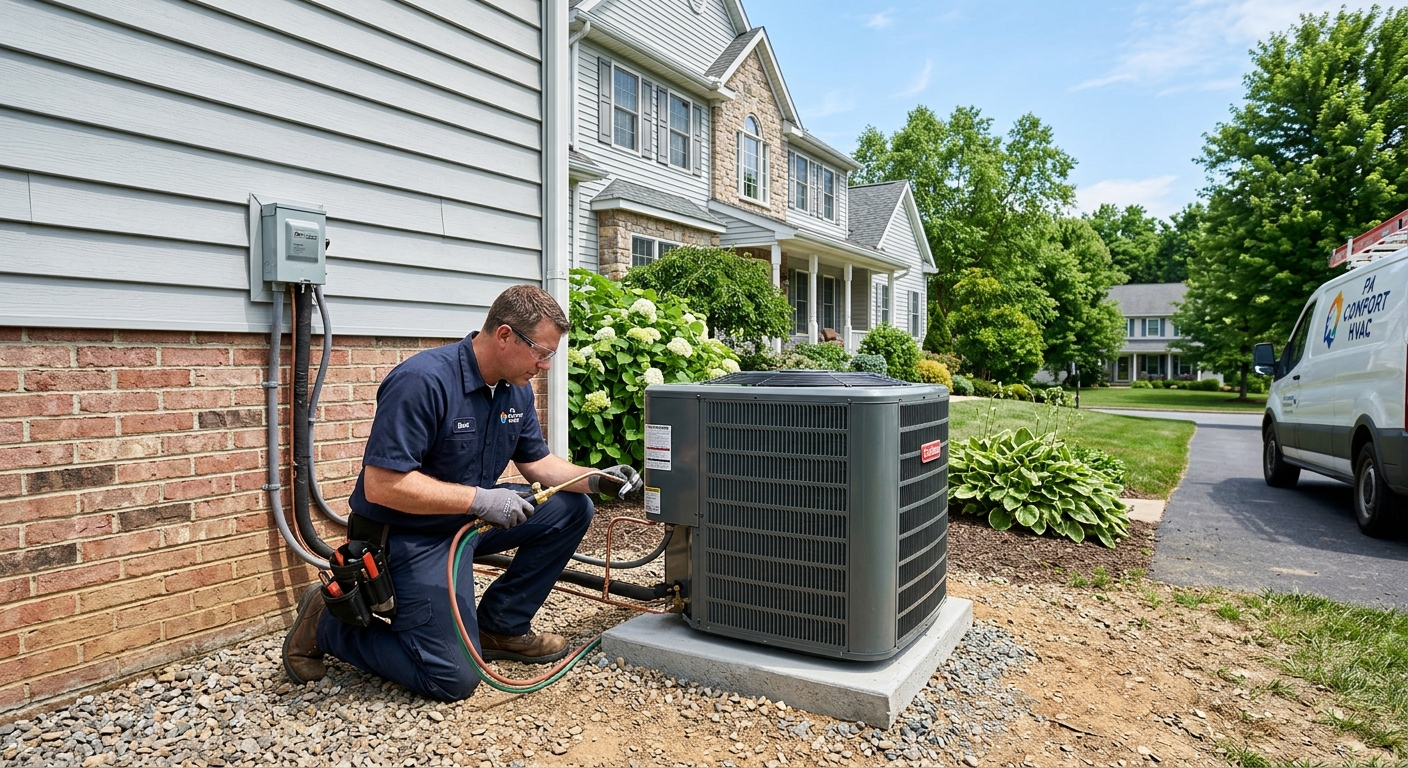
What a new HVAC system costs in Elizabeth
Elizabeth is mainly a community of residential homeowners, with an 87.2% homeownership rate and 81.5% of homes built before 1980 (U.S. Census Bureau, ACS 2024). Most houses here have had at least one major HVAC replacement or retrofit, and retrofitting is the rule rather than the exception. Existing ductwork is never guaranteed to be up to modern standards—tight spaces and past practices mean ducts can be undersized, leaking, or even routed awkwardly around joists or beams. For many older Elizabeth homes, upgrading your comfort system often goes hand-in-hand with duct repairs or, in rare cases, installation from scratch.
Southwestern Pennsylvania is strongly heating-dominated. Elizabeth experiences about 5,600 heating degree days and just 1,050 cooling degree days per year. This tilts every recommendation toward reliable, efficient heating. If you’re replacing a forced-air furnace or considering an all-electric upgrade, the system’s performance in cold weather is crucial. Cooling needs are still real during humid August stretches, but any investment here ought to put heat first.
| System |
Best for |
Efficiency |
Price range (installed) |
| Central AC replacement (existing ducts) |
homes with sound ductwork |
16–20 SEER2 |
$4,900–$12,000 |
| Air source heat pump (ducted) |
year-round heating and cooling |
8–10 HSPF2 |
$7,900–$17,000 |
| Cold-climate heat pump (ducted) |
heat pump as primary heat |
9–11 HSPF2 |
$13,000–$17,000 |
| Ductless mini-split (single zone) |
additions, rooms without ducts |
20–30 SEER2 |
$3,200–$6,900 |
| Full duct system installation |
homes with no existing ducts |
— |
$8,900–$17,500 |
Installed estimates for a typical Elizabeth home. Equipment tonnage, duct condition and electrical capacity move these more than brand.
Refrigerant rules and your existing system
The refrigerant landscape has changed, but if you own a system that uses R-410A in Elizabeth, you are not forced to replace it. Federal rules require all new residential HVAC equipment to use lower-global warming potential refrigerants like R-32 or R-454B, but servicing of older R-410A (and even R-22) units remains completely legal as of 2024. No component of Pennsylvania or Allegheny County code (see Pennsylvania Uniform Construction Code) bans the continued use or servicing of these older units.
Where you may start to feel the transition is in the cost of repairs. R-410A will become more expensive as manufacturers shift their production and supply begins to tighten. This doesn’t mean your current system is obsolete or a liability today—it does mean that if your R-410A system develops a significant leak, the repair-versus-replace math may tip more quickly toward replacement, simply due to refrigerant price and availability. In most cases, minor service or maintenance remains a good investment on an otherwise functional unit.
The bottom line for Elizabeth homeowners: you do not have to replace a working R-410A system just because of the refrigerant rules. But as time goes on and parts or refrigerant become more expensive, those dollars may be better spent on new, higher-efficiency equipment tailored for local climate demands.
Reading an installation proposal
If you’ve requested HVAC replacement quotes around Elizabeth, you might notice a big spread in both price and detail. A proper quote should do more than name a brand and a bottom-line number. Look for model numbers (both indoor and outdoor units) — only matched pairs deliver the efficiency claimed. Tonnage should be justified with a load calculation, not “what was there before.” Expect a line item for ductwork assessment and sealing or repair. Electrical work matters: you may need a new circuit or even a panel upgrade, especially when switching to an all-electric heat pump in an older home with legacy service panels.
Condensate handling, thermostats, permit costs, and commissioning details should all be explicit. Labor warranty is separate from equipment warranty — know who will stand behind the install. Permits are not a formality; the City of Pittsburgh requires them for new or replacement HVAC systems. If any of these are missing from a proposal, you can’t compare apples to apples.
| Line item |
What to look for |
Red flag if… |
| Equipment |
model numbers, indoor and outdoor matched |
brand name only |
| Sizing |
load calculation attached |
matched to the old nameplate |
| Ductwork |
condition assessed, sealing scoped |
not mentioned |
| Electrical |
circuit and panel capacity confirmed |
assumed adequate |
| Line set |
replaced or documented as reused |
silent |
| Commissioning |
measured airflow and charge, documented |
no startup report |
| Warranty |
labour years stated separately |
manufacturer only |
| Permit |
included and priced |
'not needed' |
What construction era means for your system
In Elizabeth, the odds are high your home was built before 1980, and almost certainly before modern HVAC standards went mainstream. Ducts—if present—were often installed strictly for heating, not central cooling, which means they may be undersized or poorly sealed for today’s high-efficiency air conditioning or heat pumps. A lot of these older systems snake through tight crawlspaces or finished basements, and many runs are fitted to past generations of smaller or less powerful blowers.
Insulation in walls and attics may be thin by current code, and older single-pane windows still make an appearance. If you’re considering a transition to a heat pump, pay close attention to your electrical panel’s ampacity; many older services are only 100 amps, sometimes less, which could become a bottleneck for electric heating equipment or when adding a new high-SEER AC. Gas systems rely on chimneys or dedicated flues—if you have a masonry chimney, inspecting its condition before installing a modern gas furnace is essential for safety and performance.
In short, don’t expect any "just drop it in" install in a classic Elizabeth home. These buildings reward thorough assessment, and often require some modest upgrades alongside the new system for best long-term performance and comfort.
What a Pennsylvania HVAC contractor must hold
In Pennsylvania, there is no statewide HVAC contractor license, either for residential or commercial work. Instead, residential HVAC is regulated at the municipal level. For homeowners in Elizabeth and Allegheny County, this means any contractor working on your home must be registered for home improvement work if your project exceeds $500. You can verify this Home Improvement Contractor (HIC) registration at hic.attorneygeneral.gov.
Refrigerant handling is federally regulated. Anyone installing or servicing air conditioning and heat pump systems must hold an EPA Section 608 certification, regardless of state or municipal rules. Beyond certification, mechanical permits are required for installing or replacing a central system in the City of Pittsburgh—permits cover compliance with the Pennsylvania Uniform Construction Code, which itself relies on the IRC as its model.
All employers must carry worker’s compensation—verification is available through the state’s WCAIS system (wcais.pa.gov) and you should ask to see a current certificate. Liability insurance is not overseen by the state but is typically carried by reputable firms. In summary: check HIC registration, look for a 608-certified technician for refrigerant work, confirm permit and inspection are included, and verify both insurance and workers’ comp up front.
What size system does a Elizabeth home need?
In Elizabeth, no decision makes a bigger impact on comfort or energy bills than properly sizing your HVAC system. Oversizing is not a safety margin — it leads to short cycling, poor humidity removal, frequent on/off operation, and shorter equipment life. In our heating-heavy climate, with a winter design temperature of 8 °F and 5,600+ heating degree days, the risk is ending up with a furnace or heat pump that blasts too much heat in short bursts — never running long enough to evenly warm the house or dry out the air.
Every job should start with a Manual J load calculation. This considers not just the square footage, but insulation, windows, orientation, infiltration, and existing duct design. Rules-of-thumb like “one ton per 500 square feet” ignore the quirks of older homes with questionable insulation or leaky windows, and copying the size from the old system only entrenches old mistakes. Your key question to any contractor is simple: “Did you run a Manual J calculation, and can I see it?” Accept nothing less.
Don’t let anyone tell you bigger is better. The right size system runs steady, delivers comfort in every room, keeps bills under control, and lasts longer. In our area, that means engineering for the real design day — not theoretical extremes, and never just for summer cooling alone.
When an HVAC repair stops being worth it
In Elizabeth, the math of repair versus replacement comes down to a few honest factors. For younger equipment—typically under 10 years—a single failed part is often worth fixing, especially if your system was properly sized and installed to begin with. As systems age past 10 or 15 years, bigger failures or consecutive breakdowns signal that ongoing repairs may not make sense, especially if any single fix reaches a third of the cost of replacement.
A cracked heat exchanger always calls for immediate replacement, because it’s a carbon monoxide hazard—no exceptions. Likewise, when a compressor fails outside of warranty on an older unit, dropping several thousand dollars makes little sense. Refrigerant rules matter too: for systems using R-410A, rising refrigerant prices can tip the balance on larger leaks, but early replacement for that reason alone isn’t recommended until the rest of the system is clearly on its last legs. In southwestern Pennsylvania, efficiency gains from new systems are real, but most payback comes from better sizing and duct sealing rather than just high-efficiency equipment.
| Situation |
Recommendation |
Typical cost |
Reasoning |
| Under 10 years, single component failure |
Repair |
$300–$1,200 |
Still within expected service life; most failures not cause for replacement |
| 10–15 years, repair over a third of replacement |
Consider replacing |
$4,900–$12,000 |
Major repairs on an aging system often aren’t worth the investment |
| 15+ years, any major failure |
Replace |
$4,900–$12,000 |
System is past typical life expectancy; newer equipment will be safer, more reliable |
| Cracked heat exchanger, any age |
Replace immediately |
$4,900–$12,000 |
Unsafe to operate; carbon monoxide hazard to occupants |
| Compressor failure past warranty |
Replace |
$7,900–$17,000 |
Major expense with no guarantee of extended life; best invested in new system |
| Working system, high bills |
Test ducts and envelope first |
$300–$800 |
Leaky or uninsulated ducts and air leaks usually cause poor efficiency |
Frequently asked questions — HVAC installation in Elizabeth
How much does a furnace replacement cost in Elizabeth?
For most homes in Elizabeth, a straightforward furnace replacement — using solid existing ductwork and not requiring major electrical or gas upgrades — falls in the range of $4,900–$12,000. This wide price band is due to the age and diversity of homes in the area: some pre-1960 houses require additional work for old or undersized ducts, while others can reuse what’s already there. Always get a complete written proposal that includes model numbers, duct assessment, necessary permits, and a commissioning/startup report. Don’t pay more for gimmicks or equipment features that Allegheny County’s heating-dominated climate won’t justify.
Is natural gas available throughout Allegheny County?
Natural gas is widely available in Allegheny County neighborhoods, including Elizabeth, but there are pockets — especially in less densely populated or rural areas — where homes still rely on propane or fuel oil. For most residents, Peoples Gas is the local utility, and switching to gas for heating is often possible if your street is serviced and you’re willing to pay for a new connection. For homes in neighborhoods with no gas main, installing a high-efficiency heat pump or a ductless mini-split (at $3,200–$6,900 for a single zone) may be a practical alternative.
What does a heat pump cost installed in Elizabeth?
A ducted air source heat pump system, fully installed in an Elizabeth home, typically costs $7,900–$17,000. The final figure depends heavily on the condition and size of your existing ductwork, the available electric panel capacity, and whether you opt for a cold-climate model for reliable winter heat. Because heating needs here are substantial, don’t cut corners on performance for our climate. If you lack existing ducts or have trouble spots, a ductless mini-split (at $3,200–$6,900 for a single zone) can often supplement or independently heat key rooms.
Does Pennsylvania license HVAC contractors?
Pennsylvania does not issue a statewide HVAC license for residential contractors. Instead, HVAC work — installation and replacement included — is regulated at the municipal level. For Elizabeth area homeowners, this means your contractor must be registered as a Home Improvement Contractor (HIC) for any job over $500, which you can verify at hic.attorneygeneral.gov. Handling refrigerant also requires a federal EPA Section 608 certification. Equipment costs may run $4,900–$12,000 for most replacements, so ensure whoever you hire is registered and insured.
Why are my Elizabeth energy bills high with a new system?
If you’ve recently upgraded your system — say, spent $7,900–$17,000 on a ducted heat pump — but your winter and summer bills remain stubbornly high, the likely reasons are leaky or undersized ductwork, poor insulation, or air leaks around windows and doors. In Elizabeth’s housing stock, even new equipment cannot overcome the losses from old construction details. Before assuming the system is at fault, have your contractor check duct sealing, verify airflow, and recommend basic weatherization steps. Addressing these can offer bigger payback than going for still higher equipment efficiency.
Is a heat pump a good choice for Elizabeth winters?
Modern cold-climate heat pumps can reliably heat an Elizabeth home through most of the winter. The latest models are engineered for performance at 8 °F—the local winter design temperature—and offer efficiency that rivals or exceeds combustion furnaces. Choosing a heat pump (investment typically $13,000–$17,000 for a fully installed cold-climate model) depends on your insulation, window quality, and whether your ductwork is ready for the required airflow. If you have access to natural gas and existing ducts sized for heating, compare both options before deciding.
What is SEER2 and how is it different from SEER?
SEER2 is the updated industry efficiency rating for cooling equipment that better reflects how real-world ductwork and installation affects energy use. In practice, SEER2 drops most equipment’s rating by 5–7% compared to the old SEER values, but gives a more honest account of what you get in an actual Elizabeth home with its duct runs and attic temps. For example, a central AC replacement (at $4,900–$12,000 installed) might have been rated 18 SEER but is now 16.2 SEER2. When comparing quotes, always look for SEER2 figures.
How far ahead should I schedule in Elizabeth?
Most Elizabeth contractors book two to four weeks out in spring and early summer, and as much as six weeks during a heat wave or cold snap. In emergency cases, repairs can often be scheduled quicker, but full system replacements — especially those with ductwork or electrical upgrades — are best planned early. If you know your current system is aging or unreliable, get estimates ahead of the season. Expect to budget $4,900–$12,000 for a full replacement and clarify with your contractor about their current lead times.
Do I need ENERGY STAR equipment to qualify for incentives?
In Pennsylvania, utility rebates and some federal incentives often specify ENERGY STAR or CEE certified equipment, but not all require this label exclusively. For example, upgraded ductless mini-splits or cold-climate heat pumps (investments from $3,200–$17,000) may qualify for incentives if they meet specific efficiency ratings, even without the ENERGY STAR tag. Check the specific requirements of your utility and the relevant incentive program, and provide your contractor with the forms ahead of time to ensure the equipment you’re considering checks every box.