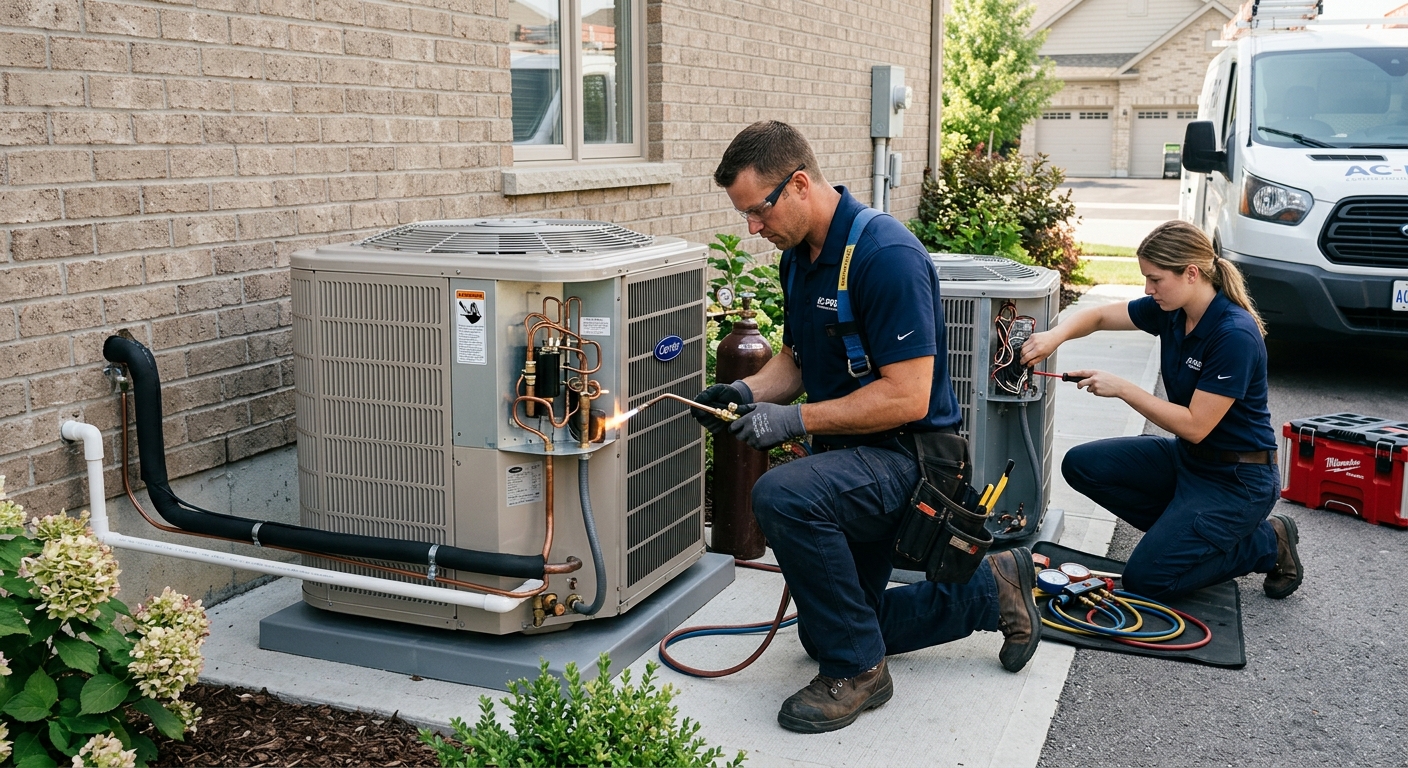
Exeter heating and cooling prices by system type — 2026
Exeter falls into the heart of Luzerne County’s older housing stock, with 69.4% of homes built before 1980 and homeownership topping 80.7% (U.S. Census Bureau, ACS 2024). That drives demand for both replacement jobs and retrofits—especially for families ditching ancient boilers for forced-air or making due with space heaters. Since most existing homes weren’t built with AC in mind, a good chunk of Exeter customers either have aging, cobbled-together ducts or none at all. This means many installations involve either careful assessment of current ductwork or full new duct system installs.
This region is a clear heating market: with 6,100 heating degree days versus just 850 cooling degree days, sizing and equipment selection should always prioritize heating performance over cooling. The winter design temperature of 4 °F is a level where underpowered or misapplied systems fail to keep up, especially in older structures. That’s one reason many jobs here involve swapping out fuel oil or coal-era systems for modern ducted heat pumps or dual-fuel setups, and why cold-climate models have such a strong case.
| System |
Best for |
Efficiency |
Price range (installed) |
| Central AC replacement (existing ducts) |
homes with sound ductwork |
16–20 SEER2 |
$4,700–$11,000 |
| Air source heat pump (ducted) |
year-round heating and cooling |
8–10 HSPF2 |
$7,500–$16,000 |
| Cold-climate heat pump (ducted) |
heat pump as primary heat |
9–11 HSPF2 |
$12,000–$16,000 |
| Ductless mini-split (single zone) |
additions, rooms without ducts |
20–30 SEER2 |
$3,000–$6,500 |
| Full duct system installation |
homes with no existing ducts |
— |
$8,400–$17,000 |
Installed estimates for a typical Exeter home. Equipment tonnage, duct condition and electrical capacity move these more than brand.
Operating cost, not sticker price
Sticker price is just the start. In Exeter, with 6,100 heating degree days and a winter design temperature of 4 °F, you’ll spend far more on heating than cooling over the life of your system. Here’s how the math works for any heating or cooling system: take the equipment’s efficiency rating (SEER2 for cooling, HSPF2 or AFUE for heating), factor in the amount of work it needs to do (which is where those degree days come in), and multiply by the cost per unit of energy from your utility—PPL Electric Utilities or UGI Utilities for most homes here.
For example, if your heat pump has an HSPF2 of 10 and Exeter’s high heating degree days mean you’ll need to deliver about 40 million BTUs of heat over the season (numbers will vary for your home’s size and insulation), the system needs roughly 4,000 kWh to do the job. If your electric rate is $0.14 per kWh (find your actual rate on your PPL bill), that’s around $560 for the heating season, before delivery charges or taxes. Gas, propane, or oil? The calculation works the same: take the system’s AFUE, find your total BTUs needed (based on degree days), and divide by your fuel’s energy content and price.
The biggest gotcha in this math: leaky ductwork. Even the most advanced cold-climate heat pump will run at a loss if installed on a duct system that leaks or is poorly insulated. A cheaper system on good, sealed ductwork might actually outperform a premium one installed badly. Always ask for an honest assessment of your home’s “envelope”—not just the shiny new box—and get the installer to show you the calculations for your actual house, not some idealized model.
Separating installers from equipment sellers
The quality of the install matters more than the brand or even the efficiency rating. In Exeter and wider Luzerne County, you can buy the best-rated equipment on the market—but if it’s not sized or set up for your home’s unique envelope, it won’t deliver comfort or savings. Good installers will walk the property, ask about your current hot and cold spots, and insist on a manual load calculation—not just a like-for-like swap.
Check that contractors hold Home Improvement Contractor (HIC) registration via hic.attorneygeneral.gov, and that the refrigerant tech is certified under EPA Section 608. Ask if municipal mechanical permits are included (required in Wilkes-Barre for full HVAC jobs), and get every equipment model and configuration listed on the contract.
- Check HIC registration at hic.attorneygeneral.gov
- Verify EPA Section 608 certification for refrigerant installers
- Request a copy of workers’ compensation insurance (verify at wcais.pa.gov)
- Ask for an upfront, written contract covering >$500 scope
- Confirm the permit status (especially in Wilkes-Barre)
- Demand a manual load calculation — not just a rough guess
- Ask for exact equipment model numbers, not just tons or BTUs
- Request documented commissioning (airflow and charge readings)
- Clarify who manages inspections if required
- Check that the quote includes duct assessment or sealing (for ducted jobs)
- Look for at least a one-year labor warranty
- Avoid “upsize” or “downsize” recommendations without justification
In this saturated Scranton–Wilkes-Barre market, be wary of bids that never inspect your attic or crawl. Fast, no-visit quotes are common here—and they nearly always cost more in the long run.
Rebates and tax credits for Exeter homeowners
There are three main incentive layers available to Exeter homeowners considering HVAC upgrades: federal tax credits, rebates from your utility, and state-level efficiency programs. Here’s how they differ: a tax credit, such as those found via federal programs, is claimed when you file your taxes—it lowers how much you owe, but doesn’t affect your upfront invoice. A utility rebate, on the other hand, generally comes as a check or invoice reduction after you purchase and install qualifying equipment.
Your electric utility (PPL Electric Utilities for most of Exeter) and natural gas supplier (UGI Utilities in Wilkes-Barre and Hazleton area) may offer their own efficiency rebates—usually for high-efficiency central ACs, heat pumps, or weatherization measures. Names, eligibility, and amounts change frequently, and not every installer participates. The best starting points: check your utility’s official website for an “Efficiency” or “Rebates” page; use the ENERGY STAR rebate finder for federal and manufacturer deals.
No reputable contractor will give you a rebate guarantee upfront, since both the eligibility and funding vary year to year. Any specific cash value cited in an old article may be out of date. For Exeter, expect to do a little homework—but the best installers will help you with paperwork and provide model documentation needed for claim forms.
What a Pennsylvania HVAC contractor must hold
Pennsylvania does not issue a state-level HVAC license for residential work. Regulation happens at the municipal level, so requirements will differ between Exeter, Wilkes-Barre, Hazleton, and other Luzerne County municipalities. For contracts over $500, all contractors must be registered as Home Improvement Contractors (HIC)—you can verify this at hic.attorneygeneral.gov. There is no state HVAC, electrical, or plumbing license for residential jobs outside of specific cities with their own exam systems (not listed for Luzerne County in these facts).
Every installer working with refrigerant must hold an EPA Section 608 certification, which is federal and applies to all AC, heat pump, and mini-split installs. For installations in Wilkes-Barre, a mechanical permit is required for replacements or new central systems, and the job may be subject to an inspection by the local code enforcement office.
Pennsylvania contractors must provide proof of workers’ compensation insurance, even if their team is small—always ask for this certificate and verify it using the state’s WCAIS site (wcais.pa.gov).
State law (the Home Improvement Consumer Protection Act) also requires a written contract and provides a 3-business-day right of cancellation for jobs over $500. Be wary of anyone offering to “waive your insurance deductible”—it’s against state law.
The central decision for a Exeter homeowner
In Exeter and throughout Luzerne County, two numbers define your heating dilemma: a winter design temperature of 4 °F and 6,100 heating degree days. That’s a clear signal that heating, not cooling, should determine your system choice and sizing. Old advice about heat pumps failing in the northeast is outdated—modern cold-climate models hold significant capacity well below freezing—but they do still lose output as temperatures drop. Dual fuel systems, where a heat pump carries the load until it gets cold enough for a gas furnace to take over, are a popular and effective solution here.
If you have natural gas (common in Wilkes-Barre and Hazleton urban areas), a high-efficiency gas furnace plus central AC or as backup to a heat pump makes both performance and economic sense. But rural Exeter and outer Luzerne County areas often rely on propane or fuel oil. In these cases, a ducted cold-climate heat pump can deliver the same or better comfort with much lower annual cost and none of the volatility of delivered fuel markets—especially if your electricity comes from PPL Electric Utilities and rates are stable.
A furnace is still the right call if your home already has a sound gas line and chimney, envelope upgrades are out of reach, or you hit those rare arctic cold snaps when even the best heat pump needs backup. For homes without ducts (common in older coal-era houses), ductless systems or new duct installations are on the table.
| Option |
Installed cost |
Operating cost here |
Best when |
Incentive eligible |
| Gas furnace + central AC |
$4,700–$11,000 |
lowest with existing gas, reliable in deep cold |
existing gas service, coldest zones |
yes, for high-efficiency models |
| Ducted heat pump (cold climate) |
$7,500–$16,000 |
very low—if home is insulated tightly |
good envelope, all-electric goal |
yes, with specific models |
| Dual fuel (heat pump + gas backup) |
$12,000–$16,000 |
optimized for lowest cost in variable temps |
gas on site, deep cold spells |
yes, combined incentives likely |
| Ductless multi-zone |
$8,400–$17,000 |
excellent for zoned, room-only use |
no ductwork, zone control |
yes, especially for heat pumps |
Zone control without ductwork
Ductless mini-split systems are a practical solution for Exeter’s many older homes—especially those with additions, converted attics, basements, or rooms that have never been connected to any central system. Since Luzerne County’s housing stock is dominated by pre-1940 construction, a lot of Exeter residents face limited space for new ducts or would need to tear up finished plaster to add them. That’s where single-zone mini-splits shine: install a head in the room you actually use and avoid the headache and expense of full duct installation.
Single-zone units (one outdoor, one indoor) are best for spot heating/cooling—think home offices, upstairs bedrooms, or sunrooms. For whole-home solutions, multi-zone systems allow one outdoor compressor to support up to eight indoor heads, each with its own control. However, performance can drop if all heads run flat-out in extreme temperatures; sometimes, separate single-zone units work better. Watch for aesthetics (heads are always visible), drainage (condensate lines must be run and kept frost-free in winter), and make sure the installer locates both heads and lines where they won’t disrupt your walls or trim work.
Especially in Exeter’s retrofit-heavy market, ductless is often the only realistic way to gain efficient, zoned comfort without massive disruption or cost.
Frequently asked questions — HVAC installation in Exeter
Is an annual maintenance plan worth it?
Annual maintenance can extend the life of your HVAC system and keep it running efficiently, especially in Exeter where cold winters put real strain on heating equipment. It’s common to see old systems nurse through a decade or more with simple annual care—but also common to see minor problems turn into emergency replacements in the heart of January. In Exeter, a typical annual plan covers one or two checks and tune-ups (cleaning, safety checks, and filter changes), which can be a good investment on a system you want to keep going for years. Given HVAC replacement costs from $4,700–$11,000 for central AC (with higher for full heat pump setups), regular maintenance is generally worth the small up-front cost—especially in an older home where small leaks or clogs can spiral quickly.
What is the R-410A refrigerant phase-down?
R-410A is the most common refrigerant for newer air conditioners and heat pumps, but both the EPA and international regulations are gradually phasing it out due to global warming potential. In Pennsylvania—including Exeter—this means that all new HVAC systems will transition to lower-impact refrigerants starting in the next few years, and contractors must be certified under EPA Section 608 to handle refrigerant. The good news: it’s still legal to repair, refill, and operate systems with R-410A, but some newer models and parts will run different refrigerants. If you’re installing something in the $4,700–$11,000 range, expect to see different refrigerant types depending on model and manufacturer.
How much does a new HVAC system cost in Exeter?
For Exeter homeowners, the price depends on what you need and what’s already in place. If you have solid ductwork and just need a central AC replacement, expect $4,700–$11,000 installed. Replacing everything—like a full ducted heat pump system or new ductwork—runs between $7,500–$17,000 depending on the complexity. Ductless single-zone systems are a lower cost option for add-ons or problem rooms, starting at $3,000–$6,500. Your actual cost is shaped by the size and layout of your home and whether you’re converting from oil, coal, or radiant bases.
Is it worth switching from oil or propane to a heat pump?
In Exeter and rural Luzerne County, oil and propane can cost a fortune to run—especially with 6,100 heating degree days each winter. Modern cold-climate ducted heat pumps deliver reliable heat even down to single digits and can offer big long-term savings if your insulation and air sealing are up to snuff. The installed cost for a full air-source heat pump setup is $7,500–$16,000, but the annual operating costs are much lower than delivered fuels. If your house is very drafty, consider envelope upgrades first. For many Exeter homeowners, a heat pump system is an excellent investment that pays off faster than another round of oil tanks.
Does my utility offer a heat pump rebate in Exeter?
Rebates and incentives do exist for Exeter residents through PPL Electric Utilities and sometimes UGI Utilities, but names and amounts change each year. Qualified high-efficiency heat pumps and ductless mini-splits often include rebates to reduce your upfront cost—sometimes by several hundred dollars on a $7,500–$16,000 installed price. Always check your utility’s official efficiency or rebate webpage and the ENERGY STAR rebate finder before signing a contract, and ask your installer for updated paperwork. Offers change, so don’t assume last year’s deals are available now.
How does northeastern Pennsylvania's climate affect system sizing?
In Exeter, the key factors are the high heating degree days (6,100/year) and the winter design temp of 4 °F. That means every HVAC system here needs to be sized and selected for heating performance first, not cooling—undersized units will leave you chilly or with sky-high bills. A system that might work fine farther south would short-cycle and fail to heat reliably in Exeter. The price for a properly sized cold-climate heat pump starts at $12,000–$16,000 installed but can save in operating costs and comfort over time.
How long does HVAC installation take in Exeter?
For a basic central AC replacement with good access and usable ducts, most Exeter jobs wrap up in a day or two. Full system swaps—like converting from boiler to forced-air, adding ductwork, or installing a multi-zone mini-split—often run two to four days. Supply chain issues are less acute than in big cities, but older houses may reveal hidden hurdles (plaster repair, unforeseen electrical). For a full duct system and heat pump install, expect $8,400–$17,000 and several days of house access, plus any municipal inspections required in Wilkes-Barre.
What does a ductless mini-split cost in Exeter?
For a single-zone ductless mini-split (popular for additions or attics in Exeter’s pre-war homes), expect a total installed cost between $3,000–$6,500, depending on capacity, line run length, and electrical upgrades. Multi-zone setups run higher, usually in the $8,400–$17,000 range for whole-home coverage. These numbers include both parts and labor—but not substantial electrical panel upgrades, which add to the bill. Ductless is ideal where installing or updating ductwork would be messy, costly, or simply not possible.
Who inspects HVAC work in Exeter?
In Wilkes-Barre and similar municipalities, code enforcement offices handle permits and inspections for new HVAC installations and replacements. If you’re in a part of Exeter covered by local permit requirements, your contractor will pull a mechanical permit and schedule inspections with the municipal office. For jobs outside city lines, requirements may differ—but licensed installers must still follow the Pennsylvania Uniform Construction Code (based on the IRC). Installation prices—such as $4,700–$11,000 for central AC—don’t typically include extra inspections unless major violations or surprises occur. Always ask in advance who schedules and is responsible for permitting and inspection.