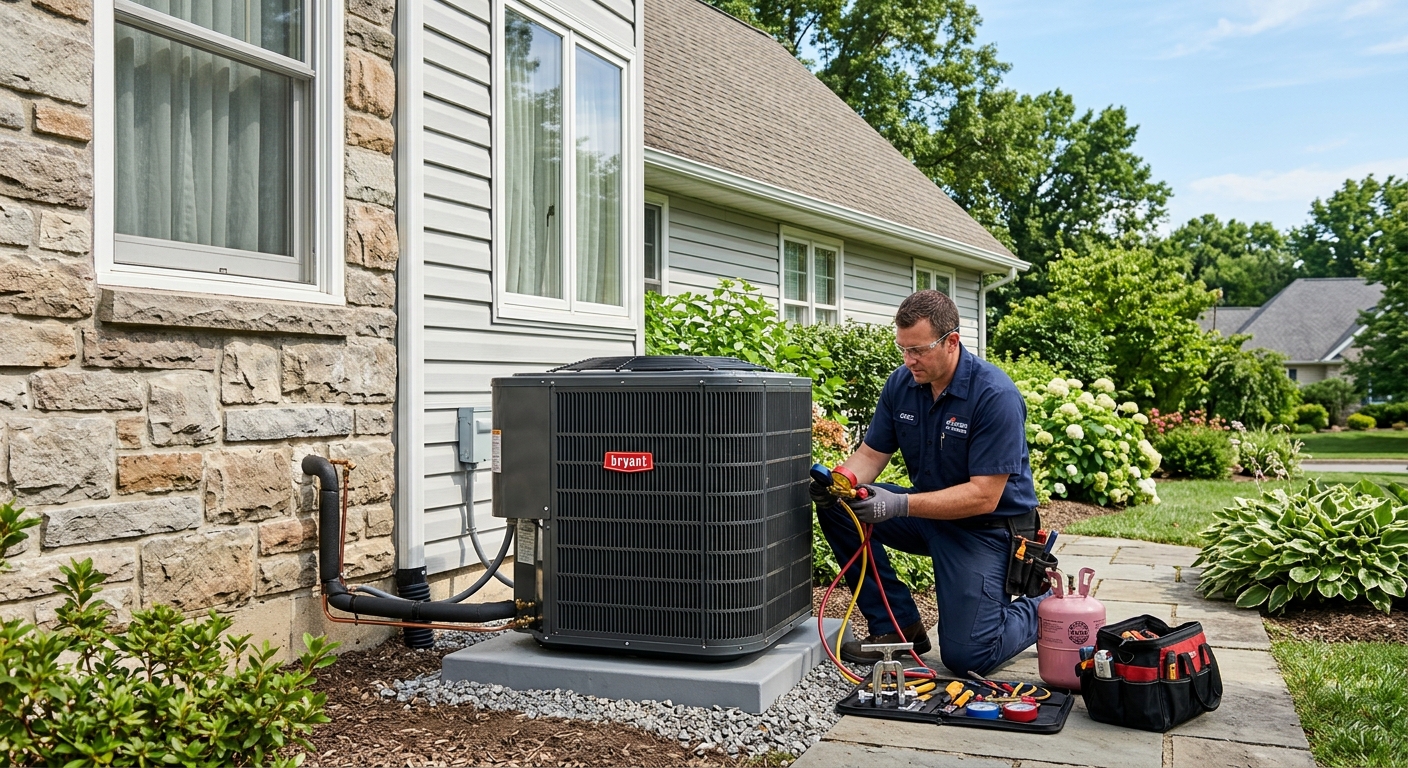
What a new HVAC system costs in Forks
If you own a home in Forks, you are part of a community with a high homeownership rate and a majority of single-family residences (U.S. Census Bureau, ACS 2024). Most heating and cooling projects here are replacements or retrofits, not first-time installs. With nearly a quarter of homes built before 1980, your current system may be outdated or coming up for replacement. In towns like Bethlehem and Easton, early-1900s rowhomes complicate outdoor condenser placement and ductwork retrofits, making system selection even more important.
Forks sits in a true heating-dominated climate — there are 6,100 heating degree days and only 850 cooling degree days annually. That means winter efficiency and reliability are front and center, with cooling season still long enough to matter. Central AC is not universal in older homes, but many retrofits have added it using existing ducts. Where ducts aren't present or can't be easily added, mini-splits have filled the gap.
| System |
Best for |
Efficiency |
Price range (installed) |
| Central AC replacement (existing ducts) |
homes with sound ductwork |
16–20 SEER2 |
$5,500–$13,500 |
| Air source heat pump (ducted) |
year-round heating and cooling |
8–10 HSPF2 |
$8,800–$19,000 |
| Cold-climate heat pump (ducted) |
heat pump as primary heat |
9–11 HSPF2 |
$14,500–$19,000 |
| Ductless mini-split (single zone) |
additions, rooms without ducts |
20–30 SEER2 |
$3,500–$7,700 |
| Full duct system installation |
homes with no existing ducts |
— |
$10,000–$20,000 |
Installed estimates for a typical Forks home. Equipment tonnage, duct condition and electrical capacity move these more than brand.
Filtration, humidification and ventilation
Forks and the broader Northampton County area see long, cold winters and often sticky summers. Winter air dries out as outdoor humidity drops, making whole-house humidifiers appealing. These add moisture to every room, but most require annual cleaning and regular pad changes to avoid mold or scale. For homes with forced air, portable units rarely make a dent in dry air across a full house.
Overly large air conditioners, pitched as a power option, actually struggle to dehumidify. When a system cools a house too quickly, it doesn't run long enough to pull moisture from the air — leading to that clammy feeling in July. Proper sizing is more important than adding dehumidification gadgets in most Forks homes.
On the filtration front, MERV 8–10 filters are generally enough for houses here, balancing dust removal and air flow on existing blowers. Pushing to a MERV 13 is possible on new or major upgrades, but forcing a high rating onto older systems can starve the blower and shorten equipment life. HEPA filter upgrades and hospital-grade UV lights are often oversold — for routine local asthma, investing in better seals and regular filter swaps pays off more than pricey gadgets.
Finally, mechanical ventilation is mostly for newer homes with airtight envelopes; older Forks homes naturally leak enough for code compliance, while newer builds or extensive remodels may need an ERV or HRV.
Permits, licensing and inspections in Forks
Pennsylvania does not issue a statewide HVAC contractor license for residential work. Instead, residential HVAC projects fall under local code enforcement and permitting, including in Forks Township. You must hire a contractor registered under the Home Improvement Contractor (HIC) program for any project over $500—check registration status at hic.attorneygeneral.gov before you sign a contract.
The actual permit requirement comes from your township. In Forks and neighboring municipalities, new HVAC installations and most full replacements require a mechanical permit and an inspection when the work's finished. This ensures conformance with the Pennsylvania Uniform Construction Code (UCC) based on the International Residential Code. Forks manages its own code office, distinct from nearby Bethlehem or Palmer.
No matter the local licensing landscape, anyone handling refrigerant (like R-410A, R-454B, or R-32) must have EPA Section 608 certification. Every reputable crew here should be able to provide proof, and you can ask to see it. Pennsylvania also enforces mandatory workers' compensation insurance—verify coverage through WCAIS (wcais.pa.gov) to minimize your risk as a homeowner.
Finally, the Home Improvement Consumer Protection Act (HICPA) requires a written contract, including a three-day cancellation right for jobs over $500. Never pay in full upfront and never agree to “waive your deductible”—that’s not allowed under Pennsylvania law.
Mini-splits and zoning in Forks homes
Mini-split heat pumps are a practical solution for many Forks homes — especially those built long before central air became common. If you’ve got an addition, finished attic, or basement that never seems comfortable, or if your old house never had ductwork, a ductless mini-split can heat and cool that space with little disruption. In places like Easton and Bethlehem, where early-1900s rowhomes leave almost no room for big condensers or new ducts, ductless is often the only realistic approach.
Single-zone mini-splits serve one room or open area with a dedicated wall head and outdoor unit. They’re less complex and typically more efficient for isolated needs, with installs ranging $3,500–$7,700. Multi-zone systems let you run several indoor units (heads) off a single outside compressor, but there’s a tradeoff: all heads must be running for the unit to reach its rated efficiency, and capacity is split when you need multiple rooms chilled or heated at once. Sometimes, running two separate single-zone systems will outperform a big multi-zone in real-world Forks usage.
Aesthetic objections—indoor heads visible on the wall—are real for some, especially in carefully preserved older homes. Condensate lines will need smart placement, sometimes routed through a closet or chase, so installation skill matters. If you’re adding cooling to a home that never had ducts, or want control for a single problem area, mini-splits are worth considering before tearing up plaster or framing.
R-410A phase-down: repair or replace?
As of 2024, new residential HVAC systems are shifting away from R-410A refrigerant due to federal HFC phase-downs. Today’s new units use lower-global warming potential (GWP) refrigerants like R-454B or R-32. If your system still uses R-410A, there’s no requirement to replace it just because of the refrigerant. Service and repair remain fully legal, and you can continue to buy R-410A for years to come—there’s no legal “ban” on maintaining what you already have.
The kicker is price: as manufacturers and distributors slow R-410A production, supply tightens and prices rise. If you develop a major refrigerant leak, the cost of recharging your system may become a larger slice of the typical repair bill. That doesn’t mean you should rush out and replace a working system, but it does tip the repair-or-replace balance if your equipment needs expensive refrigerant work.
For routine service—cleanings, capacitors, thermostats—ignore the refrigerant debate for now. For major compressor failures or hard-to-find leaks, weigh the cost of sticking with R-410A against installing a new, compliant system. In cases where a replacement is needed, expect pricing for a full heat pump system in Forks to start around $8,800–$19,000.
Heat pump or furnace: what makes sense in Forks
Forks, with its 6,100 heating degree days and a winter design temperature of 4 °F, is solidly a heating-driven market. This used to mean gas or oil heat was the default, but modern cold-climate heat pumps have changed the game. The latest cold-weather heat pumps can deliver useful heat even when outdoor temperatures plunge into the single digits. Despite marketing claims, all-air heat pumps still do lose capacity as it gets colder—so what works at 35 °F may not keep up in a February cold snap without backup.
Here's how it plays out here: if your home is in an area with natural gas service, such as central Forks or neighboring Bethlehem and Easton, a gas furnace keeps making sense. Efficient, quick heat, and the lowest risk in blackout or deep freeze conditions. If you’re in a more rural spot in Northampton County, gas is less available and propane or fuel oil is common—here, replacing your fossil system with a heat pump may save significant running costs (especially if you upgrade insulation at the same time).
Dual fuel systems—heat pump with gas backup—give you the best of both worlds, running ultra-efficient heat pump cycles in shoulder seasons and flipping to the furnace for only the coldest nights. Ductless multi-zone solutions are plausible in smaller or older Forks homes without ductwork, though installed costs can overlap with ducted retrofits.
| Option |
Installed cost |
Operating cost here |
Best when |
Incentive eligible |
| Gas furnace + central AC |
$5,500–$13,500 |
lowest with existing gas |
existing gas service, coldest zones |
state HVAC rebates usually apply |
| Ducted heat pump (cold climate) |
$8,800–$19,000 |
beats oil/propane; efficient homes |
good envelope, all-electric goal |
state, utility, and federal rebates |
| Dual fuel (heat pump + gas backup) |
$14,500–$19,000 |
blended savings; best of both |
gas on site, deep cold spells |
often eligible |
| Ductless multi-zone |
$10,000–$20,000 |
spot zone savings; electric only |
no ductwork, zone control |
may qualify for rebates |
SEER2, HSPF2 and AFUE decoded
SEER2 (Seasonal Energy Efficiency Ratio 2) measures a central air conditioner or heat pump’s cooling efficiency under 2023-updated conditions. HSPF2 (Heating Seasonal Performance Factor 2) is the comparable winter heating rating for heat pumps. AFUE (Annual Fuel Utilization Efficiency) applies to furnaces and shows how much fuel gets converted into usable heat. If you see SEER or HSPF ratings in older articles, be aware these are not directly comparable now—the "2" ratings use tougher test standards.
In Forks and broader Northampton County, heating loads far outweigh cooling loads (6,100 vs. 850 degree days), so HSPF2 and AFUE should drive your choice more than chasing ultra-high SEER2 numbers. Going from 16 to 20 SEER2 in central AC means a bigger investment, but payback is slow given our mild summers. In contrast, improving HSPF2 in a heat pump, or AFUE in a furnace, pays back faster over brutal winters. For most Forks homes, target SEER2 in the 16–18 range, HSPF2 of 9–11, and AFUE over 92%—paying for the absolute peak stats brings diminishing returns in this market.
Frequently asked questions — HVAC installation in Forks
How long should an HVAC system last in Forks?
A typical HVAC system in Forks can be expected to last 12 to 18 years with good maintenance. Systems here deal with heavy winter loads (over 6,000 heating degree days), so furnaces and heat pumps work harder than in milder climates, sometimes shortening lifespan compared to suburbs further south. For example, a replacement central AC or furnace in this market usually carries a manufacturer's warranty covering 10 years on parts. If you're considering a full system replacement — say, a high-efficiency AC for $5,500–$13,500 — investing in annual service can help you reach the upper end of that range.
Does Pennsylvania license HVAC contractors?
Pennsylvania does not require a dedicated state HVAC license for residential work in Forks or elsewhere. The law instead requires contractors to hold a Home Improvement Contractor (HIC) registration for jobs over $500. Municipalities, including Forks Township and nearby Bethlehem, regulate mechanical permits and conduct code inspections locally. Always verify HIC registration before signing off — you can do so at hic.attorneygeneral.gov. No contractor can legally waive insurance deductibles, and you should never pay in full up front, no matter the price of your job (a typical replacement is $8,800–$19,000).
Does my utility offer a heat pump rebate in Forks?
In Forks, PPL Electric Utilities serves most homes, and they regularly offer rebates for high-efficiency heat pump installations that meet current efficiency standards. These rebates can help offset the higher up-front cost of a cold-climate heat pump system (currently running $14,500–$19,000). Keep in mind offers change year to year, and eligibility depends on the model, installer, and sometimes your income or home’s insulation upgrades. Always verify with PPL before you sign a contract—your contractor should supply paperwork, but you’re the one who must apply.
How much does a furnace replacement cost in Forks?
Furnace replacement pricing in Forks depends on whether you’re swapping the unit alone or replacing it along with central air. A straightforward gas furnace replacement can fall as low as $5,500–$13,500 if existing ductwork is usable and no complicated venting work is involved. If you add an AC or heat pump, expect the total to rise. Labor and permit costs are a bit higher in the Lehigh Valley than smaller Pennsylvania towns due to local code inspections and utility access.
How much does ductwork add to an HVAC installation?
Adding ductwork in Forks significantly increases installation cost. If your home has no existing ducts—common with older houses, especially in areas like Bethlehem or Palmer—full duct installation typically runs $10,000–$20,000 on top of system costs. Retrofit projects in finished spaces can come in at the higher end due to demolition and patching. Mini-splits often end up more cost-effective when ducts would involve tearing into finished plaster or tight crawl spaces.
What is the R-410A refrigerant phase-down?
The R-410A phase-down is a federal mandate moving new air conditioning and heat pump systems to refrigerants with a lower environmental impact, such as R-454B or R-32. For Forks homeowners, this means new installs use these newer refrigerants, but your existing R-410A system does not become illegal or unserviceable. However, as R-410A production winds down, prices will rise—so if your system needs a major repair (especially a refrigerant leak), a replacement might make more economic sense. Full ducted heat pump replacement here can range from $8,800–$19,000.
Should I replace the furnace and AC at the same time?
In Forks, replacing both the furnace and central AC together often makes sense if both units are 15+ years old or have major repairs coming up. Homeowners sometimes stagger the work to save money, but installing a matched system (especially now, as refrigerant and efficiency standards change) can improve efficiency and reduce labor costs. You can sometimes get a better deal on bundled installation—a typical paired system may cost $8,800–$19,000, versus replacing piece by piece two years apart, which risks compatibility headaches or missed rebate opportunities.
Do I need to be home during installation?
In most cases in Forks, the homeowner is expected to be available at the start and finish of the installation. Installers need access for site review, thermostat placement, and electrical shut-off. While you don't have to hover all day, someone legally authorized to approve final placement should do a walkthrough. For a typical ductless mini-split ($3,500–$7,700), you'll want to discuss head location before equipment is mounted, as aesthetics matter in the older homes common here.
Which utility serves Forks?
Most Forks homes are served by PPL Electric Utilities for electricity and, if you have natural gas, UGI Utilities. Gas is common in urban and suburban areas like Bethlehem, Easton, and central Forks, but if you’re in a rural part of Northampton County, chances are you rely on propane or oil. If you plan upgrades, always confirm with your utility about rebates and available infrastructure. For example, a cold-climate heat pump install (costing $14,500–$19,000) usually qualifies for PPL electric rebates if installed by a registered contractor.