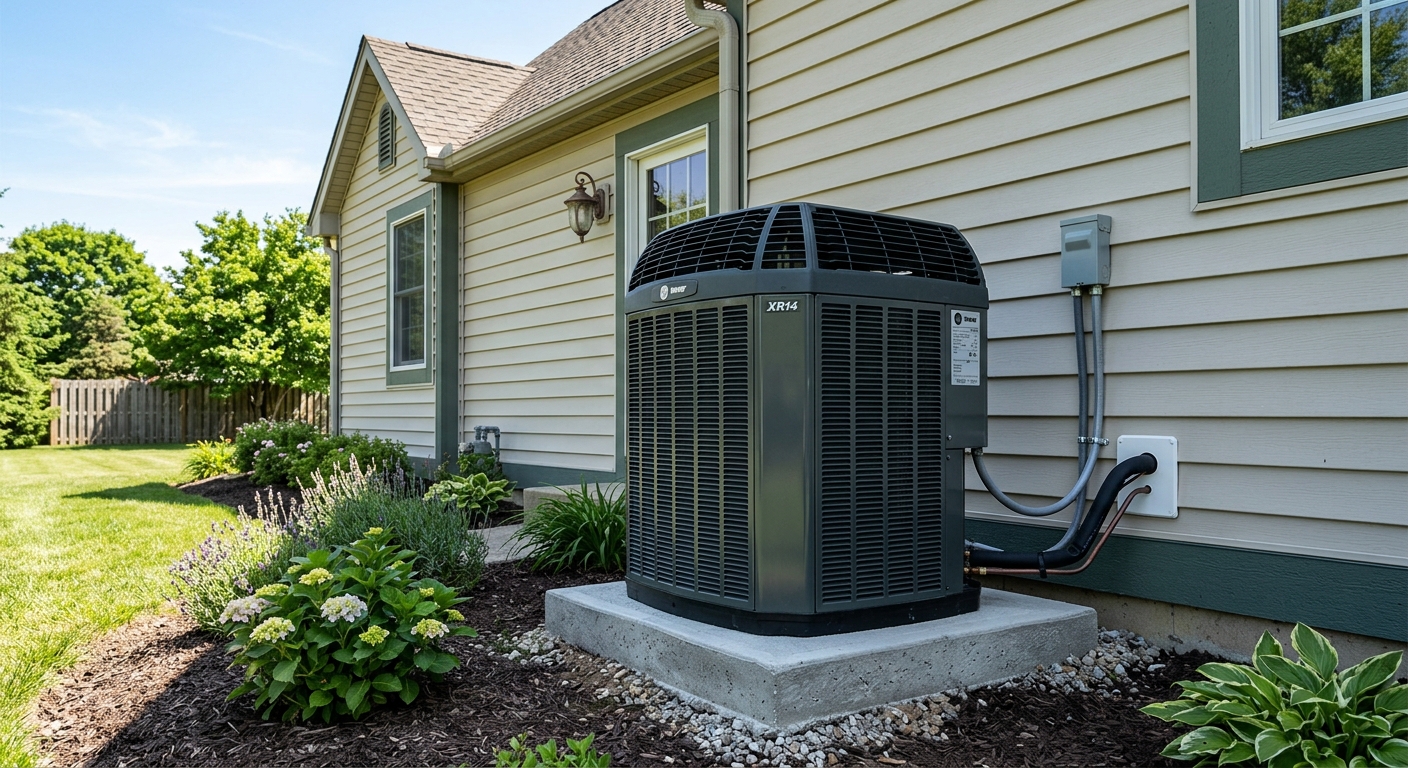
HVAC costs in Lackawaxen — 2026
Lackawaxen’s HVAC installations follow patterns set by Pike County’s unique housing stock, shaped by a high homeownership rate and a wave of late-20th-century subdivision development. With 90.9% of homes owner-occupied and over two-thirds built after 1980 (U.S. Census Bureau, ACS 2024), most houses in Lackawaxen already have forced air ductwork installed—though often not in perfect shape, and not always sized for today’s cooling or heat pump demands. That makes this a classic replacement market, not a new-install or full-retrofit one.
The local climate shapes system recommendations even more than the houses themselves. Pike County sees about 6,100 heating degree days and only 850 cooling degree days per year, making this a heating-dominated region. That means equipment selections—whether it’s a high-efficiency heat pump, a replacement furnace, or a central AC—have to deliver reliable winter performance first and foremost. Most quotes you’ll receive presume your ductwork is reusable, though this isn’t always the real case after 25–40 years of service.
| System |
Best for |
Efficiency |
Price range (installed) |
| Central AC replacement (existing ducts) |
homes with sound ductwork |
16–20 SEER2 |
$4,900–$12,000 |
| Air source heat pump (ducted) |
year-round heating and cooling |
8–10 HSPF2 |
$7,900–$17,000 |
| Cold-climate heat pump (ducted) |
heat pump as primary heat |
9–11 HSPF2 |
$13,000–$17,000 |
| Ductless mini-split (single zone) |
additions, rooms without ducts |
20–30 SEER2 |
$3,200–$6,900 |
| Full duct system installation |
homes with no existing ducts |
— |
$8,900–$18,000 |
Installed estimates for a typical Lackawaxen home. Equipment tonnage, duct condition and electrical capacity move these more than brand.
Ductwork: the part nobody quotes properly
Ductwork gets ignored until it’s too late, but it makes or breaks comfort and efficiency in Pike County’s late-20th-century homes. With many subdivision houses built between the 1980s and 2000s, most already have duct systems designed around builder-grade forced-air furnaces—sometimes undersized for full-home cooling or modern heat pump retrofits, and rarely sealed to any meaningful standard.
A duct blaster test is the straightest path to knowing what you have. This test pressurizes the ductwork and measures leakage, showing you just how much conditioned air is lost to attics, crawlspaces, or inside wall cavities. Many original ducts leak enough to waste at least 20% of your heating and cooling energy—well above what the Pennsylvania Uniform Construction Code calls acceptable for new builds.
Sealing ducts can often boost comfort and system output where leaks are moderate and the overall routing is sound. But returns built undersized, as seen in many original installs here, can quietly limit airflow, stressing new equipment and sabotaging efficiency upgrades. Where returns or main trunks are too small or poorly routed—common in homes originally heated only with a furnace—replacement, not just sealing, is often the right move.
If your ducts run through unconditioned attics or crawlspaces, poor insulation turns every system into an energy hog, especially with Lackawaxen’s cold winters. Always have your ductwork tested and evaluated before investing in new equipment. That’s when problems can be corrected cost-effectively—not after your new system is already installed.
Keeping a Lackawaxen system running
A Lackawaxen HVAC system won’t last through real winters without basic maintenance, but most of what gets “sold” isn’t required. The essentials? Change your filter on schedule (typically every 1–3 months, depending on filter type and household dust). Use only the MERV rating—most houses here are fine with MERV 8–11—that your blower can actually handle. Higher MERV isn’t better if it chokes airflow.
Annual coil cleaning pays off, especially with the region's pollen-rich summers. Neglect leaves airflow restricted and efficiency low. The condensate line should be checked and flushed—if it clogs mid-July or January, you’ll risk water damage or shutdown. Refrigerant shouldn’t “need topping up.” If your system is low, it has a leak, and that merits a proper repair, not just a recharge.
What about those prepaid maintenance contracts? Be cautious: Some offer little more than a filter swap you could do yourself. A genuinely good plan will detail exactly what’s inspected and actually test safeties, not just eyeball things. Avoid plans that promise huge discounts but require annual renewals to keep manufacturers' warranties—most Lackawaxen homeowners will get better value paying for service only when it’s needed.
Book preventive service just after the heating season (April–May) or before prime cooling (September), when you’re not waiting behind dozens of emergency calls. That’s when you’ll get the best rates and the most thorough attention.
What a Pennsylvania HVAC contractor must hold
In Pennsylvania, residential HVAC contractors are not state-licensed the same way electricians or plumbers sometimes are. The requirement is for Home Improvement Contractor (HIC) registration, which is issued by the Office of Attorney General and is required for any HVAC contract over $500. Always verify this registration using the state’s official lookup tool before signing anything.
Mechanical permits and inspections are handled by local municipalities. In Pike County, that means each township—including Lackawaxen—runs its own code office or relies on the state where a local office isn’t present. Residential HVAC work is regulated at the local level, not by a centralized state board.
For refrigerant systems—including all central air and heat pumps—EPA Section 608 certification is mandatory at the federal level. Don’t accept a contractor who can’t show proof of EPA certification for anyone recovering, charging, or opening lines.
Before work starts, check your contractor’s insurance coverage. Workers’ compensation for all employees is mandatory in Pennsylvania and can be verified through the WCAIS system. Adequate liability insurance protects you if anything goes wrong on your property, so always request a certificate naming you as an additional insured—never just take their word for it.
Efficiency ratings and what they mean for your bill
HVAC efficiency is measured by different ratings: SEER2 for cooling and HSPF2 for heat pumps' heating output. SEER2 (Seasonal Energy Efficiency Ratio 2) tells you how efficiently an AC or heat pump cools on its best days; HSPF2 (Heating Seasonal Performance Factor 2) reflects how well a heat pump heats over the entire season. These new “2” ratings replaced the original SEER and HSPF, so numbers in older articles don’t translate directly.
In Lackawaxen, heating degree days outnumber cooling degree days by seven to one. That means HSPF2 is the number to watch for overall utility savings, and chasing the very highest SEER2 is rarely worth it. In a climate with long, cold winters, paying for an 11 HSPF2 cold-climate heat pump returns more in the real world than buying an ultra-high 22 SEER2 AC. Most homes won’t break even on the extra upfront cost of premium AC-only efficiency here, because the cooling season is simply too short to rack up major savings.
If your installation is priced toward the top of the range for maximum efficiency, run the numbers: Even over a decade, the difference in annual electric use for cooling is smaller than most sales pitches claim. In Pike County, the practical sweet spot is a solid HSPF2 (8–10) and SEER2 (16–18). Going beyond that has diminishing returns unless you simply want the quietest, most advanced system available.
Repair or replace your Lackawaxen system?
Not every malfunction means you should replace your HVAC system—especially in Lackawaxen, where most homes are working with original or second-generation forced-air equipment now entering the end of its typical service life. The three questions to ask: How old is your system? What percentage of a new system would the repair cost? And is the failure a minor component or something major like a compressor or heat exchanger?
For anything under 10 years old, most single-part failures are best repaired, not replaced. When an older system starts needing frequent major repairs, especially if a single bill climbs beyond a third of replacement cost, it’s time to look at new equipment. If your old AC or heat pump runs on R-22 refrigerant, or the repair involves the compressor and warranty has expired, replacement often makes more sense. Efficiency upgrades may look appealing, but with our harsh climate, insulation and duct improvements often give a bigger payback than moving from mid-range to top-tier HVAC.
There are two non-negotiables: a cracked heat exchanger (carbon monoxide risk) and a compressor failure on an out-of-warranty, end-of-life unit. Both require immediate replacement.
| Situation |
Recommendation |
Typical cost |
Reasoning |
| Under 10 years, single component failure |
Repair |
$300–$1,200 |
Parts are available, repair costs aren’t close to replacement, continued useful life expected. |
| 10–15 years, repair over a third of replacement |
Consider replacing |
$4,900–$12,000 |
High chance you’ll sink more into additional repairs soon. |
| 15+ years, any major failure |
Replace |
$4,900–$12,000 |
Most systems at this age are at or past service life; replacement adds reliability and efficiency. |
| Cracked heat exchanger, any age |
Replace immediately |
$4,900–$12,000 |
Carbon monoxide hazard—no safe repair, needs full replacement. |
| Compressor failure past warranty |
Replace |
$7,900–$17,000 |
Costly repair with limited return; newer equipment is more efficient and reliable. |
| Working system, high bills |
Test ducts and envelope first |
$300–$800 |
Leaks are common; fixing distribution gains more than equipment swap alone. |
Lackawaxen's housing stock and its HVAC needs
Pike County's late-20th-century home boom means most Lackawaxen houses have forced air ductwork in place, but quality varies. About a third of homes were built before 1980, so if you live in an older lake cottage or farmhouse, you may have no ducts, or uninsulated lines added after-the-fact—these often deserve a ductless solution or a full duct retrofit. Homes from the 1980s onward almost always received builder-installed HVAC systems. These systems were typically sized conservatively, often a bit larger than needed for comfort but rarely for maximum efficiency.
With original equipment from the late 1990s and early 2000s nearing—or well past—its design life, the Lackawaxen HVAC market is now dominated by first replacements. Those systems probably used R-22 refrigerant (now obsolete and costly to recharge), and flues or chimneys, if equipped, may show significant wear. Electrical panels are often limited: before you consider an all-electric heat pump, check that your panel can handle 40+ amps for new equipment.
Insulation and window quality in these homes ranges from basic builder code to later upgrades—a key consideration if switching to a heat pump. Leaky ducts in unconditioned attics, marginal return sizing, and gaps around attic hatches are all problems seen regularly here. The best value is correcting distribution and insulation issues before putting in higher-priced, high-efficiency equipment.
Frequently asked questions — HVAC installation in Lackawaxen
Do I need a permit to replace HVAC in Lackawaxen?
Yes, in every Pike County municipality—including Lackawaxen Township—replacing or installing new HVAC equipment requires a mechanical permit under the Pennsylvania Uniform Construction Code. Permits (and related inspections) are enforced either by the township’s code office or, in some cases, by state inspectors if the municipality opted out. This applies whether you’re swapping in a new central AC, installing a heat pump, or replacing a furnace. Don’t be pressured to skip a permit: work done without one can leave you liable and can cause trouble when selling your home. The added permit cost is modest compared to the installed price, which for a basic central AC replacement typically falls between $4,900–$12,000.
Why do HVAC quotes in Lackawaxen vary so much?
HVAC quotes in Lackawaxen can have a wide spread—sometimes by several thousand dollars—for a few local reasons. First, it's a rural market with few contractors and travel surcharges from Milford or Bushkill are common. Second, many price their quotes assuming your ductwork is usable, but when a tech inspects and finds leaky or undersized runs, the actual cost climbs fast. Equipment brand plays a role, but equipment size, duct condition, and electrical needs matter more. Single-zone ductless mini-splits, for example, can run from $3,200–$6,900, depending mostly on installation complexity, not just equipment. Always get an itemized quote and ask what’s included regarding duct sealing, refrigerant, and old equipment disposal.
Is natural gas available throughout Pike County?
No, natural gas is not widely available in Pike County. Access is mostly limited to small pockets near Milford; the majority of homes in Lackawaxen and other rural townships rely on propane or fuel oil. Some new developments may have underground propane tanks or cooperative propane distribution. If you’re considering converting to a gas furnace, it’s essential to verify gas service first. Most HVAC replacements in this area are heat pumps or propane/oil systems—central AC paired with an LP furnace, for example, typically costs between $4,900–$12,000. Before planning a conversion, check with your local code office or utility.
Should I replace the furnace and AC at the same time?
In many Lackawaxen homes, it makes sense to replace both the furnace and central AC together, especially if both units are over 15 years old. Combined system replacements ensure matched efficiency ratings and full manufacturer warranty. However, if one component is much newer and the rest of your system is in good shape, replacement isn’t always required—especially when budgets are tight. If your existing furnace is efficient, safe, and under 10 years, but your AC fails, it’s reasonable to only replace the failed part (as long as refrigerant types match). Keep in mind, a full system replacement—including central AC—ranges from $4,900–$12,000 in this area, and labor savings for bundling both can be real.
When is the best time of year to replace HVAC in Lackawaxen?
The best time to schedule HVAC replacement in Lackawaxen is in the spring (April to May) or early fall (September to October). Off-peak months mean contractors have more scheduling flexibility, less competition from emergency no-heat or no-cool calls, and sometimes better pricing. Demand spikes in July and January—which can push project timelines out—so planning ahead saves stress and, sometimes, money. This matters even more if you’re installing a full duct system, which can run $8,900–$18,000. Booking ahead in an area with a tight contractor market helps ensure you get someone who will take the time to do the job right.
What size HVAC system does my Lackawaxen home need?
System sizing should never be guessed, especially in Lackawaxen, where insulation, duct quality, and glazing differ home-to-home. Contractors should perform a Manual J load calculation, which reflects your home’s square footage, orientation, window quality, air sealing, and duct losses. Most late-20th-century homes here were originally fitted with oversized equipment, which can cause short cycling and reduce system lifespan. Don’t accept a “rule-of-thumb” approach. A heat pump for a typical home might cost $7,900–$17,000, with true sizing determined after surveying your house—not just reading old nameplates. Proper sizing saves money and keeps comfort stable through Pike County’s cold snaps.
Should I close vents in unused rooms?
In Lackawaxen’s forced-air systems, closing vents in unused rooms is not a good idea. Your duct system was sized for balanced airflow; closing registers increases static pressure, which forces your blower to work harder and can actually reduce total system efficiency. In some cases, this kind of restriction causes cold spots, noisy ducts, or even coil icing in air conditioners. The better approach is to keep vents open for stable pressure and use a programmable thermostat to match heating/cooling to your schedule. Saving money by closing vents isn’t a real gain; you’ll get more savings out of duct sealing—typically priced $300–$800 locally—than from shutting doors and vents.
Are duct sealing and insulation eligible for incentives?
Duct sealing and insulation are sometimes eligible for utility or federal incentives, but it depends on the program and whether a contractor uses qualifying materials and testing. In Pike County, Met-Ed offers some energy efficiency rebates, but these change frequently. The big value comes from reducing duct losses—often 20% or more—especially through attics and crawlspaces typical of Lackawaxen construction. A professional duct sealing job usually ranges $300–$800 here. Before hiring, ask your contractor if their work qualifies for incentives and if they provide post-sealing test results. DIY options rarely meet incentive requirements.
How much does a furnace replacement cost in Lackawaxen?
Replacing a furnace in a typical Lackawaxen home usually costs between $4,900–$12,000, all-in. That includes the equipment, labor, removal of the old unit, and standard permit fees. Costs hit the higher end if your ductwork needs upgrades, the installation requires electrical or venting changes, or if you’re switching fuel types (like moving from oil to propane). For smaller homes or straightforward swaps, you may see quotes toward the lower end of the range. Always insist on an itemized quote, and confirm that your contractor’s HIC registration and insurance are in order before work begins.