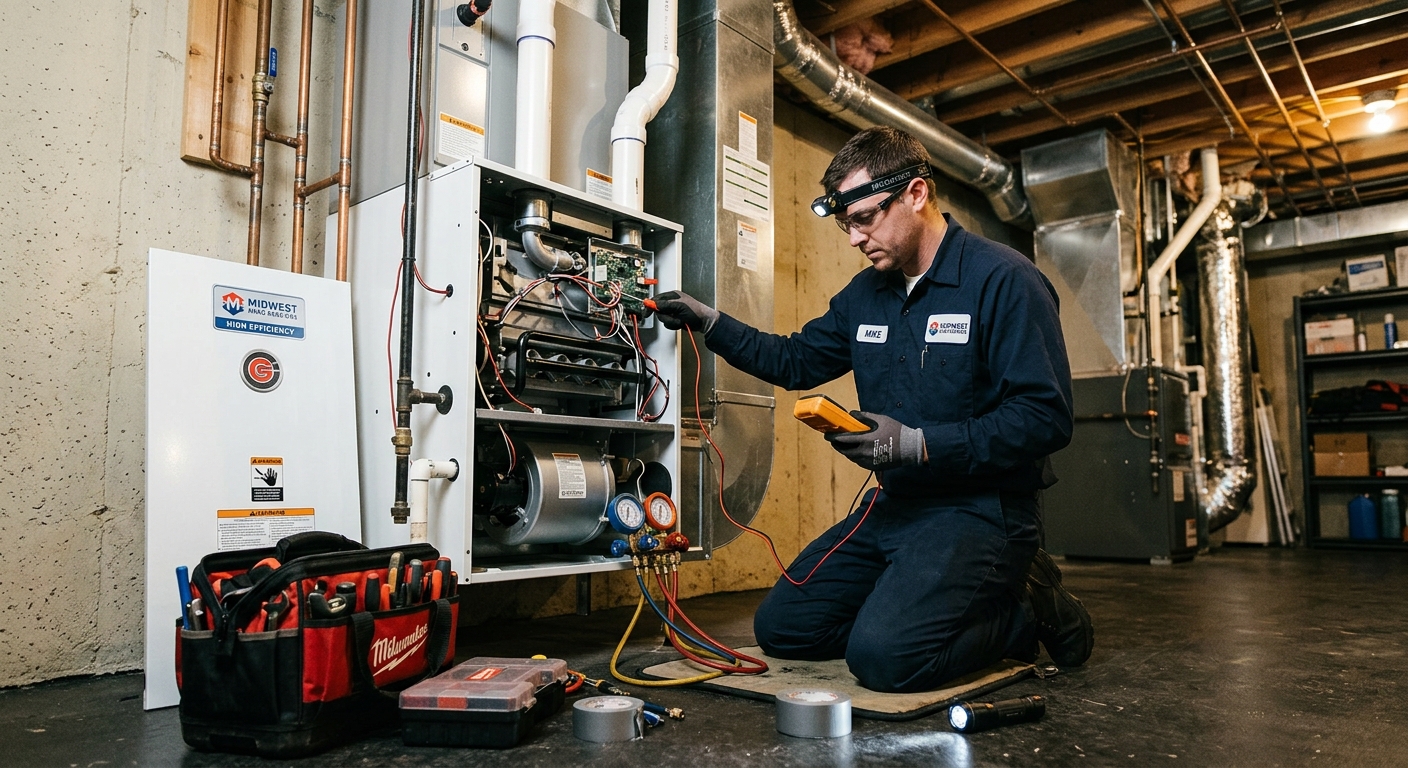
What a new HVAC system costs in London Grove
London Grove sits in an area with a 96.7% homeownership rate and over 22.8% of homes built before 1980 (U.S. Census Bureau, ACS 2024). What this means in practical terms is most houses are single-family and owner-occupied, and many are now facing the point where original equipment is wearing out. Large tracts of Chester County housing built from 1970 to 2000 were installed with forced-air systems that are now at or beyond their design lifespan. That makes this a replacement market as much as a retrofit one — most homes already have ductwork, but its condition and sizing can vary.
Southeastern Pennsylvania gets about 4,800 heating degree days per year and only 1,450 cooling degree days, making this climate strongly heating-dominated. Winters are cold enough to stress any system, and summers get humid, but the biggest energy spend will be on heating. Any HVAC investment here needs to prioritize cold-weather performance above chasing the highest possible cooling efficiency.
| System |
Best for |
Efficiency |
Price range (installed) |
| Central AC replacement (existing ducts) |
homes with sound ductwork |
16–20 SEER2 |
$6,400–$15,500 |
| Air source heat pump (ducted) |
year-round heating and cooling |
8–10 HSPF2 |
$10,500–$22,000 |
| Cold-climate heat pump (ducted) |
heat pump as primary heat |
9–11 HSPF2 |
$16,500–$22,000 |
| Ductless mini-split (single zone) |
additions, rooms without ducts |
20–30 SEER2 |
$4,100–$9,000 |
| Full duct system installation |
homes with no existing ducts |
— |
$11,500–$23,000 |
Installed estimates for a typical London Grove home. Equipment tonnage, duct condition and electrical capacity move these more than brand.
Reading the yellow label
Every HVAC unit sold today carries an efficiency rating required by federal standards. For cooling, the important numbers used to be SEER (Seasonal Energy Efficiency Ratio), now replaced by SEER2. For heating (on heat pumps), HSPF2 (Heating Seasonal Performance Factor 2) is the new label. The higher these ratings, the less energy the equipment uses to deliver the same comfort. But how high is “worth it” for London Grove?
With 4,800 heating degree days and just 1,450 cooling degree days per year, Chester County is heating-dominated. That shifts the math: a bump in HSPF2 is generally more valuable than a bump in SEER2. Investing in a cold-climate heat pump with HSPF2 around 10 can justify itself in winter heating savings. On the other hand, paying for the absolute highest SEER2 numbers (above 20) doesn’t pay back quickly here: our summers just aren’t long or hot enough to turn that extra efficiency into meaningful dollars.
Keep in mind: what was called SEER and HSPF was recently replaced by SEER2 and HSPF2, which use tougher testing conditions and produce lower numbers for the same equipment. Figures from older articles don’t compare apples-to-apples. Bottom line: prioritize solid heating ratings (HSPF2 9–10 or up) and let cooling efficiency plateau at 16–18 SEER2 unless you use your AC nearly nonstop.
Permits, licensing and inspections in London Grove
Pennsylvania does not have a statewide trade license for residential HVAC contractors. Instead, installation and replacement are overseen at the local level, with each municipality in Chester County running its own code office or, in a few cases, deferring to the state Department of Labor & Industry if they’ve opted out. Contractors are required to have Home Improvement Contractor (HIC) registration from the Office of Attorney General for any job above $500 — this can be checked at hic.attorneygeneral.gov, and it’s basic consumer protection, not a trade license. Mechanical permits are mandatory for full system installations and usually for any central system replacement; this brings in official inspections as part of the process.
Every HVAC installer legally working on refrigerant lines must have federal EPA Section 608 certification, regardless of the state or municipality — this helps ensure safe handling and environmental responsibility. For your protection, workers’ compensation insurance is mandatory for all employers, and can be verified through the WCAIS portal (wcais.pa.gov). A written contract is required on jobs over $500, and you have the right to cancel within three business days. These rules protect London Grove homeowners from fly-by-night operators and ensure there’s recourse if work isn’t up to code.
London Grove's housing stock and its HVAC needs
London Grove’s housing is typical of Chester County’s broader suburban wave: homes built overwhelmingly between 1970 and 2000, with about 22.8% predating 1980, and most of the rest as part of master-planned subdivisions (U.S. Census Bureau, ACS 2024). This means most structures have ductwork, generally sized for both heating and (sometimes undersized) cooling — though insulation and window quality can lag modern standards. In these homes, first-system replacements are happening now, and it’s common to find original builder-grade HVAC still running, usually at the edge of reliable service life.
If your house is in this segment, the original ductwork was probably sized for forced-air heating first and central AC as an add-on. Ducts can leak, insulation was often minimal by today’s code, and windows may be basic double-pane. Electrical panels in these homes can sometimes be tight if you’re considering an all-electric conversion like a heat pump, so panel capacity should be checked early in the planning. Venting and flue conditions for gas furnaces can also be a question mark after 20–30 years. In short, most London Grove replacements are straightforward — you’ll rarely need new ducts — but don’t assume the original installation was flawless.
Mini-splits and zoning in London Grove homes
Ductless mini-split systems deliver heating and cooling directly to a room or area, making them a strong option for situations where adding ducts would cause disruption or prove cost-prohibitive. In London Grove, mini-splits are especially practical for room additions, attic or basement conversions, or older homes with radiant or baseboard heat and no ductwork at all. They’re also an option for rooms that have always been too hot or cold despite a central system.
Single-zone ductless systems, serving one room per outdoor unit, are generally the most efficient and reliable setup. Multi-zone systems connect multiple indoor heads to one outdoor compressor, and while they can look tidier, they often struggle to balance loads if all rooms aren’t used equally; this can underperform compared to running two or three singles. Placement matters — indoor heads are visible, which some homeowners dislike, and condensate drainage (often requiring a new line run) should have a clear plan.
Chester County’s housing built from 1970–2000 mostly has forced-air systems, so mini-splits are less common for whole-home use but excellent for targeted upgrades. If your home predates central air, consider ductless for comfort without tearing into finished walls and ceilings. The math in this area: ductless is usually most competitive for spot conditioning — a single-zone system runs between $4,100–$9,000 installed.
The decision point on an aging system
Deciding whether to repair or replace an HVAC system in London Grove largely comes down to hard math and safety. Most forced-air units last 15–20 years; after that, even minor repairs become more frequent, major component failures become likely, and any boost in efficiency is quickly overshadowed by the risk and hassle of another breakdown. Still, repairs make sense for younger equipment or inexpensive fixes — especially anything under a third of the cost of a new installation.
Consider the type of failure: a fan or capacitor is fixable and not a sign of overall decline. A failed compressor (in AC or heat pump) or a cracked heat exchanger (in a furnace) is much more serious and typically signals time for a full replacement, especially if the unit is past its expected service life. Systems using older, phased-out refrigerants are also harder and more expensive to repair, tilting the scale toward replacement. Before chasing high utility bills with a new system, make sure the issue isn’t leaky ducts or poor insulation — that’s often a few hundred dollars to fix with immediate payoff.
| Situation |
Recommendation |
Typical cost |
Reasoning |
| Under 10 years, single component failure |
Repair |
$300–$1,200 |
Most parts still under warranty; one-off fixes are cost-effective |
| 10–15 years, repair over a third of replacement |
Consider replacing |
$6,400–$15,500 |
Major investment better put toward new system with warranty |
| 15+ years, any major failure |
Replace |
$6,400–$15,500 |
Likely more failures ahead, efficiency well below current models |
| Cracked heat exchanger, any age |
Replace immediately |
$6,400–$15,500 |
Safety issue — carbon monoxide risk |
| Compressor failure past warranty |
Replace |
$10,500–$22,000 |
Compressor is the core; fixing rarely makes economic sense |
| Working system, high bills |
Test ducts and envelope first |
$300–$800 |
Air leaks and insulation are usually the true culprit |
Running the numbers on London Grove's climate
When comparing HVAC options in London Grove, it pays to understand how climate and efficiency ratings become real-world dollars. Chester County’s 4,800 heating degree days (HDD) far outweigh the 1,450 cooling degree days (CDD), and the winter design temperature drops to 14°F — meaning your system’s winter performance will affect your annual costs the most. PECO Energy serves as the electric utility for most homes nearby, so all-electric systems depend directly on their rate per kilowatt-hour (found on your monthly bill).
Suppose a house needs 60,000 BTU of heat per day in January. If you run a heat pump with 9 HSPF2 (roughly 2.64 COP), and PECO’s rate is (let’s say) $0.16/kWh, the cost to deliver that heat is:
- 60,000 BTU x 30 days = 1,800,000 BTU/month
- 1,800,000 BTU ÷ 3,412 = 527.6 kWh equivalent (1 kWh = 3,412 BTU)
- If actual delivered efficiency is 2.64 COP, divide by that: 527.6 ÷ 2.64 = 200 kWh/month
- Monthly cost: 200 kWh x $0.16 = $32
Change that COP (essentially the HSPF2 rating) and the numbers shift. If ductwork is leaky or undersized, the real cost can jump by 20–40%. This is why a high-efficiency system running through poor ducts is rarely a good spend; sealing and insulating that old ductwork often saves more. To run your own numbers, grab the “rate per kWh” on your bill and plug in your monthly or seasonal use. The same math works for cooling — just substitute in SEER2 and cooling degree days. In London Grove, get the heat right before chasing high SEER2 numbers, and always fix the ductwork first.
Frequently asked questions — HVAC installation in London Grove
Who inspects HVAC work in London Grove?
Work on heating and cooling systems in London Grove comes under the oversight of local municipal code offices, each running its own permitting and inspection process. In Chester County, most installations—including full system replacements—trigger a mechanical permit and a required inspection. Inspections focus on code compliance, safe installation, and sometimes efficiency. Contractors are guided by the Pennsylvania Uniform Construction Code, backed by the state but enforced locally. After a new system installation, a building inspector (from your township’s code office) will typically sign off before the final payment. As a London Grove homeowner, you never need to act as your own inspector, but make sure a permitted job includes a final inspection. Most projects above $500 require a written contract; for a new central AC, that means a cost of $6,400–$15,500.
How much does a furnace replacement cost in London Grove?
Furnace replacement costs in London Grove vary depending on the size of your home, fuel type, and whether any duct repairs are needed. For most suburban Chester County homes with existing ducts, replacing just the furnace (not the AC) falls in the lower-to-middle range of central AC replacement prices, since labor and permit requirements are similar. While this page’s bands are for AC and heat pumps, a straightforward furnace swap with no duct or venting surprises generally costs between $6,400–$15,500 installed. This includes removal of the old unit, safe new installation, and municipal inspection. Extras like upgrading the electrical panel or relining an old chimney could nudge the cost toward the higher end, so always get a clear, written proposal before work starts.
What is commissioning and why does it matter?
Commissioning is a thorough check and adjustment process that happens after your new HVAC system is physically installed but before it’s officially turned over to you. In London Grove, commissioning is not just flipping a switch; it’s about verifying — with instruments — that your equipment is set up for both safety and peak efficiency in our specific climate. This includes calibrating thermostats, adjusting refrigerant charge, confirming airflow, and checking duct sealing. For heat pumps and central AC, improper commissioning can mean the difference between getting a 20-year run and constant early failures. With prices for a new system ranging up to $22,000 for top-end installs, proper commissioning protects your investment and ensures comfort across our long winter heating season.
Is a high-efficiency system worth the extra cost here?
In a climate like London Grove, where heating dominates the utility bill, paying extra for a high HSPF2 rating on a heat pump or an efficient furnace makes sense up to a point. Higher efficiencies mean lower operating costs, but there is a ceiling: pushing way past HSPF2 10 or SEER2 17 usually doesn’t pay back the added expense unless your house is especially large or you keep it at extreme temperatures. Most homes in Chester County use 4,800 heating degree days per year, so the energy spend is real — but labor and materials here mean that the top-tier high-efficiency systems (like some cold-climate heat pumps at $22,000) often take more than a decade to break even versus good mid-tier options. The exception: older, leaky homes with high heating loads and rising utility bills. Seal the house and ducts first for the best return.
How long should an HVAC system last in London Grove?
Most HVAC units in London Grove installed on or after the 1990s can be expected to last 15–20 years with regular maintenance. The system’s true lifespan depends on usage patterns, duct condition, and quality of the original installation. Forced-air systems from Chester County’s big suburban boom are now at the tail end of their “reliable service” window — if you haven’t replaced yours yet, expect more frequent repairs and declining efficiency. If your equipment is past 15 years and a major repair is quoted at more than a third of the cost of a new install (for example, over $6,400–$15,500 per today’s bands), strongly consider full replacement for improved comfort and lower risk.
Which utility serves London Grove?
Nearly all homes in London Grove and the wider Chester County area receive electric service from PECO Energy, which handles distribution and billing. For natural gas, PECO is also the primary supplier in the more developed parts of the county, though homes in the rural fringes sometimes rely on propane or fuel oil. Your heating costs—and your decision between a gas furnace or heat pump—will be affected by which fuels are available and their current prices. When calculating your own operating costs or comparing system payback, the electric “rate per kWh” on your PECO bill is what to use. For an air source heat pump, expect total installed costs in the $10,500–$22,000 range, higher for all-electric setups that need a panel upgrade.
How is a tax credit different from a rebate?
In Pennsylvania, including London Grove, a rebate is cash paid directly to you (often by the utility or equipment maker) after a qualifying install — lowering up-front cost. A tax credit, on the other hand, knocks down what you owe Uncle Sam at tax time. Federal credits for high-efficiency systems are available, but they’re claimed when you file your taxes, not at check-out. Both incentives reduce your net cost, but rebates are faster, while credits depend on your tax situation. For a ductless mini-split in London Grove, rebates or credits might lower the price below $4,100–$9,000 installed. Always check local, state and utility programs before you sign a contract, because incentives change and not all systems qualify.
Is a heat pump a good choice for London Grove winters?
Heat pump technology has improved enough that most modern systems work well through a typical London Grove winter. The key is selecting a cold-climate model with a solid HSPF2 rating (look for 9 or above) and with enough capacity to handle our design temperature of 14°F. For most homes, an air source heat pump in the $10,500–$22,000 range will cover both heating and cooling, saving money in mild weather and handling 80–90% of the coldest nights; an emergency electric or gas backup can fill the gap on the few nights where heat pumps run out of steam. In Chester County’s climate, heat pumps make sense for both comfort and long-term operating costs, especially if your ducts and house are reasonably tight.
What is SEER2 and how is it different from SEER?
SEER2 stands for Seasonal Energy Efficiency Ratio 2, the current federal standard for measuring cooling efficiency of air conditioners and heat pumps. The shift from SEER to SEER2 came in 2023 and includes more realistic test conditions (like higher static pressure from ductwork expected in the field), so SEER2 numbers are always lower than legacy SEER values for the same equipment. In practical terms for London Grove, a system rated 18 SEER under the old system might now be rated 15.2 SEER2, though nothing about the actual unit has changed. Comparing SEER and SEER2 directly can be misleading — always use SEER2 when shopping for a new system or reviewing proposals. Central AC replacement in this area averages $6,400–$15,500 installed; be sure your bid spells out the SEER2 number, not just “high-efficiency.”