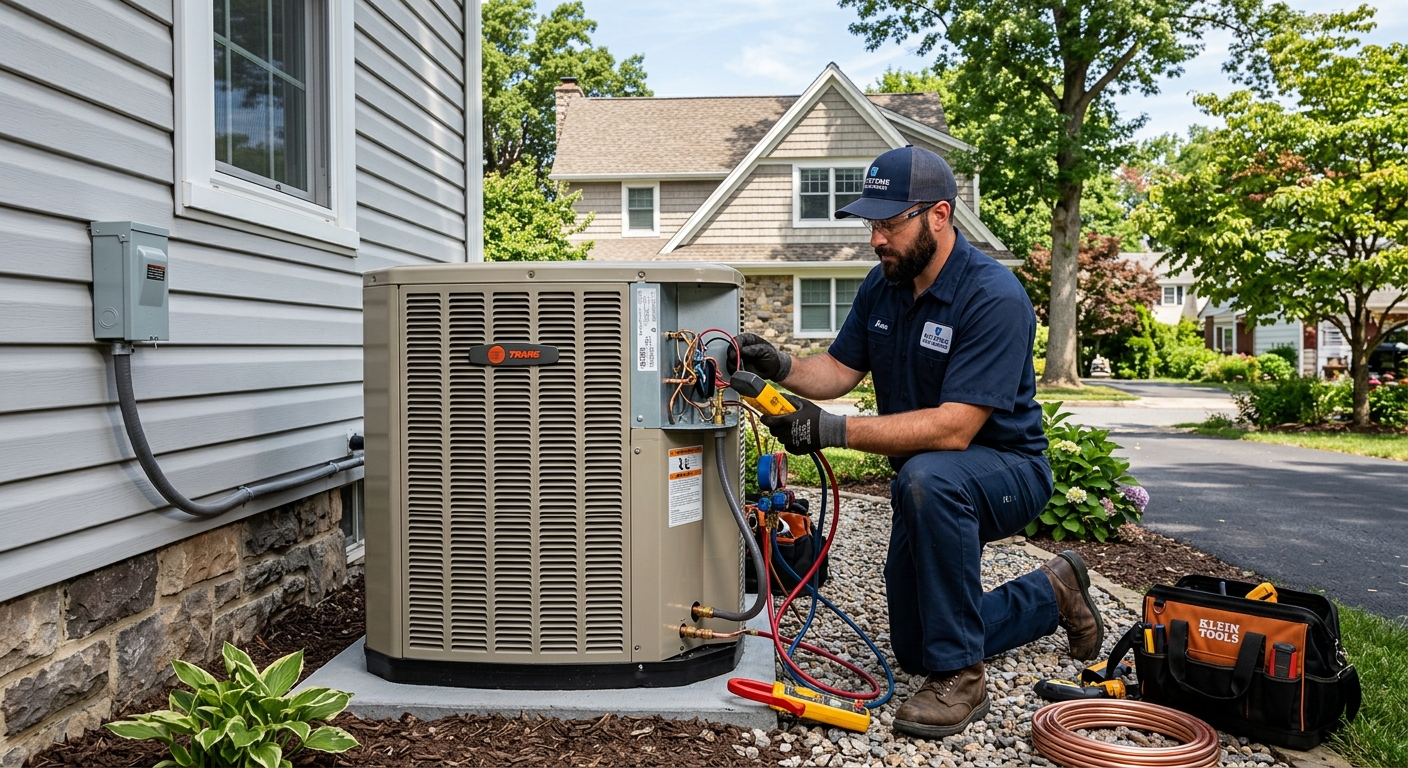
HVAC costs in Lower Swatara — 2026
Lower Swatara homeowners face a relatively predictable HVAC landscape thanks to a stable housing stock and high homeownership. With 85.1% of households owning their homes and nearly half built before 1980 (U.S. Census Bureau, ACS 2024), this is a replacement-heavy market. The typical scenario is retiring an aging split-system air conditioner and reusing the home’s existing ductwork—standard for post‑1950 tract homes around Colonial Park and throughout Swatara Township. Full retrofits are less frequent since most homes already have central forced-air systems in place.
Dauphin County's climate leans much more heavily on heating than cooling. With about 5,200 heating degree days and only 1,250 cooling degree days each year, it’s clear that staying warm is a bigger energy expense than keeping cool. This skews recommendations toward systems that excel in cold weather, while still offering reliable summer comfort. If your home already has sound ductwork, replacement of a central AC or adding a ducted heat pump is usually straightforward. Homes without ducts, or new additions, are a good fit for ductless mini-splits, but these are less typical here.
| System |
Best for |
Efficiency |
Price range (installed) |
| Central AC replacement (existing ducts) |
homes with sound ductwork |
16–20 SEER2 |
$5,000–$12,000 |
| Air source heat pump (ducted) |
year-round heating and cooling |
8–10 HSPF2 |
$8,000–$17,000 |
| Cold-climate heat pump (ducted) |
heat pump as primary heat |
9–11 HSPF2 |
$13,000–$17,000 |
| Ductless mini-split (single zone) |
additions, rooms without ducts |
20–30 SEER2 |
$3,200–$7,000 |
| Full duct system installation |
homes with no existing ducts |
— |
$9,000–$18,000 |
Installed estimates for a typical Lower Swatara home. Equipment tonnage, duct condition and electrical capacity move these more than brand.
What a Pennsylvania HVAC contractor must hold
Pennsylvania does not issue a statewide license specifically for HVAC contractors doing residential work. Instead, the regulation of residential HVAC is handled at the local (municipal) level. In Lower Swatara and neighboring parts of Dauphin County, contractors must be registered as Home Improvement Contractors (HIC) with the Pennsylvania Office of Attorney General if they perform contracts over $500—this is a consumer protection measure that covers residential work done in homes, not commercial buildings. The best way to verify a contractor’s registration is to search the state’s official HIC database. Municipalities also require mechanical permits and inspections for any installation or major replacement of central HVAC equipment.
Regardless of state or municipal licensing, any technician handling refrigerant must hold a valid EPA Section 608 certification. That is federal law, applies anywhere in the U.S., and covers anyone connecting gauges, charging or recovering refrigerant. As a homeowner, you should always ask to see this credential for the person who will be working on your system—not just the company in general.
Insurance and workers’ compensation are also non-negotiable. All employers in Pennsylvania must carry workers’ compensation, whether privately through the market or self-insured. You can ask for proof and verify coverage directly through the state’s WCAIS website. Never accept a verbal assurance—ask for documentation.
Separating installers from equipment sellers
The real difference in HVAC isn’t usually the brand on the sticker—it's the quality of installation behind your walls. Even the best equipment will disappoint if the contractor cuts corners. In Lower Swatara, where the HVAC market is crowded and competitive due to the concentration around the Harrisburg–Carlisle metro, it pays to vet the installer, not just the quote.
Genuine pros give you more than a price. Start by confirming HIC registration using the state’s database. Next, EPA Section 608 certification is a must for anyone handling refrigerants. Ask specifically who will be “on the gauges” and look for their card. Top installers perform a Manual J load calculation for your home and supply equipment model numbers (not just tonnage) right on the quote. They commission your system—meaning they measure supply airflow and refrigerant charge at startup, and provide this documentation to you with the final paperwork.
- Check HIC registration at the official Pennsylvania site
- Verify EPA Section 608 certification for the technician
- Get a Manual J load calculation (not just a verbal guess)
- Insist on written equipment model numbers in the proposal
- Read the contract—the HICPA requires this in Pennsylvania
- Request documented commissioning reports with startup data
- Review mechanical permit and inspection requirements for your township
- Demand proof of general liability and workers’ comp (check via WCAIS)
- Find out who is doing the actual install (subs, employees, etc.)
- Beware of “same-day next-day” sellers who skip calculations
- Don’t sign a proposal that leaves equipment type or size open-ended
- Ask for recent local references—not just a list, but names with addresses
In a dense market like Dauphin County’s metro area, lowballers swarm. Suspiciously cheap quotes mean skipped steps—especially load calculations, commissioning, or even pulling a permit. That’s not savings, it’s buying someone else’s mistake.
Maintenance that actually extends system life
Most of what really matters in HVAC maintenance is simple. Change filters at the recommended interval using the right MERV rating—go too high and you’ll reduce airflow, too low and you’ll let dust through. For the standard furnaces and air handlers in Lower Swatara homes, a MERV 8–11 pleated filter is about right unless you have a specific allergy need. Coil cleaning (both indoor evaporator and outdoor condenser) once a year keeps efficiency up and prevents early wear. If your system has a condensate line or pump, make sure it’s flushed out before cooling season to prevent backups and water damage—especially important with our freeze-thaw cycles.
The most overlooked item is refrigerant charge. Just “topping up” is a bad sign—it means there’s a leak that needs fixing. Any contractor who regularly needs to add refrigerant without finding the leak is costing you money and shortening system life.
Annual service plans can be worthwhile for homeowners who forget to schedule, but read the terms. Plans that only include a filter and a five-minute look at your system aren’t worth even a modest price. Look for plans that clearly list what is checked, cleaned, and tested.
Schedule cooling maintenance early spring and heating maintenance in late summer or fall, before the emergency calls flood in—otherwise the best techs are already booked up.
What you can actually claim on a heat pump here
If you’re considering a heat pump in Lower Swatara, know how incentives work. There are three broad categories: federal tax credits, local utility rebates and state-level programs. Each operates differently, especially in how you get the benefit. Federal tax credits (like those for qualifying heat pumps) reduce what you owe the IRS for the next tax year—you don’t see cash savings up front, it comes off your tax bill months later. Utility rebates, on the other hand, usually reduce your invoice or arrive as a check shortly after purchase, putting savings in your pocket faster.
For Lower Swatara, the main electric utility is PPL Electric Utilities. UGI Utilities supplies natural gas. Both typically offer efficiency rebates, but amounts, eligibility and application steps change every year. Rather than trust any article for up-to-date figures, check the official utility websites: look for their energy efficiency section with rebates for heat pump installation. You should also check the ENERGY STAR Rebate Finder and search by ZIP code for federal and utility offers. These are the current sources for what’s available—don’t assume last year’s offer is still valid, and treat any published number as a general ballpark, not a guaranteed deal.
State-level programs beyond the tax credit and utility rebates come and go. Any direct-rebate opportunity will be listed by your electric utility or through ENERGY STAR.
Efficiency ratings and what they mean for your bill
Every modern air conditioner and heat pump is rated using SEER2 for cooling and HSPF2 for heating. These are updated versions of the older SEER and HSPF standards you might see in old articles—the new tests are stricter, so numbers are slightly lower even though the equipment hasn’t changed. SEER2 (Seasonal Energy Efficiency Ratio 2) tells you how efficiently the system cools over a typical Southeast PA summer; higher means lower bills. HSPF2 (Heating Seasonal Performance Factor 2) tracks how efficiently a heat pump heats during winter.
Which rating to pay for? In Dauphin County, it’s all about heating. With 5,200 heating degree days but only 1,250 cooling degree days, the cost of keeping your house warm outstrips the cost of cooling it by a large margin. That means HSPF2 is usually where your money goes furthest. If you’re buying a standard air conditioner, 16–18 SEER2 is adequate—it’ll get you solid comfort and a reasonable payback without spending extra for a high number you rarely use. For heat pumps, a higher HSPF2 (9 or above) brings tangible winter savings, but ultra-premium models give diminishing returns. High SEER2 matters most if you have high summer usage or plan to stay in your home a very long time, otherwise the premium rarely pencils out in Lower Swatara’s moderate summers.
Sizing: why bigger is worse
When it comes to HVAC systems in Lower Swatara, oversizing is one of the costliest mistakes. It is not a bonus or a hedge—it’s a real defect. An oversized unit heats or cools so quickly it shuts off before properly dehumidifying or distributing air, causing clammy air in summer, wide temperature swings, and much shorter equipment life because of constant starts and stops (short cycling). Instead of comfort, you get nuisance and early failure.
That’s why professional design begins with a Manual J load calculation—a room-by-room math process that factors in window size, insulation, air leaks, local weather and your home’s square footage. “Rules of thumb,” like a set number of tons per square foot or copying the old system's size (which was likely oversized anyway), guarantee you are paying for a problem. Always ask: “Did you run a Manual J load calculation, and can I see the report?” If they’re basing their recommendation off the tag on your dead or dying unit, they’re copying forward a decades-old guess, not doing real work.
The calculation uses Lower Swatara’s winter design temperature—12 °F is the standard for this part of south-central Pennsylvania. This means the system should heat your house reliably when it’s 12 °F, not just on a mild day. If a contractor cannot show their math, you have reason to move on.
Frequently asked questions — HVAC installation in Lower Swatara
How much does a furnace replacement cost in Lower Swatara?
Homeowners in Lower Swatara often ask about furnace replacement, but pricing in this region usually focuses on full system swaps with a central air or heat pump, since most homes have split systems. While furnaces alone aren’t included in the main price bands, a complete central air conditioning replacement, which often goes hand-in-hand with furnace change-outs, runs $5,000–$12,000 installed for typical jobs re-using existing ductwork. Costs can go higher if there are duct repairs or upgrades, or if the equipment is much larger than standard. Because nearly half the houses were built before 1980, the scope of work often includes updating older equipment and sometimes addressing aging ductwork at the same time, so plan accordingly if your system is near end-of-life.
Can a heat pump heat my house without backup?
In Lower Swatara’s winter climate—with a design temperature of 12 °F and about 5,200 heating degree days—modern cold-climate heat pumps are up to the task of heating most homes by themselves. If you’re investing in a ducted cold-climate model, expect installation to run in the $13,000–$17,000 range. Choose equipment rated specifically for cold climates (look for 9–11 HSPF2 ratings) and make sure your home is reasonably well insulated and sealed. In post‑1950 tract homes with decent windows and typical wall construction, there are very few days when backup heat is actually required. For the few extremely cold nights, most systems can bring on an electric resistance backup, but in practice, a correctly sized, quality install will seldom need it here. Ask for expected balance point calculations on your quote to know exactly what to expect.
How do I verify an HVAC contractor's insurance?
To protect yourself in Lower Swatara—or anywhere in Pennsylvania—you should always verify both general liability insurance and workers' compensation coverage before signing any contract over $500. For general liability, ask the contractor or their agent to send you a “certificate of insurance” listing your address as the certificate holder. For workers’ compensation, Pennsylvania employers are required to carry coverage—use the state’s WCAIS site to verify by company name or policy number. A quality contractor will not hesitate to provide these documents, especially as workers' compensation is mandatory in this state. When you’re considering a significant investment like a central AC installed at $5,000–$12,000, verifying insurance is not just due diligence—it’s protection for your home and finances.
Which utility serves Lower Swatara?
Lower Swatara is primarily served by PPL Electric Utilities for electricity, and natural gas is widely available through UGI Utilities. This directly affects your choice of HVAC system since both utilities offer rebates from time to time, and gas availability makes dual-fuel or straightforward furnace replacements common in this area. If you’re considering a system upgrade or fuel switch—say, moving to a ducted heat pump which runs from $8,000–$17,000 installed—confirm your utility accounts so you can check for available rebates or efficiency programs. Always look at your bills for the utility names; third-party suppliers sometimes appear in deregulated energy markets, but PPL and UGI own the infrastructure.
Is an annual maintenance plan worth it?
In Lower Swatara, annual maintenance plans can be worth the investment when they offer thorough inspections and genuine cleaning—not just a filter swap and a quick checklist. Regular maintenance helps protect systems installed at $3,200–$17,000, which is a common price range for homes in this area. Plans that include coil cleaning, airflow checks, verification of refrigerant charge, and safety inspection of combustion equipment are solid value, especially if you tend to forget to schedule yearly tune-ups. Beware of "plans" that only provide prioritized service or minor discounts—those aren’t worth paying for on their own. Make sure any plan spells out what’s included in writing and double-check the cancellation policy; Pennsylvania’s Home Improvement Consumer Protection Act entitles you to a 3 business-day cancellation for contracts over $500.
What is a Manual J load calculation?
A Manual J load calculation is the gold standard for sizing new HVAC systems in Lower Swatara homes. It is a detailed process using your home’s insulation, window type, orientation, square footage, air leakage, and our local design temperatures—12 °F for winter—to determine exactly how much heating and cooling power your house actually needs. It replaces rough “rule of thumb” sizing methods that often lead to oversized or undersized equipment. Insist on seeing the contractor’s Manual J report before you agree to a big job, especially on projects in the $8,000–$17,000 range for heat pumps or central AC replacement. This calculation protects your investment and ensures you get comfort, efficiency, and a properly dehumidified house year-round.
What is commissioning and why does it matter?
Commissioning is the verification step that ensures your HVAC system—whether a central AC, heat pump, or ductless mini-split—is set up and running exactly as intended. In Lower Swatara, commissioning should cover supply and return airflow measurements, refrigerant charge checks, control calibration, and confirmation that all safety devices are working. A quality install in the $5,000–$17,000 range is only as good as its commissioning: skipping this step leaves you with a system that could be inefficient, unreliable, or even fail prematurely. The contractor should provide a written commissioning report. This serves as a baseline for future tune-ups and warranty support, and is your proof that the startup wasn’t rushed. If commissioning isn’t mentioned in your proposal, ask for it—or find a contractor who will.
How much does ductwork add to an HVAC installation?
Adding new ductwork in Lower Swatara, where many homes already have existing ducts, is usually only required in major remodels or new additions. For a full duct system (supply, return, registers, and grilles) in a typical local home, expect to pay between $9,000–$18,000 installed—on top of the equipment costs for furnace or heat pump. Post‑1950 tract homes in this area were mostly built with central forced air, so repairs or sealing are more common (and far cheaper) than a complete ductwork replacement. However, if your home was built before central HVAC became standard, the cost is significant and should be factored in early, as it may also require upgrades to your electrical panel or some drywall patching.
Does my utility offer a heat pump rebate in Lower Swatara?
Both PPL Electric Utilities and UGI Utilities (the main providers in Lower Swatara) frequently update their rebate and incentive programs for new heat pumps. Don’t rely on static numbers from articles; instead, visit your electric and gas utility websites and search for the energy efficiency or home rebate sections. You should also look up the ENERGY STAR rebate finder for offers available by your ZIP code. The average cost for a ducted air source heat pump install here is $8,000–$17,000, but rebates change every year and may depend on system efficiency, contractor qualifications, and application timing. Take five minutes to verify current opportunities at the official sources—rebate terms are not locked in and can change without notice.