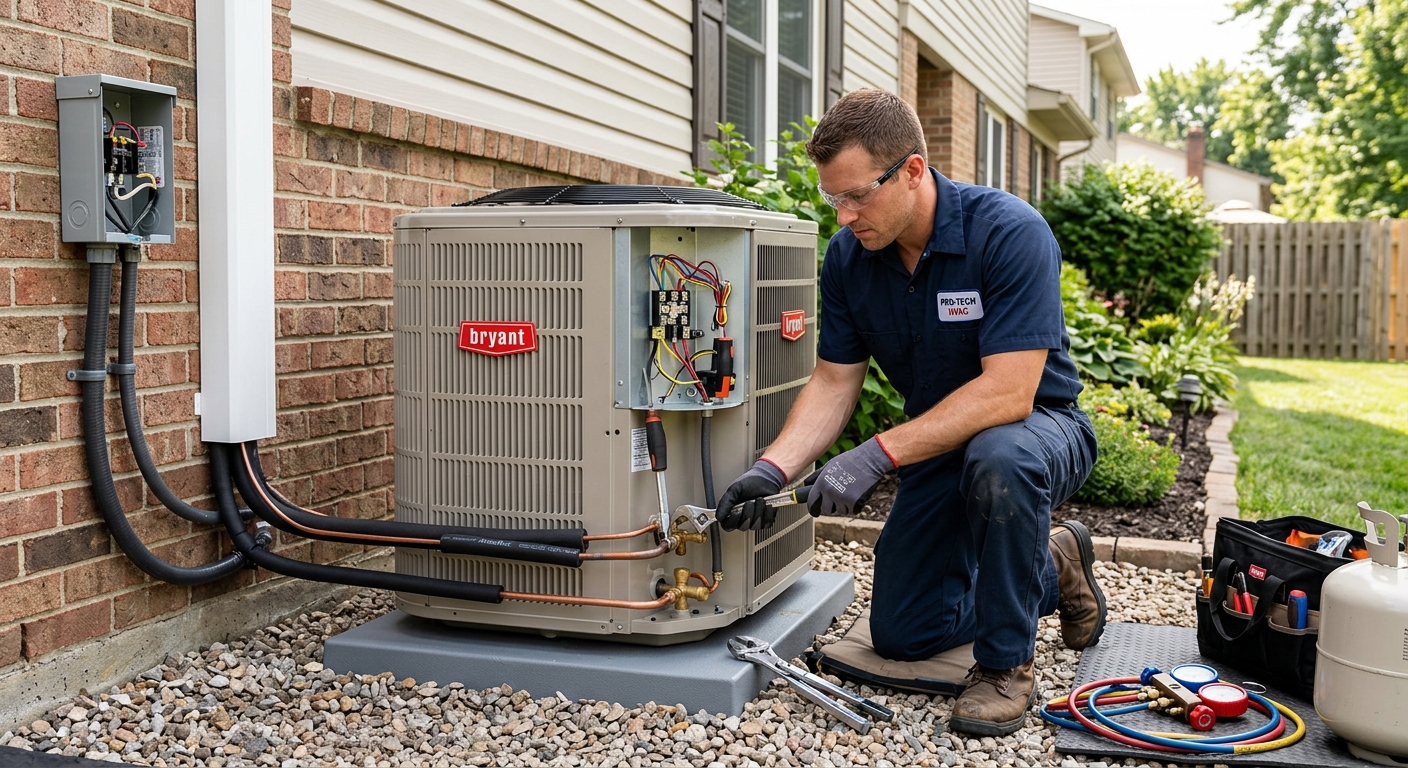
What a new HVAC system costs in Millersville
In Millersville, the decision to install or replace an HVAC system depends heavily on the age and type of home you own. With 69.2% of homes built before 1980 and a homeownership rate of just over half (U.S. Census Bureau, ACS 2024), this is a true retrofit and replacement market more than a new construction one. Many houses here simply weren’t built with central air in mind, and older Lancaster city rowhomes from 1880–1930 often can’t accept new ductwork without major disruption—making ductless or high-velocity systems far more practical.
Millersville and the surrounding Lancaster County region see about 5,200 heating degree days each year, compared with only 1,250 for cooling. That means our market is much more heating-dominated, and any decision on equipment type should prioritize reliable, efficient heat over cooling performance alone. Central AC makes sense where good ductwork already exists, but most upgrades here focus on year-round solutions like air source heat pumps or on targeted zoning with mini-splits.
| System |
Best for |
Efficiency |
Price range (installed) |
| Central AC replacement (existing ducts) |
homes with sound ductwork |
16–20 SEER2 |
$4,800–$11,500 |
| Air source heat pump (ducted) |
year-round heating and cooling |
8–10 HSPF2 |
$7,700–$16,500 |
| Cold-climate heat pump (ducted) |
heat pump as primary heat |
9–11 HSPF2 |
$12,500–$16,500 |
| Ductless mini-split (single zone) |
additions, rooms without ducts |
20–30 SEER2 |
$3,100–$6,700 |
| Full duct system installation |
homes with no existing ducts |
— |
$8,700–$17,500 |
Installed estimates for a typical Millersville home. Equipment tonnage, duct condition and electrical capacity move these more than brand.
When ductless is the right answer
Ductless mini-splits genuinely come into their own in certain situations found all over Millersville and Lancaster County. If you’re heating and cooling an addition, a finished attic or basement, or any space that your central system never reached, mini-splits eliminate the need for invasive ductwork runs and patching finished walls. For homes built before 1980—especially those classic rowhomes seen across Lancaster—trying to shoehorn in conventional ducts can turn into a mess fast, both for the building and your budget.
Single-zone mini-splits offer the best value for isolated needs: each indoor unit gets its own outdoor compressor, so performance is rarely compromised. Multi-zone systems, with several indoor units on one outdoor condenser, look neater outside and can serve up to five rooms, but head placement becomes crucial to avoid cold or hot spots. The tradeoff: a multi-zone system splits capacity, and comfort can suffer if you regularly heat or cool most rooms at the same time. Unless looks are paramount, separate single-zone units usually perform better and may end up costing about the same after installation.
Don’t overlook drainage. Every mini-split indoor head generates condensate, which needs either a gravity line to a drain or a pump—a detail that’s sometimes skipped, leading to headaches in an older home with thick walls and no easy pipe run. And while some homeowners object to the look of the indoor head, careful placement (above a closet door or window) can minimize its visual impact. In retrofit-heavy, older housing stock like Millersville, ductless is often less about choice and more about what’s genuinely practical.
Duct condition, leakage and sealing
If your Millersville home predates the 1980s, the state and condition of your ductwork can swing the performance of a new system as much as the brand of equipment you choose. Duct leakage is surprisingly common and can waste a serious fraction of heating or cooling energy, especially in homes that have seen multiple renovations, patched duct runs, or decades of mild neglect. The real killer is often undersized or under-returned ductwork—something that slows airflow and quietly murders both comfort and efficiency.
A duct blaster test pressurizes your system to reveal actual leakage rates, measured in cubic feet per minute (CFM). This makes it possible to separate minor sealing jobs from sections so leaky or poorly routed they demand replacement. Replacement is rare unless the ducts are rusted out, crushed, or wildly undersized, but it happens—a lot of older systems were sized for a furnace only, not for heat pumps or air conditioning. If your ducts run through unconditioned attics or crawlspaces (still seen in some Millersville capes and split-levels), uninsulated sections add significant heating and cooling losses.
In rowhomes and other pre-war Lancaster housing stock, many homes simply lack hidden ducts altogether or have makeshift solutions appended over generations. Retrofits—whether ductless units or high-velocity mini-ducts—usually prove less disruptive and more effective than trying to rework ancient trunk lines. Bottom line: always test or evaluate your distribution system before replacing your central HVAC equipment. Otherwise, you risk installing new machinery that performs no better than the old.
Refrigerant rules and your existing system
If you have an existing central air conditioner or heat pump using R-410A in Millersville, you do not need to worry about your system becoming illegal or unserviceable. R-410A remains legal to sell and use in repairs even as newly manufactured residential systems shift to lower-GWP refrigerants like R-454B and R-32. This change is part of a nationwide phase-down to cut the climate impact of high-GWP HFCs supported by current federal rules, but it’s focused entirely on new equipment—not what’s already in your home.
You should know, however, that as distributors stock less R-410A—since manufacturers are only making so much of it—the per-pound price for this refrigerant is likely to climb year over year. That doesn’t mean you need to replace your system, but if you develop a significant leak after your unit is out of warranty, repair costs (mostly from the refrigerant itself) may outstrip the value of limping the system along. Still, there is no requirement, in Millersville or Pennsylvania, to upgrade or swap out a working R-410A system on account of these refrigerant regulations. Only when you replace the system will you move to the new refrigerants, along with whatever safety and service changes they bring.
What each system actually costs to run in Millersville
Running costs for heating and cooling in Millersville are driven by our climate and your equipment’s efficiency—not just the sticker price or the fuel. Millersville, with about 5,200 heating degree days and 1,250 cooling degree days each year, is firmly a heating-dominated market. Your system will work hardest when outdoor temperatures hit the winter design low of 12 °F. To figure out actual costs, you’ll need three numbers: your system’s efficiency (in SEER2 for cooling, HSPF2 or AFUE for heating), the annual heating/cooling load driven by local degree days, and your electric rate (find it under “Supply” on your most recent bill from PPL Electric Utilities).
Here’s a sample calculation for heating with a heat pump:
- Estimate the annual heating load: For a modestly insulated Millersville home of 2,000 square feet, you might need roughly 40 million BTUs per season.
- If your ducted heat pump has an HSPF2 of 9, every kWh produces about 3,070 BTU. So, divide 40,000,000 BTU by 3,070 to get roughly 13,040 kWh for space heating per season.
- Multiply your usage by your actual per-kWh cost—let’s say it’s 16¢, but you must check your bill—so 13,040 x $0.16 = $2,086 for heating that season.
Compare the same process for a gas or oil furnace installation, converting fuel price to BTUs and factoring in the unit’s AFUE. Uncertainty comes from your home’s envelope and especially from duct leakage; a leaky duct system can turn a high efficiency system into a wasteful one. Focus less on peak efficiency numbers and more on whether your ducts are solid and insulated. Honest math beats guesses every time—in Millersville, especially where pre-1980 housing is the norm.
How to vet an HVAC contractor in Millersville
A brand-new, high-end system is only as good as its installation. In Millersville’s moderate suburban HVAC market, quality of workmanship outweighs brand stickers by a wide margin. Start by asking whether your contractor holds a current Home Improvement Contractor (HIC) registration through the Pennsylvania Office of Attorney General—for any job over $500, this is not optional and is easily verified online. For refrigerant-handling, insist on technician-level EPA Section 608 certification, regardless of what the business owner says about training.
The best contractors perform a full Manual J load calculation, recommend equipment by model—not just by tonnage—and include commissioning measurements for airflow, refrigerant charge, and static pressure. You want these numbers documented at startup, not just “it feels good.” Quotes should be in writing, with every model and scope detail spelled out, and include clear terms as required under Pennsylvania’s Home Improvement Consumer Protection Act (HICPA).
- Verify HIC registration at hic.attorneygeneral.gov
- Ask for proof of EPA Section 608 certification for anyone handling refrigerant
- Look for a current certificate of insurance and workers’ compensation—check worker comp at WCAIS (wcais.pa.gov)
- Check for documented Manual J load calculations (not just guesses based on square footage)
- Get model numbers and efficiency ratings (SEER2, HSPF2, AFUE) specified in the proposal
- Request written commissioning reports on airflow and refrigerant charge
- Ask about duct leakage testing—especially critical in pre-1980 homes
- Look for clear start and completion timelines
- Confirm a 3-business-day right to cancel as required by law
- Read the warranty for labor and components—don’t trust oral guarantees
- Ask for local references, especially in your part of Lancaster County
- Get written change order/overage policies
In a market as active as Lancaster County’s moderate suburban areas, be wary of anyone who won’t put things in writing, dodges permit questions, or tries to rush you into an immediate signature.
Permits, licensing and inspections in Millersville
Pennsylvania does not have a statewide HVAC contractor license for residential work. Instead, residential and light commercial HVAC work is governed locally. In Lancaster city, for example, any installation or replacement of central heating and cooling equipment generally requires a mechanical permit and inspection—if you’re in Millersville or a neighboring township, it’s your local municipality overseeing these permits, not the state. Always check with your borough or township office before work begins; filter changes and simple thermostat programming (not full system installs) generally don’t require permits in Lancaster County homes.
No state trade license is required for residential HVAC—instead, every company taking on jobs over $500 must hold a Home Improvement Contractor registration (HIC) with the Pennsylvania Office of Attorney General. Always verify this at hic.attorneygeneral.gov. For refrigerant handling, EPA Section 608 certification is federally required for the technician on site, regardless of local rules.
If you want proof of proper insurance or workers’ compensation coverage, Pennsylvania runs its verification system online at WCAIS (wcais.pa.gov). Before signing, confirm both the contractor’s HIC registration and their workers’ comp insurance, especially when multiple workers are involved—state law requires it. Permit compliance and a proper final inspection are your best protection against corner-cutting in this market.
Frequently asked questions — HVAC installation in Millersville
How cold does it get in Millersville and does that affect heat pumps?
Heat pumps in Millersville must be able to handle serious cold snaps. Our winter design temperature is 12 °F, and Lancaster County averages about 5,200 heating degree days yearly—meaning your equipment needs to provide steady heat well below freezing. Modern cold-climate heat pumps handle these conditions much better than older units, but not all models do equally well. In homes without gas service (common in more rural township areas around Millersville), cold-climate heat pumps can serve as the main heating source, especially if backed up by electric resistance or existing baseboard heat. Expect to pay $12,500–$16,500 installed for a ducted cold-climate system. Older ductwork may need help, or you might consider ductless mini-splits for hard-to-heat rooms. Before deciding, always check the manufacturer’s minimum operating temperature and consult a local contractor who understands our specific winters.
How is a tax credit different from a rebate?
In Pennsylvania—and in Millersville specifically—a tax credit is a direct reduction in your income tax, taken when you file your return for the year you upgraded or replaced your HVAC system. A rebate, on the other hand, usually comes as a check or direct deposit from the utility or manufacturer after you’ve made your purchase and submitted proof. Both help lower the out-of-pocket cost, but a $1,000 tax credit saves you $1,000 off your tax bill; a rebate gives you that money back directly. With current installation prices for an air source heat pump in Millersville running between $7,700–$16,500, securing both a rebate and a tax credit makes a real difference. Always read the small print—many programs require specific efficiency ratings and paperwork.
How much does a furnace replacement cost in Millersville?
While this page focuses on heat pumps and AC, many Millersville homes are equipped with gas or oil furnaces. The real cost to replace a furnace can swing widely depending on whether you need to modify or replace your existing ductwork. If your ducts are in good shape, expect a new mid- to high-efficiency furnace installation to be in the same ballpark as a central AC or air source heat pump install—which ranges from $4,800–$11,500 for the AC side. Gas service is common in town, but if you’re rural and on propane or oil, conversion costs go up. Always insist on a proper inspection of your ducts before investing in a new furnace.
How far ahead should I schedule in Millersville?
In Millersville and nearby Lancaster County towns, reputable HVAC contractors often book out two to four weeks during the peak spring and fall seasons—sometimes longer if you need a major upgrade, ductwork, or electrical upgrades. For a straightforward ductless mini-split or central AC replacement, you might get squeezed in faster if the contractor isn’t overloaded, but last-minute slots are rare during busy periods. With total system costs ranging from $3,100–$16,500 depending on scope, don’t rush to sign with the first available bidder. Quality installers in our moderate suburban market have a steady backlog—if someone’s available “tomorrow,” ask why.
Who inspects HVAC work in Millersville?
In Millersville, as in most of Lancaster County, municipal inspectors—not the state—oversee residential HVAC permits and final inspections. If you’re in Lancaster city, the Bureau of Code Compliance handles all HVAC inspections; if you’re in another township, your municipal office will direct you to the correct inspector. Pennsylvania does not regulate residential HVAC work at the state licensing level, but all mechanical permits and code compliance are enforced locally. For a full ducted system installation (which can run $8,700–$17,500), expect a township inspector to check installation for code compliance before your contractor is finished.
Can I service my R-410A system after the refrigerant change?
Yes, homeowners in Millersville (and all of Pennsylvania) can still have their R-410A systems serviced, even as new HVAC equipment transitions to different, lower-GWP refrigerants. The refrigerant change applies only to new systems currently being manufactured and sold—not to those already in service. What you need to watch are rising refrigerant costs and parts availability as the phase-down proceeds. If your system needs a major repair or refrigerant charge in the future, the economics may favor upgrading. For now, though, there is no law or regulation requiring you to replace a working R-410A system, and servicing will remain available for the foreseeable future—with a repair bill sometimes approaching $4,800–$11,500 if major components fail.
Do I need dual fuel in south-central Pennsylvania?
Dual fuel systems (heat pump plus gas furnace backup) make sense in parts of Pennsylvania where electricity is expensive, gas is cheap, and winter lows hover near or below the cold tolerance of a standard heat pump. In Millersville, natural gas service is common in the town and suburbs, so dual fuel can offer the best of both worlds: efficient heat pump operation most of the year, with gas firing up during rare bitter cold snaps. In rural areas relying on propane or oil, the case for dual fuel is weaker due to higher fuel costs. Remember, a quality cold-climate heat pump can handle even our coldest days, but if you’re planning to install a new system costing $7,700–$16,500, get a local contractor to run cost comparisons based on your actual rates and comfort needs.
How long should an HVAC system last in Millersville?
An HVAC system in Millersville can be expected to last 12–20 years, with the range depending on equipment quality, the harshness of our freeze-thaw cycles, and—far more than most realize—the condition of your home’s ductwork. In houses built before 1980 (which is nearly 70% of local housing), older duct systems can undermine a new system’s performance and lifespan. Investing in routine maintenance and sealing keeps even lower-cost systems going strong. Replacement cost for a typical system runs $4,800–$16,500 depending on type. Always check maintenance history and duct condition before ruling on replacement age.
How much does a new HVAC system cost in Millersville?
In Millersville, total installed cost depends on your home’s age, ductwork condition, and whether you need air conditioning only or year-round heating and cooling. If you have working ductwork, a new central AC is likely to run $4,800–$11,500, while a full air source heat pump averages closer to $7,700–$16,500. Installing a ductless mini-split for a single room or addition will cost $3,100–$6,700. Full ductwork in a home that never had it ranges quite a bit, typically from $8,700–$17,500. The biggest factors aren’t brand, but how much of the distribution system needs work and whether your home’s electrical panel is up to the task.