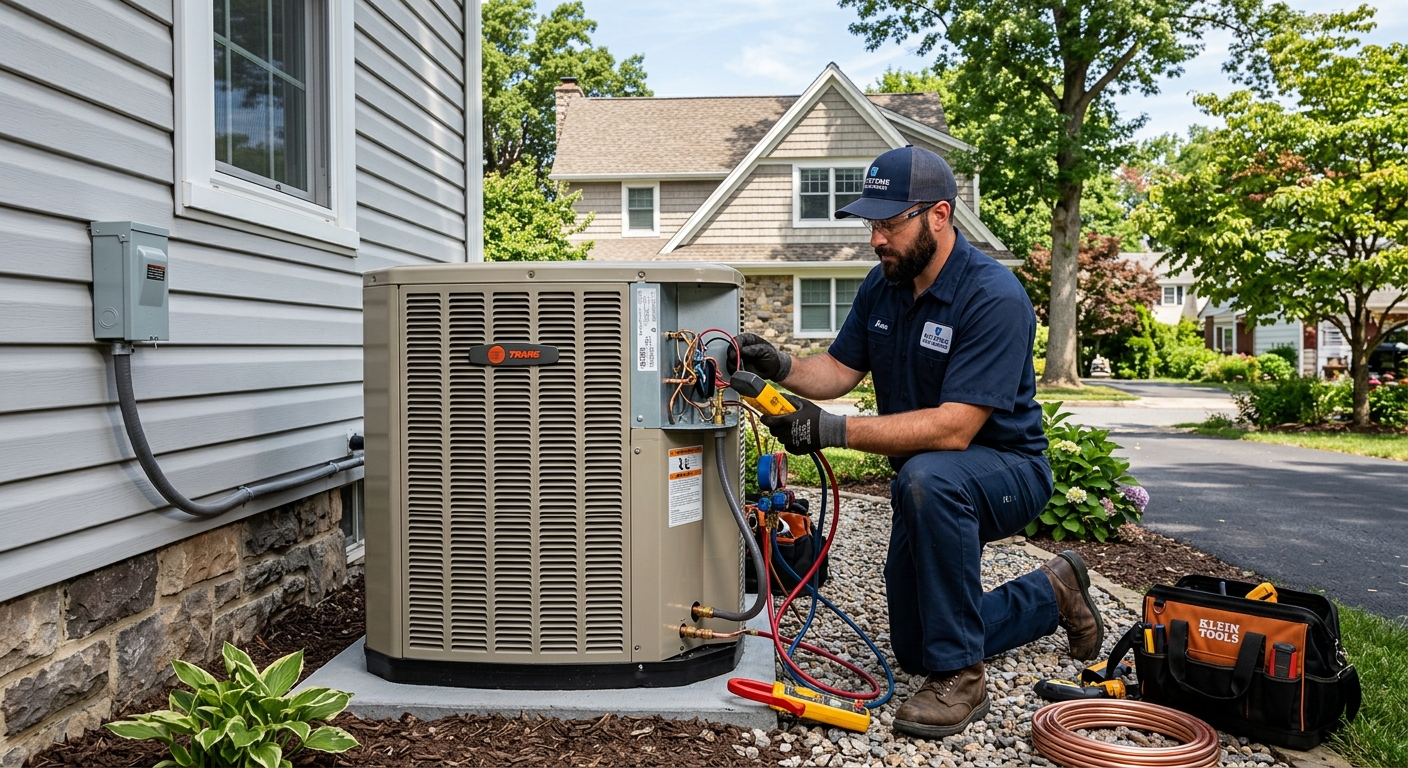
What a new HVAC system costs in Mount Pleasant
Mount Pleasant’s higher-than-average homeownership rate and housing stock—built mostly before 1980—mean most heating and cooling projects here are replacements and retrofits, not new construction. With 85.0% of homes owner-occupied and nearly seven out of ten built before Reagan took office (U.S. Census Bureau, ACS 2024), existing ductwork quality varies widely. Many homes started off with oil or coal heat, with air conditioning and ductwork added decades later—and in some cases, never at all. You’ll often find mismatched or leaking ducts when a previous upgrade stopped with the furnace.
Our climate is heating-dominated. With 5,600 heating degree days each year compared to just 1,050 cooling degree days, your furnace or heat pump does the heavy lifting most months, while the A/C gets a real workout only in July and August. This is why, in Mount Pleasant, spending on a robust heating system (or a cold-climate heat pump) nearly always takes priority over chasing ultra-high A/C efficiency ratings—though nobody wants to sweat through a Westmoreland County heat wave either.
| System |
Best for |
Efficiency |
Price range (installed) |
| Central AC replacement (existing ducts) |
homes with sound ductwork |
16–20 SEER2 |
$4,700–$11,500 |
| Air source heat pump (ducted) |
year-round heating and cooling |
8–10 HSPF2 |
$7,500–$16,000 |
| Cold-climate heat pump (ducted) |
heat pump as primary heat |
9–11 HSPF2 |
$12,500–$16,000 |
| Ductless mini-split (single zone) |
additions, rooms without ducts |
20–30 SEER2 |
$3,000–$6,600 |
| Full duct system installation |
homes with no existing ducts |
— |
$8,500–$17,000 |
Installed estimates for a typical Mount Pleasant home. Equipment tonnage, duct condition and electrical capacity move these more than brand.
Zone control without ductwork
Ductless mini-splits solve problems that central systems just can’t reach in Mount Pleasant homes—especially those built before central air was standard. The layout in many mid-20th-century houses, and postwar additions that never connected to the original vents, make mini-splits nearly ideal for conditioned space without the demolition and expense required to add ducts. They’re the go-to for bonus rooms, finished basements, attic bedrooms, sunrooms, and any room that always stays hotter (or colder) than the rest because the central system never reached it well—or at all.
In a single-zone setup, a mini-split heats or cools one area with its own wall- or ceiling-mounted head. Multi-zone systems can serve several rooms with one outdoor compressor and multiple indoor units. However, multi-zone units distribute capacity between zones, so if several rooms call for cooling at once, no single head gets the system’s full power. Separate single-zone mini-splits offer better performance but cost more overall. Aesthetically, the indoor heads are visible and require condensate drains—placement matters to minimize visual impact and avoid patching finished plaster.
Ductless systems excel in retrofits; with most Mount Pleasant homes built before 1980, installers can avoid tearing into walls or rerouting wire and drain lines through stubborn brick and plaster. For spaces where ductwork isn’t practical or wanted, a quality ductless install at $3,000–$6,600 per zone offers reliable comfort without the headaches—or the dust.
Mechanical permits for HVAC work in Mount Pleasant
Pennsylvania does not issue a statewide HVAC contractor’s license for residential installs. Instead, Mount Pleasant and the rest of Westmoreland County rely on local municipalities to enforce the Pennsylvania Uniform Construction Code (UCC), which covers residential work. Some towns handle their own permitting; others have the state handle it. Regardless of who issues the permit, a mechanical permit is always required for new HVAC installations or significant replacements—and homeowners should never accept a contractor’s claim that a permit is “not needed.”
While there’s no state-issued HVAC license, contractors must be registered for home improvements over $500 through the Pennsylvania Office of Attorney General, and written contracts are required under state law. Anyone handling refrigerant—including all A/C and heat pump work—must have federal EPA Section 608 certification for safe refrigerant handling. Homeowners can verify a contractor’s insurance and mandatory workers’ compensation coverage using the state’s official online systems, offering protection if a worker is injured on your property. Skipping these checks risks your wallet and property rights.
Every step—quote, permit, install, inspection—depends on local enforcement, not a state HVAC license.
What a real HVAC quote contains
In Mount Pleasant, a legitimate HVAC quote is detailed—and lets you compare apples to apples. It should list model numbers for both the outdoor and indoor units (furnace or air handler and A/C or heat pump condenser). If the installer only lists a brand and price, you gain no insight: efficiency ratings depend on matched equipment, not just brand badges. Sizing (in tons or BTUs) must come from a proper load calculation, not guesses or past installs. The quote should specify whether ductwork is being evaluated, sealed, or replaced, since most homes here have midcentury ductwork that may leak or be poorly insulated. Look for notes on whether the refrigerant line set will be reused or replaced, and whether electrical updates or a panel upgrade are included—a must for many pre-1980 homes.
Condensate handling isn’t glamorous but matters; improper drainage leads to damage. The thermostat, mechanical permit, and documented commissioning report (startup airflow and refrigerant measurements) round out a complete quote. Warranty terms should separate labor from equipment—those are rarely the same. Here’s what to look for:
| Line item |
What to look for |
Red flag if… |
| Equipment |
model numbers, indoor and outdoor matched |
brand name only |
| Sizing |
load calculation attached |
matched to the old nameplate |
| Ductwork |
condition assessed, sealing scoped |
not mentioned |
| Electrical |
circuit and panel capacity confirmed |
assumed adequate |
| Line set |
replaced or documented as reused |
silent |
| Commissioning |
measured airflow and charge, documented |
no startup report |
| Warranty |
labour years stated separately |
manufacturer only |
| Permit |
included and priced |
'not needed' |
Running the numbers on Mount Pleasant's climate
When you live in Mount Pleasant—a region logging 5,600 heating degree days and a winter design temp of 8 °F—heating is by far the dominant “cost of comfort.” Cooling degree days are just 1,050 annually, so your system works hardest from October through April. To confidently compare furnace, heat pump, and A/C operating costs, you need three things: the efficiency rating (like HSPF2, SEER2, or AFUE), the climate’s annual load (from degree days), and your actual cost per kilowatt-hour or therm (see the electric rate chart on your West Penn Power bill).
Suppose you heat a typical 1,800-square-foot home with a 9 HSPF2 heat pump, and your last December-to-March bill showed 10,000 kWh used at $0.13 per kWh. This puts your electric heating spend at $1,300 just for the winter (10,000 x $0.13). If you switch to a 10 HSPF2 system, you boost efficiency ~11%, cutting your usage to about 9,000 kWh—a savings of $130. These are estimates: actual savings swing based on air leaks, insulation, thermostat settings, and, most of all, duct system condition. For cooling, a typical high-efficiency A/C running 16 SEER2 will cost a fraction of your annual heating—maybe $35 a month in July and August. Fuel-based heating (like natural gas) uses the same math: total BTUs, divided by system efficiency (AFUE rating), times your gas supplier’s rate.
Remember, leaky ducts or poor airflow erase equipment gains. A mid-efficiency system in a tight, well-ventilated house often beats a top-end unit on old, leaking ductwork. The best way to estimate your savings is by plugging your historic usage and rates into these formulas. Your rate (per kWh or therm) is always on your utility bill.
Maintenance that actually extends system life
There’s a lot of noise about “must-have” HVAC maintenance, but in Mount Pleasant, three things matter most: changing filters at the right interval (often 1-3 months), at a MERV rating your blower is designed for; keeping coils clean to maintain efficiency and air quality; and keeping the condensate drain open so you avoid water damage, especially during humid Westmoreland County summers. Checking refrigerant charge is worth doing once per year—but if your A/C or heat pump ever “needs a top-up,” you have a leak. Adding refrigerant without finding and fixing the leak isn’t maintenance—it’s a waste of money and sets the stage for compressor failure.
Annual service plans can offer value, mostly as insurance that you’ll get service during a cold snap or heat wave, but many are just glorified filter swaps plus a quick look-over. Read the fine print: if there’s no real inspection of the blower, coil, refrigerant charge, and controls, it’s not worth much. The slow season—early spring for A/C or early fall for heat—is the best time to schedule: contractors aren’t buried in emergency calls, and you’ll get a more thorough check.
How to vet an HVAC contractor in Mount Pleasant
Brand matters far less than how the system is installed. In Mount Pleasant’s retrofit-heavy market, the right installer is worth more than a glossy logo—one missed duct connection, improper charge, or lazy commissioning turns even the fanciest new A/C or heat pump into just another expensive gadget. Always start by verifying contractor registration through the state home improvement registry for jobs over $500. Ensure the actual technician doing your refrigerant work holds EPA Section 608 certification. Require a load calculation—never accept proposals based only on your old unit’s size. Ask for model numbers (both indoor and outdoor) and insist on detailed quotes listing electrical work, duct assessment, and labor warranty terms. Proper commissioning—a startup report documenting airflow and refrigerant charge—should be standard, not an extra.
- Check Home Improvement Contractor registration for active status
- Request proof of workers’ compensation insurance
- Ask to see EPA Section 608 card for refrigerant work
- Insist on a Manual J or similar load calculation
- Review detailed quote with equipment model numbers
- Confirm labor warranty is spelled out, not just equipment warranty
- Require documented commissioning/start-up measurements
- Demand clear pricing for permits and all line items
- Ask if technicians are employees or subcontractors (insurance coverage issue)
- Request references from Mount Pleasant or nearby Westmoreland County
- Check that proposed electrical work is coordinated with your home’s panel limits
- Find out if ductwork will be tested, sealed, and insulated where accessible
A low price with missing furnace details or “permit not required” is a red flag. In a moderate market like Westmoreland County, quality pros are busy but local word-of-mouth quickly exposes slapdash operators.
Frequently asked questions — HVAC installation in Mount Pleasant
Does my utility offer a heat pump rebate in Mount Pleasant?
In Mount Pleasant, West Penn Power is the main electric utility. While rebate programs can change year to year, the major incentives for heat pumps or central A/C have typically come through Pennsylvania state energy efficiency programs, with the utility sometimes adding extra incentives. These rebates generally apply to high-efficiency systems—often requiring a cold-climate ducted heat pump or a ductless unit installed by a participating contractor. A typical rebate range is $650 to $1,200, depending on system efficiency and installation specifics. Given that air source heat pumps run $7,500–$16,000 installed, the rebate helps but doesn’t change the math entirely. Always confirm current offers with West Penn Power before purchase, and get a written estimate for what is available for your specific house in Mount Pleasant.
Is a high-efficiency system worth the extra cost here?
Mount Pleasant’s climate, with 5,600 heating degree days, means your heating system does the bulk of the work each year. Upgrading from a standard 8 HSPF2 heat pump to a 10 or 11 HSPF2 (“cold-climate”) system costs more up front—think $12,500–$16,000 for a typical install—but brings the best payback if your house is well-insulated and your ductwork is in good shape. In older homes with leaky ducts, the benefit of an ultra-high-efficiency unit can be lost. In cooling mode, the energy savings are less significant because we just don’t rack up enough cooling hours. If your ducts are sound and you plan to stay in your home for at least 8-10 years, a top-tier system pays for itself in comfort and reliability, especially over unpredictable Westmoreland County winters.
What MERV filter rating should I use?
System age and blower strength matter in Mount Pleasant’s housing—most homes were built before 1980, with ductwork and furnace blowers not designed for restrictive, high-MERV filters. For most residents, a MERV 8 to 11 filter strikes the right balance between capturing dust and pollen and not choking airflow. A MERV 13 or higher filter can be used only if your blower and ductwork are up to it (which is rare in retrofit jobs). Higher MERV ratings may improve air quality, but can trigger fluttering or reduced system efficiency if your equipment or ducts aren’t sized for it. Filters should be replaced every 1-3 months depending on dust and allergy needs. Typical filter service comes standard with annual maintenance, which runs less than $200—well worth scheduling for peace of mind.
Does Pennsylvania license HVAC contractors?
Pennsylvania doesn’t issue a statewide HVAC license for residential work. In Mount Pleasant and the rest of Westmoreland County, contractors need to register through the state’s Home Improvement Contractor system for jobs over $500, but true occupational licensing is handled locally (if at all). For refrigerant work—such as installing or replacing a heat pump or A/C—EPA Section 608 certification is required on a federal level, regardless of state or local rules. Always verify HIC registration online when getting quotes (especially if the job is above $500), and ask to see the technician’s EPA card for peace of mind. Local permit requirements and enforcement add another layer, so double-check the township or Greensburg’s code office before work begins.
Is natural gas available throughout Westmoreland County?
In Westmoreland County, including Mount Pleasant, most neighborhoods have access to natural gas through Peoples Natural Gas, making it the most common fuel for heating retrofits and furnace replacements. However, in some rural townships and outskirts, homeowners still rely on propane or fuel oil, especially where mainline gas isn’t run. If you’re considering switching from oil or propane to gas, verify utility access for your street before shopping for equipment. If gas isn’t available, air source or cold-climate heat pumps—running $7,500–$16,000 installed—are now a strong alternative, especially given recent advances in cold-weather performance and rising oil prices.
Is a heat pump a good choice for Mount Pleasant winters?
Modern cold-climate heat pumps now handle Mount Pleasant’s chilly winters far better than heat pumps from a decade ago. With a design temperature of 8 °F and long heating seasons (5,600 heating degree days), a properly sized cold-climate heat pump keeps pace with most single-family homes—in fact, many new installs run entirely gas-free. That said, homes with poor insulation or drafty old windows may require a backup (like electric or hydronic heat strips) on frigid nights. Upfront cost is higher—cold-climate ducted systems reliably land at $12,500–$16,000—but long-term savings and improved comfort make it a serious contender, especially with natural gas or fuel oil prices rising. If you’re off the main gas grid, a heat pump is now the go-to option here.
Should I close vents in unused rooms?
It’s a common myth in Mount Pleasant that closing vents saves money—but the reality is, it rarely helps and often makes things worse. Your HVAC system was (or should have been) sized for the total load of the house. Closing vents dramatically increases pressure in the ductwork, which forces your furnace or A/C blower to work harder and can result in duct leaks or reduced equipment life. In older homes with retrofit ductwork, high pressure can really stress already-leaky connections. If certain rooms are uncomfortable or unused, it’s better to look at zoning solutions like a ductless mini-split (at $3,000–$6,600 per zone) or professional duct balancing, not simply shutting off vents. Balance is the key for reliable comfort and lower bills in Westmoreland County houses.
Why do HVAC quotes in Mount Pleasant vary so much?
The spread in quotes here is often shocking. In Mount Pleasant, costs swing because so many homes are retrofits, not new builds—68.7% of houses were built before 1980, so equipment sizing, ductwork condition, electrical upgrades, and even insulation levels change job-to-job. Some companies quote only equipment and brand, skipping the labor and fixes needed for your ductwork or panel. Others include everything for one bundled price. True full-system jobs (with permits, new ductwork, electrical and commissioning) can hit $8,500–$17,000, while “swap and go” outfits cut corners but leave your comfort (and long-term cost) at risk. Always compare line-by-line, and never trust a low-ball quote that glosses over ducts, electrical, or permits.
How long does HVAC installation take in Mount Pleasant?
Most straightforward replacements in Mount Pleasant—central air conditioners or ducted heat pumps where ducts are already in good shape—take about one day of onsite work, sometimes stretching to two if electrical issues or duct repairs crop up. Full new installs (with duct system installation) on older Mount Pleasant homes, especially midcentury or postwar layouts, usually run two to four days depending on access, attic or crawlspace conditions, and electrical panel upgrades. Ductless mini-splits are fast—single-zone jobs routinely finish in half a day, while multi-zone setups may take two. Schedule with some lead time in spring or fall, as contractors are booked solid in the hottest and coldest months. Most full duct system installs land between $8,500–$17,000, factoring labor, duct routing, insulation and necessary patching.