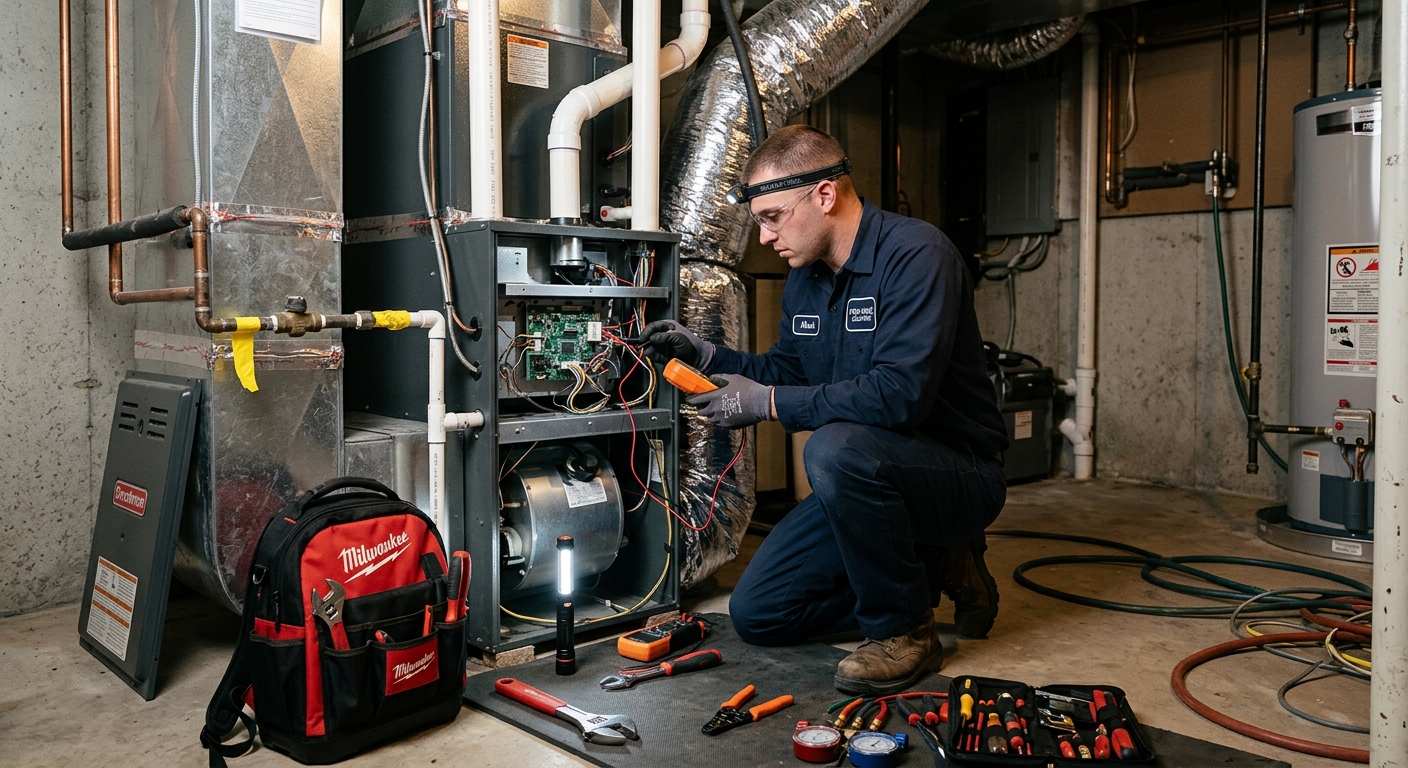
New Hanover heating and cooling prices by system type — 2026
New Hanover is made up almost entirely of owner-occupied single-family homes, with a homeownership rate of 98.7% and most homes built after World War II (U.S. Census Bureau, ACS 2024). That combination means this is mainly a replacement market, not a first-time installation market — most homes already have some kind of ductwork, but many systems are reaching or past their expected service lives. In parts of Montgomery County like Abington, Cheltenham, and Upper Dublin, that same post‑1945 housing stock drives demand for retrofit ductwork and electrical upgrades to handle today’s higher-efficiency equipment, and you’ll see that reflected in quotes for both AC and heat pump replacements.
Our climate is heating-dominated: cold winters bring roughly 4,800 heating degree days, while summers are humid but moderate at about 1,450 cooling degree days. For most homes, the heating side of the system does the heavy lifting, and system sizing reflects that. When you’re comparing costs, installation prices across the board are shaped less by brand and more by whether ducts are in decent shape and whether heavy-up wiring is needed for electric heat or new heat pumps.
| System |
Best for |
Efficiency |
Price range (installed) |
| Central AC replacement (existing ducts) |
homes with sound ductwork |
16–20 SEER2 |
$5,700–$14,000 |
| Air source heat pump (ducted) |
year-round heating and cooling |
8–10 HSPF2 |
$9,200–$19,500 |
| Cold-climate heat pump (ducted) |
heat pump as primary heat |
9–11 HSPF2 |
$15,000–$19,500 |
| Ductless mini-split (single zone) |
additions, rooms without ducts |
20–30 SEER2 |
$3,700–$8,000 |
| Full duct system installation |
homes with no existing ducts |
— |
$10,500–$20,500 |
Installed estimates for a typical New Hanover home. Equipment tonnage, duct condition and electrical capacity move these more than brand.
Comparing HVAC estimates in New Hanover
In New Hanover, two HVAC quotes that list only a brand and a price aren’t truly comparable. When you review proposals, demand detailed line items. Always verify that both indoor and outdoor unit model numbers are specified—mixing unmatched components might save a few hundred upfront, but robs you of the efficiency you’re paying for. Sizing should be justified with a load calculation; accepting a tonnage just because your old unit was "three tons" risks oversizing or undersizing for your updated home.
Look for line-set details: are they being replaced or reused? A new high-efficiency system often calls for a new line set, especially if you're switching from R-22 to R-410A or to the new refrigerants. Any needed electrical upgrades (like a new breaker) should be included, not assumed. Every quote should address condensate drainage, a new or reprogrammed thermostat, and whether permit and inspection costs are included. The commissioning process is more than a handshake — you should get a startup report with measured airflow and refrigerant charge. Finally, clarify warranty years for labor, separately from manufacturer parts coverage.
| Line item |
What to look for |
Red flag if… |
| Equipment |
model numbers, indoor and outdoor matched |
brand name only |
| Sizing |
load calculation attached |
matched to the old nameplate |
| Ductwork |
condition assessed, sealing scoped |
not mentioned |
| Electrical |
circuit and panel capacity confirmed |
assumed adequate |
| Line set |
replaced or documented as reused |
silent |
| Commissioning |
measured airflow and charge, documented |
no startup report |
| Warranty |
labour years stated separately |
manufacturer only |
| Permit |
included and priced |
'not needed' |
What each system actually costs to run in New Hanover
Calculating what it costs to run your HVAC system in New Hanover starts with understanding how efficiency, climate, and your utility rate all play together. Here, winters dominate—our area sees about 4,800 heating degree days but only 1,450 cooling degree days, so heating uses more energy than cooling for most homeowners. Local utility, PECO Energy Company, delivers your power and natural gas, but each homeowner’s rate appears right on the monthly bill.
For electricity, your system’s efficiency rating (SEER2 for cooling, HSPF2 for heat pumps, AFUE for furnaces) shows how much fuel turns into delivered heating or cooling. Want to compare? Grab last winter’s kWh total and divide it by your home’s square footage, or use utility “fuel cost per kWh” and multiply by your system’s expected annual usage. Say your heat pump needs 10,000 kWh to heat your house for a year (using published HSPF2 ratings and degree days); at $0.17 per kWh (your bill will show a real number), that’s $1,700 for heating. A system with lower HSPF2 would require more kWh, raising bills.
But these numbers are only as useful as your ductwork and insulation: a high-efficiency system connected to leaky ducts or running in a drafty house won’t realize its promised savings. That’s why one neighbor’s bills can differ sharply from another’s, even with the same equipment. When comparing running costs between units, always adjust for your rate and understand that envelope and duct losses can move the total by hundreds of dollars per year.
What a Pennsylvania HVAC contractor must hold
For residential HVAC work in Pennsylvania, there is no statewide HVAC trade license or board regulating who can perform heating and cooling installations. Instead, contractors must register as Home Improvement Contractors (HIC) with the Pennsylvania Office of Attorney General for any work above $500, and local municipalities—including those in Montgomery County—enforce mechanical permitting and inspection. This matters: the state differentiates between residential and commercial regulation, and for single-family homes in New Hanover, the rules are driven by the municipality, not the state.
Anyone handling refrigerants—whether for installation, service, or disposal—must have federal EPA Section 608 certification. For permitting, municipalities generally require mechanical permits for installation or replacement of HVAC equipment, especially if it involves new electrical or gas work.
Insurance requirements are enforced through the workers’ compensation system; in Pennsylvania, all employers must maintain coverage, and you can verify a contractor’s status using WCAIS (wcais.pa.gov). Always ask for a written contract (required by state law for jobs over $500), and check a contractor’s HIC registration at hic.attorneygeneral.gov before signing. This protects both your investment and your legal standing under the Home Improvement Consumer Protection Act.
R-410A phase-down: repair or replace?
R-410A has been the standard refrigerant in most residential air conditioners and heat pumps for years, but new federal policy is phasing down high global-warming-potential (GWP) refrigerants. That’s why most newly manufactured systems now use lower-GWP options like R-454B or R-32. If your home in New Hanover has an existing R-410A system, you are not forced to replace it: these systems remain legal to own, operate, and service.
However, as manufacturers stop making new R-410A equipment, production and import of the refrigerant itself are tapering. This doesn’t mean you can’t repair a leak or replace a failed part—but it does mean over time, the cost of R-410A for recharging your system will likely rise as supplies tighten. The tipping point for replacement versus repair gets closer if your system is out of warranty, over 10 years old, and needs a major refrigerant repair. In that case, you’ll have to weigh the high cost of both refrigerant and labor against the alternative—installing a new system using next-generation refrigerant, which will have lower refill costs in the future.
If your R-410A system is running fine and simply needs a maintenance check or an inexpensive repair, keep it. Replacement only makes sense if the repair cost nears a third or more of new system replacement, especially as that refrigerant cost ticks upward.
The decision point on an aging system
Making the repair-or-replace call on aging HVAC systems in New Hanover should always start with the basics, not knee-jerk sales pressure. First, look at system age against the expected service life (roughly 10–15 years for AC/heat pumps, slightly longer for furnaces here). If a specific part fails and it’s the first major repair under 10 years, repairing for $300–$1,200 usually makes sense. But if the unit is 10–15 years old and the repair cost is a third or more of replacement, consider putting that money toward a new unit (often between $5,700–$14,000 for AC). Once you pass 15 years, major repairs typically aren’t sound investments.
Here are the two "no choice" scenarios: a cracked heat exchanger (for gas furnaces) is a safety hazard and cannot be patched; it means immediate replacement. For compressors on older heat pumps or ACs, once out of warranty, replacing only the compressor often costs nearly as much as a new unit, and future failures are likely.
High energy bills on a "working" system? Before replacing equipment, test your ducts for leaks and evaluate insulation. Solving envelope problems can pay back faster than new machinery in New Hanover’s climate.
| Situation |
Recommendation |
Typical cost |
Reasoning |
| Under 10 years, single component failure |
Repair |
$300–$1,200 |
Expected life not reached, low payback for replacement |
| 10–15 years, repair over a third of replacement |
Consider replacing |
$5,700–$14,000 |
Repair cost approaches value of new, efficiency gain possible |
| 15+ years, any major failure |
Replace |
$5,700–$14,000 |
Further repair dollars unlikely to pay back |
| Cracked heat exchanger, any age |
Replace immediately |
$5,700–$14,000 |
Safety/code issue, cannot be repaired |
| Compressor failure past warranty |
Replace |
$9,200–$19,500 |
Repair rivals new equipment cost, reliability concern |
| Working system, high bills |
Test ducts and envelope first |
$300–$800 |
Efficiency upgrades wasted if air loss goes unchecked |
The comfort problem that isn't temperature
In southeastern Pennsylvania, winter dryness and summer humidity are at the root of most comfort complaints—not just the reading on the thermostat. Our cold winters dry indoor air as your heating runs, often dropping relative humidity well below comfort range. The fix is sometimes a whole-house humidifier, but these add maintenance: they need regular cleaning and water panel changes to avoid mold and mineral buildup.
Come summer, our humid climate can make homes clammy rather than cool, especially with an oversized air conditioner that rapidly lowers temperature but barely runs long enough to remove moisture. That’s why sizing matters not just for cooling, but for healthy, dry air indoors. Adding a dehumidifier to central systems can help, but this is an extra cost, and you may not need it unless you notice persistent stickiness or musty odors. High MERV filters offer better air quality, but above MERV 13, you risk choking airflow unless you have a new, high-capacity blower. For tightly sealed newer homes, mechanical ventilation might be a benefit, but for most older homes in New Hanover, the real upgrade comes from right-sizing equipment—not tacking on more gadgets than you need.
Before buying any humidifier, dehumidifier, or “air quality” add-on, make sure you’re solving a real humidity or air cleanliness problem, not just adding complexity and future maintenance.
Frequently asked questions — HVAC installation in New Hanover
Who inspects HVAC work in New Hanover?
Montgomery County townships and boroughs each operate their own code enforcement offices, and New Hanover follows this local approach. If your HVAC installation or replacement involves new electrical or mechanical connections—such as setting a new heat pump or running new ductwork—it typically triggers a permit and inspection requirement by your municipal building department. The inspector will review both safety and building code compliance under the Pennsylvania Uniform Construction Code framework. Permit costs and what’s required should be called out on your HVAC quote. For a full duct system installation, expect to see lines like $10,500–$20,500, and that often includes permit and inspection fees bundled in. Always confirm in writing that your HVAC contractor is pulling the correct local permit and scheduling inspections before signing a contract.
How is a tax credit different from a rebate?
In New Hanover and throughout Pennsylvania, a tax credit reduces the amount of tax you owe when you file your federal or state return, while a rebate is money paid directly back to you by a manufacturer, utility company, or government program, often right after a qualifying installation. For instance, if you install an air source heat pump for $9,200–$19,500, you might be eligible for both—say, a $2,000 federal tax credit you’ll claim next spring, plus a utility rebate that’s subtracted from the contractor’s invoice or mailed to you after purchase. Make sure to clarify with your installer which incentives apply up front, and get documentation for both. Always keep copies of invoices and model numbers, as both rebate and credit programs will probably require proof.
Do I need dual fuel in southeastern Pennsylvania?
Dual fuel—using both a heat pump and a backup gas furnace—can be attractive in places with winter temperatures that dip below the efficient range of standard heat pumps. In New Hanover’s climate, our winter design temperature of 14 °F and 4,800 heating degree days mean that a modern cold-climate heat pump can usually cover most of the heating season, but keeping a gas backup can help when the coldest weeks hit, or if electricity rates are high. Dual fuel isn’t required for code or safety, but it increases comfort and flexibility for homeowners nervous about relying solely on electric heat. It does add to installation cost—often in the range of $15,000–$19,500 for a full system—but it’s rarely required unless your house loses heat quickly or you’re in an older, drafty building.
Is natural gas available throughout Montgomery County?
Natural gas service in Montgomery County is widely available, especially in its dense inner suburbs like Lower Merion and Abington. For New Hanover and some far northwestern townships, service can be more spotty, with certain homes still relying on propane or fuel oil for heating. Before planning to install a gas furnace or stove, always confirm with PECO whether your address can be hooked up, and factor in the cost and timeline for extending a gas main or installing a propane system. For homes without existing gas service, the cost of switching, plus rising interest in electrification, may shift your decision toward a ducted heat pump—usually installed at $9,200–$19,500.
What size HVAC system does my New Hanover home need?
The only way to know the right size for your home is through a professional load calculation—essential for accurate HVAC sizing in any Montgomery County home. Unlike the old “square footage” rules of thumb, today’s calculations take insulation, orientation, windows, and air leakage into account. Using the local winter design temperature (14 °F) and actual heating and cooling degree days (4,800 and 1,450), a properly sized unit delivers better comfort and lower bills. Over- or undersizing causes high humidity, uneven temperatures, and premature equipment wear. Sizing up “just in case” will cost more up front (systems like central AC replacements run from $5,700–$14,000), but doesn’t fix the real problem. Always ask your HVAC contractor to show the worksheet and assumptions before installation.
When is the best time of year to replace HVAC in New Hanover?
The least expensive and most flexible time to replace your HVAC system in New Hanover is typically in the shoulder seasons: spring and early fall. That’s when demand for installations drops and contractors are more likely to run specials or fit you in faster. In the heat of summer or depths of winter, available slots fill fast, lead times stretch, and you’re less likely to see discounts. If you’re planning a major system—like a ductless mini-split, running $3,700–$8,000 per zone—it’s wise to schedule before you need it, rather than as an emergency fix. You’ll get better attention, more detailed proposals, and a chance to compare options without the pressure of failing equipment in extreme weather.
What does a heat pump cost installed in New Hanover?
For a typical New Hanover single-family home with sound existing ductwork, an air source heat pump system—including installation—usually runs from $9,200–$19,500. This price includes the outdoor unit, indoor air handler or furnace coil, and controls, but can move up or down depending on your current duct condition, whether your electric panel needs an upgrade, and the specific heat pump model’s cold-weather performance rating. If your system is replacing both AC and heat, or if your house requires a full duct retrofit (more common in the older sections of Montgomery County), total project cost will be higher, especially if you upgrade to a cold-climate heat pump for year-round comfort.
What does a ductless mini-split cost in New Hanover?
Installing a single-zone ductless mini-split in New Hanover typically costs between $3,700–$8,000. That estimate covers the outdoor compressor, indoor wall-mounted unit, refrigerant line set, electrical hookup, and basic mounting—larger homes or projects with more zones will cost proportionally more. Ductless systems make the most sense for additions, bonus rooms, or houses without viable existing ductwork (common in some of the older homes built before 1980, making up about 32.2% of local housing per the census). Always check that the quote includes mechanical permits (required in most Montgomery County townships), and installation by an EPA Section 608 certified technician, as handling any refrigerant without proper credentials is not legal or safe.
Why are my New Hanover energy bills high with a new system?
Even with a brand new, high-efficiency HVAC system in New Hanover, high energy bills can happen if your ductwork leaks, your home is poorly insulated, or the equipment is oversized. Many post-war Montgomery County homes have aging ducts that were never properly sealed and could lose 20–30% of airflow into crawlspaces or attics. A mid-efficiency central AC system, installed for $5,700–$14,000, will underperform if paired with leaking or uninsulated ducts. Plus, a system sized "extra large" for peak weather will shut off too quickly to remove humidity or heat evenly, further raising bills. The answer isn’t always fancier equipment; sometimes the real fix is duct sealing, attic insulation, or a blower door test to track down air leaks. Before blaming the unit, get a home performance evaluation—many local contractors offer this as part of the installation or post-install service.