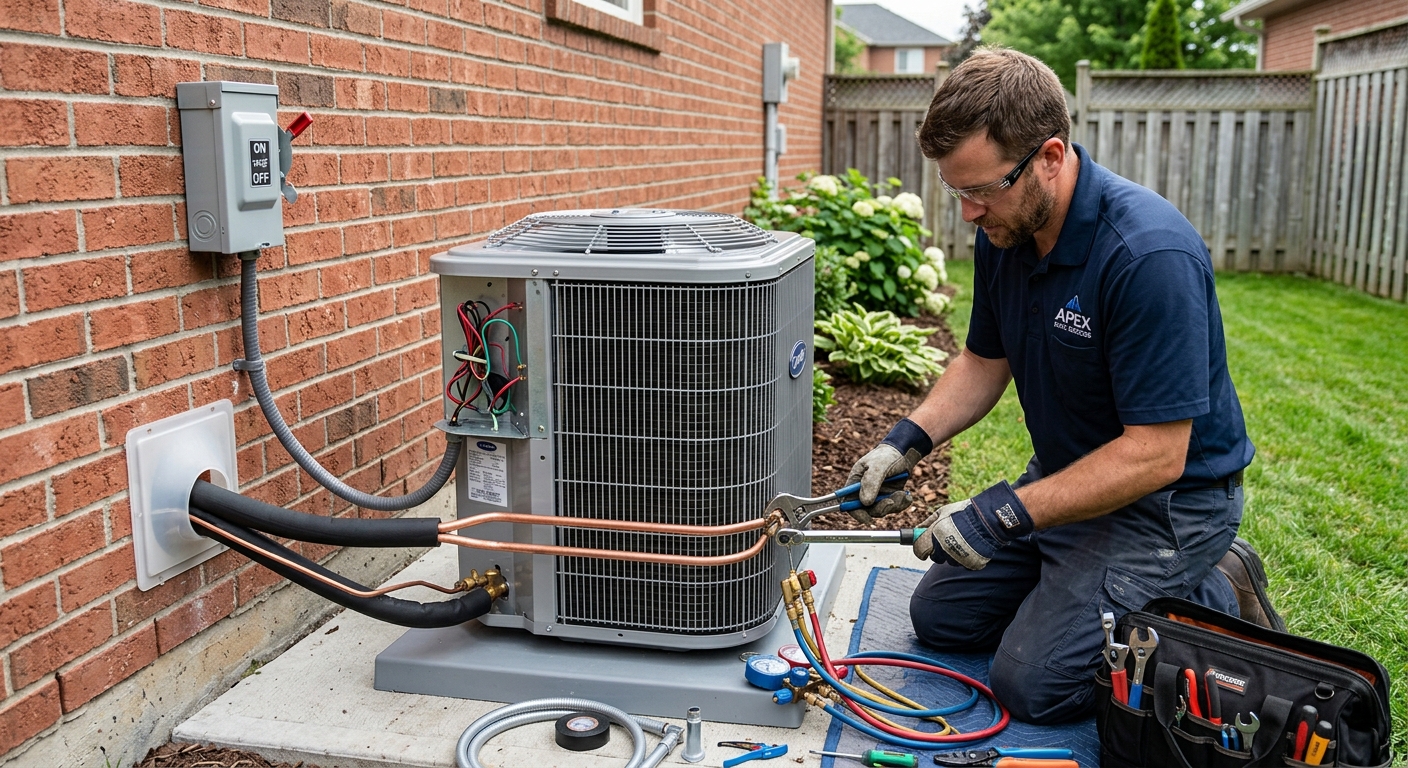
HVAC costs in Perkiomen — 2026
In Perkiomen, most homeowners are maintaining or upgrading existing central HVAC systems rather than installing them for the first time. With an 88.4% homeownership rate and over a third of homes built before 1980 (U.S. Census Bureau, ACS 2024), this is a mature retrofit and replacement market. Many homes—especially in the surrounding post-war suburbs—already have some form of ductwork, but the quality and capacity often lag behind current standards for efficiency and comfort, so duct upgrades are common when new equipment is installed.
The climate shapes both equipment selection and sizing. With approximately 4,800 heating degree days and 1,450 cooling degree days, Perkiomen is a heating-dominated area with humid summers. That means winter performance matters most, but cooling reliability and efficiency still matter for July and August. When weighing an upgrade, expect recommendations to default toward heat pumps or dual-fuel if your home is all-electric or lacks natural gas, and toward gas furnaces if you have existing PECO gas service and reliable ductwork.
Here is a realistic snapshot of installed system prices in 2026:
| System |
Best for |
Efficiency |
Price range (installed) |
| Central AC replacement (existing ducts) |
homes with sound ductwork |
16–20 SEER2 |
$6,000–$14,500 |
| Air source heat pump (ducted) |
year-round heating and cooling |
8–10 HSPF2 |
$9,500–$20,000 |
| Cold-climate heat pump (ducted) |
heat pump as primary heat |
9–11 HSPF2 |
$15,500–$20,000 |
| Ductless mini-split (single zone) |
additions, rooms without ducts |
20–30 SEER2 |
$3,800–$8,300 |
| Full duct system installation |
homes with no existing ducts |
— |
$10,500–$21,500 |
Installed estimates for a typical Perkiomen home. Equipment tonnage, duct condition and electrical capacity move these more than brand.
When an HVAC repair stops being worth it
In Perkiomen, deciding between repairing your HVAC and replacing it should start with straight math and a bit of realism about system age. A well-maintained furnace or air conditioner typically lasts 15–20 years here—sometimes less with older, low-efficiency units or poor ductwork. Once you're past a decade, weigh any repair that costs more than one-third the price of replacement very carefully, especially if the system uses R-22 refrigerant (most do not, unless pre-2010) or the failure involves the compressor or heat exchanger. Efficiency gains alone rarely justify full replacement unless your utility bills are astronomical, and with 4,800 heating degree days, you won’t recoup a five-figure investment on efficiency alone unless the old system is truly failing.
There are two cases where replacement is mandatory: a cracked heat exchanger in a furnace, which poses a deadly carbon monoxide risk, and a compressor failure on an older (out-of-warranty) heat pump or AC. In both, a patch job is false economy. For everything else—especially if your system is under 10 years old and using R-410A—repair is often the right (and most economical) call. If your bills are high with a working system, duct leakage or insulation is usually the first place to look before replacing major equipment.
| Situation |
Recommendation |
Typical cost |
Reasoning |
| Under 10 years, single component failure |
Repair |
$300–$1,200 |
Equipment has remaining life; repairs are cost-effective. |
| 10–15 years, repair over a third of replacement |
Consider replacing |
$6,000–$14,500 |
Approaching end of serviceable life; expensive repairs unlikely to pay off. |
| 15+ years, any major failure |
Replace |
$6,000–$14,500 |
New system will outlast a costly repair on aged equipment. |
| Cracked heat exchanger, any age |
Replace immediately |
$6,000–$14,500 |
CO risk—cannot be safely repaired. |
| Compressor failure past warranty |
Replace |
$9,500–$20,000 |
Compressor is the heart of the system; high repair cost plus old age. |
| Working system, high bills |
Test ducts and envelope first |
$300–$800 |
Wasted energy usually comes from leaks and insulation, not the equipment. |
Heat pump or furnace: what makes sense in Perkiomen
Perkiomen’s winter design temperature is 14°F, and with 4,800 heating degree days, we are clearly in a heating-dominated climate. That used to mean furnaces by default, but modern cold-climate heat pumps retain usable capacity down into the teens. The lingering myth that heat pumps “don’t work” here is now out of date, though performance still drops as temperatures plummet—underscoring why dual-fuel (heat pump with gas backup) is sometimes the most efficient middle ground.
If your house has reliable PECO natural gas service, a gas furnace and central AC or a dual fuel (hybrid) setup will still be the simplest, especially where deep cold spells push heat pumps to their limits. In the outer townships or areas without gas lines, the choice shifts: heat pumps outperform oil or propane furnaces on comfort and efficiency, with much steadier annual costs (and no fuel deliveries). The only clear case for a furnace is an uninsulated or drafty house with dependable gas service and no budget or plan to improve the building envelope; here, the raw heat output of a furnace is unmatched during arctic snaps.
| Option |
Installed cost |
Operating cost here |
Best when |
Incentive eligible |
| Gas furnace + central AC |
$6,000–$14,500 |
$1,200–$1,800/yr |
existing gas service, coldest zones |
some programs |
| Ducted heat pump (cold climate) |
$9,500–$20,000 |
$1,600–$2,300/yr |
good envelope, all-electric goal |
yes |
| Dual fuel (heat pump + gas backup) |
$15,500–$20,000 |
$1,300–$2,000/yr |
gas on site, deep cold spells |
yes |
| Ductless multi-zone |
$10,500–$21,500 |
$1,600–$2,600/yr |
no ductwork, zone control |
yes |
Comparing HVAC estimates in Perkiomen
An HVAC estimate is only as good as the detail it contains. In Perkiomen, genuine apples-to-apples comparisons depend on getting actual model numbers for both the indoor and outdoor units—otherwise you're comparing guesses. Confirm the quoted tonnage aligns with a load calculation matched to your home’s size, insulation, and windows, not just what was there before. Good estimates will spell out whether the refrigerant line set is being replaced or reused; old line sets can leak or limit new system performance. If a panel upgrade or electrical work is required, that must show up on the quote. Look for condensate drainage details, thermostat included or not, permit costs, and a copy of the final commissioning checklist with actual measurements of airflow and refrigerant charge. Warranty terms should split equipment and labor. If a quote just has a brand and price, it tells you almost nothing about what you’re paying for.
| Line item |
What to look for |
Red flag if… |
| Equipment |
model numbers, indoor and outdoor matched |
brand name only |
| Sizing |
load calculation attached |
matched to the old nameplate |
| Ductwork |
condition assessed, sealing scoped |
not mentioned |
| Electrical |
circuit and panel capacity confirmed |
assumed adequate |
| Line set |
replaced or documented as reused |
silent |
| Commissioning |
measured airflow and charge, documented |
no startup report |
| Warranty |
labour years stated separately |
manufacturer only |
| Permit |
included and priced |
'not needed' |
Separating installers from equipment sellers
In Perkiomen, the truth is that the same model HVAC system can perform beautifully or poorly depending entirely on who installs it. A premium brand installed badly will disappoint—and the local market is dense enough that you’re likely to encounter both sharp specialists and pure equipment sellers. Always check for current Home Improvement Contractor (HIC) registration for all jobs over $500, and for EPA Section 608 certification for anyone handling refrigerant. If a company cannot give you a model number for the equipment and attach a load calculation, you’re not getting a professional job. Look for proof of measured commissioning (airflow and charge) and a site assessment that includes ducts, electrical, and condensate handling.
- Verify HIC registration at hic.attorneygeneral.gov before signing anything.
- Ask for the technician’s EPA Section 608 card for refrigerant work.
- Insist on a load calculation documented for your home.
- Get model numbers for all equipment pieces—both indoor and outdoor units.
- Confirm line set and ductwork plans in writing.
- Check if the estimate includes mechanical permit(s) and what’s entailed.
- Require a written contract for all work over $500 (Pennsylvania law).
- Demand a commissioning report with measured airflow and charge.
- Ask for warranty terms that specify both equipment and labor coverage.
- Request documentation of workers’ compensation insurance, confirmable via WCAIS.
- See if indoor air quality and humidity control are considered (not an up-sell, but as needed).
- Never accept a price-only, brand-only proposal—insist on itemization.
Given the crowded Greater Philadelphia HVAC market, rushed or unlicensed bids are common. If someone pushes you to sign “today only,” claims permits aren’t needed for major work, or won’t show credentials, walk away—there are plenty of real professionals in Montgomery County.
Refrigerant rules and your existing system
If your Perkiomen HVAC system uses R-410A, service is still available and will remain so for years. The difference in 2026 is new installations are shifting to lower-GWP refrigerants like R-454B and R-32, because of the industry-wide phase-down of high-GWP HFCs. That’s good for the environment, but for homeowners, the main effect is economic: R-410A refrigerant is gradually getting more expensive because supply is intentionally dropping. Routine service—like refrigerant top-up for a minor leak—will cost more as the price rises, especially on older, leak-prone systems. This tightens the case for replacement if significant repairs or recharging is ever needed, but does not make any R-410A system suddenly obsolete or illegal.
There is no mandate to swap out a working system. The lead time is years; parts and refrigerant remain available, but you should factor potential future costs into any major repair decision. For new installs, expect almost all contractors in Perkiomen to propose compliant refrigerants by default in 2026. If your system is ten years old and low on refrigerant, weigh the replacement cost more seriously—otherwise, keep it maintained and only upgrade when age, reliability, or repair cost genuinely call for it.
What a Pennsylvania HVAC contractor must hold
Pennsylvania does not issue a statewide HVAC contractor license for residential work; regulation is handled locally by each municipality. In Perkiomen and all of Montgomery County, the Home Improvement Contractor (HIC) registration, issued by the Office of Attorney General, is required for any residential contract exceeding $500. Every company and salesperson must provide their HIC number, which you should verify directly. Mechanical permits are issued and inspected by the local township code enforcement office—never by the state itself for a homeowner’s HVAC job.
Every technician who handles refrigerant must have federal EPA Section 608 certification, regardless of any local rules. Legitimate contractors will also provide proof of workers' compensation insurance if they have employees (always verify using the state’s WCAIS online system). Major work, like adding or replacing HVAC equipment with new electrical or mechanical connections, requires permitting and municipal inspection. Finally, Pennsylvania’s Home Improvement Consumer Protection Act means a written contract and a three-day right to cancel are your legal rights on jobs over $500—and anyone waiving your homeowner’s deductible is breaking the law.
Frequently asked questions — HVAC installation in Perkiomen
How is a tax credit different from a rebate?
In Perkiomen, a tax credit is an amount you claim on your federal or state tax return to directly reduce your tax liability—if you owe $2,000 in tax and get a $1,000 credit, you pay only $1,000. A rebate, on the other hand, is money sent directly to you or applied as a discount by your installer or utility, often much sooner than any tax benefit. Both are common on efficient HVAC systems: for example, a cold-climate heat pump at $15,500–$20,000 installed may unlock both a federal tax credit and a PECO rebate. Credits lower next spring’s tax bill; rebates put cash back in your pocket within weeks or months of installation. Neither is automatic—both require paperwork, but a reputable contractor in Montgomery County will supply documentation to maximize your total benefit.
What does a heat pump cost installed in Perkiomen?
Installed cost for a ducted air source heat pump in Perkiomen typically ranges from $9,500–$20,000, with the main differences due to system size, efficiency rating, ductwork upgrades, and whether cold-climate equipment is specified. If your house never had central AC or the ducts are marginal, a full installation (including new ductwork) can land at the upper end of that range—and for single-zone ductless (mini-split) systems, expect around $3,800–$8,300 per zone. Quotes will vary based on your home's age and electrical setup, but most homes in this area, especially those built before 1980, will see line-item costs for duct improvements, not just equipment. It’s smart to ask what upgrades are included before comparing estimates so you know what you’re getting.
What is commissioning and why does it matter?
Commissioning is the final quality check when your new HVAC system in Perkiomen is started up. A proper commissioning includes measuring airflow, verifying refrigerant charge, checking duct leakage, and making sure the thermostat and safety devices are set correctly. Why does it matter? The most efficient equipment—whether it costs $6,000–$14,500 or $15,500–$20,000—won’t deliver its rated performance if it’s not dialed in for your house. Sloppy startups mean short-cycling, uneven temperatures, high bills, and sometimes early failure. Demand a commissioning report as part of your contract; it’s evidence the installer did more than just set and forget. In crowded Montgomery County, asking for these numbers is what separates real pros from “box changers.”
What does HSPF2 measure?
HSPF2 stands for Heating Seasonal Performance Factor 2, the latest standard metric for a heat pump’s averaged heating efficiency over a typical winter in climates like southeastern Pennsylvania. It represents how much useful heat (in BTUs) a system produces per watt-hour of electricity used across the season. For our region, where winter temperatures can touch 14°F and heating is the main load, a higher HSPF2 means real savings. Modern ducted heat pumps in Perkiomen often score between 8–11 HSPF2. When comparing systems costing $9,500–$20,000, look for both the SEER2 (cooling) and HSPF2 (heating) numbers—they’re not interchangeable. Remember, HSPF2 is measured under typical U.S. conditions, and systems with higher ratings are generally more efficient (and more expensive upfront).
Why are my Perkiomen energy bills high with a new system?
High bills in a Perkiomen home, even with a new HVAC system, are usually caused by air leaks or poorly sealed ducts—the legacy of postwar and 1970s construction here in Montgomery County. Equipment efficiency matters, but if your ducts leak or insulation is thin, no system (even a $15,500–$20,000 cold-climate heat pump) will solve the problem alone. Another common culprit is improper commissioning: if airflow or refrigerant charge are off, the system works much harder than necessary. Have your installer run a duct leakage test—costing around $300–$800—and address insulation gaps in attics or crawlspaces first. A careful look at the full HVAC envelope almost always yields more savings than just swapping out equipment.
How much does a furnace replacement cost in Perkiomen?
Replacing a gas furnace (with or without central AC) in Perkiomen generally falls in the $6,000–$14,500 range, with the middle of that band being most typical for straightforward swaps using existing ductwork in good shape. Costs climb toward the upper end when significant duct, vent, or electrical upgrades are needed—especially in homes built before 1980, where original ducts are often undersized for today’s higher-performance systems. Factor in permit fees and a written contract (required in Pennsylvania for jobs over $500), but be skeptical of any quote that comes in far below that range; the difference is almost always corners cut on equipment, installation, or code compliance.
Who inspects HVAC work in Perkiomen?
In Perkiomen and the rest of Montgomery County, HVAC installations and replacements are inspected by your local township or borough code enforcement office—not by the state. If your job involves new electrical or mechanical connections, a building or mechanical permit with final municipal inspection is required. The local code official checks for compliance with the Pennsylvania Uniform Construction Code (UCC), making sure installations are safe, properly sized, and meet all ventilation and combustion standards. For day-to-day service—like changing a filter or swapping a thermostat battery—no inspection is required, but anything above that triggers oversight. Always insist that your contractor’s quote includes permit fees (usually built into jobs from $6,000–$14,500 upward) and the scheduling of inspector walk-throughs. It protects your investment and ensures your warranty is valid.
How does southeastern Pennsylvania's climate affect system sizing?
With 4,800 heating degree days and steamy, humid summers, Montgomery County homes need systems sized for both reliable winter heat and strong summer dehumidification. Oversized systems short-cycle and leave indoor air clammy; undersized ones struggle in January cold snaps or July heat waves. Sizing must be based on a load calculation matched to your home's insulation, age, and window quality—not just square footage or old equipment nameplates. In Perkiomen, this often reveals original equipment was too large or small (especially in homes built pre-1980). Load calculation is essential for any install in the $9,500–$20,000 or $6,000–$14,500 bands, and ensures you get comfort and efficiency, not just capacity.
Is a heat pump a good choice for Perkiomen winters?
Yes—modern cold-climate heat pumps are well-matched to Perkiomen’s winter temperatures (as low as 14°F at design) and will keep most well-insulated homes consistently warm. Advances in inverter technology and improved capacity at low temperatures mean most homes can run all-electric without a backup furnace. However, the key is sizing: an undersized unit will struggle, while oversizing can hurt efficiency. Where natural gas is not available, or to avoid fluctuating fuel costs, a heat pump in the $9,500–$20,000 range is generally the best value. For the coldest, draftiest homes, or in case of frequent deep-freeze events, consider a dual-fuel system or targeted weatherization improvements along with your new heat pump.