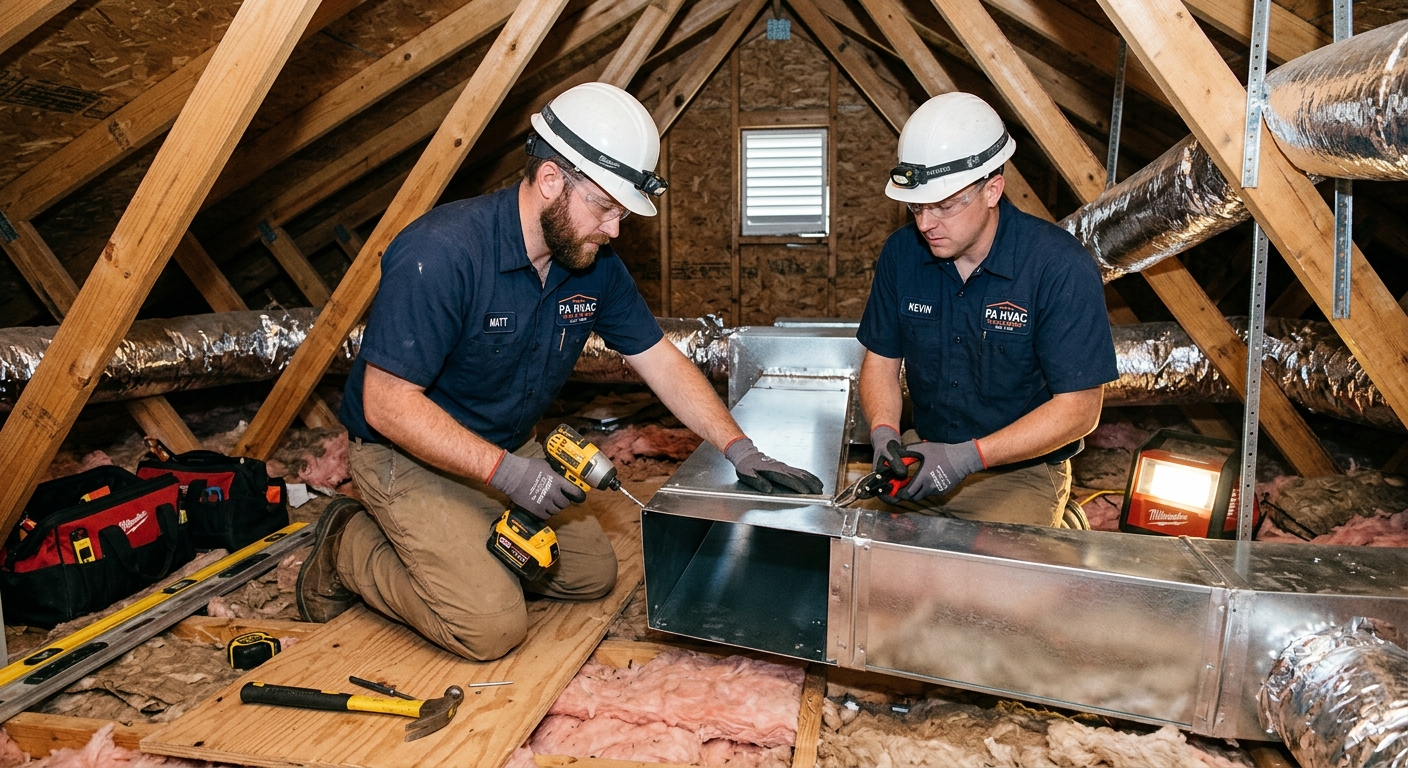
What a new HVAC system costs in Pittston
If you’re in Pittston and thinking about a new HVAC system, you’re dealing with a market shaped by older homes and a blend of ownership and rental. Just under half of all Pittston homes are owner-occupied (48.9%), and a full 85.2% were built before 1980 (U.S. Census Bureau, ACS 2024). This means most HVAC projects here are replacements or retrofits—often swapping out old boilers and radiators for forced air systems, especially in the many 1900–1940 coal-era houses throughout Luzerne County. Ductwork may or may not be present, and what exists often wasn’t designed for modern cooling loads.
Pittston’s weather is all about winter: the region sees 6,100 heating degree days versus just 850 for cooling, so you need reliable and efficient heat more than you need peak AC muscle. It’s common to upgrade or supplement heating alongside your cooling system, with heat pumps gaining traction as all-in-one solutions. If you own one of the region’s older homes, brace for possible ductwork upgrades or even a full new duct system if you want central AC or a ducted heat pump.
| System |
Best for |
Efficiency |
Price range (installed) |
| Central AC replacement (existing ducts) |
homes with sound ductwork |
16–20 SEER2 |
$4,400–$10,500 |
| Air source heat pump (ducted) |
year-round heating and cooling |
8–10 HSPF2 |
$7,000–$15,000 |
| Cold-climate heat pump (ducted) |
heat pump as primary heat |
9–11 HSPF2 |
$11,500–$15,000 |
| Ductless mini-split (single zone) |
additions, rooms without ducts |
20–30 SEER2 |
$2,800–$6,100 |
| Full duct system installation |
homes with no existing ducts |
— |
$7,800–$15,500 |
Installed estimates for a typical Pittston home. Equipment tonnage, duct condition and electrical capacity move these more than brand.
Reducing the net cost of a Pittston installation
When you’re weighing the up-front cost of a new HVAC system in Pittston, be sure to look beyond the sticker price. There are three typical ways to bring the net cost down: federal tax credits, local utility rebates, and sometimes state-level programs. Tax credits—like those available for qualifying high-efficiency heat pumps and central AC—lower your income tax bill on your next return. Rebates, on the other hand, come from your utility and knock money off your invoice or show up as a direct payment. In Pittston and across Luzerne County, your electric service is usually through PPL Electric Utilities, and most homes in the urban core also have natural gas from UGI Utilities. Both regular change their incentive and rebate offers—sometimes annually.
There is no one-size-fits-all rebate or credit, and the best source for up-to-date information is your utility’s own energy savings or efficiency program web page. You should also search the ENERGY STAR rebate finder online to see what’s currently available for your postcode. Don’t make decisions based on rebate figures you see in articles—rebate names, eligibility, and amounts change, and the best number is the one you confirm yourself during your project. Check early, as you may need to use a participating contractor or pre-apply before installation. If you have questions, both PPL and UGI post detailed guides and have customer helplines. Tax credits will only pay you back after the next tax year, so factor that into your cash flow.
Separating installers from equipment sellers
In Pittston’s crowded HVAC market, installation quality is far more important than which brand of equipment you choose. Two homes may have identical systems, but poor installation on one will wipe out savings and comfort. Luzerne County has a lot of contractors thanks to a saturated market around Wilkes-Barre and Hazleton. Always check the Pennsylvania Office of Attorney General’s Home Improvement Contractor (HIC) registration before signing anything over $500—use hic.attorneygeneral.gov to verify. For any system using refrigerant, ensure the actual installer, not just the business owner, has EPA Section 608 certification. Ask if a proper load calculation is part of your quote, not just a “rule of thumb” guess. The contract should include model numbers for all major equipment, not just the tonnage, and spell out commissioning steps: airflow and refrigerant charge should be measured and documented at startup.
- Home Improvement Contractor (HIC) registration is up-to-date and shown on the quote.
- EPA Section 608 certified installer will be working on your job.
- Written contract before work begins, as required by law if over $500.
- Load calculation included, using your actual house measurements.
- Model numbers for both indoor and outdoor equipment on the quote.
- Detailed scope for ductwork—repair, sealing, or replacement listed if needed.
- Permits included in bid (required for central systems in Wilkes-Barre).
- Commissioning report provided at startup—airflow & refrigerant charge measured.
- Insurance and workers’ compensation proof available on request.
- Warranty details for labor and equipment stated separately.
- No pressure to waive your insurance deductible (that’s prohibited).
- References with projects similar to your home’s era and system type.
If a contractor’s pitch is all about speed, discounts, or “premium brands,” but skips these basics, that’s a red flag—especially with so many HVAC outfits chasing business in the Pittston area.
Comparing HVAC estimates in Pittston
To make a fair comparison between HVAC estimates in Pittston, you’ll need more detail than just a brand name and a dollar figure. First, insist on model numbers for both the indoor and outdoor units—mixing and matching can tank efficiency and void some warranties. Each quote should also include system tonnage (size) along with the attached load calculation so you know it’s the right fit for your home. Find out whether the line set (the tubing that carries refrigerant) will be replaced and if so, why; reusing is an option only if it’s clean, corrosion-free, and properly sized. Electrical work is a big deal, especially for all-electric conversions—if you need a panel upgrade, it should be noted up front. Look for condensate drainage plans, details on the thermostat provided, and clear mention of mechanical permits (these are required for central systems in Wilkes-Barre). Finally, make sure labor and equipment warranties are listed separately—if you ever need service, that distinction matters.
| Line item |
What to look for |
Red flag if… |
| Equipment |
model numbers, indoor and outdoor matched |
brand name only |
| Sizing |
load calculation attached |
matched to the old nameplate |
| Ductwork |
condition assessed, sealing scoped |
not mentioned |
| Electrical |
circuit and panel capacity confirmed |
assumed adequate |
| Line set |
replaced or documented as reused |
silent |
| Commissioning |
measured airflow and charge, documented |
no startup report |
| Warranty |
labour years stated separately |
manufacturer only |
| Permit |
included and priced |
'not needed' |
Reading the yellow label
The yellow label on a new HVAC system tells you its efficiency, typically in SEER2 (cooling) and HSPF2 (heating, for heat pumps). SEER2 (Seasonal Energy Efficiency Ratio 2) gauges how many BTUs of cooling output you get per watt-hour; higher SEER2 numbers mean more efficient central AC or mini-splits. HSPF2 (Heating Seasonal Performance Factor 2) is the same idea for heating—how much heat you get per energy consumed across a season. These “2” numbers just reflect updated government test standards and are a bit lower than the older SEER/HSPF ratings you might see in dated articles.
Here in Luzerne County, with 6,100 heating degree days versus 850 for cooling, it’s clear that efficient heating pays back more over time than ultra-high cooling efficiency. For Pittston, that means you don’t get “extra back” by chasing SEER2 numbers above about 18–20, unless you run AC as much as a home in the Deep South. But when shopping for heat pumps, higher HSPF2—think 9 or better—really can impact your long-term bills, especially as more homes switch from oil and old furnaces. For an average household in Pittston, don’t spend for the very highest SEER2; prioritize HSPF2 or AFUE for heating, and understand that new federal labels mean you should only compare recent numbers to recent numbers.
Retrofit versus replacement in Pittston
Pittston’s housing stock is overwhelmingly pre-1980—over 85% of homes fall into this category—so owners often face different problems than you’d see in a newer suburb. Many of these older Luzerne County houses were built for coal boilers or furnaces, not central AC. Ducts may have been retrofitted decades ago and are sometimes undersized or poorly sealed, especially if added for air conditioning well after original construction. If your home still uses hydronic heat (baseboards or radiators) and you’re adding a forced-air system, expect to budget for full duct installation ($7,800–$15,500).
Insulation and window quality are another issue: older homes often leak heat, and new HVAC can’t fix that. Electrical panels may not have the amperage for an all-electric system, and many Pittston homes will need a panel upgrade to run a heat pump or modern central AC. For gas furnaces, the existing chimney or flue should be inspected to meet code and safety. If you’re one of the few with 1990s or 2000s builder-grade forced air systems, those are now at end of life, and sizing may be oversized for today’s higher insulation standards. It’s vital to get a contractor who understands these quirks and doesn’t take ductwork or panel upgrades for granted.
Permits, licensing and inspections in Pittston
Pennsylvania does not issue a statewide HVAC trade license for residential contractors. The credential required for HVAC installation in Pittston and across Luzerne County is Home Improvement Contractor (HIC) registration for all contracts over $500, issued by the Pennsylvania Office of Attorney General. You can verify a registration at hic.attorneygeneral.gov. Mechanical permits are required for new central HVAC systems and most replacements in Wilkes-Barre, which handles its own codes and inspections—check with your local municipality if you are outside city limits, as some towns opt out and rely on state inspectors.
EPA Section 608 certification is a federal requirement for anyone handling refrigerants, so always ask to see proof that the technician working on your Pittston home is certified—this isn’t just for the company, but for the actual installer. If you’re hiring a crew, workers’ compensation is mandatory for employees in Pennsylvania, and you can look up a contractor’s coverage status through WCAIS (wcais.pa.gov). For insurance, always ask for a certificate before work begins. Pennsylvania’s Home Improvement Consumer Protection Act also requires a written contract with a 3-business day right of cancellation, and it is illegal for a contractor to offer to waive your homeowners insurance deductible. No specific HVAC license or board is involved—permits, proper insurance, and verifiable certifications are what matter most here.
Frequently asked questions — HVAC installation in Pittston
Can I service my R-410A system after the refrigerant change?
Yes, you can still have your R-410A air conditioning or heat pump system serviced in Pittston and throughout Pennsylvania, even though new systems may switch to different refrigerants in the coming years. Technicians with EPA Section 608 certification (required everywhere in the U.S.) are trained to handle R-410A safely and can recharge or repair your existing system as needed. Local supply houses in Luzerne County continue to stock R-410A, so you won't be forced to replace your unit just because of the new regulations. However, as the market shifts, expect prices for R-410A refrigerant to go up slightly. If your system is over 12 years old and a major repair will cost more than half of a new installation—say, $4,400–$10,500 for a central AC replacement—it’s smart to weigh replacement instead of spending big money on an old unit. Otherwise, keep yours running as long as possible, since new refrigerants require new equipment.
Is a high-efficiency system worth the extra cost here?
In Pittston, a heating-dominated climate with 6,100 heating degree days, you’ll get a better long-term payoff from investing in heating efficiency than stretching for extremely high cooling efficiency. Upgrading to a central AC or heat pump above 18 SEER2 is rarely worth the extra cost in Luzerne County, where the cooling season is short (just 850 cooling degree days). But if you’re considering a ducted heat pump, targeting a higher HSPF2—around 9 or better—is worthwhile, especially as electricity replaces more oil and old natural gas systems in Pittston. For most homes, a heat pump replacement falls in the $7,000–$15,000 range. Make sure you’re not upsold on “premium” AC numbers that won’t earn back the premium in reduced bills. Spend where it actually matters for Pittston's long winters: on efficient heat delivery and a solid install.
What HVAC tax credits are available to Pittston homeowners?
Pittston homeowners have access to federal tax credits for qualifying high-efficiency heat pumps, central air conditioners, and other improvements. These credits reduce the income tax you owe for the year after your installation—unlike a utility rebate, which lowers your out-of-pocket cost up front. To maximize available credits, make sure your qualifying equipment is properly documented by your contractor, and keep all receipts. The actual amount of these credits, and which equipment types qualify, changes every year, so do not rely solely on outdated articles or news stories. In addition to federal credits, check the efficiency rebate pages for your local utilities—PPL Electric and UGI Utilities in most of Luzerne County—and confirm any offers using the ENERGY STAR rebate finder. For example, a heat pump in the $7,000–$15,000 range may get you both a tax credit and a local rebate. Always verify before you buy.
How much does a new HVAC system cost in Pittston?
A new HVAC system in Pittston will cost you anywhere from $4,400–$15,500 in 2026, depending on what your home needs. If you already have solid ductwork and are replacing just the central AC, plan on $4,400–$10,500. Ducted heat pumps, which offer efficient heating and cooling, run $7,000–$15,000, while a full new duct system (if you have an old boiler or baseboards and no ducts at all) adds significantly, costing $7,800–$15,500. Ductless mini-splits for single rooms or additions start at $2,800–$6,100. The biggest cost movers are duct condition, equipment size (tonnage), and whether your electric panel needs upgrading to handle new demand. No brand or features can avoid those basics. Get detailed estimates and always compare what's included.
How often should I change my filter?
For most Pittston households using central forced-air HVAC, you should check your filter every month and change it at least every 2–3 months—or more often during heavy heating use, which is most of the year in Luzerne County. Older homes, which make up most of the Pittston market, often leak more dust due to original windows and gaps. If you’ve recently had ductwork added or your home is seeing more traffic (renovations, pets, open windows), a dirty filter can clog even faster. Not changing your filter is the leading cause of short cycling, restricted airflow, and unexpected service calls that can easily add up, especially with parts and labor costs increasing. For reference, a preventable blower failure could lead you into the $2,800–$6,100 range of repairs or replacement. A clean filter is cheap insurance.
Is a heat pump a good choice for Pittston winters?
Heat pumps are increasingly popular in Pittston and the rest of Luzerne County thanks to new cold-climate models. With winter design temperatures around 4°F and 6,100 heating degree days, you need a system matched to tough Northeast Pennsylvania winters. Modern cold-climate ducted heat pumps—expect to pay $11,500–$15,000 installed—can handle the majority of your heating load without a backup in well-insulated homes. For draftier older houses, your contractor may recommend a dual-fuel setup or keep the old boiler for backup. Electricity from PPL Electric is widely available, so fuel switching is possible in most areas. If your current oil or propane bills are high, or you’re planning to add central AC, a heat pump is worth considering as long as your insulation and ductwork are up to par.
How do I verify an HVAC contractor's insurance?
In Pittston and throughout Pennsylvania, any legitimate HVAC contractor should readily provide a certificate of insurance upon request before starting your project. For workers’ compensation, you can confirm a contractor’s policy is active by searching the WCAIS system at wcais.pa.gov. This matters when equipment installations, usually running from $4,400–$15,500, involve crews and ladders—your own homeowners insurance should never be the fallback for injuries. Proof of insurance is part of your consumer rights under Pennsylvania law, and reputable contractors are used to customers asking. Combine this with verification of Home Improvement Contractor (HIC) registration (hic.attorneygeneral.gov). Don’t be shy about requesting written proof; those who evade or change the subject are ones to avoid.
Do older Pittston homes need ductwork replaced?
Many Pittston homes built before 1980—over 85% of the local stock—have either no central ductwork or old ducts added much later, sometimes undersized or leaky. If you’re converting from an old boiler or adding central AC for the first time, you’ll most likely need new ducts, especially to get modern comfort and efficiency. Expect a full duct system to run $7,800–$15,500. Even if your home has existing ducts, a good contractor will inspect for leaks, poor sizing, and airflow issues. In some cases, cleaning and sealing may be enough, but never spend thousands on new equipment without checking the “bones” first—good airflow matters as much as the equipment brand, especially in old Luzerne County houses.
How far ahead should I schedule in Pittston?
Pittston sits in one of the most competitive HVAC contractor markets in the state (part of the Scranton–Wilkes-Barre metro), but the surge times—spring and late summer—still book out fast, especially for larger jobs. If you need a full duct installation ($7,800–$15,500) or are planning a major conversion from an old boiler, start contacting contractors 6–8 weeks in advance to lock in permits and inspections. For more routine replacements, 2–4 weeks is usually enough, but don’t wait for a total breakdown during a cold snap. Last-minute installs may cost more and you won’t get your pick of reputable crews. Ask contractors about their lead times up front; good ones will tell you honestly, and those with tomorrow’s availability in peak season may have a reason why they’re wide open.