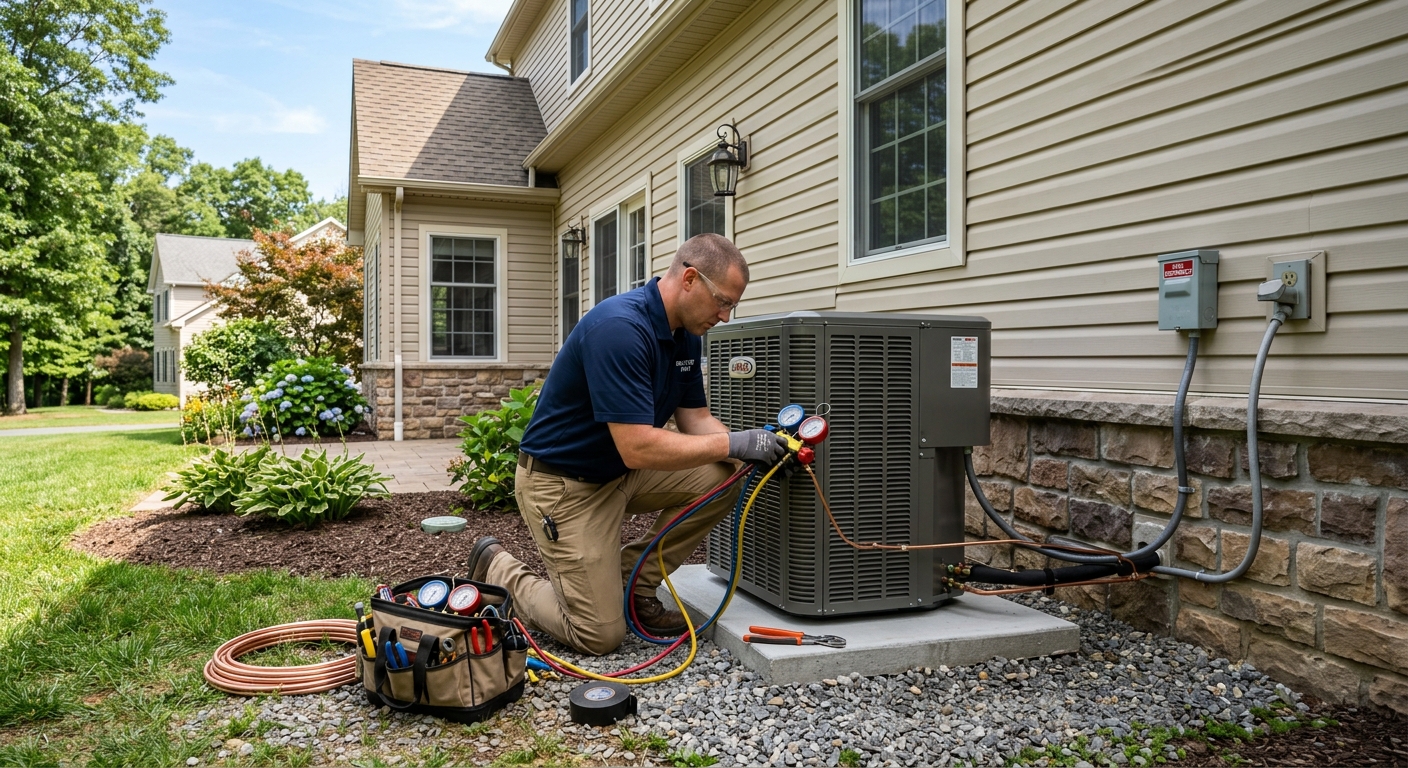
What a new HVAC system costs in Pottsville
In Pottsville, where 90.7% of homes were built before 1980 and just over half of residents own their homes (U.S. Census Bureau, ACS 2024), most HVAC projects involve replacing outdated equipment in older houses rather than simple first-time installs. Many of these pre-1940 coal-region homes have unusual layouts or original structures, so even if you have central air, expect that custom ductwork, patching, or rerouting of condensate lines may be needed. The housing stock’s age means it’s common to find existing ducts in rough shape or sized for different types of systems, making a direct equipment swap rare.
Pottsville’s climate leans heavily on heating: the area sees 6,100 heating degree days against only 850 cooling degree days. This shapes most HVAC decisions—heat pumps and high-efficiency furnaces tend to deliver more year-round value than ultra-high-efficiency air conditioners. If your ducts are sound, replacing central AC or moving to a heat pump can be straightforward, but many local homes require full ductwork or opt for ductless mini-splits, especially in additions or rooms never reached by original systems.
| System |
Best for |
Efficiency |
Price range (installed) |
| Central AC replacement (existing ducts) |
homes with sound ductwork |
16–20 SEER2 |
$4,400–$10,500 |
| Air source heat pump (ducted) |
year-round heating and cooling |
8–10 HSPF2 |
$7,000–$15,000 |
| Cold-climate heat pump (ducted) |
heat pump as primary heat |
9–11 HSPF2 |
$11,500–$15,000 |
| Ductless mini-split (single zone) |
additions, rooms without ducts |
20–30 SEER2 |
$2,800–$6,100 |
| Full duct system installation |
homes with no existing ducts |
— |
$7,900–$15,500 |
Installed estimates for a typical Pottsville home. Equipment tonnage, duct condition and electrical capacity move these more than brand.
SEER2, HSPF2 and AFUE decoded
SEER2 (Seasonal Energy Efficiency Ratio 2) rates air conditioner and heat pump cooling efficiency. HSPF2 (Heating Seasonal Performance Factor 2) tells you how efficiently a heat pump provides heat. AFUE (Annual Fuel Utilization Efficiency) applies to furnaces, measuring how much of the fuel actually turns into heat for your home. These new “2” ratings (SEER2, HSPF2) replaced the older SEER/HSPF numbers; figures found in older articles aren’t directly comparable to what’s on new yellow efficiency labels now.
In Schuylkill County, with 6,100 heating degree days per year and just 850 for cooling, heating bills add up fast, so HSPF2 and AFUE have a much bigger impact on your wallet than squeezing a couple extra SEER2 points out of your air conditioner. In Pottsville, it rarely pencils out to spend for the top-listed SEER2—most homes see excellent payback from middle-of-the-market units (16–18 SEER2). For heat pumps, an HSPF2 of 9–10 is usually the value sweet spot; above this, costs rise without much savings in most real-world homes. For furnaces, 92%–95% AFUE makes more sense than going for the absolute highest available, unless you plan to stay put for decades. It makes sense to upgrade from the low end, but spending for the highest rating—even with rebates—rarely pays off here.
Refrigerant rules and your existing system
If your Pottsville home’s existing system uses R-410A, you’re not required or forced to replace it. New rules now require that all newly manufactured systems use refrigerants with a lower global warming potential, such as R-454B or R-32. These new refrigerants don’t mix with the old: replacement means entirely new equipment, not just a “recharge.”
For homeowners with a working R-410A system, nothing becomes illegal or unserviceable. Licensed techs can still repair and recharge R-410A units, but the cost of the refrigerant has started to climb—and will keep doing so as supplies get tighter. This affects decisions on older units: if a compressor or coil develops a major leak, repair costs plus expensive refrigerant start nudging you toward replacement ahead of a full system breakdown. If your system is cooling fine and isn’t leaking, no rule says you must swap it; just be aware: if a major repair pops up, weigh the total cost, considering that repair with R-410A will trend up over time. The law targets future systems, not those already cooling homes in Pottsville.
Choosing an installer in Schuylkill County
In Schuylkill County, installation is everything. The same HVAC equipment performs very differently if installed poorly—brand means little if the system’s not sized, connected, and balanced for your house. Properly sited outdoor units, tight duct joins, and correct refrigerant charge outlast “big name” brands every time.
Pennsylvania doesn’t require a statewide HVAC or trade license. Instead, your contractor needs a Home Improvement Contractor (HIC) registration number, which can be verified at hic.attorneygeneral.gov for jobs over $500. Always check that the technician working with refrigerant holds a current EPA Section 608 card. A thorough installer does a Manual J load calculation, lists exact equipment model numbers (not just an AC “tonnage”), and will commission the system—meaning they’ll measure airflow and refrigerant charge at startup, and document the results.
- Verify HIC registration at hic.attorneygeneral.gov
- Confirm EPA Section 608 certification for the refrigerant tech
- Ask for proof of workers’ compensation via WCAIS
- Request a Manual J (load calculation) in the proposal
- Quote lists model numbers, not just tonnage or BTUs
- Job includes commissioning—documented airflow and charge
- References from other local jobs (ideally, similar home age)
- Written contract for work over $500 as required by law
- No waiving of homeowner’s insurance deductible (illegal)
- Roles and permits (who files them) stated clearly
- Will handle custom sheet metal if needed in pre-1940 homes
- Clear timetable, showing estimated start and finish dates
Red flag: in this thin rural contractor market, some outfits push travel charges or gloss over code requirements outside Pottsville—get all fees and responsibilities (including permits) in writing before any deposit leaves your hands.
Reducing the net cost of a Pottsville installation
Buyers in Pottsville can often tap into three main types of incentives: a federal tax credit, utility rebate, and, sometimes, state-level programs. A tax credit reduces what you owe the IRS the following year—not the check you write your installer. A rebate knocks dollars off your invoice or is mailed as a check, so it’s real money back sooner.
The electric utility for Pottsville is PPL Electric Utilities and, for natural gas, UGI Utilities. Both utilities frequently update their efficiency rebate programs. Eligibility and amounts shift every year; this is why most online articles’ rebate numbers are already out of date when you find them. Instead, check PPL Electric and UGI Utilities’ “save energy” or “rebates” pages directly, and use the ENERGY STAR rebate finder for the latest offers. Always confirm details directly with the utility or energy office before assuming anything is in place for your project.
State-level programs also change year to year, and eligibility for incentives can depend on the specific equipment model, installer requirements, and even your tax situation. Never assume you’ll get full rebates until you have confirmation in hand; treat every number in a generic article as a starting point, not a guaranteed dollar. Consult your utility and the official rebate finder before signing any contract.
Mechanical permits for HVAC work in Pottsville
Pennsylvania does not license HVAC contractors at the state level for residential work. Instead, all residential HVAC work in Pottsville falls under the Pennsylvania Uniform Construction Code (UCC), which is based on the International Residential Code. The Pottsville Bureau of Licenses and Inspections handles the local permit process, so you must comply with city—not state—requirements. For HVAC replacement or new installations, expect to need a mechanical or building permit in Pottsville; in other Schuylkill County boroughs and townships, check with your local code office as rules and permits can differ.
A Home Improvement Contractor (HIC) registration is required by law for jobs over $500—always verify at hic.attorneygeneral.gov. The technician doing refrigerant work must hold a federal EPA Section 608 certification, regardless of whether your project is a routine replacement or a new install. To check workers’ compensation status, use the WCAIS system (wcais.pa.gov), which lets you confirm insurance is current and valid for all employees on your property. None of this paperwork is optional for reputable installers, and you should always have copies or confirmation before work begins. Smaller repairs, like replacing a filter or swapping thermostat batteries, are usually done without permits in Schuylkill County.
Humidity and air quality in Pottsville homes
Pottsville’s cold-winter climate means indoor air is often dry from November through March—those 6,100 heating degree days steal moisture fast. Come summer, we see periods of high humidity, and homes with older or leaky ducts can become stuffy even with the AC running.
Right-sizing matters: if your AC is oversized for the square footage, it will cool the air before it has time to pull out enough moisture, leaving you cold but clammy. Don’t buy bigger than your load calculation says. Whole-house humidifiers help fight static and dry sinuses in winter but bring a maintenance burden: they must be cleaned regularly to avoid mold, especially on older water-fed “bypass” units. High-MERV filters do catch finer particles, but too high a rating for your blower can cut airflow and shorten equipment life; balance is better than brute force. Tightly-sealed homes—more rare in Pottsville’s old coal-region stock, but present in newer renos—sometimes need mechanical ventilation, but this is often oversold in local housing where natural leakage is the rule, not the exception.
Add-ons like “air scrubbers” and UV lamps get pitched a lot but deliver modest real-world benefit in most Pottsville homes. You rarely need more than right-size equipment, a clean filter, and occasional humidity control; spend elsewhere if budgets are tight.
Frequently asked questions — HVAC installation in Pottsville
When is the best time of year to replace HVAC in Pottsville?
For Pottsville homeowners, spring and early fall are ideal for HVAC replacement. During these milder months, demand is lower and most contractors have better schedule flexibility—which often means better pricing and less hassle if you need custom ductwork or other adjustments common in older Schuylkill County homes. In contrast, dead-of-winter furnace failures or midsummer AC emergencies may result in longer waits, rush charges, or limited options. Off-season work can also give you more time to review incentives and choose the right system—like a ducted heat pump, which typically runs $7,000–$15,000 installed. Planning ahead avoids heating or cooling gaps and can net you a much tidier installation, especially when your home requires custom solutions typical of Pottsville’s pre-1940 housing.
Do I need dual fuel in northeastern Pennsylvania?
In Pottsville’s climate, with its 6,100 annual heating degree days, dual fuel (a heat pump paired with a gas or oil furnace) can make sense—especially if your home is hard or expensive to insulate. The advantage: your system automatically uses the most efficient fuel as temperatures change, giving you a backup on the coldest 4 °F design days. For many homes—especially those inside city limits with good gas access—this offers flexibility and efficiency. Dual fuel setups carry higher upfront cost, often similar to or above a cold-climate ducted heat pump ($11,500–$15,000). For smaller or better-sealed houses, a high-efficiency furnace or standard heat pump usually does the job. Ask your installer to model your payback using actual local fuel rates before committing to dual fuel. Sometimes the added complexity isn’t worth it in all-Pottsville homes.
What is a Manual J load calculation?
A Manual J calculation is the process used to determine exactly how much heating or cooling your Pottsville home needs. It factors in square footage, window size and orientation, insulation, duct condition, and even air leakage—especially relevant in Schuylkill County’s pre-1940 housing with its quirks and drafts. Contractors running Manual J calculations avoid the common trap of just matching your old system’s size—which is often oversized in this region’s older stock. Sizing a new system by the numbers means better comfort, lower bills, and properly balanced humidity. If your quote for central AC replacement ($4,400–$10,500) or a whole new heat pump omits a Manual J, you’re getting guesswork, not engineering, and that’s a shortcut no Pottsville homeowner should accept.
What does a heat pump cost installed in Pottsville?
For most Pottsville homes, a new air source heat pump (which both heats and cools) typically falls in the $7,000–$15,000 installed price range, depending on whether you’re swapping out existing equipment or doing a full new install with new ductwork or electrical. Older homes here—especially those with no or poor ducts—can run higher for custom solutions. Cold-climate models come in at the upper end, but for most owner-occupied homes in the city, the average is around $11,500. If you just need a ductless mini-split for a sunroom or addition, single-zone units run $2,800–$6,100. Every quote should be specific to your square footage, insulation, and layout.
How long should an HVAC system last in Pottsville?
With regular maintenance, most central HVAC systems in Pottsville last 12–18 years. In the older stock of Schuylkill County, life tends toward the lower end if your system is fighting leaky ducts or high dust from original coal-region construction. Modern systems built for both heating and cooling, such as ducted heat pumps installed for $7,000–$15,000, often reach the upper part of that range if the ductwork is in good condition and filters are changed regularly. Winter’s hard use on equipment—thanks to 6,100 heating degree days—means annual inspections and cleanings are always money well spent. If your system is breaking down often, runs with noisy starts, or has repair quotes pushing half the cost of new, replacement is probably the smarter move.
Do I need ENERGY STAR equipment to qualify for incentives?
Not always. Some utility and federal rebates require ENERGY STAR–rated equipment, while others base eligibility on the efficiency rating—such as SEER2, HSPF2, or AFUE—regardless of whether the badge is on the box. In Pottsville, incentives from PPL Electric or UGI Utilities sometimes specify ENERGY STAR for their rebates; federal tax credits often stick with minimum efficiency numbers, so a high/HSPF2 heat pump (for example, $11,500–$15,000) might qualify even if it lacks ENERGY STAR branding. Always confirm with your utility and the ENERGY STAR rebate finder before making a purchase—never rely solely on what’s promised by a manufacturer or installer. Qualification rules change yearly, so check directly before you buy.
Does Pennsylvania license HVAC contractors?
Pennsylvania does not offer a statewide HVAC or mechanical license for residential projects. Instead, contractors must register as Home Improvement Contractors (HIC) with the Office of Attorney General for jobs over $500, which you can verify at hic.attorneygeneral.gov. In Pottsville, mechanical permits for installations—such as a central AC replacement at $4,400–$10,500—are enforced locally by the Pottsville Bureau of Licenses and Inspections. Additionally, any technician handling refrigerant must have a federal EPA Section 608 certification. Electrical, plumbing, and other trades may require separate municipal licensing in some Pennsylvania cities, but in Schuylkill County’s towns, verification starts with HIC registration and local permits.
Which utility serves Pottsville?
Pottsville is served by PPL Electric Utilities for electricity and UGI Utilities for natural gas. In the city and older boroughs of Schuylkill County, natural gas service is common and can make both furnace and heat pump installations more cost-effective. Outlying townships often rely on propane or fuel oil instead. This utility mix can affect both the system type you choose and what rebates or incentives you’re eligible for—for instance, a ductless mini-split installation (typically $2,800–$6,100) may have rebates specific to your electric utility. Always check with your specific utility for the best incentives available in your Pottsville zip code.
Why do HVAC quotes in Pottsville vary so much?
You’ll see price swings in Pottsville’s HVAC quotes because most homes are older, with unpredictable ductwork and unique installation obstacles not found in suburban developments. Contractors factor in custom labor, permit costs, travel to outlying areas (sometimes passing on a travel charge), and equipment quality. Material costs can also fluctuate due to changes in refrigerant pricing and supply. For example, central AC replacement may come in anywhere from $4,400–$10,500, driven mostly by duct condition, electrical upgrades, house size, and whether equipment needs to be brought up narrow Yorkville stairways or retrofitted to century-old framing. Always get detailed, apples-to-apples bids—model numbers, scope, and all fees broken down—before making a decision.