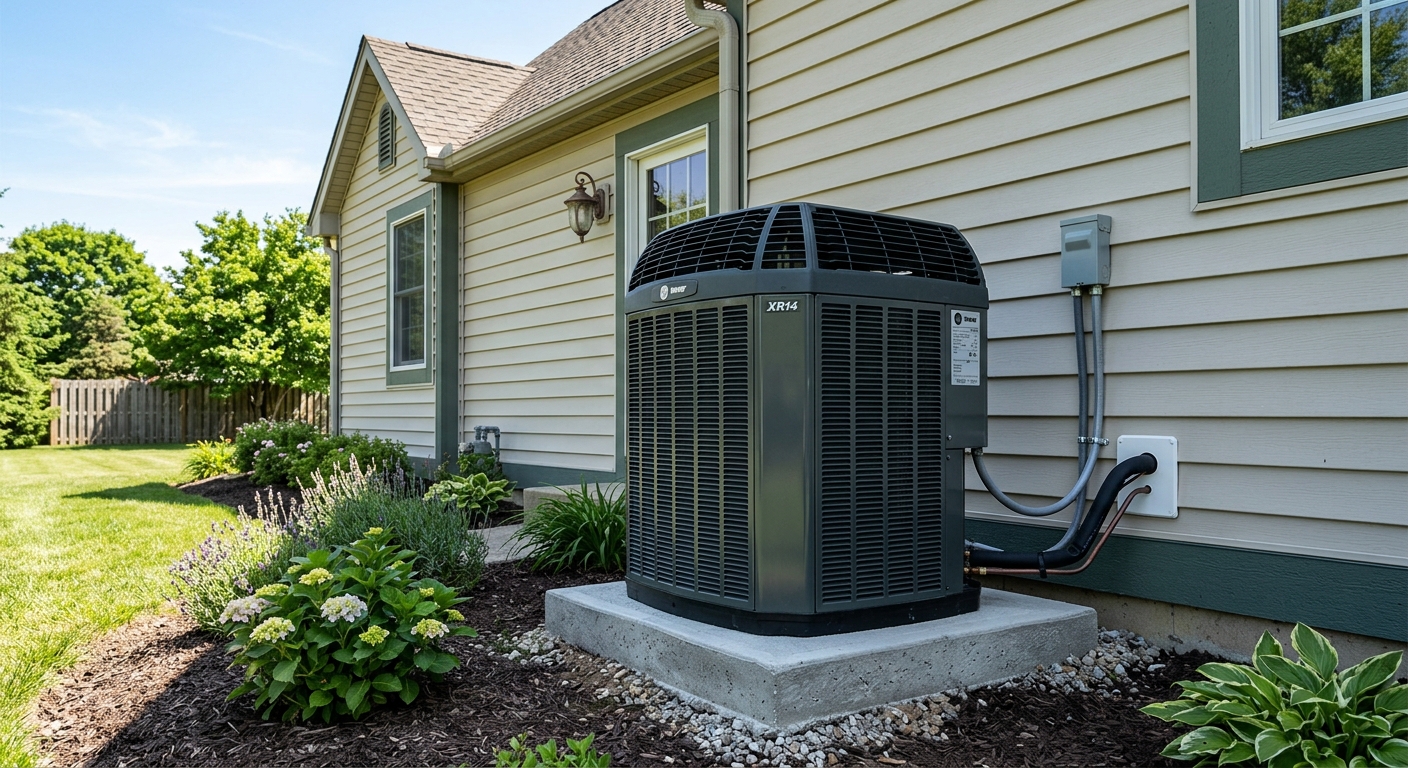
What a new HVAC system costs in Quakertown
In Quakertown, most HVAC projects are full system replacements or upgrades, not first-time installations. That’s driven by the local housing stock: over 80% of homes were built before 1980, and only 55.3% are owner-occupied (U.S. Census Bureau, ACS 2024). These numbers mean much of the market is working with aging, retrofit-prone houses—outdated ductwork, insulation, and equipment. The recent wave of post‑1960 suburban tract development, especially in places like Bensalem and Middletown, means plenty of homes getting their first full replacement and often, much-needed ductwork fixes. If your ducts are in decent shape, sticking to a replacement can save you serious money.
Southeastern Pennsylvania is a heating-dominated market—our region’s winter design temperature is 14 °F, with nearly 4,800 heating degree days compared to just 1,450 cooling degree days. That means your investment should prioritize reliable, efficient heating. Air-source heat pumps sized for our conditions have become a strong year-round option, but a traditional gas furnace and central AC are still common in homes with robust natural gas service, especially in the developed Bucks County townships.
| System |
Best for |
Efficiency |
Price range (installed) |
| Central AC replacement (existing ducts) |
homes with sound ductwork |
16–20 SEER2 |
$5,400–$13,000 |
| Air source heat pump (ducted) |
year-round heating and cooling |
8–10 HSPF2 |
$8,600–$18,500 |
| Cold-climate heat pump (ducted) |
heat pump as primary heat |
9–11 HSPF2 |
$14,000–$18,500 |
| Ductless mini-split (single zone) |
additions, rooms without ducts |
20–30 SEER2 |
$3,500–$7,600 |
| Full duct system installation |
homes with no existing ducts |
— |
$9,700–$19,500 |
Installed estimates for a typical Quakertown home. Equipment tonnage, duct condition and electrical capacity move these more than brand.
Comparing HVAC estimates in Quakertown
If you’re collecting HVAC quotes in Quakertown, don’t settle for a brand name and a bottom line. True comparison comes from details. Ask for both indoor and outdoor unit model numbers—efficiency ratings are only valid when you have a matched pair. You should always see equipment sizing with the load calculation used (not just a copy of your old system). Duct inspections matter here; post-1960 homes often have original ductwork, and a walkthrough should show whether it needs sealing or upsizing. Confirm whether the line set (the copper pipes for refrigerant) gets replaced or reused, because reusing an old, contaminated line can kill a new compressor. Electrical scope needs a clear statement about your panel’s capacity—the estimate should say if upgrading is required.
Permit fees, the startup commissioning process, and both labor and equipment warranty must be spelled out. A labor warranty adds value no manufacturer policy can match. In Bucks County, mechanical permits are standard for replacement or new installation, so make sure these are included up front. If your quote doesn’t explicitly mention these items, comparison is impossible—don’t assume later clarification will work in your favor.
| Line item |
What to look for |
Red flag if… |
| Equipment |
model numbers, indoor and outdoor matched |
brand name only |
| Sizing |
load calculation attached |
matched to the old nameplate |
| Ductwork |
condition assessed, sealing scoped |
not mentioned |
| Electrical |
circuit and panel capacity confirmed |
assumed adequate |
| Line set |
replaced or documented as reused |
silent |
| Commissioning |
measured airflow and charge, documented |
no startup report |
| Warranty |
labour years stated separately |
manufacturer only |
| Permit |
included and priced |
'not needed' |
Rebates and tax credits for Quakertown homeowners
There are three potential savings layers for a new HVAC system in Quakertown: federal tax credits, utility rebates, and occasional state-level programs. Here’s the difference: tax credits reduce your federal income tax owed—usually realized when you file your return the next year. Rebates from your utility or state are applied to your invoice or sent by check, reducing your net cost up front or shortly after purchase.
PECO Energy Company is the main electric and gas utility serving developed Bucks County townships, including Quakertown. Rebates change frequently; to find out what’s available right now, visit your utility’s efficiency program page and the ENERGY STAR rebate finder. Expect program names and payout amounts to shift—any number you see online is just a starting point. Always verify directly before making a decision. Federal tax credits—such as for high-efficiency heat pumps or qualifying central AC—are detailed at IRS.gov and ENERGY STAR. Some Pennsylvania programs exist for weatherization, but available incentives for HVAC change year-to-year. Never count on yesterday’s rebate until you see your eligibility in writing. Let your contractor know up front if you want to maximize incentives—they should help supply verification paperwork for qualifying models.
Permits, licensing and inspections in Quakertown
Pennsylvania does not issue a statewide HVAC contractor license for residential work. Instead, residential installations are regulated in each municipality—including Quakertown—using the Pennsylvania Uniform Construction Code (UCC), which is based on the International Residential Code (IRC). That means the mechanical permit process differs slightly from township to township, even within Bucks County. In some areas, mechanical permits are triggered for any central HVAC change-out; in others, only for major modifications or new installations. Always ask if your job will be inspected by the municipal code office before you begin.
All contractors bidding your job should carry a valid Pennsylvania Home Improvement Contractor (HIC) registration, legally required for work over $500. Verify the registration at hic.attorneygeneral.gov. Anyone handling refrigerant—installing or servicing AC or heat pump systems—must hold a federal EPA Section 608 certification. For insurance, you can check workers’ compensation status in the state’s WCAIS system (wcais.pa.gov). If a contractor cannot provide both HIC registration and proof of workers’ comp, do not move forward. Labor & Industry does not routinely inspect residential work, but mechanical permits usually include a code official’s final walk-through before you can operate the system.
The decision point on an aging system
Deciding whether to repair or replace your HVAC system in Quakertown depends on a few key criteria. Age is first: most equipment lasts 15–20 years if installed and serviced correctly, but breakdowns are more likely once you’re past 10–12. If the repair is a minor part or under a thousand dollars, and your system is less than a decade old, repair is almost always your best bet. But if you’re facing repairs that cost more than a third of a full replacement, or multiple failures in quick succession, replacement may make more sense—especially since older systems tend to be much less efficient. Major failures like a cracked heat exchanger or a dead compressor (especially outside warranty) are often not repairable or cost-effective in Bucks County’s heating-oriented climate.
The big exception: the type of refrigerant. If your system uses an obsolete refrigerant (most pre-2010 units do), it's time to start planning for replacement, since future repairs get costly or outright impossible. However, if your system is working fine but your bills are high, start with a duct inspection and air leak check—many Quakertown homes have leaky ducts or poor insulation, not faulty equipment. Don’t rush to replace based on bills alone.
| Situation |
Recommendation |
Typical cost |
Reasoning |
| Under 10 years, single component failure |
Repair |
$300–$1,200 |
Likely the lowest-cost/fastest option with years of useful life left |
| 10–15 years, repair over a third of replacement |
Consider replacing |
$5,400–$13,000 |
Money on repairs is often lost if full failure is soon |
| 15+ years, any major failure |
Replace |
$5,400–$13,000 |
Near or at end of service life; breakdowns more likely |
| Cracked heat exchanger, any age |
Replace immediately |
$5,400–$13,000 |
Safety hazard: can release carbon monoxide |
| Compressor failure past warranty |
Replace |
$8,600–$18,500 |
Repair often near cost of new system, no warranty on remaining parts |
| Working system, high bills |
Test ducts and envelope first |
$300–$800 |
Many Quakertown homes have high losses from leaky or uninsulated ducts |
Sizing: why bigger is worse
Getting HVAC sizing right is the most important—and most commonly botched—part of replacing your system. In Bucks County, bigger is not better. Oversized equipment is a real problem: it short cycles, fails to properly dehumidify, causes uncomfortable temperature swings, and wears itself out prematurely. Think of it like city driving versus highway: a system stopping and starting all the time does not last.
Good contractors use a Manual J load calculation for every replacement, factoring in your home’s windows, insulation, duct losses, and more—not just square footage. Rules of thumb (“1 ton per 500 square feet”) sound easy but ignore Quakertown’s real world details: whether additions were insulated well, how tight the house is, and window orientation. The key question to ask is: “Did you run a Manual J load calculation, and can I see it?” If a contractor matches your new system to the old nameplate (the size tag on your current system), they’re replaying someone else’s guess—good or bad.
Equipment in this market should be sized for a winter design temperature of 14 °F—not for theoretical worst-case highs or lows. To stay comfortable and keep humidity under control in our humid summers, it has to run steadily, not in five-minute sprints. Proper sizing pays you back in both comfort and years of service.
Retrofit versus replacement in Quakertown
Quakertown’s housing stock is mostly pre-1980, which means most projects are replacements or retrofits, not first-time installations. In late-1990s and newer subdivisions—quite common from the post‑1960 tract development in Bucks County—the original HVAC, frequently builder-grade, is hitting its end-of-life mark right about now. Builder-grade systems were often oversized (“just in case”), and original ductwork was typically sized for heating loads, not modern air conditioning efficiency or optimal air flow. If you’re dealing with an all-electric conversion or want to go with a heat pump, your electrical panel capacity may be a barrier; many older homes in this area have maxed out panels that won’t support double or triple the old load.
Older homes also bring insulation and window quality into the equation; drafty walls, single-pane windows, and unlined chimneys can wipe out the efficiency improvements from new equipment. Chimneys and flues, if you convert from fuel oil or switch to high-efficiency gas, should always be checked for liner condition and proper venting. If you’re upgrading ductwork, be prepared: retrofitting can get expensive, but it’s sometimes the only way to fix chronic hot and cold spots or support a modern system’s airflow demands.
Frequently asked questions — HVAC installation in Quakertown
How much does a furnace replacement cost in Quakertown?
A furnace replacement in Quakertown generally falls within the price range for a central system swap, especially if you pair it with an AC or heat pump. For an average-sized single-family home with existing ducts, expect a furnace replacement (including labor and disposal) to total $5,400–$13,000, depending on the unit’s efficiency, brand, and any upgrades to ductwork or controls. Your existing gas line and venting can affect cost: homes in the developed Bucks County townships usually connect to PECO’s natural gas, which can keep furnace installs straightforward. However, if you heat with propane or oil, additional venting or tank work could raise your outlay. Always get your quote in writing; the “brand and price” approach leaves plenty of wiggle room you’ll pay for later.
Can I service my R-410A system after the refrigerant change?
Yes—you can still maintain and repair your R-410A air conditioner or heat pump in Quakertown, even though newer systems will eventually transition to different refrigerants. The EPA’s rules target production of new equipment and refrigerant supply, not homeowners’ rights to repair existing systems. Contractors in Pennsylvania with EPA Section 608 certification will continue to have legal access to R-410A for the foreseeable future, but prices may rise over time as the industry phases in alternatives. If you’re quoted a much higher refrigerant price, keep in mind some markup is real, but massive price jumps could be a red flag. Planning ahead, consider replacement once repairs approach $5,400–$13,000 or you face major compressor issues, but day-to-day service is still on the table for years.
When is the best time of year to replace HVAC in Quakertown?
The sweet spot for HVAC installation in Quakertown is the shoulder seasons—late spring and early fall. That’s when contractors are less buried under no-heat or no-cool emergencies, and you’ll often see shorter wait times and better-quality installations. Busy periods—mid-July or a January cold snap—mean crews are stretched, jobs are backlogged, and quick fixes can end up as long-term problems. If your system gave you trouble last season and you’re looking at a full replacement or upgrade (like a ductless mini-split for $3,500–$7,600), book your estimate as soon as you suspect it’s needed, not after a breakdown. Give yourself time to compare quotes and consider the available rebates—those sometimes change mid-year, and can influence your decision if you aren’t under urgent time pressure.
What HVAC tax credits are available to Quakertown homeowners?
For Quakertown homeowners, the primary tax credits are federal. These credits—often part of IRS Section 25C—reduce your tax owed for the year after you install a qualifying high-efficiency heat pump, air conditioner, or advanced furnace. Credits usually cover a percentage of the installed cost, up to a set limit, but always check recent IRS and ENERGY STAR sources since amounts shift from year to year. There are also utility rebates available through PECO Energy Company; these rebates apply to your invoice or arrive by check after installation, and are separate from tax credits. If you install a qualifying air source heat pump (ducted), you might cover some of the $8,600–$18,500 total with combined credits and rebates—but never bank on a rebate or credit until you verify your specific job with current program details.
Is natural gas available throughout Bucks County?
Natural gas is widely available in southeastern Bucks County townships, including Bensalem, Bristol, and Middletown, with PECO providing service in these more developed areas. However, if you’re in northern or rural parts of Bucks County—including outlying sections around Quakertown—you’re more likely to be on propane or fuel oil. Before you plan a gas furnace installation (typically $5,400–$13,000), confirm whether gas service is already available to your address, or factor in the cost and time of a new line. Converting from oil or propane can sometimes carry substantial added costs, so ask up front during the estimate process.
How do I verify an HVAC contractor's insurance?
In Pennsylvania, you should always verify both a contractor’s Home Improvement Contractor (HIC) registration and proof of workers’ compensation before hiring. For the HIC registration, check hic.attorneygeneral.gov—the state’s official lookup tool. For insurance, Pennsylvania uses WCAIS (wcais.pa.gov), where you can check if an employer carries a valid, current workers’ comp policy. Don’t accept a paper copy or phone promises alone; policies can lapse without warning, and any injury on your property could come back on you if the coverage isn’t current. On larger jobs (like duct system installs, which run $9,700–$19,500), you are well within your rights to ask for copies of their insurance certificate before work begins.
How much does a new HVAC system cost in Quakertown?
For a typical Quakertown home with sound ductwork in place, a full central AC or heat pump replacement runs from $5,400–$18,500, depending on the system’s size, brand, efficiency, and scope of installation. The average for a heat pump replacement is around $14,000, while a single-zone ductless mini-split can be installed for as little as $3,500–$7,600. Costs go up fast if you need a full duct system or major panel upgrades, common in homes where the original equipment or wiring is at end of life. Always get multiple detailed estimates and ask for them to spell out inclusions like ductwork, permits, and warranties.
Do I need dual fuel in southeastern Pennsylvania?
In Quakertown and the broader Bucks County area, winter design temperatures get as low as 14 °F. For most modern, cold-climate heat pumps, that’s within their effective range—but a dual fuel system (heat pump plus gas furnace) might be worth considering if your electrical panel is limited or if you want maximum comfort in rare deep freezes. Natural gas is widely available in most developed areas, making dual fuel practical and sometimes the lowest operating cost in the coldest months. However, full electric is increasingly practical and efficient here; many homes have gone all-electric without trouble. For mid- to high-end replacements, the cold-climate ducted heat pump band ($14,000–$18,500) covers most real-world scenarios unless you have special needs or unusually high heating bills.
Why are my Quakertown energy bills high with a new system?
Even with brand new equipment, high energy bills in Quakertown often trace back to leaky ducts, sub-par insulation, or old windows—not the system itself. Many area homes, especially pre-1980 stock, were built with minimal air sealing or have had renovations that caused new leaks. A freshly installed system—even one in the $8,600–$18,500 range—can't fix air leakage, poor attic insulation, or duct losses outside conditioned space. Before replacing again or jumping to another contractor, consider a duct leakage test and an insulation assessment. Getting your “thermal envelope” right often shaves more off your monthly bill than any ultra-efficient equipment can on its own, especially in Bucks County’s heating-dominated climate.