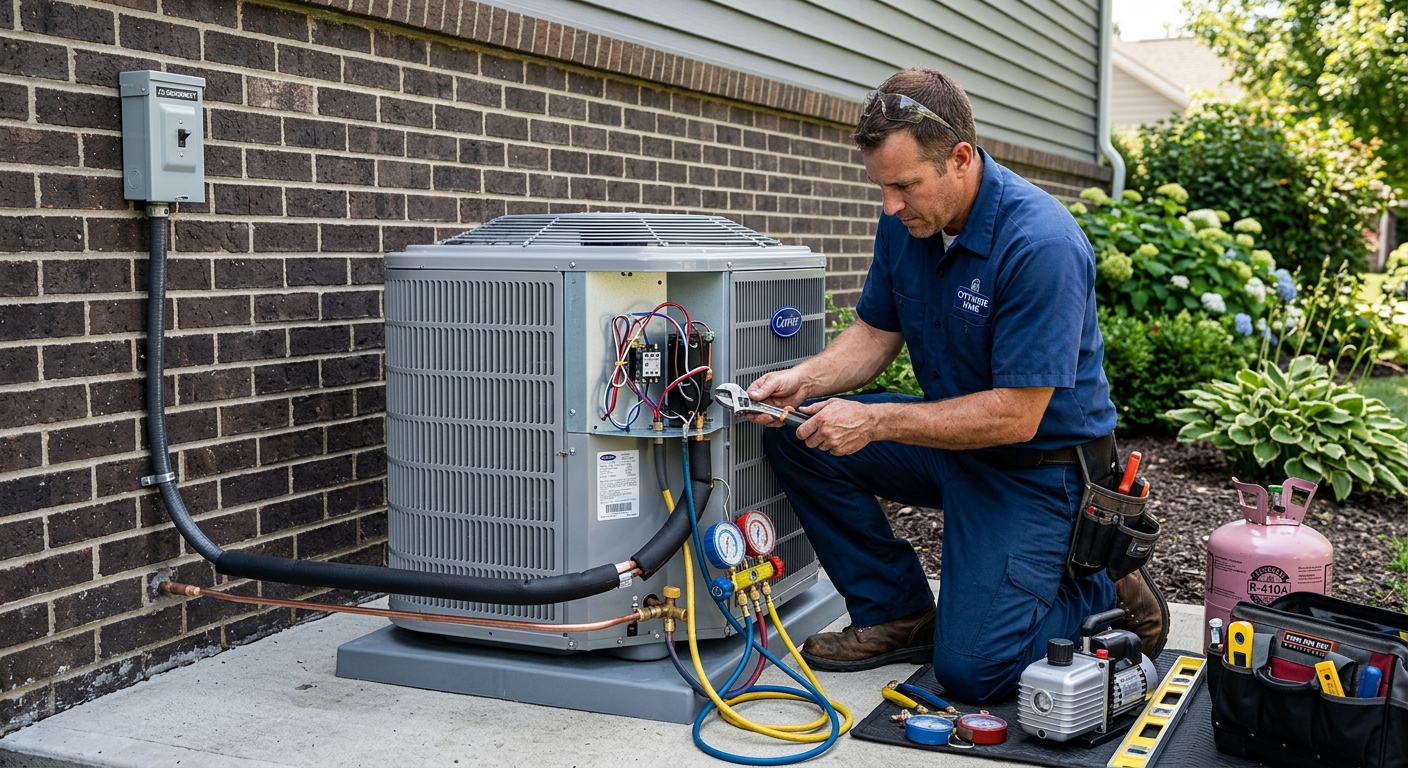
Silver Spring heating and cooling prices by system type — 2026
Silver Spring, Pennsylvania, is a homeowner community — with a homeownership rate of 79.2% and almost three out of four houses being single-family units (U.S. Census Bureau, ACS 2024). Most of this housing was built after 1960, so the market here is dominated by replacements and upgrades to existing split systems, not first-time installs. As central air became standard during the era of tract development in Hampden and Silver Spring, most houses have existing ductwork, although many ducts are now aging and benefit from attention or replacement.
Our climate tells the real story: south-central Pennsylvania sees about 5,200 heating degree days and only 1,250 cooling degree days each year. This is a heating-first region. Any HVAC decision in a Silver Spring home should lead with winter performance, though good cooling isn’t optional for our humid summers. Reliable gas service in most developed neighborhoods puts gas furnaces and heat pumps on nearly even ground for many homeowners. Ductless solutions, while strongly indicated for additions or unfinished spaces, remain the minority unless ductwork is impractical or gone bad.
| System |
Best for |
Efficiency |
Price range (installed) |
| Central AC replacement (existing ducts) |
homes with sound ductwork |
16–20 SEER2 |
$5,500–$13,500 |
| Air source heat pump (ducted) |
year-round heating and cooling |
8–10 HSPF2 |
$8,800–$19,000 |
| Cold-climate heat pump (ducted) |
heat pump as primary heat |
9–11 HSPF2 |
$14,500–$19,000 |
| Ductless mini-split (single zone) |
additions, rooms without ducts |
20–30 SEER2 |
$3,500–$7,700 |
| Full duct system installation |
homes with no existing ducts |
— |
$10,000–$20,000 |
Installed estimates for a typical Silver Spring home. Equipment tonnage, duct condition and electrical capacity move these more than brand.
When ductless is the right answer
Ductless mini-splits are the genuine fix in spots where central air simply can’t serve. If you’ve got a finished attic, walkout basement, sunroom, or new addition in your Silver Spring house, a ductless system often beats running new ducts through tight chases or tearing open ceilings and walls. Houses from the 1950s or earlier can dodge steep duct retrofits. Even in a post-1960 neighborhood, there are plenty of rooms on the wrong side of a closed door or too far down the trunk to get cool. In these cases, a single-zone ductless mini-split — one outdoor unit serving one indoor “head” — is cost-effective, delivers real comfort, and avoids the noise or drafts of window units.
Single-zone setups almost always outperform multi-zone systems (one outdoor unit with several heads) in efficiency and reliability, but if you have three or more spaces needing conditioning, multi-zones become practical — just know that when one outdoor unit is overloaded, all rooms suffer. Heads are compact, but not invisible; placement is about compromise between comfort and how much wall space you’re willing to give up. Every indoor unit needs a drain for condensate, which is often the limiting factor for location, especially in finished spaces.
Silver Spring’s tract homes were typically built for ducted systems, but any home never retrofitted for central air, or with a major basement or attic finish after the fact, is a candidate for ductless. Newer homes lean replacement, while older ones (especially anything pre-1960 in neighboring townships) are ripe for mini-splits where a retrofit is just not worth the mess and money.
The decision point on an aging system
For most Silver Spring homeowners, the choice to repair or replace a heating or cooling system should be honest — not just tilted toward a sale. Here’s how I advise you to weigh it: First is age. Most central systems here, with regular maintenance, last 12 to 18 years before expensive parts go. When it’s under 10 years old and a single component fails, repair makes sense. When something big fails and you’re on the far side of 15 years, put that money toward a new system.
Second is cost. If a repair runs more than a third the cost of full replacement (say, above $3,000–$5,000), it rarely pencils out. Critical failures — like a cracked heat exchanger or a compressor that’s out of warranty — are “replace” every time. Beyond that, if your bills are high but the system is running, look at your ductwork and attic insulation before blaming the equipment. Payback for a high-efficiency system in this climate is real, but mainly for systems in daily use, not for marginal cooling.
| Situation |
Recommendation |
Typical cost |
Reasoning |
| Under 10 years, single component failure |
Repair |
$300–$1,200 |
Parts are available, labor is moderate, remaining lifespan justifies the cost |
| 10–15 years, repair over a third of replacement |
Consider replacing |
$5,500–$13,500 |
Not worth sinking major money into a middle-aged system |
| 15+ years, any major failure |
Replace |
$5,500–$13,500 |
End of normal service life; risk of further failures increases |
| Cracked heat exchanger, any age |
Replace immediately |
$5,500–$13,500 |
Safety hazard; CO risk. No repair is safe or code-compliant |
| Compressor failure past warranty |
Replace |
$8,800–$19,000 |
Repair exceeds half of replacement, refrigerant phase-out risk |
| Working system, high bills |
Test ducts and envelope first |
$300–$800 |
Leaks or poor insulation waste energy more than mediocre equipment |
What a Pennsylvania HVAC contractor must hold
Pennsylvania does not issue a statewide HVAC trade license for residential work. All residential HVAC installation and replacement in Silver Spring and elsewhere in Cumberland County is regulated at the municipal level. Contractors must register for residential jobs over $500, under a state program for home improvements, but the mechanical permit and inspection come from your local township or borough’s code department.
It’s the municipalities or the state Department of Labor & Industry (for opt-out towns) that enforce the building and mechanical codes — specifically, the Pennsylvania Uniform Construction Code, based on the IRC. That applies to everything from furnace replacements to ductwork upgrades. Any contractor handling refrigerant is also required under federal law to hold EPA Section 608 certification, regardless of state or local licensing.
For residential jobs, you should verify that your company is registered for home improvements (this protects your contract and right of cancellation). Contractors with employees must also carry workers’ compensation insurance; you can confirm this by searching the Pennsylvania WCAIS database. Ask for proof of general liability insurance, as there’s no trade-specific state HVAC license required for homeowners.
R-410A phase-down: repair or replace?
The industry-wide transition away from R-410A to new, lower-GWP refrigerants like R-454B and R-32 is now underway, but the reality for Silver Spring homeowners is this: your current R-410A system remains legal and can be serviced for the foreseeable future. What’s changing is the economics of repair, especially if you have a refrigerant leak. As R-410A production is phased down, the price per pound is already rising and will likely continue to do so for several years. For routine repairs that don’t involve opening the refrigerant circuit, nothing changes.
If your R-410A system develops a major leak or compressor failure and is out of warranty, the cost to recharge can be the tipping point that nudges you toward a new system — not because it’s illegal, but because the numbers may no longer make sense. For now, repairing a working, tight system is still reasonable, and replacing equipment just due to the new refrigerants is unnecessary. If your contractor pushes replacement on the sole basis of R-410A, ask for a real comparison of repair cost versus replacement and how much refrigerant you actually need.
Service plans: worth it or not?
Most annual service plans offer a spring and fall check — mainly a quick tune-up, filters, and a visual safety inspection. What matters: keep your filter changed at the right interval (monthly for 1" filters, generally 6–12 months for 4" media), and use a MERV rating your blower can handle. Overdoing it on MERV can burn out motors in older equipment. Coil cleaning, scraping dust off the blower, and flushing the condensate line are all worth doing every year or two.
The big expense is a refrigerant check. The best service plan tests the charge, not just “tops it up.” If your system needs refrigerant added every year, it has a leak — this should be fixed, not masked. Don’t pay for an annual plan that only provides basic cleaning or quick checks. In south-central Pennsylvania, schedule maintenance in March or early September. You’ll avoid the backlog ahead of summer and winter rush when crews are scrambling to keep up with breakdowns, not tune-ups.
Gas, electric or both in south-central Pennsylvania
Silver Spring and much of Cumberland County sit in a true mixed-fuel market. Winters here hit a design temperature of 12 °F, with around 5,200 heating degree days each year — strong heating demand, but not the coldest in the state. Cold-climate heat pumps have advanced to the point where they hold most of their capacity down to single digits; old myths about heat pumps "not working" below freezing don't quite apply anymore.
Where reliable natural gas service is available (most urbanized townships, per the local utility coverage), a high-efficiency furnace remains competitive, especially as fuel costs fluctuate less than propane or oil. Dual fuel (heat pump with gas backup) is a strong performer here, letting you run the pump for mild weather and switch to the furnace in real cold snaps. Out in the rural parts of the county — where natural gas lines don’t reach — homeowners face a starker choice: expensive propane/oil, or all-electric. In those zones, a heat pump is almost always the economic winner, especially as electricity remains the most stable utility.
A furnace is still the best call if you have an older, drafty home, little insulation, and no plans for envelope upgrades, or if backup heat for power outages is a local worry. But most modern homes — and any aiming for an all-electric future — can lean toward a ducted cold-climate heat pump or dual-fuel hybrid.
| Option |
Installed cost |
Operating cost here |
Best when |
Incentive eligible |
| Gas furnace + central AC |
$5,500–$13,500 |
Lowest if gas is available |
existing gas service, coldest zones |
Partial (AC upgrades) |
| Ducted heat pump (cold climate) |
$8,800–$19,000 |
Lower than oil/propane, competitive with gas |
good envelope, all-electric goal |
Yes |
| Dual fuel (heat pump + gas backup) |
$14,500–$19,000 |
Efficient mild, lowest cost deep cold |
gas on site, deep cold spells |
Yes |
| Ductless multi-zone |
$10,000–$20,000 |
Room by room, higher unless zoning saves energy |
no ductwork, zone control |
Yes |
Frequently asked questions — HVAC installation in Silver Spring
Is a high-efficiency system worth the extra cost here?
For many homeowners in Silver Spring, paying for higher efficiency does make sense if you’re using your system across long heating and cooling seasons or energy prices trend up. Most homes in this township were built after 1960, so insulation levels and ductwork are better than in Carlisle’s older housing — which means you’ll actually see the savings from a 16–20 SEER2 central AC or a high HSPF2 heat pump. The installed price for a typical high-efficiency central AC falls in the $5,500–$13,500 range, and while the upfront investment can be higher, you’ll recoup some of that through reduced electric and gas bills—especially over a 12–15 year lifespan. For lightly used systems or in rarely occupied homes, the payback is much smaller, so balance your use against the higher initial spend.
Is an annual maintenance plan worth it?
In Silver Spring, the real value of a service plan depends on what’s included and your own comfort with basic maintenance tasks. If you’re handy enough to change filters and hose down your outside coil, you may not need the plan. Most plans run in the $300–$800 range annually and include seasonal cleanings, filter changes, and a safety check—which can catch big trouble before summer or winter. Skip plans that push unnecessary services or don’t test the system thoroughly. Schedule your own maintenance before the weather turns, and you’ll get the full value of whatever coverage you choose. For new high-efficiency units, a plan may help meet warranty terms, but for older systems, always ask what’s included versus just paying as you go.
Is natural gas available throughout Cumberland County?
Natural gas is common in urbanized townships like Silver Spring and Carlisle, thanks to established utility lines. Most newer developments and dense suburban blocks have gas service, enabling direct furnace replacements or gas backup for heat pumps. But as you move west into the rural parts of Cumberland County, gas lines get sparse or disappear entirely. Out there, homes rely on propane or fuel oil and all-electric solutions become more attractive, especially given the typical cost for swapping in a heat pump is $8,800–$19,000. Always check with your township or utility for exact service before planning any new installation, because access to gas or lack of it will steer your equipment decisions.
What does HSPF2 measure?
HSPF2 stands for Heating Seasonal Performance Factor version 2, and it measures the overall efficiency of a heat pump’s heating cycle over an entire season, not just at peak. It’s the ratio of total heat output to total electricity consumed, using test conditions that map to the new federal standard. For Silver Spring, with its 5,200 heating degree days, HSPF2 directly impacts how much you’ll spend on winter heating. Typical new ducted heat pumps in this area fall into the 8–11 HSPF2 range, with the highest usually found on cold-climate rated models in the $14,500–$19,000 installed price band. Higher HSPF2 means lower electric bills when you’re using your system as the main heat source.
Should I replace the furnace and AC at the same time?
In many Silver Spring homes, especially those built post-1960, the furnace and central AC share the blower and ductwork. If one side of your system is near or past its service life, or you’re upgrading for efficiency or incentive eligibility, replacing both components together makes good sense—including cost savings on installation. Expect a combined replacement bill in the $5,500–$13,500 bracket for typical split systems. If your furnace is much newer than your AC or vice versa, you can stagger replacements—but mismatching new and old equipment sometimes hampers efficiency or warranty coverage. If your ducts and blower are solid and repairs are minor, you don’t always have to replace both at once.
Do I need ENERGY STAR equipment to qualify for incentives?
In most cases, qualifying for state, utility, or federal incentives requires meeting certain efficiency thresholds, and ENERGY STAR is the easiest shorthand, but not the only path. For Silver Spring, check both your installer’s paperwork and PPL’s utility incentives, as local standards may point to specific SEER2 or HSPF2 numbers rather than the ENERGY STAR logo itself. As a rule, stepping up to a qualifying heat pump or cold climate system—typically in the $8,800–$19,000 range—will get you into incentive territory. Always request written confirmation from your contractor that what you’re ordering is eligible, and if you can, download the specific rebate form before making a decision.
How much does ductwork add to an HVAC installation?
In Silver Spring, most homes already have ducts, but repairs or full replacements do come up as the housing stock ages. Installing a complete new duct system can run $10,000–$20,000 for a typical home, on top of whatever you’re paying for equipment. Minor repairs or re-sealing can fall well below that, often between $300–$800. If the ducts are sound and sized right, don’t pay to replace them. Only go for new ductwork if airflow or allergy issues won’t go away with repairs—otherwise, keep your existing runs and put the savings into a higher-efficiency system or envelope improvements.
Do I need a permit to replace HVAC in Silver Spring?
Yes, you do. Cumberland County municipalities—including Silver Spring—require a mechanical permit for HVAC replacement under the Pennsylvania Uniform Construction Code, which is enforced locally. The permit triggers an inspection by your township’s code department to verify new system safety, code compliance, and proper refrigerant handling. Permit fees are typically modest compared to system cost and are included in most contractor’s bids. For a standard central AC replacement in this market, expect a price band of $5,500–$13,500, with permitting as a routine step. Always check that your contractor pulls the proper municipal permits; skipping this exposes you to fines and potential insurance coverage gaps.
How long does HVAC installation take in Silver Spring?
For most standard replacements in Silver Spring’s single-family homes—a furnace and AC swap, or a ducted heat pump—installations typically take one full day, sometimes stretching into two for more complicated ductwork or electrical upgrades. Adding a new duct system is a larger job and can push the schedule closer to four to five days, especially in homes with finished basements or custom layouts. Quick-turn jobs are common thanks to the county’s busy HVAC workforce along the I-81 corridor. Ductless mini-splits, if single-zone, take less than a day per unit. For a typical system installation in the $5,500–$13,500 price range, homeowners should expect to have normal heating or cooling restored by the end of the next business day in most cases.