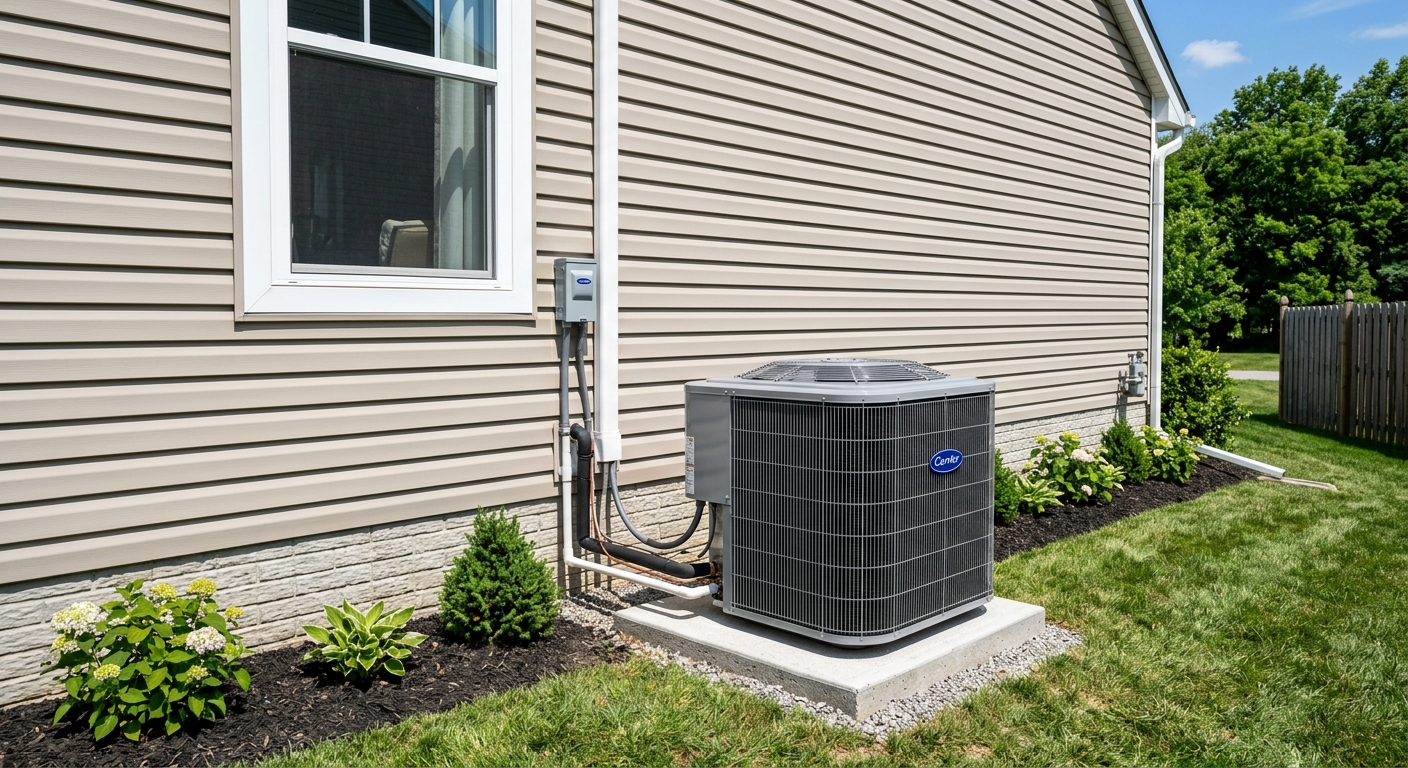
Whitpain heating and cooling prices by system type — 2026
Whitpain’s HVAC market is shaped by its high homeownership rate (81.7%) and the fact that 41.6% of its homes were built before 1980 (U.S. Census Bureau, ACS 2024). This means most houses here already have some type of heating and cooling, with many now approaching their second or even third round of replacement. The classic post-war suburban housing that stretches across Abington, Cheltenham, and Upper Dublin is common in Whitpain too, which implies many homes originally received ductwork adequate for heating, but not always for modern high-efficiency central air or heat pumps. If you’re in one of these homes, odds are you’re looking at replacement of existing central systems or retrofitting new ductwork to bring everything up to modern standards.
With 4,800 heating degree days versus 1,450 cooling degree days, this is a heating-weighted market – so heat output and winter efficiency matter more than a premium air conditioner alone. Below is a quick way to compare the main system options and price bands for a typical Whitpain home. These prices reflect both equipment and installation in 2026:
| System |
Best for |
Efficiency |
Price range (installed) |
| Central AC replacement (existing ducts) |
homes with sound ductwork |
16–20 SEER2 |
$6,100–$14,500 |
| Air source heat pump (ducted) |
year-round heating and cooling |
8–10 HSPF2 |
$9,700–$20,500 |
| Cold-climate heat pump (ducted) |
heat pump as primary heat |
9–11 HSPF2 |
$16,000–$20,500 |
| Ductless mini-split (single zone) |
additions, rooms without ducts |
20–30 SEER2 |
$3,900–$8,500 |
| Full duct system installation |
homes with no existing ducts |
— |
$11,000–$22,000 |
Installed estimates for a typical Whitpain home. Equipment tonnage, duct condition and electrical capacity move these more than brand.
The refrigerant change and what it means for repairs
The refrigerant used in most Pennsylvania home HVAC systems has been shifting. Newly manufactured central air conditioners and heat pumps now use lower-global warming potential (GWP) refrigerants such as R-454B or R-32, as part of the national phase-down of higher-GWP HFCs. If your system was installed in the last 10–15 years, it almost certainly uses R-410A. Here’s the good news: you do not have to replace your working R-410A system just because the new standards have arrived. It is still entirely legal to service and repair.
The main issue is cost over time: as production of R-410A drops, its price may climb, especially when there are leaks to repair. This means that, for older equipment, the cost of topping off refrigerant after a leak could go much higher than it used to. At some point, on a unit over about 12–15 years old, this can tip the balance in favor of replacement over repeated top-offs—especially if the system is already inefficient compared to modern models.
If your AC or heat pump is working well and not leaking, there’s no financial or regulatory reason to act. Replacement only becomes a priority if you face major repairs on a system that’s already showing its age, or if repeated refrigerant service bills are stacking up faster than you’d like. If you tend to keep appliances running until their useful life ends, you can continue doing so, just with a more careful eye on repair costs as your system ages.
Reading an installation proposal
Comparing HVAC installation quotes in Whitpain should go well beyond glancing at the brand and the bottom line. You want to see a full list of equipment—model numbers for both the indoor and outdoor units—since real efficiency and warranty only apply to matched systems. Sizing is crucial: any quote should attach a heating and cooling load calculation, not just use the number printed on your old system’s nameplate. For retrofits, pay close attention to what’s being done with your existing line set (the copper pipes carrying refrigerant) and whether it’s being replaced or just reused. If any electrical upgrades or panel work are needed, these must be spelled out, not assumed. Other small but vital points: how condensate will be handled, what thermostat is being installed, and if local mechanical permitting—required in much of Montgomery County—is included.
The best proposals include an itemized breakdown, a commissioning report showing measured airflow and refrigerant charge at startup, and clarify the labor warranty (distinct from the equipment warranty). Any skipped details here make apples-to-apples price comparison impossible—a one-line bid with just a price and brand gives you none of the protection a proper contract offers under Pennsylvania’s consumer protection laws.
| Line item |
What to look for |
Red flag if… |
| Equipment |
model numbers, indoor and outdoor matched |
brand name only |
| Sizing |
load calculation attached |
matched to the old nameplate |
| Ductwork |
condition assessed, sealing scoped |
not mentioned |
| Electrical |
circuit and panel capacity confirmed |
assumed adequate |
| Line set |
replaced or documented as reused |
silent |
| Commissioning |
measured airflow and charge, documented |
no startup report |
| Warranty |
labour years stated separately |
manufacturer only |
| Permit |
included and priced |
'not needed' |
Efficiency ratings and what they mean for your bill
There are three main ratings to know: SEER2 measures a system’s cooling efficiency, HSPF2 rates heating efficiency for heat pumps, and AFUE describes fuel-burning furnace efficiency. The SEER2 and HSPF2 scales replaced the older SEER and HSPF figures, so be wary when comparing numbers from older articles or brochures—they are not apples-to-apples.
For Whitpain and Montgomery County as a whole, your energy bills reflect more days spent heating than cooling: 4,800 heating degree days against just 1,450 for cooling. This means that if you’re considering a heat pump, you’ll get better long-term savings from a higher HSPF2 rating (heating) than from pushing the SEER2 (cooling) to top-tier numbers. For air conditioning alone, most homes here see only a couple of serious cooling months a year; even a mid-tier SEER2-rated AC will do fine, and going for the highest model usually doesn’t pay off in our climate zone.
If you’re quoted high efficiency at a serious premium, only stretch above the minimum required HSPF2 if you intend to stay in the house for the foreseeable future and use your heat pump for both heat and AC. The premium for ultra-high SEER2 or HSPF2 models often won’t pay itself back before the next replacement cycle, especially at our local energy rates and seasonal weather patterns.
Retrofit versus replacement in Whitpain
Whitpain has a mix of housing ages, but nearly 42% of homes were built before 1980, and much of the rest is post-war suburban stock common in Montgomery County. This means most houses have existing ductwork, but the quality and size vary. Earlier homes may have ducts sized for heating only, not for modern high-efficiency cooling or heat pumps. This can affect air distribution and comfort — and may require ductwork upgrades or even a full replacement ($11,000–$22,000).
Newer subdivisions with builder-grade central systems, especially those put up in the late 1990s or early 2000s, are now coming up for their first full system replacement. Many of these homes received slightly oversized equipment at the start, which can translate to both short cycling (leading to early failure) and higher run costs. If your home is from that era, expect decisions on efficiency and comfort to hinge on whether the original install cut corners with insulation, window quality, or electrical panel capacity—an important factor if converting to all-electric heating like a heat pump ($9,700–$20,500).
Flue and chimney condition only matter if you stick with a conventional gas furnace. In most Whitpain homes, replacing like-for-like remains straightforward—unless deeper upgrades for comfort or efficiency are part of your plan.
When an HVAC repair stops being worth it
Every homeowner wants to save money, and sometimes a repair makes more sense than a full replacement—especially if your system is less than 10 years old and has a single failing component or a simple fix. The expected service life for most central air and heat pumps is 12–20 years, admittedly shorter for builder-grade equipment put in during the suburban booms. If the repair is minor and under a third of the cost to replace, sticking with what you’ve got can be the smart play. Where it gets trickier is when the fix approaches half of replacement, or if your unit is over 15 years old and facing a compressor or heat exchanger failure.
Two situations where you must replace: a cracked heat exchanger (this is a carbon monoxide risk and not negotiable), and a compressor failure on a system already past its prime. If your equipment runs fine but your bills are high, don’t jump to replacement—duct sealing or insulation often produces bigger savings for less outlay. Remember, as R-410A becomes scarcer, refrigerant-related repairs cost more, tipping the math further toward replacement for older cooling systems.
| Situation |
Recommendation |
Typical cost |
Reasoning |
| Under 10 years, single component failure |
Repair |
$300–$1,200 |
Much less than replacement; most parts still in production |
| 10–15 years, repair over a third of replacement |
Consider replacing |
$6,100–$14,500 |
Major repair cost is too close to new for aging equipment |
| 15+ years, any major failure |
Replace |
$6,100–$14,500 |
Well past service life; reliability will not return |
| Cracked heat exchanger, any age |
Replace immediately |
$6,100–$14,500 |
Safety hazard; repairs are not permitted or effective |
| Compressor failure past warranty |
Replace |
$9,700–$20,500 |
Compressor is the 'engine'; out-of-warranty cost is very high |
| Working system, high bills |
Test ducts and envelope first |
$300–$800 |
Efficiency gains here are usually higher per dollar spent |
Permits, licensing and inspections in Whitpain
Pennsylvania does not have a statewide trade license for HVAC contractors on the residential side. Instead, the Pennsylvania Uniform Construction Code is enforced by municipalities—including all of Montgomery County’s townships—so inspection, code, and permit requirements are handled locally. A Home Improvement Contractor (HIC) registration, as issued by the Pennsylvania Office of Attorney General, is required for any contract over $500, and is the main credential you’ll see in Whitpain jobs. You can verify HIC status at hic.attorneygeneral.gov before signing a contract.
Refrigerant handling is another layer entirely: all contractors working with refrigerant—any AC or heat pump job—must have EPA Section 608 certification (this is a federal, not state, standard). When a project requires a permit, Whitpain and most surrounding municipalities will expect the HVAC contractor to pull a local mechanical or building permit, especially if there are new electrical or significant mechanical connections (like a new system or a line set replacement).
Insist on proof of workers’ compensation coverage for anyone with employees—Pennsylvania law makes this mandatory. Homeowners can use WCAIS (wcais.pa.gov) to check insurance status. Permitting, insurance, and federal certification together do more to protect you than any state trade license ever could in Whitpain today.
Frequently asked questions — HVAC installation in Whitpain
How is a tax credit different from a rebate?
In Pennsylvania, a tax credit is a dollar-for-dollar reduction of the income tax you owe; you claim it on your federal or state return after purchasing and installing your HVAC system, usually during the next tax season. A rebate, on the other hand, is cash or a check you get back directly from the utility, manufacturer, or sometimes the state—often a few weeks or months after installation. For example, installing a high-efficiency ducted heat pump in Whitpain could qualify for a utility rebate of several hundred dollars, while the same installation may also give you a federal tax credit depending on system performance. Remember, the cost to install a ducted central heat pump here typically runs $9,700–$20,500, so stacking both credits and rebates can have a real impact on your out-of-pocket cost. Keep in mind, you’ll need to save your paperwork—the rebate and tax credit each require different forms and proof.
Do I need a permit to replace HVAC in Whitpain?
Yes, in Whitpain and most Montgomery County townships, a permit is typically required whenever you replace or install HVAC equipment involving new mechanical or electrical connections. This usually includes replacing a central air conditioner, furnace, or heat pump, as these projects often impact home safety and code compliance. Simple filter changes or swapping a thermostat battery usually don’t trigger the permit process. Expect your HVAC contractor to handle permitting and inspection with the township. Permit fees are usually folded into your quoted price—say, for replacing a central AC system at $6,100–$14,500—and are part of what insurance adjusters and home inspectors look for during resale. Always ask to see the permit paperwork before work starts; if a contractor tells you it’s “not needed,” that’s a red flag for Whitpain homeowners.
How does southeastern Pennsylvania's climate affect system sizing?
Southeastern Pennsylvania, including Whitpain, has 4,800 heating degree days and 1,450 cooling degree days. This makes it a climate that leans more heavily on reliable heating, but tends toward humid, muggy summers where air conditioning matters for comfort and indoor air quality. When sizing an HVAC system here, the installer should use a Manual J load calculation to ensure the new equipment can handle the coldest winter nights (down to 14°F design temp) while not being oversized for moderate summers. An oversized or undersized unit will run inefficiently and wear out faster. So if you’re seeking to install a ductless mini-split, make sure your proposal doesn’t just repeat the old system’s size—one zone might run $3,900–$8,500, but only if it’s truly correct for your space and insulation quality.
Why do HVAC quotes in Whitpain vary so much?
Quotes for HVAC installation in Whitpain can swing thousands of dollars due to differences in duct condition, electrical capacity, labor quality, and how much detail each proposal includes. Many houses built before 1980 have older or undersized ductwork, so bids can rise if additional air sealing or duct replacement is required. Some quotes fold in electrical work or upgrades, while others assume existing panels and circuits are enough. Factor in brand, efficiency rating, and how much is contracted out versus done in-house, and it’s easy for a simple system replacement to range from $6,100–$14,500 for central AC, for example. The only way to compare apples to apples is to look for complete, well-explained line items—not just the bottom-line price or brand name.
Is it worth switching from oil or propane to a heat pump?
If you rely on oil or propane for heating in the far northwestern parts of Montgomery County, switching to a ducted or ductless heat pump is worth considering. Heat pumps provide both heating and cooling and run on electricity—often delivering lower operating costs, especially if your current system is 20+ years old and fuel prices are high. Installation for a ducted system in Whitpain typically costs $9,700–$20,500; if you need new ducts, add another $11,000–$22,000. If your house is insulated well and has a decent electrical panel, the investment pays out over time—especially with available rebates and the predictability of electric rates compared to oil or propane. Just be sure your installer properly sizes the heat pump for winter lows and discusses any needed weatherization first.
When is the best time of year to replace HVAC in Whitpain?
The best time to replace your HVAC system in Whitpain is typically in the spring or early fall, before the peak summer cooling or winter heating demand hits. Contractors often have more availability, and you may see slightly lower prices or better scheduling flexibility for central AC replacement ($6,100–$14,500). Plus, your system upgrade won’t leave you without heating or cooling during the extremes. If you wait for the hottest or coldest days, you risk emergency pricing, supply chain delays, or scheduling backlogs. Shoulder season replacements also make it easier for the township to schedule inspections and, if needed, for utilities to handle any electrical upgrades without a rush. Start planning at least a few months in advance if you can.
Is a high-efficiency system worth the extra cost here?
In Whitpain, upgrading to a high-efficiency system only pays off if your usage justifies it and you plan to stay in the house for many more years. Our climate is heating-dominated, so look for higher HSPF2 (heating) ratings for heat pumps: going from 8 to 10 HSPF2 usually makes sense. But paying a premium for the very highest SEER2 (cooling) units often doesn’t return the investment because we only see a few weeks of real AC load each year. If your current central system is due for replacement—say, a typical $9,700–$20,500 for a ducted heat pump—run the numbers on projected utility savings and compare that to the jump in upfront cost. In many Whitpain homes, mid-high efficiency offers more bang for your buck than top-shelf units with bells and whistles you rarely use.
What MERV filter rating should I use?
For most Whitpain homes, a MERV 8 filter balances effectiveness, airflow, and affordability. This captures most pollen, dust, and lint common in southeastern Pennsylvania without putting undue strain on your system, which is especially important in houses with older or original ductwork. If your system has been sized with stronger airflow or you have allergies, you could step up to MERV 11 or 13—but only if your contractor verifies it won’t choke off return flow (which risks coil icing or overheating). Keep in mind, higher MERV filters might cost $10–$30 more per change, and are worth budgeting for if your bills are high or you’re considering a ducted heat pump at $9,700–$20,500. Never use a filter so thick that your blower struggles, especially on aging builder-grade systems.
Should I close vents in unused rooms?
In Whitpain homes—especially those with original ductwork or older systems—closing vents in unused rooms is almost never a good idea. It may seem like a way to save on bills, but it can actually hike up static pressure in your ductwork, forcing your blower motor to work harder and possibly shortening the life of your system. Airflow balance is part of how modern heating and AC units are designed for our region’s mix of old and new construction. If you’re seeing uneven temps, talk to your contractor about minor damper adjustments or modest zoning upgrades. Meanwhile, you’re better off using a smart thermostat and addressing insulation or weatherstripping if you want to reduce run costs (for example, a ductless mini-split in a trouble zone runs $3,900–$8,500 installed). Never tape or plug vents to “force” air elsewhere—it usually backfires.