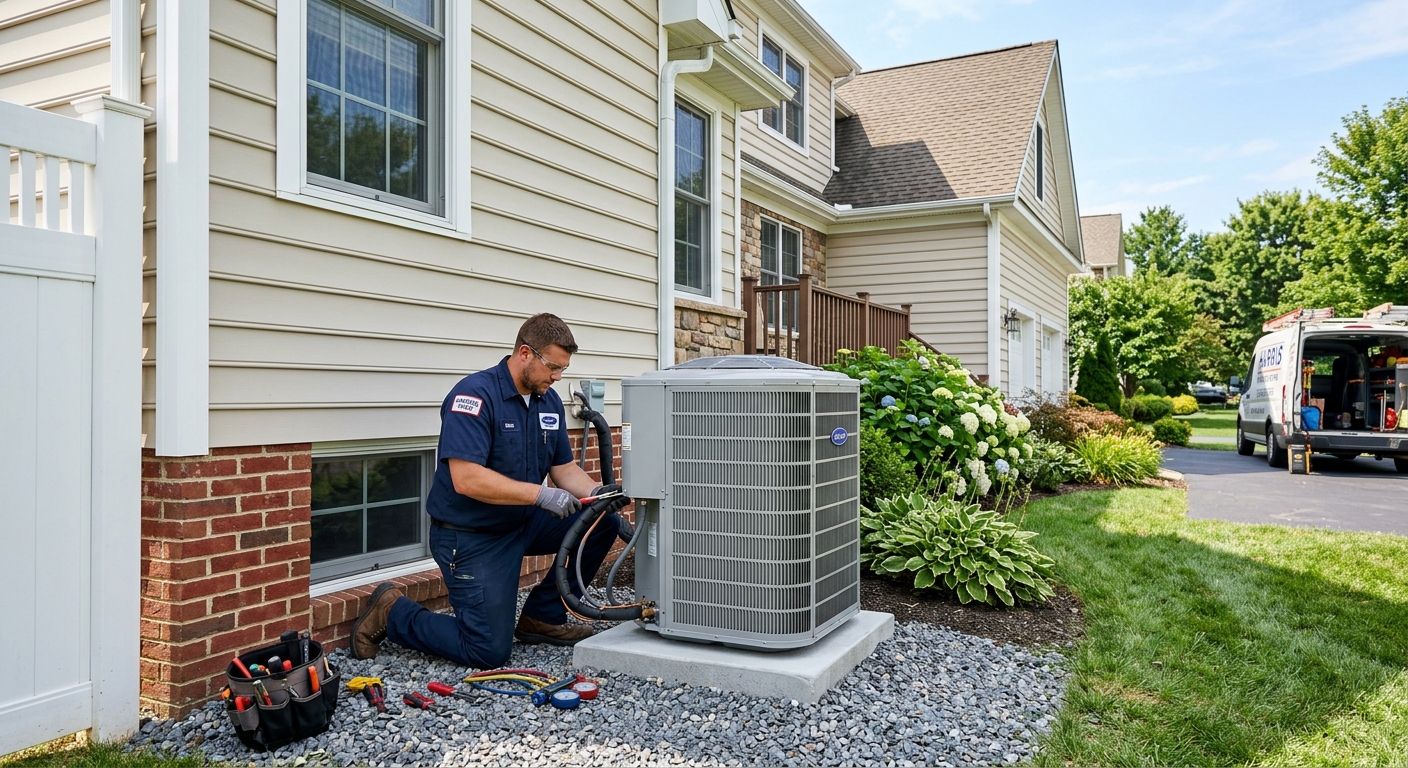
What a new HVAC system costs in Allegheny
Allegheny sits in Blair County, where more than half the homes were built before 1980 and homeownership rates are above 70% (U.S. Census Bureau, ACS 2024). This combination creates a market heavily weighted toward retrofit work—many homes still have original radiator heat or aging forced-air systems with undersized or poorly sealed ductwork. Most jobs aren’t simple furnace or AC swaps; they're updates or full conversions to modern air conditioning and heating, especially in the 1900–1940 wood-frame homes clustered around Altoona and Hollidaysburg. These houses frequently need duct retrofits or replacements, sometimes squeezed into tight lots.
This region is decisively a heating market. With 6,300 heating degree days and only 750 cooling degree days, winter costs and comfort dictate system selection far more than summer cooling. That’s why efficient heat sources—whether gas, oil, or heat pump—matter so much here. System cost depends less on brand and more on your home’s duct condition, existing electrical service, and how much of the old infrastructure can be reused.
| System |
Best for |
Efficiency |
Price range (installed) |
| Central AC replacement (existing ducts) |
homes with sound ductwork |
16–20 SEER2 |
$4,500–$11,000 |
| Air source heat pump (ducted) |
year-round heating and cooling |
8–10 HSPF2 |
$7,200–$15,500 |
| Cold-climate heat pump (ducted) |
heat pump as primary heat |
9–11 HSPF2 |
$11,500–$15,500 |
| Ductless mini-split (single zone) |
additions, rooms without ducts |
20–30 SEER2 |
$2,900–$6,300 |
| Full duct system installation |
homes with no existing ducts |
— |
$8,100–$16,000 |
Installed estimates for a typical Allegheny home. Equipment tonnage, duct condition and electrical capacity move these more than brand.
Separating installers from equipment sellers
The truth in HVAC isn’t the logo on the box—it’s how your system is installed. A properly engineered and commissioned install will outperform a “premium” system thrown in by the lowest bidder every time. In Blair County, the difference between a reliable 20-year system and a string of uncomfortable, expensive seasons nearly always comes down to attention to detail: sizing, ductwork, airflow balancing, and charge.
Start with real verification: Pennsylvania doesn’t license HVAC at the state level, but any bid over $500 requires Home Improvement Contractor (HIC) registration—something easily checked online. For systems involving refrigerants (every heat pump and central AC), the actual technician must have current EPA Section 608 certification. Your quote should always specify exact model numbers, not just “3-ton heat pump,” and include a Manual J load calculation to prove sizing isn’t just a guess. Quality installers will document measured airflow and refrigerant charge at startup—these are your proof. In this saturated market (contractors spread across Blair and neighboring counties), choose skill and detail over fast talk or aggressive upselling.
- Check HIC registration at the Attorney General’s website
- Confirm EPA Section 608 certification for refrigerant work
- Ask for a Manual J load calculation
- Demand an itemized, written contract (over $500 is required by law)
- Look for model numbers, not just size (tonnage or BTU)
- Require measured startup values (airflow, refrigerant charge)
- See proof of general liability insurance
- Confirm active workers’ compensation via WCAIS
- Clarify who pulls the mechanical permit and arranges inspection
- Ask about warranty registration (labor and parts)
- Get references from recent jobs in Allegheny or nearby boroughs
- Insist on actual commissioning, not “starts and runs”
Red flags: in a crowded market like Blair County, high-pressure sales, lack of insurance, or generic quotes without detail are reasons to walk away. Take your time—quality trumps speed every time.
Permits, licensing and inspections in Allegheny
Pennsylvania does not issue a statewide HVAC trade license for residential work. In Blair County, including Allegheny, HVAC contractors must register as Home Improvement Contractors for any contract over $500, which you should confirm through the provided state registry. Actual work is regulated at the local level—municipal mechanical permits are required and enforced by the city or township’s code enforcement office. Inspections track the Pennsylvania Uniform Construction Code (UCC), which sets minimum standards for safety, ventilation, and performance.
Mechanical permits are a must for almost all new installs or replacements. Your contractor should pull the permit, schedule inspections, and address any code corrections. If refrigerants are involved (every modern AC or heat pump), federal law says only EPA Section 608 certified techs can connect or disconnect the system. Insurance and workers’ compensation are required for every employer (not just big operations), and you can verify coverage at the WCAIS portal. Permits, load calculations, and inspection sign-offs protect your investment—don’t accept shortcuts. If your quote doesn’t include all these, or if a contractor steers you away from permits, that’s a sign to reconsider.
Gas, electric or both in north-central Pennsylvania
Choosing between gas, electric, or dual-fuel heat in Allegheny isn’t just a technology decision—it’s about matching your home to real winter conditions. With a winter design temperature of 2°F and 6,300 heating degree days, Blair County sits among Pennsylvania’s longest, coldest heating seasons. That means an underpowered or wrongly set up system will struggle for months, not weeks. Modern cold-climate heat pumps are legitimate, supplying reliable heating even below freezing. But capacity does decline as temperatures drop toward zero, which is why many local homes still use gas or a mix (dual fuel) to handle the coldest nights.
In Altoona and Hollidaysburg, natural gas is common, so the decision often comes down to heat pump or gas—or both. Head just outside the boroughs, though, and gas is replaced by propane or oil, both of which are less efficient and prone to price spikes. In these rural townships, a cold-climate heat pump is suddenly much more appealing, especially combined with upgraded insulation or weatherization. If you already have solid, reliable gas service and a newer furnace, replacement may not make financial sense yet. But if your home is on oil or propane, or your gas furnace and AC are aging out, dual fuel or a full heat pump upgrade is often the more stable and efficient option. A high-efficiency gas furnace remains the right call where household envelope and installer quality can’t fully support a heat pump, or for those who simply favor the familiar and rapid heat output of gas.
| Option |
Installed cost |
Operating cost here |
Best when |
Incentive eligible |
| Gas furnace + central AC |
$4,500–$11,000 |
Stable on gas grid |
existing gas service, coldest zones |
Sometimes (utility rebate applies) |
| Ducted heat pump (cold climate) |
$7,200–$15,500 |
Low on current electric rates |
good envelope, all-electric goal |
Often (state/federal rebates) |
| Dual fuel (heat pump + gas backup) |
$11,500–$15,500 |
Controlled by system logic |
gas on site, deep cold spells |
Yes (energy programs) |
| Ductless multi-zone |
$8,100–$16,000 |
Lower in mild/chilly seasons |
no ductwork, zone control |
Yes (utility/state/federal rebates) |
When ductless is the right answer
Ductless mini-splits aren’t just a fad in Allegheny—they’re an answer to a genuine problem. Many Blair County homes were never built with central air in mind, and the thought of tearing into 1920s plaster to install ductwork makes most owners start sweating before the AC even runs. Ductless shines in additions, upstairs bedrooms, attic conversions, or basements that the main system never touched. A single-zone mini-split is most cost-effective for one room or a finished attic, with installed pricing from $2,900–$6,300. When the whole house is involved, a multi-zone system can link several indoor heads to a single outdoor unit—but the price can approach a full ducted system, and performance drops if each head needs to run simultaneously.
Aesthetics do matter. Wall-mounted heads are visible, so plan their placement. Floor or ceiling console units are an option if wall space is tight. Proper condensate handling is critical—don’t just “let it drip outside.” For older houses on small lots with original wood-frame walls, ductless is often cheaper, cleaner, and less disruptive than forcing in new ducts. In these homes, trying to stuff big metal trunks into little closets is both expensive and unsightly. Sometimes, ductless isn’t just the right answer—it’s the only practical one.
What construction era means for your system
If your Allegheny house predates 1980 (and odds are it does), there’s a good chance the original build never had central air—or the ducts were sized just for heating. That means cooling performance will suffer, especially upstairs, unless ducts are upgraded or replaced. Older houses often have minimal attic insulation, drafty windows, and aging chimneys or flue liners—spell trouble for both heat pumps and new gas furnaces if left unchecked. Want to make the jump to an all-electric system? You may need to upgrade the electrical panel to support heat pump load, particularly in two-story or larger homes.
Homes from the mid-1900s onward may have better, but still under-insulated, ducts. If you’re dealing with a 20-plus-year-old system, chances are you’re not just “swapping metal boxes”—you’re correcting airflow, upgrading filters, and tightening up the envelope so your new investment actually pays back. Always have your installer check the duct sizes, insulation levels, and any visible watermarks or rust at the chimney, especially for gas equipment. Every system is an ecosystem; an old Allegheny house needs a contractor who knows how to work inside tight walls, not just someone who can bolt down a condenser.
Efficiency ratings and what they mean for your bill
Efficiency ratings often sound more complicated than they are, but here’s what matters in Allegheny: SEER2 measures cooling efficiency, HSPF2 is for heating efficiency in heat pumps, and AFUE rates gas furnace efficiency. SEER2 and HSPF2 are the “new” standards—numbers from older SEER or HSPF articles aren’t apples-to-apples. Each extra point of HSPF2 can save 5–7% on electric heating, which adds up in our region with over 6,300 heating degree days. SEER2 matters for cooling, but with only 750 cooling degree days, the return on a super-high-SEER2 system just isn’t there for most homes in Blair County.
If you’re spending, pay for a moderate-to-high HSPF2 or AFUE rating to get the most back in our long heating season. Go for 16–18 SEER2 on AC (not the 20-plus numbers, unless you run the AC non-stop or have a heavily glass-fronted home), and target 9+ HSPF2 for heat pumps. Beyond those, the efficiency premium takes too long to pay off in real energy bills. Most homes in Allegheny do better investing in weatherization—air sealing and insulation—than chasing ultra-high equipment ratings.
Frequently asked questions — HVAC installation in Allegheny
Does my utility offer a heat pump rebate in Allegheny?
Yes, if your home in Allegheny is served by Penelec, utility rebates for high-efficiency heat pumps are often available on qualifying equipment. Many state and federal programs target homes switching from electric resistance heating or oil to cold-climate heat pumps. Rebates can make a sizeable dent in your upfront cost—sometimes between $500–$2,000 depending on system size and type. It’s best to check directly with Penelec, since program details change yearly. Most contractors in Blair County have experience applying for these, but you’re the one who has to sign off. Always confirm eligibility before you commit, as some programs require specific efficiency ratings or approved installers.
When is the best time of year to replace HVAC in Allegheny?
In Allegheny and the broader Blair County area, spring and early fall are usually best for HVAC replacement. Local contractors aren’t overwhelmed by cooling or heating emergencies, so installation dates tend to be more flexible and labor costs stable. Scheduling in shoulder seasons also means you won’t be left without heating at 2°F or sweating through a July heat wave. If you plan a full system upgrade or ductwork changes, booking during these “quiet” periods often leads to better attention, fewer jobsite delays, and potentially room for negotiation—especially if your new system falls in the $7,200–$15,500 range for a heat pump install. Incentives can also change by the season, so it’s smart to ask your contractor what's available in the months ahead.
How much does ductwork add to an HVAC installation?
In Blair County's Allegheny homes—especially those built before 1980—ductwork is often the swing factor in total HVAC cost. If your house needs a new duct system or a complete retrofit, this can add $8,100–$16,000 to the project, depending on house size and accessibility. Retrofitting old plaster walls or navigating around unique framing details tends to push the number to the higher end. If the existing ducts are solid and only need sealing or minor repairs, you’ll spend far less. Always have your ducts inspected before making decisions; sometimes a ductless option is the better play for your budget and comfort.
How often should I change my filter?
For most Allegheny homes, changing your HVAC filter every 2–3 months is typical, though homes with pets, smokers, or high dust from open windows may need monthly changes. In Blair County, where a majority of houses are older and may have leaky ductwork or less effective filtration, it’s even more important to check filters regularly. Clogged filters force your system to work harder, reduce air quality, and can shorten the lifespan of equipment that might cost $4,500–$11,000 to replace. Your installer should show you how to inspect and change filters—if you’re unsure, don’t hesitate to call for a walkthrough after install.
Should I repair or replace my HVAC system in Allegheny?
If your equipment is 15–20 years old and facing a major repair in Allegheny, replacement often makes more sense—especially with pre-1980 homes where efficiency upgrades pay back faster due to long heating seasons. Repairing a failing system might seem cheaper short-term, but with new heat pumps running from $7,200–$15,500 installed and utility rebates available, payback is often surprisingly quick when you factor in energy savings and comfort. If your system is less than 10 years old, well-maintained, and the repair is minor, fix it and budget for future replacement. Have your contractor give you detailed numbers so you’re not forced into a rushed decision.
Which utility serves Allegheny?
Most of Allegheny and central Blair County is served by Penelec, a FirstEnergy company, for electricity. If you have gas service in Altoona, Hollidaysburg, or the surrounding boroughs, it comes from Peoples Natural Gas—beyond that, rural townships rely more on propane or fuel oil. This is important when picking a system, as homes with no natural gas may find a cold-climate heat pump or high-efficiency mini-split more cost effective over time, even at the higher $11,500–$15,500 installed price for the best systems.
Do I need a permit to replace HVAC in Allegheny?
Yes—Allegheny is in Blair County, and nearly every HVAC replacement or installation will require a mechanical permit from your municipality’s code enforcement office. This is driven by Pennsylvania’s Uniform Construction Code, not just local rules. Your installer should handle the permit process and schedule any required inspections. If refrigerant handling is involved, only a Section 608 certified technician can legally do the connections. Permitting adds cost and time, but ensures your system (say a $7,200–$15,500 heat pump install) meets safety and code requirements that protect home resale value and warranty eligibility.
What is SEER2 and how is it different from SEER?
SEER2 is the updated federal test method for measuring cooling efficiency on air conditioners and heat pumps, replacing the old SEER rating. The “2” means stricter, real-world test conditions—higher static pressure (how hard the blower must work)—which generally results in a lower number compared to old SEER ratings for the same model. For example, a system rated at 18 SEER often scores about 16 SEER2. This matters for Allegheny because comparing apples to apples helps you know what you’re buying, especially if you’re looking at a $4,500–$11,000 installed system. In Blair County’s climate, a solid midrange SEER2 is typically worth the investment.
What does a heat pump cost installed in Allegheny?
For a typical single-family home in Allegheny, a quality ducted heat pump system professionally installed runs from $7,200–$15,500, depending on the house size, duct condition, and chosen efficiency rating. If your home requires significant ductwork upgrades, older panel upgrades, or outdoor condenser placement challenges (very common in Blair County’s older homes), plan on the higher end of the range. Single-zone ductless mini-splits are much less at $2,900–$6,300 per installed head. All quotes should include labor, permits, and commissioning to meet Pennsylvania’s consumer protection and local code rules.