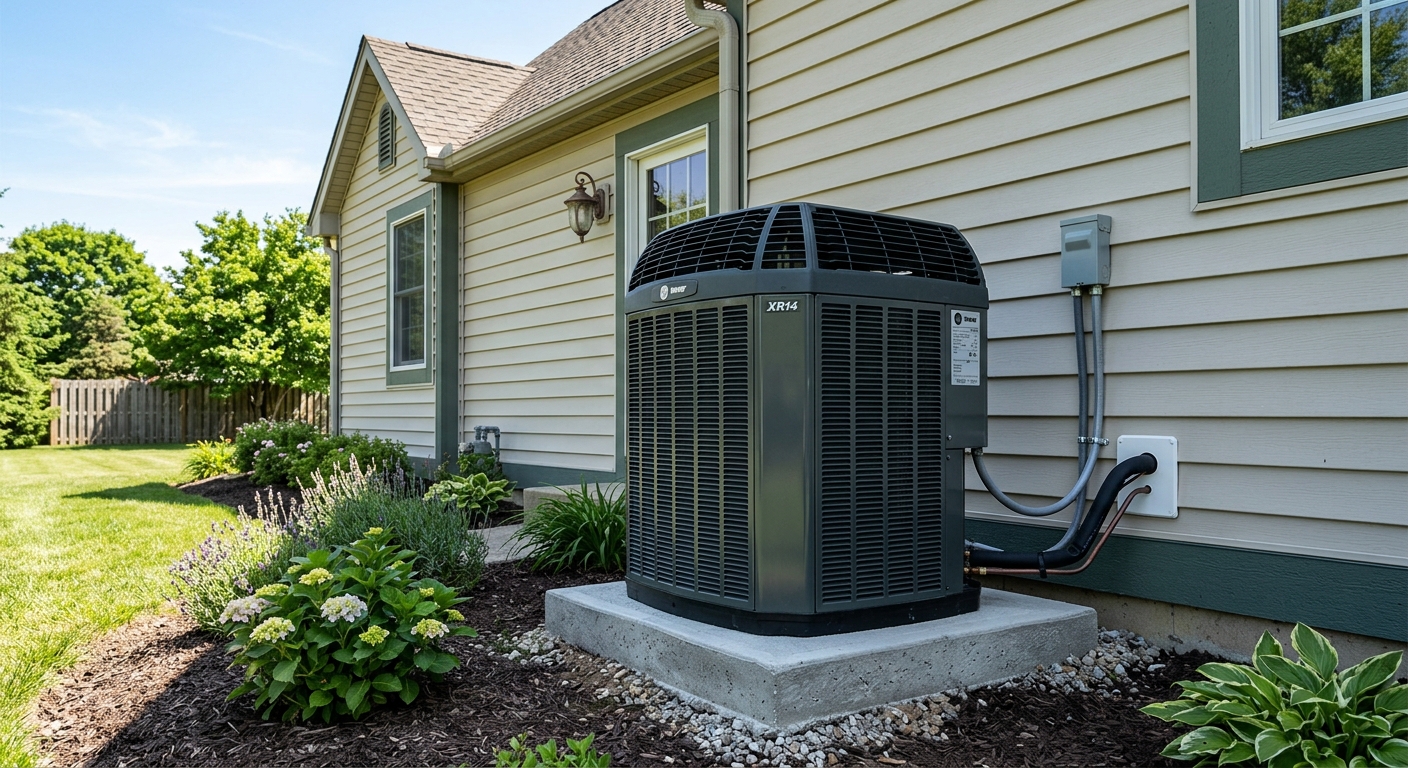
HVAC costs in Greene — 2026
Greene homeowners face a different HVAC landscape than metro areas. With a homeownership rate of 75.9% and nearly 40% of houses built before 1980 (U.S. Census Bureau, ACS 2024), most installs here are replacements, not first-time system installations. These older houses—mainly ranches and split-levels built between 1950 and 1980—often have original ductwork that wasn’t sized or sealed for modern equipment, which can drive up installation costs when upgrading or replacing HVAC systems.
This is a heating-dominated market. South-central Pennsylvania posts around 5,200 heating degree days per year, with just 1,250 cooling degree days. Greene’s winter design temperature reaches 12 °F and freeze-thaw cycling is the norm. That means heating efficiency, and the equipment’s ability to reliably produce heat in the cold, usually matter more here than chasing the highest cooling efficiency.
If your house still uses its original ductwork, don’t be surprised if you’re told it needs work or full replacement. Ductless is an option in properties never built with central air, but most jobs in Greene involve swapping out aging central systems and tuning up—or sometimes replacing—the ducts.
| System |
Best for |
Efficiency |
Price range (installed) |
| Central AC replacement (existing ducts) |
homes with sound ductwork |
16–20 SEER2 |
$5,100–$12,500 |
| Air source heat pump (ducted) |
year-round heating and cooling |
8–10 HSPF2 |
$8,200–$17,500 |
| Cold-climate heat pump (ducted) |
heat pump as primary heat |
9–11 HSPF2 |
$13,500–$17,500 |
| Ductless mini-split (single zone) |
additions, rooms without ducts |
20–30 SEER2 |
$3,300–$7,100 |
| Full duct system installation |
homes with no existing ducts |
— |
$9,200–$18,500 |
Installed estimates for a typical Greene home. Equipment tonnage, duct condition and electrical capacity move these more than brand.
Reducing the net cost of a Greene installation
If you’re looking to cut the cost of a new HVAC system in Greene, you’ll want to pay attention to three main sources: federal tax credits, utility rebates, and (sometimes) state-level programs. Here’s how they really break down in terms of dollars in your pocket—or still on the table.
Federal tax credits, like those currently available for high-efficiency heat pumps and central air conditioners, directly reduce your tax bill for the following year. If you qualify for a $2,000 tax credit, that comes off what you owe the IRS. But since it’s credit against taxes, you don’t see those savings right away. In contrast, rebates—most often from your electric utility—usually come as a check or bill reduction after installation, softening the upfront expense.
In Greene and the rest of Franklin County, West Penn Power delivers electric service, and UGI Utilities provides natural gas in some areas. Both typically offer efficiency incentives that update annually and can meaningfully lower the net price. Always check your utility’s efficiency program web pages directly, since rebate levels, qualifying equipment lists, and submission deadlines change every year. The ENERGY STAR rebate finder is another trustworthy, up-to-date resource.
If you’re quoted a rebate or credit based on an article, treat it as a ballpark—not a guarantee. Confirm eligibility with your contractor using current program terms, and don’t be shy about asking them to handle the paperwork if it’s offered. Every year, some homeowners miss out by assuming last year’s deal is still in place.
Maintenance that actually extends system life
A lot of what gets sold as “maintenance” isn’t worth your money in Greene, but a few basics do make a difference for system longevity and efficiency.
-
Filter changes – Change your filter at the interval recommended by your system’s blower, not what’s printed on the filter’s packaging. For most homes here, that’s every 2–4 months. Use a MERV rating that matches your blower’s specs. A high MERV filter in an older system can actually strain the motor and shorten its life.
-
Coil cleaning – A dirty indoor or outdoor coil cuts your efficiency and can freeze up your system in our long heating season or short but humid summer.
-
Condensate line – Keep it clear or risk leaks and water damage, particularly in cooling mode during Greene’s muggy stretches.
-
Refrigerant charge – This should be measured, not just topped off. If your system needs refrigerant, it has a leak. Simply adding more without finding and fixing the leak just kicks the can down the road.
Annual service plans can be worthwhile if they include coil cleaning, a full refrigerant check, filter swaps, and real performance testing. If it’s just a fast filter change and once-over, that’s not worth a contract. Schedule maintenance in late winter or very early spring—before emergency breakdowns have contractors scrambling, so you avoid both the rush and the premium labor rate.
Operating cost, not sticker price
In Greene, the annual cost to run your system usually matters more than the installation price alone. With 5,200 heating degree days and only 1,250 cooling degree days, the electric bill from heating is no small line item. West Penn Power’s delivery area covers Greene, so your electric rate is the key number when you’re doing the math.
Here’s how to estimate and compare:
1. Efficiency matters: Find the HSPF2 or SEER2 on your system. HSPF2 measures heating efficiency for heat pumps. SEER2 is cooling efficiency.
2. Annual load: Degree days let you estimate your home’s demand. For example: a typical home uses about 10,000–12,000 kWh per year for heating/cooling if fully electric.
3. Local rates: Your true cost per kWh or per therm is printed on your West Penn Power bill under “rate” or “price to compare.” Plug this number into your calculation—never use a rate from an outdated article.
Let’s walk through an example using sample numbers:
- Your current system uses 12,000 kWh/year @ $0.13/kWh — $1,560 in annual electric cost
- You upgrade to a ducted heat pump that is 20% more efficient. Projected usage is now 9,600 kWh/year — that’s $1,248/year, saving $312 annually
But remember: every duct leak, insulation gap, or bad installation can wipe out these savings. A high-efficiency system on leaky, unsealed original ducts common in Greene’s 1950–1980 housing will underperform a lower-efficiency unit on tight, well-planned ductwork. Always factor duct condition into the real operating costs.
Zone control without ductwork
Ductless mini-splits stand out in Greene, especially considering so many Franklin County ranches and split-levels were never built with air conditioning, or have ductwork best left untouched. If you’re adding a bedroom, finishing a basement, or are tired of battling a second-floor room that never cools or heats, a mini-split often beats ducted solutions on both cost and comfort.
Single-zone mini-splits ($3,300–$7,100 installed) are best for independent spaces—like a brand-new addition or trouble spot. Multi-zone mini-splits let you run multiple indoor heads from one outdoor unit, but be careful: a multi-zone setup usually loses some efficiency compared to a series of single-zone systems and may struggle in heat mode during a Greene deep freeze.
Indoor head placement is about finding a balance—out of the way visually, while still giving the unit enough airflow. Aesthetic objections are real; not everyone wants a white box on the wall. The outdoor unit also needs careful siting for drainage (condensate) and winter operation, since snow and freezing rain are common.
The bottom line: in houses that never had central air, or where the original ductwork is undersized, ductless offers real flexibility and usually a better value and comfort than trying to retrofit ductwork through finished plaster or tight spaces. Greene is more of a ductless market than you might think—the housing stock makes it so.
What a Pennsylvania HVAC contractor must hold
Pennsylvania does not issue a statewide license for residential HVAC contractors. In Greene and elsewhere in Franklin County, regulation is handled at the municipal level. That means your install may require a mechanical or building permit, or both, depending on your specific borough or township—Chambersburg, for example, typically requires one for a central system replacement.
Every HVAC contractor advertising for work in Greene must have a Home Improvement Contractor (HIC) registration issued by the Pennsylvania Office of Attorney General if the job is quoted over $500. You should verify this on the state’s hic.attorneygeneral.gov website. There is no separate state HVAC trade license for residential work, but federal law does require an EPA Section 608 certification for anyone handling refrigerant—meaning any legit installer must provide proof if asked.
All employers must also carry workers’ compensation, which you can verify through the WCAIS system (wcais.pa.gov). When you hire, make sure your contractor shows proof of this and general liability insurance—in writing, not just a handshake. Installers should also pull the correct permits before starting any work that goes beyond a thermostat or filter change.
What a real HVAC quote contains
A good HVAC quote in Greene isn’t just a brand sticker and a price. For a true apples-to-apples comparison, demand these details: model numbers for both indoor and outdoor units (matched, not just compatible), total tonnage and the load calculation used, line-set replacement or its certified reuse, the full scope of any electrical upgrades (including whether a panel change is required), condensate pump or drain, thermostat details, permit costs, and a commissioning report confirming correct refrigerant charge and airflow.
Warranties must be split between labor and equipment. You want to see every year spelled out, not just a copy of the manufacturer’s brochure. The quote should make clear whether new ductwork or remediation is included and whether any municipal permits and inspections are accounted for in the total.
Here’s how to judge what you’re looking at:
| Line item |
What to look for |
Red flag if… |
| Equipment |
model numbers, indoor and outdoor matched |
brand name only |
| Sizing |
load calculation attached |
matched to the old nameplate |
| Ductwork |
condition assessed, sealing scoped |
not mentioned |
| Electrical |
circuit and panel capacity confirmed |
assumed adequate |
| Line set |
replaced or documented as reused |
silent |
| Commissioning |
measured airflow and charge, documented |
no startup report |
| Warranty |
labour years stated separately |
manufacturer only |
| Permit |
included and priced |
'not needed' |
Frequently asked questions — HVAC installation in Greene
How often should I change my filter?
For Greene homes, the right replacement interval depends on your system’s blower and filter type, but a safe starting point is every 2–4 months. If you live in one of Greene's older houses (many from 1950–1980), a filter that’s too restrictive can actually stress your blower motor and lead to expensive repairs. For most homes, a mid-MERV filter changed seasonally offers the best balance. Replacement filters are a lot cheaper than a service visit to unclog a coil or replace a burnt-out motor. Even the best high-efficiency system—costing $8,200–$17,500 here—will lose years off its life if airflow is blocked.
How is a tax credit different from a rebate?
A tax credit, like the federal credit for a heat pump or high-efficiency central air in Greene, is claimed when you file your taxes—so you don’t see that savings until the following year, and it only lowers what you owe the IRS. For example, if you get a $2,000 tax credit on a system that costs $13,500, you pay full price at install and recover the credit at tax time. A rebate, on the other hand—typically offered by your electric or gas utility in Greene—comes as a check or bill deduction, sometimes within weeks of installation. Credits help in total budget math, but rebates actually reduce your upfront cost. Always check your current utility programs and the ENERGY STAR finder.
Does Pennsylvania license HVAC contractors?
Pennsylvania does not have a statewide HVAC trade license for residential work. In Greene, as elsewhere in Franklin County, regulation is handled at the municipal level, and every contractor working on projects over $500 must have HIC registration with the Pennsylvania Office of Attorney General. You can verify a contractor’s HIC number online. Any installer dealing with refrigerant (such as for a new mini-split, which runs $3,300–$7,100 here) must also hold EPA Section 608 certification. Always ask for proof of insurance and confirm that required municipal permits are actually pulled before work begins.
Do I need to be home during installation?
In Greene, it’s best if you can be present at the start and end of your HVAC installation or replacement. Installers will need access to both indoor and outdoor components—especially in our ranch and split-level homes where system locations may not be obvious and older ductwork often needs assessment. If you're having a high-value system installed (say, air-source heat pump for $8,200–$17,500), it's wise to be there to answer questions about thermostat location, electrical panel access, and any surprises behind finished walls. Most contractors can coordinate timing and updates by phone, but a brief walkthrough with your installer ensures no details get missed.
How much does ductwork add to an HVAC installation?
Ductwork costs are significant—especially in Greene, where nearly 40% of homes were built before modern central air became standard. A full duct system installation runs $9,200–$18,500 on its own, not including the price of the furnace, heat pump or AC unit. Even if you don’t need all-new ductwork, upgrades for sizing, sealing, or replacing failing sections can add thousands to a project. For homeowners considering a replacement, have your contractor inspect and measure the ducts up front—doing ductwork as a separate project after the HVAC can increase both cost and hassle.
Should I replace the furnace and AC at the same time?
In Greene households with central HVAC, replacing the furnace and air conditioner together can mean better matched equipment and higher efficiency—especially if both are 15+ years old. A typical central AC replacement costs $5,100–$12,500, but a dual-fuel or heat pump system upgrade may raise that to $8,200–$17,500. If your furnace or AC is much newer than the other, you can safely stagger replacements. However, aging ductwork—common in Greene’s older homes—should also be evaluated. Mismatched air handlers and coils can cost you comfort and efficiency, so ask for a load calculation and compatibility review before you decide.
How much does a new HVAC system cost in Greene?
For a standard central air conditioner replacement in Greene—with existing ducts in good condition—expect $5,100–$12,500 installed. Ducted heat pumps run higher, usually $8,200–$17,500. If you’re installing a full duct system (for example, in an older ranch that never had central air), the all-in price could reach $18,500, especially if electrical or panel upgrades are needed. Mini-split systems for individual rooms or additions start at $3,300–$7,100. The main swings in price come from ductwork condition, electric panel upgrades, and system capacity—not the brand alone.
How cold does it get in Greene and does that affect heat pumps?
Greene regularly sees winter temperatures as low as 12 °F, with pronounced freeze-thaw cycling. This has a direct effect on heat pump performance. Standard heat pumps can become less efficient or require supplemental electric heat during deep freezes, while cold-climate models—priced at $13,500–$17,500 installed—are designed to keep heating efficiently even below 20 °F. If you’re thinking about a heat pump as your primary system, discuss cold-weather performance and sizing with your contractor. If your home is older or lacks weatherization, you may need supplemental heat or extra air sealing to get the most from your investment.
What is SEER2 and how is it different from SEER?
SEER2 is the new industry standard for measuring cooling efficiency, replacing the old SEER rating. SEER2 adds stricter testing that better reflects real operating conditions—more like how an AC or heat pump will actually perform during Greene’s muggy summer days. Most new systems will list both numbers, but always compare SEER2. A typical central AC in Greene runs between 16 and 20 SEER2; higher numbers mean better efficiency and potentially lower electric costs. For reference, upgrading from a 13 SEER (old rating) to a 20 SEER2 system (spent $12,500) can cut cooling costs, but duct condition and installation still matter as much as the rating itself.