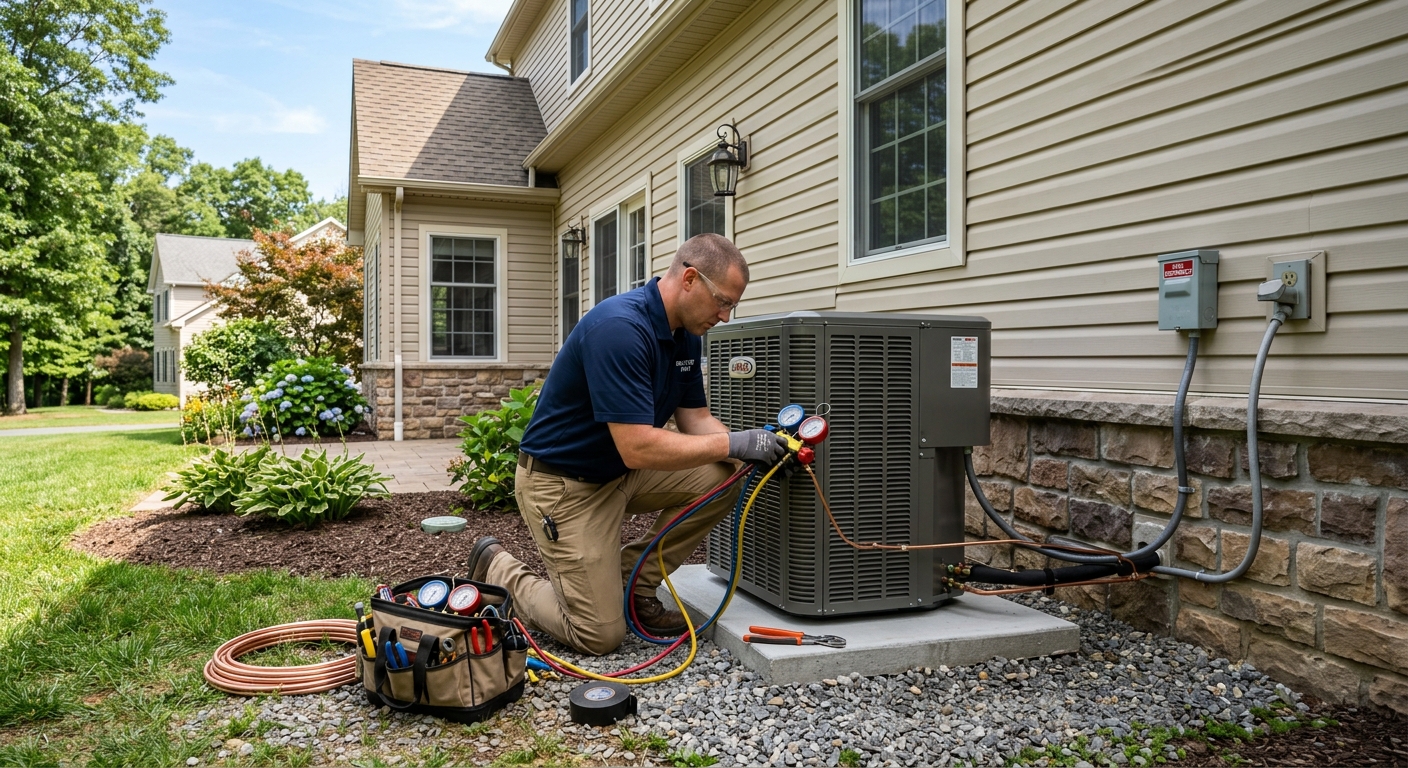
What a new HVAC system costs in Dallas
Dallas, Pennsylvania, sits at the intersection of a high homeownership rate and older housing stock (76.6% owned, 54.4% built before 1980), making this a retrofit and replacement heavy market rather than a landscape of new installations. Here, most central HVAC jobs mean working within the constraints of 1900–1940 coal-era homes, where boiler-to-forced-air conversions are common. This often means no existing ductwork or ducts that were never intended for modern air conditioning.
With 6,100 heating degree days and only 850 cooling degree days, Luzerne County and Dallas are solidly heating-dominated, but you cannot ignore summer — it gets warm enough that central AC or heat pumps are more than a luxury. These extremes shape system choice, as heating performance and duct integrity matter as much as cooling capability. Retrofitting older homes frequently means dealing with inadequate or nonexistent ductwork, so full duct system installations or ductless solutions are often considered. Expect pricing to swing widely based on duct conditions, equipment capacity tailored to the home, and the necessity (or not) of additional electrical upgrades.
| System | Best for | Efficiency | Price range (installed) |
|---|
| Central AC replacement (existing ducts) | homes with sound ductwork | 16–20 SEER2 | $5,100–$12,000 |
| Air source heat pump (ducted) | year-round heating and cooling | 8–10 HSPF2 | $8,200–$17,500 |
| Cold-climate heat pump (ducted) | heat pump as primary heat | 9–11 HSPF2 | $13,500–$17,500 |
| Ductless mini-split (single zone) | additions, rooms without ducts | 20–30 SEER2 | $3,300–$7,100 |
| Full duct system installation | homes with no existing ducts | — | $9,200–$18,500 |
Installed estimates for a typical Dallas home. Equipment tonnage, duct condition and electrical capacity move these more than brand.
Permits, licensing and inspections in Dallas
In Pennsylvania, HVAC work on single-family homes is regulated under the Pennsylvania Uniform Construction Code (UCC), based on the International Residential Code. For Dallas, this means permits and inspections happen locally—either by your municipality or, where the municipality has opted out, by the Pennsylvania Department of Labor & Industry. There is no statewide HVAC license—installers must instead hold a Home Improvement Contractor (HIC) registration, which is a consumer protection and insurance check, not a technical trade licence. Anyone working with refrigerants—installing, servicing, or disposing—is required at the federal level to have EPA Section 608 certification, regardless of local licensing.
If your job goes over $500 (which any replacement or install will), a written contract is required and you retain a 3-day right of cancellation under Pennsylvania’s Home Improvement Consumer Protection Act. Labor laws mandate workers’ compensation coverage for all employers; you can verify a contractor’s insurance and workers’ compensation via the WCAIS online system provided by the state. For mechanical permits, especially for central HVAC install or replacement, expect your contractor to pull a permit and coordinate the mandatory inspection—particularly in Wilkes-Barre and larger municipalities.
In summary: check contractor HIC registration, ensure federal refrigerant certification, and insist on appropriate local permits. Homeowners are not responsible for the permit, but should confirm it’s been pulled before work begins.
The decision point on an aging system
Most Dallas homeowners will eventually face the question: repair or replace? This is a heating-driven market, so reliability through winter matters more than wringing out one more summer’s use. As a rule, you repair when a system is under 10 years old and the failure is limited to a single part. If the repair bill climbs past a third the cost of replacement—or if the system is more than 15 years old—consider the math carefully. Key factors: cost of the fix, age of the system, refrigerant type (outdated R-22 systems don’t warrant major investment), and whether a major component like the compressor or heat exchanger has failed.
Replacement is not negotiable when the heat exchanger is cracked (this is a carbon monoxide risk) or when a compressor fails on an out-of-warranty, past-its-prime system. Energy efficiency only pays back with substantial run time. Given Luzerne County’s balance of cold winters and modest summers, the biggest savings often come from duct and envelope fixes, not just a new box. Always ask your contractor to spell out the long-term math before pushing for full replacement.
| Situation | Recommendation | Typical cost | Reasoning |
|---|
| Under 10 years, single component failure | Repair | $300–$1,200 | Most parts are available, system has remaining life |
| 10–15 years, repair over a third of replacement | Consider replacing | $5,100–$12,000 | Cost of repair approaches value of new system |
| 15+ years, any major failure | Replace | $5,100–$12,000 | Near or beyond typical service life |
| Cracked heat exchanger, any age | Replace immediately | $5,100–$12,000 | Safety hazard—CO risk |
| Compressor failure past warranty | Replace | $8,200–$17,500 | Very high cost, near total system value |
| Working system, high bills | Test ducts and envelope first | $300–$800 | Duct leakage or poor insulation is often the culprit |
What size system does a Dallas home need?
Proper sizing is the make-or-break factor for HVAC performance in Dallas. Oversizing isn’t a safety margin—it’s a mistake. It leads to short cycling, uneven temperatures, poor humidity control, and shortens the life of expensive equipment. That’s an expensive way to get less comfort and reliability.
A real load calculation—Manual J, to be specific—factors in your home’s square footage, window area, insulation, orientation, airtightness, and occupancy. The guideline here? Demand to know if your contractor has run a load calculation and ask to see it. If someone is sizing the new system off the old unit’s data plate, they’re just copying someone else’s error, which could be decades old.
In Dallas, system selection has to account for a winter design temperature of 4 °F. That’s the benchmark used in Manual J for heating capacity—making accuracy critical. Square-footage “rules of thumb” are especially wrong in Luzerne County’s mix of 1900–1940 stock and more modern builds. Retrofitted homes especially can’t be sized like new builds or southern homes. Take the time to insist on a real calculation. It’s the best way to avoid comfort and efficiency headaches that you can’t undo with equipment alone.
How to vet an HVAC contractor in Dallas
Installation quality overshadows every other variable—a skilled, attentive installer is worth more than a brand sticker on the equipment. In Dallas, you have a saturated HVAC contractor market due to the Scranton–Wilkes-Barre metro concentration, but volume doesn’t always mean vetted experience or skill.
Verify HIC registration through the Attorney General’s database, which is required for any work over $500. Technicians who handle refrigerants (which is almost anyone replacing or installing central HVAC or a heat pump) must have EPA Section 608 certification. Ask to see it. Insist on a detailed proposal that shows equipment make and model, not just “3 ton condenser.” Your job should include a Manual J load calculation—if it isn’t offered, take it as a sign of guesswork. At completion, you’re entitled to see airflow and refrigerant charge measurements; this commissioning step directly impacts your comfort and the system’s lifespan.
- Check contractor HIC registration at hic.attorneygeneral.gov
- Verify workers’ compensation status on WCAIS
- Request EPA Section 608 card for lead technician
- Does quote specify both model and tonnage?
- Is a Manual J load calculation included?
- Ask for a copy of the local mechanical permit
- Will the contractor be present for inspection?
- Get warranty terms for parts and labor, in writing
- Ask who handles follow-up warranty service
- Demand documentation of commissioning (airflow, charge)
- Ask about post-installation duct leakage test
Red flags: vague pricing (“about $9,000 for a 3-ton”), missing registration numbers, lack of local references or jobs, and anyone pressuring you to make a fast decision in a crowded, competitive Dallas market. If a contractor can’t hand over proof, move on—there’s no shortage of competition here.
Why your ducts may be the real problem in Dallas
In Dallas, the biggest comfort and efficiency culprit is often not your furnace or air conditioner—but your ductwork. Older Luzerne County homes, many converted from their original coal or oil heating, often have mismatched, leaky, or undersized duct systems—if they have them at all. Duct leakage can waste 20% or more of conditioned air, sending your comfort and money into the attic or crawlspace.
A duct blaster test is the best way to measure exactly how much air your ducts lose. If the test shows major leaks, you have two honest options in these older buildings: professionally seal the ducts (using mastic, not tape), or replace sections that are beyond saving. Returns are often undersized or choked by decades of dust and modifications, hurting system performance and driving up electric bills. Ducts running through unheated crawlspaces or attics are a constant source of energy loss—especially in our winters.
Because many homes in Dallas were never designed for central air, do not assume your ducts are “fine” just because the old system ran. The best move is to test and repair the ductwork before replacing your equipment. Putting a new, efficient system onto a leaky duct network just wastes money, and you can’t fix it after the fact without doubling your expense.
Maintenance that actually extends system life
For Dallas homeowners, smart HVAC maintenance is about what actually keeps the system running—not what fills a service plan brochure. Priority one: change the filter regularly, matching MERV rating to your blower’s specs. Too high, and you overwork the motor; too low, and you breathe dust year-round, especially during our long heating season.
Annual coil cleaning helps your system run efficiently and prevents musty odors when the AC finally kicks on. Clearing the condensate line matters for both central air and high-efficiency furnaces—the line can clog during muggy Luzerne County summers. Have a technician check the refrigerant charge as part of any AC or heat pump service; topping it off annually means there’s a leak, and that needs fixing, not hiding.
Are annual service plans worth it? Sometimes. If it includes a real inspection, cleaning, and full operational check, it can be peace of mind. Skip plans locking you into prepaid service calls without specifics on what will be done. The best time for preventative maintenance is spring and fall—scheduling outside of summer’s rush or winter emergencies gets you more attention, quicker service, and less waiting.
Frequently asked questions — HVAC installation in Dallas
When is the best time of year to replace HVAC in Dallas?
For most Dallas homeowners, spring or early fall is ideal for HVAC replacement. Contractors aren’t tied up with emergency repairs, so you get more flexible scheduling and, sometimes, better pricing. Luzerne County’s long heating season means you don’t want to risk being caught mid-winter with no heat, and our warm but short summers make pre-cooling season a smart window. Plan for both because a stuck project in April won’t be a crisis, but in January it absolutely is. Prices don’t necessarily drop in the off-season, but your options do—especially in a busy, contractor-heavy market. Expect to pay anywhere from $5,100–$12,000 for a replacement, and ask for bids early to avoid the rush.
Do I need a permit to replace HVAC in Dallas?
Yes, in Dallas and most Luzerne County municipalities, you’ll need a mechanical permit for HVAC replacements or new installs. Local enforcement handles this—Wilkes-Barre, for example, requires permits and inspections for central HVAC. Your contractor should obtain the permit, pay the fee, and schedule the inspection. Be wary of anyone who suggests “working around” permits to save money. It jeopardizes resale and insurance, plus our region’s code enforcement is active. Mechanical permits do not apply to plug-in heaters—those are exempt—but major system work always needs sign-off. Costs for permitted replacements typically run $5,100–$12,000; check that the permit fee is included in your quote and ask to see proof before work starts.
Is it worth switching from oil or propane to a heat pump?
Switching from oil or propane to an air source heat pump is increasingly common around Dallas as fuel prices swing and heat pump technology improves. For homes on the PPL Electric grid, potential savings on fuel and maintenance may justify the upfront cost, especially if your existing system is approaching end of life. However, remember northeastern Pennsylvania’s heating-dominated climate—your home needs a cold-climate heat pump rated for 4°F operation and adequate electrical capacity. Upfront costs range from $13,500–$17,500 for a cold-climate model with ductwork. Run the true math: factor in fuel prices, utility rates, and the cost of a serviceable backup if the coldest weeks outpace your main heat pump. Not every old home is a good candidate until you address insulation and duct leaks.
How long should an HVAC system last in Dallas?
In Dallas, a well-installed HVAC system typically lasts 15–20 years, sometimes longer with regular maintenance and a bit of luck. Northeastern Pennsylvania’s long heating season works equipment harder than in milder places, so aiming for 18–20 years is realistic if you keep filters changed and coils cleaned. If your system is past 15 years and facing a high-cost repair, investing in a new unit—$5,100–$12,000 for a central AC, or $8,200–$17,500 for a heat pump—may make more sense than pouring money into stopgap fixes. Always weigh age, repair history, and comfort before deciding.
What does HSPF2 measure?
HSPF2 stands for Heating Seasonal Performance Factor version 2—it's the metric required for heat pumps starting in 2023, and it reflects real-world heating efficiency over an entire season. The scale is adjusted to be more conservative than the old HSPF, so a heat pump rated 9–11 HSPF2 is a solid performer for Dallas, where heating is king. Unlike SEER2 (for cooling), HSPF2 shows how many BTUs you get per kilowatt-hour spent heating. When shopping for a ducted heat pump in Luzerne County, expect models running $8,200–$17,500 to hit the local efficiency sweet spot for winter.
How is a tax credit different from a rebate?
A tax credit reduces the amount of federal or state tax you owe, dollar for dollar, and usually gets applied when you file your next return—think of it as delayed savings. A rebate, in contrast, is money back (usually from the manufacturer, installer, or utility) you get after the system is installed and paperwork is processed. In Dallas or anywhere else in Pennsylvania, rebates from utilities or the state happen up front or a few weeks after, while tax credits won’t show up until April unless processed differently. Both may bring costs down, but they’re not immediate discounts. For example, a $8,200–$17,500 heat pump could net a tax credit plus a utility rebate—check eligibility before you sign.
Why do HVAC quotes in Dallas vary so much?
HVAC bids in Dallas often span a jaw-dropping range for several reasons: the condition of your ductwork, local labor availability, installer skill, and even how busy contractors are. In Luzerne County’s crowded HVAC market (centered on Wilkes-Barre and Hazleton), marketing overhead, load calculation effort, equipment tier, and how thoroughly the old system gets removed all impact your bottom line. Quotes for the same system can range from $5,100–$12,000 on central AC replacement and even higher for complex retrofits. Insist on line-itemized bids and ask for reasons behind any price jump—it’s not always about the equipment model.
Which utility serves Dallas?
Dallas and the rest of Luzerne County are served by PPL Electric Utilities for most single-family homes. If your project involves central HVAC that needs new wiring, this is who the contractor will coordinate with for service upgrades or meter fees. For natural gas heating, UGI Utilities is available in the Wilkes-Barre–Hazleton corridor, but many rural townships in Luzerne County also rely on propane or fuel oil. Your utility is critical for figuring out operating costs and, in some cases, rebate eligibility when you switch to heat pumps (which typically run from $8,200–$17,500 installed).
What does a ductless mini-split cost in Dallas?
A single-zone ductless mini-split—ideal for additions, older rooms without ducts, or recent conversions—costs between $3,300–$7,100 in Dallas, installed. The price reflects both the unit itself (which is highly efficient, running 20–30 SEER2) and the labor to mount, run refrigerant and electrical lines, and set the system up. Multiple indoor heads or zones increase the cost proportionally—factor that in if you plan to add comfort to multiple areas of your Luzerne County home. In older houses where running ducts is a non-starter, mini-splits are often the quickest and least invasive modern solution.