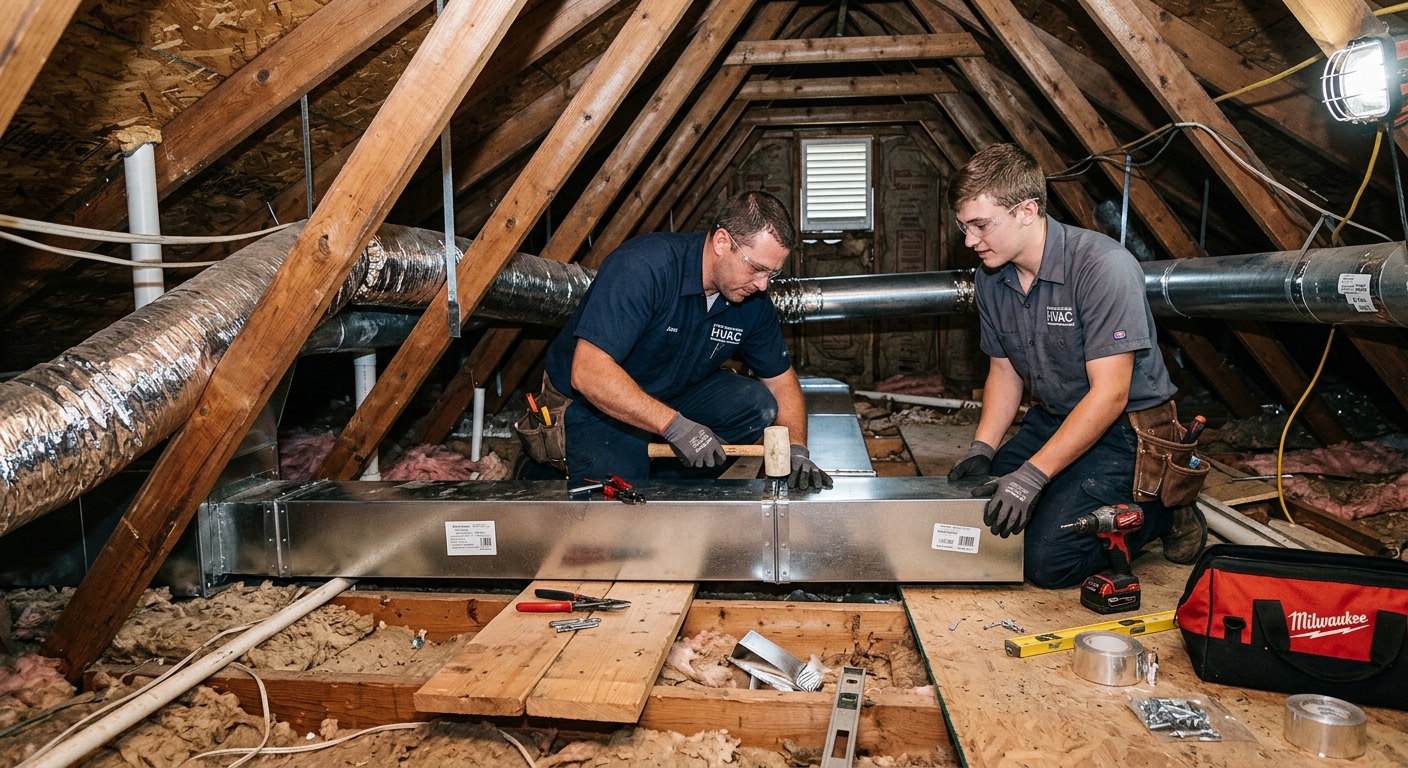
What a new HVAC system costs in Hilltown
In Hilltown, replacing or upgrading your home's HVAC system is typically a question of modernizing what you already have. The local homeownership rate sits at 84.7% (U.S. Census Bureau, ACS 2024), and with 54.0% of homes built before 1980, most jobs are not first-time installations but replacements or full-system retrofits. Post‑1960 suburban tract development in nearby Bensalem and Middletown means many houses have serviceable—but aging—ductwork, and owners are seeing the usual pattern: replace one piece and the rest soon follows, especially as original ducts weren't always designed for today's multi-stage or variable-speed systems. That brings ductwork upgrades into play more often than you’d think.
Southeastern Pennsylvania is a heating-dominated region, with about 4,800 heating degree days and just 1,450 for cooling. That should shape your decision: saving a little on a super-efficient air conditioner pays back slowly while an efficient heating system or heat pump delivers more annual value. With natural gas widely available, options range from traditional gas furnaces to modern ducted heat pumps for those considering a switch from oil or propane.
| System |
Best for |
Efficiency |
Price range (installed) |
| Central AC replacement (existing ducts) |
homes with sound ductwork |
16–20 SEER2 |
$5,800–$14,000 |
| Air source heat pump (ducted) |
year-round heating and cooling |
8–10 HSPF2 |
$9,200–$19,500 |
| Cold-climate heat pump (ducted) |
heat pump as primary heat |
9–11 HSPF2 |
$15,000–$19,500 |
| Ductless mini-split (single zone) |
additions, rooms without ducts |
20–30 SEER2 |
$3,700–$8,100 |
| Full duct system installation |
homes with no existing ducts |
— |
$10,500–$21,000 |
Installed estimates for a typical Hilltown home. Equipment tonnage, duct condition and electrical capacity move these more than brand.
The refrigerant change and what it means for repairs
If you’ve had your HVAC system serviced recently in Hilltown, you may have heard that there’s a shift away from R-410A refrigerant. New systems are now using lower global warming potential (GWP) refrigerants, like R-454B or R-32, as part of a national phase-down on high-GWP HFCs. Here’s the real-world impact: if your existing equipment uses R-410A, it remains perfectly legal to run and service. No code or regulation in Pennsylvania forces you to upgrade a working system.
However, R-410A refrigerant costs are starting to climb as new production dwindles—particularly if your system develops a major leak. When that happens, repairs can become expensive enough to call the value of the fix into question, especially for older equipment. The repair-versus-replacement line will shift over time: three years ago, a recharge was routine; now, if you have a major leak in a decade-old system, the economics of pouring more money into it are questionable. However, there’s no scenario where you must replace a functioning R-410A system just because of new refrigerant standards.
If you’re planning for a new installation or full replacement, expect your new system to use R-454B or a similar refrigerant. These offer performance and safety on par with R-410A and ensure long-term serviceability. But there’s no penalty or legal issue with running your current R-410A system in Hilltown; the change simply means heavier consideration if or when a costly repair comes up.
Rebates and tax credits for Hilltown homeowners
For Hilltown homeowners, incentives for HVAC replacements and upgrades fall into three categories: federal tax credits, utility rebates, and state-level programs. A federal tax credit directly reduces your income tax the next year (not your upfront spend), while a utility rebate, if available, will discount your invoice or deliver a check within weeks of installation.
The main electric and gas utility here is PECO Energy Company, serving Bucks County townships such as Bensalem and Bristol. These utilities usually run rebate programs for efficient heat pumps and air conditioners, but the specific models and efficiency levels covered change every year. State energy programs may offer further incentives, especially when federal or utility funds funnel through them, but again, these are subject to annual revision.
Because rebate names, qualifying products, and amounts change so often, the best advice is to check your utility’s official efficiency rebate page right before you sign a contract. The EPA’s ENERGY STAR rebate finder is another up-to-date source. Treat figures in articles like this one as ballpark starting points, not a guarantee—Hilltown homeowners should always verify current offers with PECO and through the ENERGY STAR site before finalizing a purchase. That’s the only way to avoid surprises and catch any limited-time specials.
What a Pennsylvania HVAC contractor must hold
Pennsylvania does not issue statewide trade licenses for HVAC contractors working on single-family homes. Instead, the state’s Pennsylvania Uniform Construction Code (UCC), which is based on the IRC, is enforced at the municipal level—either by your township’s code office or the state’s Department of Labor & Industry in towns that have opted out. In practical terms, hiring for work in Hilltown means making sure your contractor is properly registered at the state level and has the right permits locally.
All contractors must hold Pennsylvania Home Improvement Contractor (HIC) registration for any job above $500. You can verify HIC registration at hic.attorneygeneral.gov. For any work involving refrigerant—installation, repair, or replacement—federal law requires the installing company to have technicians with EPA Section 608 certification. Your township may require a mechanical permit and inspection for HVAC system replacements, so confirm this with your code office before work begins.
Pennsylvania requires all employers to carry workers’ compensation insurance, whether privately or self-insured. Homeowners can look up insurance status using the WCAIS system at wcais.pa.gov. Never accept a contractor’s assurances alone; always verify both HIC registration and insurance before signing.
Zone control without ductwork
Hilltown’s mix of older homes and post-1960 developments reflects what we see throughout Bucks County: some houses have ductwork that doesn’t reach every corner, while others were built before central air was the norm. Ductless mini-split systems solve room-by-room comfort problems in these environments without the mess of installing or extending ducts. They shine in additions, over-garage rooms, converted attics and basements, or anywhere duct installation would mean opening up finished ceilings.
A single-zone mini-split efficiently handles a problem spot—for example, a sunroom—at a total installed cost of $3,700–$8,100. Multi-zone systems can connect several indoor heads to one outdoor unit, saving space outside and simplifying line set routing. However, it’s important to know that when one outdoor unit serves many rooms, it can’t always match the comfort and efficiency of separate single-zone systems, particularly if each space has a wildly different load.
Aesthetics and drainage are practical concerns. The wall-mounted heads aren’t to everyone’s taste, and condensate needs to drain safely—meaning either a dedicated line or a small pump, especially in finished spaces. In older Hilltown homes or anywhere ducts were sized for heating only, ductless options often make more sense than tearing up plaster to install new ducts for modest gain.
The comfort problem that isn't temperature
Hilltown’s climate brings the full swing of Pennsylvania weather: humid, sticky summers and dry, cold winters. The 4,800 heating degree days per year mean dryness is a winter headache while the 1,450 cooling degree days make indoor humidity a summer battle.
Oversized air conditioners are a common culprit—when an AC cools the house too quickly, it shuts off before properly removing moisture, leaving you cool but clammy. The best fix is to size new equipment correctly instead of getting “more tonnage than you need.” For winter, whole-house humidifiers can help, but they must be regularly cleaned or replaced; neglect leads to mold or minerals clogging up the system fast.
High MERV filters capture more dust and pollen but can restrict airflow. Unless your system’s blower is sized for higher resistance, cranking up the MERV can put strain on older blowers—a common problem in upgrading old Hilltown systems. Newer, sealed homes may benefit from mechanical ventilation, but this is rarely necessary unless you’ve done extensive insulation and air-sealing.
A word of caution: high-end filtration or UV air cleaners are frequently oversold. Except in homes with specific allergy or asthma needs, basic upgrades like correct equipment sizing and fresh filter changes deliver most of the real comfort improvements you’ll notice.
Retrofit versus replacement in Hilltown
More than half of Hilltown’s homes were built before 1980 (U.S. Census Bureau, ACS 2024), putting most replacements solidly in retrofit territory—especially when original ductwork or electric panels are far from today’s needs. In these older houses, ducts were sometimes sized just for heating, not modern cooling loads. If you’re considering installing central AC or a heat pump, be aware: you may need new or upgraded ductwork to deliver full performance, which adds to cost but is sometimes unavoidable for comfort.
Insulation and window quality also affect sizing. Many late-century homes have modest insulation by today’s standards; that makes it all the more critical to get HVAC load calculations done right, rather than simply swapping the old unit for something of equal size.
If your house is one of the post‑1960 tract homes, you’re likely approaching the first replacement of builder-grade equipment. Most of this stock went in with generous sizing and minimum code compliance, sometimes resulting in high operating costs and uneven comfort. Now is the logical time to evaluate duct sealing, duct upgrades, and fresh insulation all in one go. For those considering switching from oil or propane heating, electric panel capacity should be confirmed before installing a heat pump, as older homes may lack the amps for a full-electric conversion.
Frequently asked questions — HVAC installation in Hilltown
Is an annual maintenance plan worth it?
Annual maintenance plans make sense in Hilltown if you want fewer breakdowns and longer system life, especially given how often system replacements run between $5,800–$14,000 for central AC alone. Regular cleanings and checks help spot failing capacitors, blower issues, and refrigerant leaks before you lose cooling or heating on a weekend. That matters in Pennsylvania’s heating-dominated climate—furnaces work hard through 4,800 degree days per year. But if you keep good records and are diligent about changing filters and scheduling one-off, out-of-pocket checkups, you don’t always need a contract. Just avoid plans that bundle in add-ons like duct cleaning or coil sanitizing every year; most homes aren’t helped by them. For a newer system under warranty, stick with at least an annual tune-up to stay covered and preserve your investment.
Do older Hilltown homes need ductwork replaced?
If your Hilltown home is one of the 54% built before 1980, your ducts may have been sized for a furnace or, in some cases, not sealed or insulated to today’s standards. That’s especially common in suburban tract homes where original ducts weren’t meant for central air but later adapted. Leaky, undersized, or poorly laid-out ductwork means uneven comfort, higher operating costs, and excessive system wear. Replacing ductwork isn’t always required: sometimes sealing, insulating, and minor reconfiguration do the trick cost-effectively. Full duct replacement typically runs $10,500–$21,000, so it's not a casual upgrade. If multiple rooms never heat or cool evenly, or if your existing ducts are falling apart or loaded with asbestos tape (occasionally seen in pre-1980 stock), it’s worth a professional assessment before pouring money into high-end equipment.
How much does a new HVAC system cost in Hilltown?
The full cost of a new HVAC system in Hilltown depends on what you’re starting with and your priorities. Replacing a central air conditioner where good ducts already exist will generally cost between $5,800–$14,000; full ducted heat pump conversions are higher, in the $9,200–$19,500 range. Homes with no prior ductwork—think some older or heavily renovated properties—see installed prices for a full duct system and equipment in the $10,500–$21,000 band. The biggest drivers are equipment size, duct condition, and electrical capacity, not just the brand sticker. Hilltown’s high homeownership rate means much of the market is replacement, which can simplify things but doesn’t always translate into lower costs if level or insulation improvements are needed.
What does HSPF2 measure?
HSPF2 stands for Heating Seasonal Performance Factor, version 2, and it’s the modern rating for how efficiently a heat pump provides heat over a season. In Hilltown’s long heating season (about 4,800 degree days), HSPF2 is more meaningful than ever. A higher HSPF2—say, 10 instead of 8—means more heat for every dollar spent on electricity, noticeable over a single winter. All the cold-climate and regular air source heat pumps covered here list HSPF2 in the 8–11 range, and those numbers translate to hundreds of dollars a year in savings over an old resistance or oil system. If you’re replacing or upgrading in Pennsylvania, HSPF2 is one number you can trust to directly affect your annual bill, especially when natural gas isn’t available and the heat pump is your main source.
Is it worth switching from oil or propane to a heat pump?
For Hilltown homes not served by natural gas—which is mostly rural Bucks County—switching from oil or propane to a modern cold-climate heat pump can pay off, especially as fuel prices stay volatile. Heat pump installation costs are in the $9,200–$19,500 range, but the long-term savings on fuel and the absence of annual maintenance for burners, oil tanks or propane regulators appeals to many. You’ll want to confirm your home’s insulation, window quality, and electric panel capacity before making the change—a 100-amp service sometimes won’t cut it for a full electric conversion. While oil furnaces push out high-temperature air instantly, today’s heat pumps work well in southeastern Pennsylvania’s climate, particularly with the right equipment choice. If your oil or propane furnace is approaching failure, it’s a smart time to look at the numbers side by side.
Do I need a permit to replace HVAC in Hilltown?
In most Bucks County townships, including Bensalem and surrounding areas, replacing or newly installing central HVAC equipment typically requires a mechanical permit. Hilltown will have its code requirements based on the Pennsylvania Uniform Construction Code. You’ll need your contractor to pull a permit for any major system upgrade or replacement, not just a simple thermostat swap. Mechanical permits ensure work is inspected for safety, duct design, refrigerant handling (for which a tech must have EPA Section 608 certification), and adherence to code. Contractors performing HVAC installations are required to register as Pennsylvania Home Improvement Contractors if the job exceeds $500—verify at hic.attorneygeneral.gov. This protects you under the Home Improvement Consumer Protection Act. Most reputable HVAC companies handle permits for you, but you should confirm before work begins. Doing it right may add a small fee, but it’s not the place to cut corners.
What does a ductless mini-split cost in Hilltown?
A ductless mini-split in Hilltown, especially for a single problem room or addition, generally runs $3,700–$8,100 fully installed. That price covers one outdoor condenser, one indoor air handler, and basic electrical connections, with efficient systems reaching up to 30 SEER2. Multi-zone setups that serve several rooms from one outdoor unit cost more—up to about double in some cases—but can be less efficient if all rooms aren’t used equally. Ductless is popular in Hilltown homes with old hot water or electric baseboard heat, or where extending ductwork would mean major remodeling. It’s also a way to avoid tearing up finished space, thanks to minimal wall penetrations. The install cost is higher than a window unit or portable AC, but for permanent comfort, zoning, and energy savings, it’s a solution that lasts decades with low maintenance.
How far ahead should I schedule in Hilltown?
In Hilltown and the broader Bucks County area, summer and winter are always the busiest seasons for HVAC contractors. If you’re looking for a new install, plan to schedule your job at least three to six weeks in advance—sometimes longer during the first heat wave or cold snap. The saturated Philadelphia-area HVAC market means more choices, but periods of high demand can still leave you waiting, especially for highly rated or smaller, owner-operated shops. Emergency replacements may be possible in a few days, but you’ll have fewer options and less negotiating power. For more complex projects, such as full duct system installations (in the $10,500–$21,000 range), extra lead time is needed for permits, equipment delivery, and coordination. The off-season (spring and fall) is when you’re most likely to get prompt service and a thorough install.
How is a tax credit different from a rebate?
A tax credit lowers your total federal tax owed for the year in which you install qualifying equipment, while a rebate—especially from PECO or another utility—cuts your out-of-pocket cost almost immediately. In Hilltown, when you install a qualifying air source heat pump (at a cost of $9,200–$19,500), a utility rebate is often paid within weeks, directly reducing what you pay installers or what you owe on your card. A tax credit, on the other hand, doesn’t show up until you file your next federal return; it only helps if you have enough tax liability to use it. Most Hilltown homeowners benefit from both, but keep in mind that rebate amounts and program rules can change every year. For the most current programs, always check the PECO Energy Company efficiency page and the official ENERGY STAR rebate finder before you buy or sign a contract.