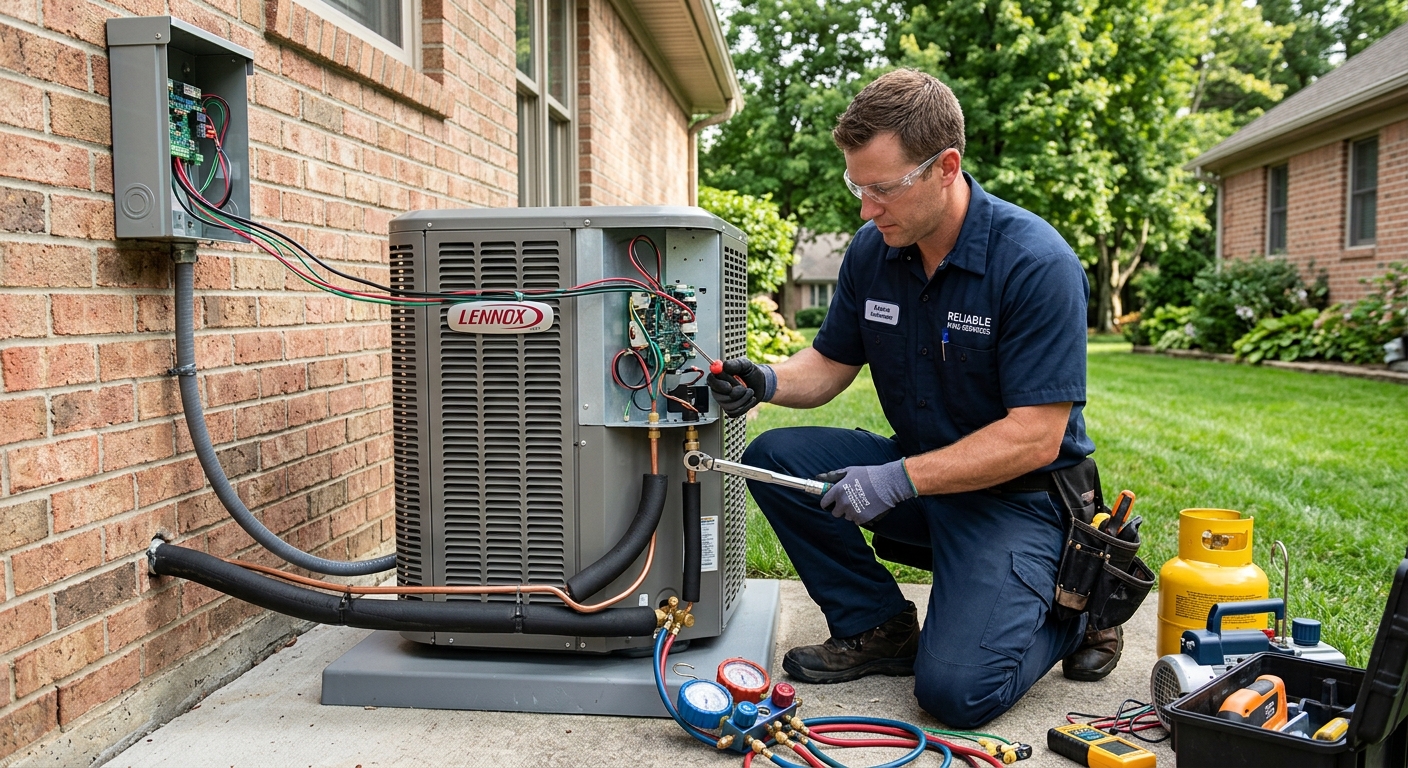
HVAC costs in Whitehall — 2026
Whitehall’s housing is older than most of Pennsylvania (84.0% built before 1980, U.S. Census Bureau, ACS 2024), and most homes here are owner-occupied single-families. That means HVAC work in Whitehall is rarely a new install in open framing—it’s usually a retrofit, with all the wrinkles of aging ductwork and electrical service. Ducts, when present, are often tight and were never designed for modern high-static, variable-speed blowers. If your home is pre-1960, expect extra time and cost for any system upgrade.
This region gets far more cold than heat: southwestern Pennsylvania averages 5,600 heating degree days and just 1,050 cooling degree days yearly. That flips the usual HVAC priorities. While central air is common, reliable and efficient heating is non-negotiable—an important consideration when weighing whether a heat pump or furnace makes more sense for your home.
| System |
Best for |
Efficiency |
Price range (installed) |
| Central AC replacement (existing ducts) |
homes with sound ductwork |
16–20 SEER2 |
$5,000–$12,000 |
| Air source heat pump (ducted) |
year-round heating and cooling |
8–10 HSPF2 |
$7,900–$17,000 |
| Cold-climate heat pump (ducted) |
heat pump as primary heat |
9–11 HSPF2 |
$13,000–$17,000 |
| Ductless mini-split (single zone) |
additions, rooms without ducts |
20–30 SEER2 |
$3,200–$6,900 |
| Full duct system installation |
homes with no existing ducts |
— |
$8,900–$18,000 |
Installed estimates for a typical Whitehall home. Equipment tonnage, duct condition and electrical capacity move these more than brand.
What a Pennsylvania HVAC contractor must hold
Pennsylvania does not issue a statewide HVAC license for residential contractors. Instead, residential HVAC work—including all work in Whitehall—is locally regulated. Mechanical permits are managed and enforced by individual municipalities or, in places that opt out, by the state’s Department of Labor & Industry. The critical step for a homeowner is to make sure your contractor has an active Home Improvement Contractor (HIC) registration if the contract is over $500. This is handled by the Pennsylvania Office of Attorney General; you can check a contractor’s status at hic.attorneygeneral.gov.
Because refrigerant is always involved in air conditioning or heat pump installations, the contractor must hold federal EPA Section 608 certification—this isn’t optional and applies regardless of local registration or permit status.
You should also verify that any HVAC company doing business in Whitehall carries valid workers’ compensation insurance. This is mandatory for all employers in Pennsylvania and can be checked through the WCAIS system (wcais.pa.gov). If they hesitate, move on.
Permits for major HVAC work are mandatory within the City of Pittsburgh, and following the Pennsylvania Uniform Construction Code is required by law. Be suspicious of anyone offering to do the job “off permit”—the risk is always on your side. Proper permits and inspections protect your investment and your safety.
What you can actually claim on a heat pump here
If you’re upgrading to a heat pump in Whitehall, you’ve probably seen mention of federal, state, and utility incentives. Here’s the honest version: federal tax credits are available for qualifying high-efficiency heat pumps, but these work as credits on next year’s tax return—they won’t reduce your upfront bill.
Cash rebates, on the other hand, usually flow from your utility—Duquesne Light Company (electric) or Peoples Gas (gas)—and reduce your invoice amount shortly after install. These rebates change every year, with amounts depending on equipment efficiency, system type, and occasionally household income.
Pennsylvania sometimes sponsors special efficiency programs, but details come and go and generally funnel through your local utility. For the most current and relevant incentive programs, visit your electric or gas utility’s home energy efficiency program web page. The ENERGY STAR rebate finder is also worth checking for stacking offers or one-time promotions: https://www.energystar.gov/rebate-finder.
Online articles—even from this year—will reference specific dollar figures or program names, but these rarely match what’s live at the time you buy. Start with your local utility, confirm with your installer, and use any article estimate as a ballpark, never a guarantee.
Refrigerant rules and your existing system
The refrigerant used in your home’s AC or heat pump matters most when you’re deciding whether to fix or replace it. New residential systems sold for 2026 installs in Whitehall are landing mostly with lower-GWP refrigerants like R-454B or R-32 as required by evolving federal rules. Meanwhile, the R-410A systems that dominated the last 15 years remain perfectly legal to own, run, and repair. You are never required to scrap a working system just because its refrigerant is being phased down.
However, R-410A is going to become more costly to buy as these new rules kick in, simply due to supply tightening. For a Whitehall homeowner, this means that a simple top-off or repair today might be affordable—but if you spring a refrigerant leak in a few years, the repair bill could run closer to the threshold where replacement makes sense, especially for an older or unreliable system.
To sum up: your current system can be legally serviced, but as replacement refrigerants take over, the long-run economics shift. If your system is working and not leaking, you do not need to do anything. When it does leak, expect a frank price conversation. The change is about refrigerant cost and repair practicality, not legality.
Service plans: worth it or not?
Service plans get heavily marketed in Whitehall, but not every home needs one. What matters most is changing your filter on schedule (every 1–3 months is typical here, but check yours), and making sure you use a MERV rating that won’t stress your blower if you have older ductwork—too high a MERV in an older system can lower efficiency or even damage components.
Coil cleaning and clearing the condensate line are valuable, but they don’t need to happen every single year unless you share space with pets or heavy dust. More important is checking refrigerant charge: a system that consistently “needs a top up” has a leak, and simply adding more is not maintenance—it is a temporary patch for a problem that is getting worse. Insist your tech finds the leak.
Annual plans are worth it only if you value priority scheduling and your unit’s history justifies yearly attention. Otherwise, you can accomplish most maintenance checklist items paying for one-off service every 18–24 months. Schedule tune-ups for March or September, before the peak heating or cooling season, to avoid waiting while the contractor handles emergencies.
Heat pump or furnace: what makes sense in Whitehall
Whitehall is a heating-driven market—5,600 heating degree days and a winter design temperature of 8 °F push any HVAC decision toward reliability in the coldest months. Old wisdom said heat pumps stop working in the 20s, but that’s out-of-date for modern cold-climate models: most maintain real heating capacity well below freezing. But even top-performing units begin to lose ground as temperatures drop below 8 °F, which is why dual-fuel setups—pairing a heat pump with a gas furnace—are still common in this county.
Natural gas is widely available in Allegheny County. If your Whitehall home already has gas, deciding between a gas furnace or a high-efficiency cold-climate heat pump comes down to your preferences for operating cost, comfort, and decarbonization. For homes stuck with propane, oil, or high electric rates, heat pumps become more appealing, especially if you can improve insulation and air sealing first.
If your ducts are in poor shape or non-existent, ductless mini-split systems offer zone control and excellent efficiency, but the initial cost is higher if you need to retrofit multiple rooms. A traditional furnace is still the clear winner for drafty, poorly insulated homes where upgrading the envelope isn’t foreseeable.
| Option |
Installed cost |
Operating cost here |
Best when |
Incentive eligible |
| Gas furnace + central AC |
$5,000–$12,000 |
low with gas service |
existing gas service, coldest zones |
AC may qualify |
| Ducted heat pump (cold climate) |
$7,900–$17,000 |
lower, all-electric goal |
good envelope, all-electric goal |
yes, if ENERGY STAR |
| Dual fuel (heat pump + gas backup) |
$13,000–$17,000 |
optimized for cold snaps |
gas on site, deep cold spells |
yes, part may qualify |
| Ductless multi-zone |
$8,900–$18,000 |
zone-based; variable |
no ductwork, zone control |
yes, often |
Ductwork: the part nobody quotes properly
In Whitehall’s older homes, ducts are either original (pre-1960, designed for a different era of furnaces) or added during remodels—rarely both efficient and airtight. It’s common for 20–40% of air to be lost through leaks, which can waste months of energy a year. A duct blaster test measures this leakage and is cheap compared to what it can save you—it pressurizes your ducts and quantifies how much air escapes versus what’s delivered to your rooms.
Sealing attics and crawlspaces makes a real difference if your ducts run through these unconditioned areas. Undersized or missing returns are another invisible killer for system performance, causing noisy blowers and poor airflow—if your system struggles in extreme weather, this is a likely culprit. Full duct replacement becomes necessary when existing runs are too small, rusted, split, or impossible to seal cost-effectively.
Given how many Whitehall homes were built before central air became common, a proper assessment up front pays dividends. Don’t wait until your new system is being installed to find out your ductwork is incompatible or leaky. Insist on a duct test and evaluation before investing money in new equipment. Skipping this step is how an $8,900–$18,000 install turns into two visits and regret.
Frequently asked questions — HVAC installation in Whitehall
Do older Whitehall homes need ductwork replaced?
For most Whitehall homes—where 84.0% were built before 1980—the short answer is: sometimes. Many older homes have ductwork designed for furnaces, which can be too restrictive or leaky for modern high-efficiency systems. Visible rust, tape, or disconnected runs are red flags. A proper duct blaster test usually costs a few hundred dollars, but it’s the only reliable way to decide between repairing, sealing, or full replacement. If new ducts are needed, expect to pay $8,900–$18,000 for a full system. Always verify duct condition before equipment is replaced.
Does Pennsylvania license HVAC contractors?
Pennsylvania does not issue a statewide HVAC trade license for residential work. Instead, residential contractors must have a Home Improvement Contractor (HIC) registration for jobs over $500, which you can check at hic.attorneygeneral.gov. Local municipalities—like the City of Pittsburgh—enforce their own mechanical permit requirements. EPA Section 608 certification, required for handling refrigerant, is a federal mandate. Remember: just because someone advertises HVAC services does not mean they’re registered and in compliance. For an install worth $7,900–$17,000, it pays to verify.
Why are my Whitehall energy bills high with a new system?
High bills despite a new system often trace to the “invisible” parts: old, leaky ductwork, missing insulation, or incorrect installation. In pre-1960 Whitehall homes, duct leakage and undersized returns sap efficiency, sometimes wasting 20–40% of heating or cooling. Even with a heat pump or high-SEER AC costing $5,000–$12,000, energy is lost if the air never reaches your rooms. Ask for a duct leakage test and have your technician walk through possible envelope improvements—equipment isn’t everything in these older houses.
Can a heat pump heat my house without backup?
In Whitehall’s climate—with a winter design temp of 8 °F and 5,600 heating degree days—modern cold-climate heat pumps can provide primary heat, but capacity and efficiency drop as the outside temperature falls to single digits. In well-sealed, insulated homes, a ducted cold-climate heat pump installed for $13,000–$17,000 can handle virtually all heating needs. If your home is drafty or poorly insulated, or if you lose heat in deep cold snaps, a backup source—like a gas furnace or electric strips—is recommended as a safety net.
What is commissioning and why does it matter?
Commissioning is the final, critical step in a new HVAC installation. It means the contractor tests every piece of your system—airflow, refrigerant charge, safety controls, thermostat settings—to be sure it runs as designed. For Whitehall homes, where systems are often installed as retrofits, skipping commissioning leads to noisy airflow, uneven temperatures, and higher bills. Think of commissioning as quality control: you’re paying $7,900–$17,000 for a system, and you deserve one that’s dialed in for your home, not just plugged in and left alone.
How much does ductwork add to an HVAC installation?
If your Whitehall home needs brand new ductwork—common in homes that never had central heat or whose ducts are beyond repair—budget $8,900–$18,000 just for the duct system, in addition to equipment costs. This reflects the complexity of retrofitting older floorplans, running ducts through basements or attic spaces, and the need to meet today’s air delivery standards. In some cases, mini-split systems with no ductwork can be less invasive and less expensive if only a few rooms need coverage.
What does a heat pump cost installed in Whitehall?
The installed cost of a ducted air source heat pump in Whitehall runs from $7,900–$17,000, with typical jobs landing near $13,000, depending on system size, efficiency, and the condition of your ducts and electrical service. Cold-climate or dual-fuel heat pumps cost more, especially if paired with gas backup for deep winter cold. Always ask for a load calculation and check if existing ductwork will support the new pressures and flows required by a heat pump system.
What HVAC tax credits are available to Whitehall homeowners?
Federally, Whitehall homeowners can claim tax credits for certain high-efficiency systems—heat pumps, central AC, advanced furnaces—installed in their principal residence. These credits reduce next year’s tax bill, not this year’s invoice. Utilities like Duquesne Light Company or Peoples Gas may also offer rebates, which reduce costs on the front end. The specific dollar amounts change every year and depend on equipment efficiency. For a typical system costing $13,000–$17,000, check the ENERGY STAR rebate finder and your utility’s energy efficiency page for current, stackable offers before committing.
What MERV filter rating should I use?
In Whitehall’s older homes, most HVAC systems and ducts weren’t designed for ultra-high resistance filters. A MERV 8 filter is usually a safe bet for good dust, pollen, and pet dander removal without overworking your blower. If you have family members with allergies or sensitivities, bump to MERV 11, but monitor your system for airflow issues. Above MERV 11, you risk restricting airflow in homes with older, undersized returns (very common here). Replacement filters average around $10–$20, but protecting a system worth $7,900–$17,000 is worth that small recurring cost.