Penn heating and cooling prices by system type — 2026
In Penn, most homes are owner-occupied, with nearly 90% ownership and a predominant single-family housing stock built before 1980. This means most residents face the realities of keeping an older home comfortable year-round, while navigating aging HVAC infrastructure. Because over half the homes predate 1980, many are already on their second or third round of HVAC equipment—making this a replacement market. Much of Penn's housing has retrofit ductwork and electrical upgrades layered onto the original construction, and it's common for those older ducts to be sized for heating, not cooling.
With 5,600 heating degree days and just 1,050 cooling degree days, Penn is a heating-dominated market. That shifts the focus: while summer comfort matters, reliable and efficient winter heat is the backbone of almost every HVAC decision in Westmoreland County. The workhorses here are systems built for cold weather—whether that's a high-efficiency furnace, a ducted heat pump, or a mini-split for homes without ducts in every room.
Upgrades here aren't just about efficiency: the condition and capacity of existing ducts, panel amperage, and municipal code enforcement all affect what kind of unit is practical—sometimes as much as budget does.
| System |
Best for |
Efficiency |
Price range (installed) |
| Central AC replacement (existing ducts) |
homes with sound ductwork |
16–20 SEER2 |
$5,300–$12,500 |
| Air source heat pump (ducted) |
year-round heating and cooling |
8–10 HSPF2 |
$8,400–$18,000 |
| Cold-climate heat pump (ducted) |
heat pump as primary heat |
9–11 HSPF2 |
$13,500–$18,000 |
| Ductless mini-split (single zone) |
additions, rooms without ducts |
20–30 SEER2 |
$3,400–$7,400 |
| Full duct system installation |
homes with no existing ducts |
— |
$9,500–$19,000 |
Installed estimates for a typical Penn home. Equipment tonnage, duct condition and electrical capacity move these more than brand.
Penn's housing stock and its HVAC needs
Penn's neighborhoods are overwhelmingly made up of homes built before 1980—over half, according to census records. That means many houses here, from postwar capes to brick ranches, were never laid out with central air in mind. Original ductwork was put in for heating, not cooling, and often needs resizing or sealing to handle modern air conditioning without issues like poor airflow or noisy vents. Where ducts are missing (not uncommon in finished attics or room additions), installation can get costly, both in dollars and drywall dust.
Many homes from this era also skimped on insulation by today's standards. You might see drafty windows, minimal wall insulation, and leaky attic hatches—factors that will directly affect how hard your HVAC has to work (and how large a system you actually need). Electrical panels can be another sticking point: all-electric systems like heat pumps may need more amps than a mid-century subpanel was ever designed to handle, so check your box before you leap. Gas equipment makes use of existing chimneys or flues, but older flues may need relining or repairs if they weren't built for new, high-efficiency furnaces.
If your home is newer—maybe in one of the late-1990s subdivisions—you're likely facing the first full replacement of builder-installed systems now. Those original units were often sized on the generous side, so a good contractor will check your actual needs before simply swapping in another oversize model. Every upgrade decision in Penn should start with the bones of the house.
Separating installers from equipment sellers
In Penn, brands are less important than workmanship. The same model heat pump can run for 20 trouble-free years in one home—or fail at year five in the next—depending on how the ductwork was sealed, the refrigerant charged, and airflow set up during installation. Old homes here, with their mix of found ductwork and electrical quirks, magnify those differences. Picking a contractor is about more than name recognition.
Before you sign, check that the business holds Home Improvement Contractor (HIC) registration with the Pennsylvania Office of Attorney General, and that every tech handling refrigerant has a valid EPA Section 608 card. List out your HVAC wants, then see if the quote covers everything: proper equipment model numbers (not just capacity), an in-home load calculation, the price in writing.
Asking if they’ll document commissioning—the startup process that confirms your system is set up right—separates pros from equipment pushers. In a moderate, suburban Pittsburgh market like Westmoreland County, the choices are plenty, and the best contractors measure airflows, refrigerant charge, and write down what they did before signing off. If you get only a brand brochure and a price, keep shopping.
- Verify HIC registration at hic.attorneygeneral.gov
- Confirm personal EPA 608 certification for refrigerant work
- Ask for written proof of workers' compensation (WCAIS database)
- Require a manual load calculation — not just rules of thumb
- Insist on a detailed line-item quote with model numbers
- Check for duct inspection or airflow measurement in the quote
- Ask about commissioning: what’s tested and documented?
- Read the contract carefully—3-day cancellation period by law
- Avoid any contractor “waiving your insurance deductible”
- Request at least two local references from past installs
- Look for written warranty details, not verbal promises
Red flag: in a market with a steady flow of HVAC work but no massive boom, the lowest bidder with no local references is often just selling boxes—not a system tailored for your home.
Permits, licensing and inspections in Penn
Residential HVAC work in Penn falls under the Pennsylvania Uniform Construction Code (UCC), but the state doesn't issue an HVAC license. Instead, rules are enforced by the Greensburg Department of Code Enforcement or your township’s code office, and every major replacement or new install will need a mechanical permit and inspection from your local municipality. For the homeowner, this means: always ask your contractor who pulls the permit and schedules the inspection—never assume it’s automatic.
In Pennsylvania, Home Improvement Contractor (HIC) registration is mandatory for any job over $500, and you can confirm this at hic.attorneygeneral.gov. There’s no separate state-issued trade license for HVAC, plumbing, or electrical, but many municipalities in Westmoreland County require their own mechanical permits for installs and replacements. The contractor handling refrigerants must have EPA Section 608 certification, regardless of local licensing.
Worker’s compensation is mandatory for all employers in this field; ask to see proof and verify it online through the WCAIS system (wcais.pa.gov). Insurance protects you if something goes wrong on-site—so don’t skip the step of confirming that your contractor is both registered and properly insured. Lead-safe rules (EPA Lead RRP) apply for homes built before 1978 if there’s any disturbance of painted surfaces.
The comfort problem that isn't temperature
Penn sits in a heating-heavy climate with sharp freeze-thaw cycles and humid summers. While degree days sway in favor of heating, many homeowners discover that temperature is only half the comfort equation. Dry winter air can pull the moisture out of both your skin and your hardwood floors, while muggy summer days make a home stuffy and sticky—even with the AC cranked.
A common but misguided fix is oversizing the air conditioner. In reality, a too-big unit cools the house too quickly to dehumidify properly—leaving you with cold, clammy air. Whole-house humidifiers help, but come with a maintenance catch: their water panels (and drains) need regular cleaning, or you’ll swap dry air for mold and mineral buildup. Air cleaners are often sold with talk of “hospital level” MERV filters, but filters with higher MERV ratings also strain the blower unless your system is sized for them.
For newer, tighter homes, mechanical ventilation (like an ERV or HRV) makes a difference—but older homes usually leak enough that these upgrades rarely pay for themselves. Be wary of expensive “air quality packages” that promise miracles. For most Penn homes, good filtration plus attention to humidity solves 90% of comfort complaints.
Operating cost, not sticker price
In Penn, heating dominates utility bills. With roughly 5,600 heating degree days—more than five times the cooling degree days—it’s more important to scrutinize your heating solution than your air conditioner. Here’s how to compare system proposals in real budget terms, using your own West Penn Power bill:
First, look for the AFUE, HSPF2, or SEER2 rating on your proposed equipment. That number converts to dollars when multiplied by your annual heating or cooling load—the product of degree days and your home's heat loss or gain. For example, a current electric rate on your own bill (from West Penn Power) multiplied by the projected annual kilowatt-hour use gives you a real-world operating cost. If two heat pumps claim 9 or 10 HSPF2, they’ll use about 10–12% less energy per year for heating compared to the previous generation. But plan for some fudge room: utility rates change, insulation quality varies house to house, and a poorly sealed or leaky duct system can double your actual cost compared to what’s on the brochure.
Do your own math: Total kWh used for heating (from contractor’s estimate or a similar home), times your actual $/kWh from your West Penn Power bill, divided by the unit’s efficiency. If you use propane or oil, calculate using gallons and the furnace’s AFUE. Remember, a high-priced, high-efficiency system can't overcome drafty windows or duct leaks. In practice, a well-installed mid-efficiency system on sealed ducts often beats a “premium” system that’s fighting poor airflow or leakage.
Service plans: worth it or not?
Annual service plans are hit or miss in Penn. Most homes depend on their HVAC for serious winter heat, so you don’t want to ignore maintenance entirely—but much of what’s packaged in a “plan” is easy DIY or rarely needed. The one thing you absolutely can’t skip: regular filter changes, sized and rated correctly for your blower—not just the highest MERV you can buy. For most homes, MERV 8–11 gets the job done without taxing the system.
Professional checks—like coil cleaning and condensate line flushes—are a good investment every 1–2 years, especially with older equipment. Refrigerant “top-offs,” on the other hand, are a red flag; if your system is low, it has a leak, and adding more is just kicking the can.
As for annual plans: if the terms cover real annual tune-ups and priority scheduling during Penn’s busy seasons (outages on 8°F winter mornings fill up every tech within 30 miles), they can offer peace of mind. Plans that simply promise “discounted repairs” or “front-of-the-line service” with hefty up-front costs don’t usually pay for themselves for a well-maintained, mid-age system. Best to schedule tune-ups just before the heating or cooling season peaks to avoid the backlog of emergency calls.
Frequently asked questions — HVAC installation in Penn
What is commissioning and why does it matter?
Commissioning is the process your installer should follow to make sure each part of your new heating or cooling system is actually operating as designed. For Penn homeowners, this is crucial. The process goes beyond just switching the unit on—it means measuring airflow, confirming that the refrigerant is properly charged, and validating that every control works as intended. It's especially important in older Penn homes with retrofit ductwork, where airflow can be unpredictable. Skipping commissioning is one reason two identical air conditioners (each costing $5,300–$12,500) can deliver completely different comfort and longevity. Ask your contractor for written, measured results from their startup checks—not just a “system looks good” sign-off.
Is an annual maintenance plan worth it?
For many Penn households, an annual maintenance plan can make sense, especially when the plan includes a real tune-up before heating season—and you get priority scheduling during those January deep freezes. Plans that only offer a discounted rate on repairs don’t save you much if you rarely need service. Since filter changes (an absolute must) and basic condenser cleaning are simple jobs many homeowners can handle, consider the plan’s price against what you’d pay for just an annual service visit, which typically lands in the $100–$300 range, though plans with more coverage may cost considerably more. Ultimately, a reasonable plan can keep your system running at its best, but don’t overpay for “extras” you don’t need.
How do I verify an HVAC contractor's insurance?
In Pennsylvania, and especially in Penn, any business performing HVAC work must carry workers’ compensation insurance for employees. The surest way to check is to request a certificate of insurance directly from the contractor—don’t take their word for it. Then, verify their registration and insurance status through the WCAIS system (wcais.pa.gov), as listed in the state's requirements. This matters: without proper coverage, you could end up on the hook for injuries that happen on your property. Good contractors expect—and welcome—these questions.
How much does ductwork add to an HVAC installation?
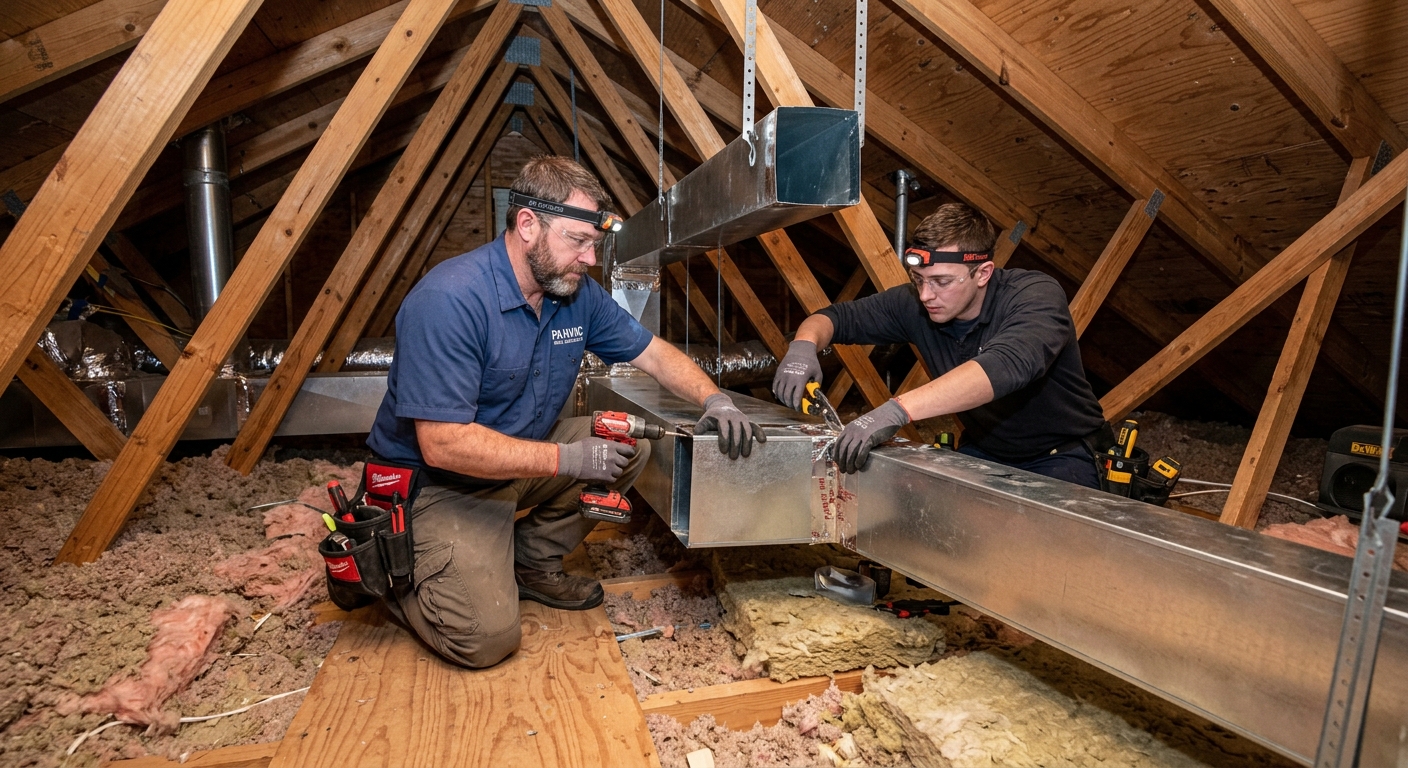
In many of Penn's pre-1980 homes, original ducts may be insufficient, or missing entirely in some rooms. Installing an all-new duct system is a big step up from a simple furnace or AC swap. A full duct installation typically adds $9,500–$19,000 to your project in Penn (on top of the equipment cost), with the exact price tied to home layout, number of registers, and whether you want hidden ducts or are okay with boxed-in chases. Anyone quoting far less isn't doing the job to code or skipping key steps.
Is it worth switching from oil or propane to a heat pump?
With natural gas widely available in Penn, choosing a heat pump over oil or propane depends on your exact location and utility rates. In rural areas lacking gas service, a ducted heat pump installation, typically in the $8,400–$18,000 range, can dramatically lower your heating bills and improve comfort—especially if your existing system is decades old. That said, you’ll need to check your electrical panel’s capacity and understand that, during Penn’s coldest snaps (around 8 °F), a backup heat source or a high-performance “cold-climate” heat pump may be wise.
How much does a furnace replacement cost in Penn?
While oil and propane systems are still common in rural parts of Westmoreland County, most Penn homes on gas can expect a furnace replacement to land in the $5,300–$12,500 range (assuming no major duct, flue, or electrical issues). Legacy homes, with older flues or questionable ductwork, may run higher. Always get an in-home estimate: a sound duct system will keep your costs on the lower end, while unexpected upgrades push toward the top.
What is SEER2 and how is it different from SEER?
SEER2 is the new standard for measuring air conditioner and heat pump efficiency, replacing the older SEER rating. The key difference is that SEER2 uses updated test conditions—closer to the static pressure and duct leakage commonly seen in actual Penn homes—so ratings are slightly lower, but reflect real-world performance. For example, a newer system may be rated at 17 SEER2 instead of 20 SEER, but performs just as well in your house. In this market, central AC replacements typically run $5,300–$12,500, with higher SEER2 often (but not always) justifying a bigger upfront investment through utility savings.
How cold does it get in Penn and does that affect heat pumps?
Penn’s winter design temperature bottoms out at 8 °F, which is cold enough to challenge some standard heat pumps. Basic units may struggle to keep up during deep freezes, making a cold-climate or dual-fuel system the better long-term bet. Cold-climate ducted heat pumps—priced $13,500–$18,000 installed—are built to keep heating output high even as outdoor temperatures drop near zero. In most cases, your installer will recommend a backup heat source or make sure your system is sized for those colder stretches.
Are duct sealing and insulation eligible for incentives?
In Pennsylvania, energy efficiency programs sometimes offer rebates for sealing or insulating ductwork—especially if your upgrades cut heating and cooling costs in older Penn homes where leaky or uninsulated ducts are common. While amounts and eligibility change yearly, improvements in duct performance can make as much difference as swapping to a new central AC in the $5,300–$12,500 price range. Check with your utility and with your installer for current details before counting on any rebate money when budgeting your project.