HVAC costs in Penn — 2026
Penn homeowners face unique choices thanks to Lancaster County's housing mix and climate. With a homeownership rate of 77.6% and nearly half of homes built before 1980 (U.S. Census Bureau, ACS 2024), Penn is split between older city rowhomes suited to ductless or high-velocity retrofits and suburban neighborhoods where replacement of aging central equipment dominates. The local housing era means many properties never had full central duct systems, especially within Lancaster city's older rowhomes from 1880–1930, pushing many homeowners toward ductless mini-splits or specialized ductwork if they want modern HVAC comfort.
The region’s 5,200 heating degree days versus 1,250 cooling degree days signal a heating-dominated market. In Penn, your winter heating costs typically outweigh summer cooling bills—so the main investment question is how best to keep warm affordably and efficiently, whether by upgrading existing forced-air systems, installing high-performance ductless systems, or embracing a cold-climate heat pump to phase out fossil fuels. The relatively mild cooling load means even SEER2 16–20 central air conditioners are sufficient, but for heating, system choices and duct condition matter deeply.
| System |
Best for |
Efficiency |
Price range (installed) |
| Central AC replacement (existing ducts) |
homes with sound ductwork |
16–20 SEER2 |
$4,900–$12,000 |
| Air source heat pump (ducted) |
year-round heating and cooling |
8–10 HSPF2 |
$7,900–$17,000 |
| Cold-climate heat pump (ducted) |
heat pump as primary heat |
9–11 HSPF2 |
$13,000–$17,000 |
| Ductless mini-split (single zone) |
additions, rooms without ducts |
20–30 SEER2 |
$3,200–$6,900 |
| Full duct system installation |
homes with no existing ducts |
— |
$8,900–$18,000 |
Installed estimates for a typical Penn home. Equipment tonnage, duct condition and electrical capacity move these more than brand.
Duct condition, leakage and sealing
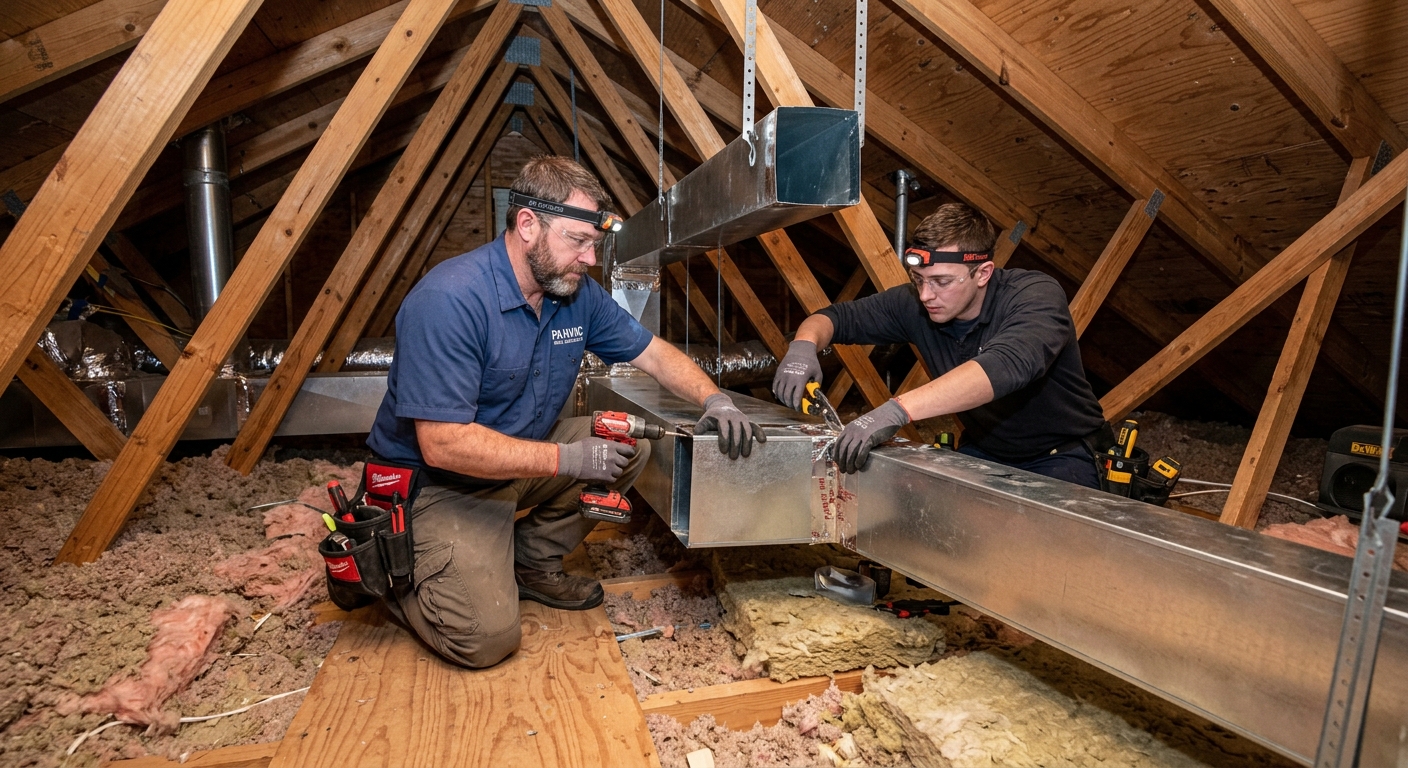
For Penn homeowners, especially those in older Lancaster city houses, the ductwork itself often matters as much as the heating or cooling unit. In homes dating from 1880–1930, it's common to find little or no original ductwork—many of these rowhomes relied on radiators or had small, retrofit duct runs squeezed behind walls and ceilings. If ducts were added later, they were often sized just for a furnace, not modern AC, and almost never sealed against leaks.
A duct blaster test uses calibrated airflow measurements to pinpoint leaks throughout your duct system, revealing how much conditioned air is escaping before reaching your rooms. In Lancaster’s aging homes, it’s not uncommon for 20% or more of air to leak out. Sealing these leaks—especially at joints and seams—can be the most cost-effective “upgrade” you do. If your ducts run through unconditioned spaces such as attics or crawlspaces, insulation and sealing are critical to reduce wasted energy.
Undersized return ducts are another silent problem: if your system is noisy or some rooms never feel comfortable, restricting returns may be the reason. Finally, if your duct runs are rusted through or so poorly routed that airflow will never balance, full replacement may be the only durable solution. Always test the existing duct system before replacing HVAC equipment. Upgrading a furnace or installing a new heat pump without resolving duct issues will limit your comfort and could shorten the new unit’s life.
Retrofit versus replacement in Penn
The path to better comfort and efficiency in Penn depends on your home's age, original construction, and whether ductwork exists at all. With 48.7% of homes built before 1980 and a density of Lancaster city homes dating from 1880–1930, many dwellings were never set up for central AC—ducts, if present, may have been added only for heating, not sized or sealed for modern cooling or high-efficiency equipment. Insulation levels and window quality in these older houses can be marginal, raising heating demand and making system sizing crucial.
If your house was built since the 1980s, especially in the suburban rings near Manheim Township or East Hempfield, central duct systems and basic insulation are likely present. Here, the bigger issue is aging original equipment: subdivisions built in the late-1990s or early 2000s are now facing their first (or second) major HVAC replacement. Builder-grade systems were usually sized a bit generously by today's efficiency standards, but electrical panels may need checking if considering an all-electric heat pump conversion. For homes hardwired for gas heat, the chimney or vent condition becomes relevant if switching fuel types, while older oil or propane setups might need bigger panel upgrades and flue work.
In sum: be wary of assuming your ductwork or panel is ready for a simple swap—age, sizing, and past retrofits require a close look before committing to new HVAC.
The central decision for a Penn homeowner
Deciding between a furnace, a heat pump, or a dual-fuel system isn’t hypothetical in Penn—it all comes down to our climate and utilities. The winter design temperature here is 12 °F, and with 5,200 heating degree days, heating is your dominant load. Modern cold-climate heat pumps can provide reliable heat well below freezing and have transformed the calculation; the old “heat pumps don’t work here” line is mostly outdated. Still, as temperatures drop, a heat pump’s output does decline, so a backup (either electric or gas) remains important for true confidence in the coldest snaps.
If you live in Lancaster, Manheim, or East Hempfield, you likely have access to natural gas—making a gas furnace plus central AC or a dual-fuel setup a practical proposition. But in rural parts of Lancaster County, where propane or fuel oil is still common, the economics shift. Heating with a modern cold-climate heat pump usually beats propane or oil for annual operating cost, especially as fuel prices fluctuate.
A gas furnace is still the best choice if the home is on gas, has an older flue that’s already safe for combustion exhaust, or the envelope is leaky enough that sizing a heat pump gets impractical. Conversely, heat pumps make sense for those seeking to electrify, homes without ready access to gas, or anyone looking to drop fossil fuels entirely.
| Option |
Installed cost |
Operating cost here |
Best when |
Incentive eligible |
| Gas furnace + central AC |
$4,900–$12,000 |
moderate |
existing gas service, coldest zones |
partial |
| Ducted heat pump (cold climate) |
$7,900–$17,000 |
low to moderate |
good envelope, all-electric goal |
yes |
| Dual fuel (heat pump + gas backup) |
$13,000–$17,000 |
moderate |
gas on site, deep cold spells |
partial |
| Ductless multi-zone |
$8,900–$18,000 |
low-moderate, room by room |
no ductwork, zone control |
yes |
What a real HVAC quote contains
If a contractor hands you a quote with nothing but a brand and a number, you don't have a real proposal. In Penn, a professional proposal for HVAC installation or replacement must show both indoor and outdoor model numbers (matched pairs matter for efficiency ratings), state the exact system tonnage backed by a load calculation (not just a swap for the old one), and clearly address if the line set will be reused or replaced. Electrical work should be described—including any panel upgrade required. You need to see whether a new condensate drain or pump is included, and which thermostat is quoted.
Permitting in Lancaster city is not optional when replacing or installing HVAC—and a legitimate quote will reference a mechanical permit and final inspection. Finally, make sure you are seeing both the equipment warranty (from the manufacturer) and the installer’s own labour warranty. Demand to see the commissioning report: it proves they measured charge and airflow, not just flipped the switch and left. Compare not just numbers, but how each line matches what you actually need.
| Line item |
What to look for |
Red flag if… |
| Equipment |
model numbers, indoor and outdoor matched |
brand name only |
| Sizing |
load calculation attached |
matched to the old nameplate |
| Ductwork |
condition assessed, sealing scoped |
not mentioned |
| Electrical |
circuit and panel capacity confirmed |
assumed adequate |
| Line set |
replaced or documented as reused |
silent |
| Commissioning |
measured airflow and charge, documented |
no startup report |
| Warranty |
labour years stated separately |
manufacturer only |
| Permit |
included and priced |
'not needed' |
What you can actually claim on a heat pump here
For Penn homeowners installing a heat pump, incentives stack in three main ways: federal tax credits, utility rebates, and (sometimes) state-level programs—though the last are rarely substantial in Pennsylvania. The federal tax credit reduces your taxes for the following year instead of lowering your upfront project cost. For cash flow, a utility rebate from your electric service (like PPL Electric Utilities in much of Lancaster County) usually comes as a check or bill credit after installation and documentation. These two work together but on different timelines.
The best place to confirm current rebate amounts for your home is your utility’s efficiency rebate program page—since names and figures often change every year. The ENERGY STAR Rebate Finder at energystar.gov/rebate-finder is also worth checking. Because incentive details get updated or withdrawn based on budgets, any price from an article gives you a starting point, not a quote. In short: plan on confirming the real, in-force dollar values right before you sign your contract—as estimates even a few months old may not survive the next rebate cycle.
If you’re thinking about a ductless or ducted heat pump, check for both the federal tax credit and whatever PPL Electric Utilities or UGI Utilities (if you’re in their service area) show on their efficiency program web pages.
Permits, licensing and inspections in Penn
Pennsylvania doesn’t license HVAC contractors at the state level for residential work—so in Penn, it’s your township or city that oversees mechanical permits and inspections. In Lancaster city, for example, a mechanical permit is required when replacing or installing central HVAC equipment, and inspections are handled by the city, not the state. Most surrounding townships in Lancaster County run their own code offices. For jobs over $500, a contractor must have a valid Home Improvement Contractor (HIC) registration from the Pennsylvania Office of Attorney General; you can look this up directly before hiring anyone.
Workers’ compensation insurance is mandatory for any employer in Pennsylvania—whether the company is self-insured or carries private coverage. Check a contractor’s workers' comp status through the WCAIS system. Separately, EPA Section 608 certification is non-negotiable for anyone handling refrigerant, no matter where in Pennsylvania the job is. In sum, your real protections come from confirming the HIC registration, workers’ compensation insurance via WCAIS, and making sure permits and inspections are part of the job, not an afterthought.
Frequently asked questions — HVAC installation in Penn
What does a heat pump cost installed in Penn?
A heat pump installation in Penn typically runs between $7,900–$17,000 for a ducted system, depending on your home's size, duct condition, and whether updates to your electrical panel are needed. This range covers most common scenarios in Lancaster County, with older homes (nearly half built before 1980) sometimes needing additional work to get the system up and running safely. Cold-climate, high-performance systems—which are recommended for winter reliability here—are on the higher end of that spectrum. Always compare quotes that specify model numbers, installed scope, and whether a mechanical permit is included.
Should I close vents in unused rooms?
In Penn, closing vents in unused rooms is rarely worth it and in many homes—especially older ones with marginal ductwork—can stress your HVAC system. Forced-air systems are designed and balanced for all vents to be open. Shutting some can increase static pressure, reduce airflow, and actually make the unit run less efficiently or even overheat. With a typical central AC replacement costing $4,900–$12,000, premature wear from closing vents is an unnecessary risk. If you have persistent comfort issues room-to-room, the better solution is a system check or zoning, not vent-blocking.
Are duct sealing and insulation eligible for incentives?
Incentives for duct sealing or insulation can be available to Penn homeowners, but they are always program-specific and change frequently. Some utility-administered programs have offered duct sealing rebates, especially if a duct blaster test confirms major leaks. Check PPL Electric Utilities’ efficiency rebate page and the ENERGY STAR Rebate Finder before scheduling duct work. Incentive amounts may help with part of the cost—often around a few hundred dollars relative to a full duct installation of $8,900–$18,000—but always confirm current program details right before starting.
What size HVAC system does my Penn home need?
The right HVAC system size for your Penn home depends on your house's square footage, insulation, windows, and—crucially—the era and type of construction. A Lancaster County home built before 1980 will have different needs than a newer suburban build. Oversizing is common, especially if the quote just copies the old nameplate size. The best way forward is a Manual J load calculation attached to your quote. A mis-sized system, whether $4,900–$12,000 for a central AC or higher for a heat pump, will underperform or fail earlier.
What does a ductless mini-split cost in Penn?
A single-zone ductless mini-split in Penn runs from $3,200–$6,900 installed. These systems are especially popular in Lancaster city, where many rowhomes from 1880–1930 never had full central ducts. Price depends on the size of the area you need to condition, installation challenges (brick or stone walls, for instance), and whether an electrical upgrade is needed. Ductless systems are a good way to add heating and cooling in spaces without existing ductwork or to handle additions and enclosed porches.
Is it worth switching from oil or propane to a heat pump?
For many Penn homeowners still heating with oil or propane—especially in rural areas outside the natural gas grid—the numbers increasingly favor installing a heat pump. While a ducted heat pump install can run $7,900–$17,000, annual operating costs for heating are lower than oil or LP (assuming a decent building envelope and up-to-date electrical). With federal and utility incentives, the real-world payback is much faster. Comfort improves, too, and you’re far less subject to unpredictable oil or propane price swings.
How do I verify an HVAC contractor's insurance?
Pennsylvania requires HVAC companies to have workers’ compensation insurance if they employ anyone, and homeowners in Penn should always verify it. Simply request their coverage information and confirm active status using the WCAIS system online before any HVAC job. For larger projects—central air replacement, heat pump or full duct installation (typically $4,900–$18,000)—this protects you from legal or financial issues if an injury occurs on your property. It’s one of the surest ways to weed out fly-by-night operators.
How long does HVAC installation take in Penn?
In Penn, a standard central AC or furnace replacement typically takes 1–2 days, while extensive retrofits—such as installing a new duct system in an older Lancaster city home or a full heat pump with electrical upgrades—can take up to 3–5 days. Ductless mini-split installs, especially multi-zone, are usually completed in 1–2 days. With all jobs, factors like permit issuance (required in Lancaster city), home age, and custom ductwork can add time. Always ask your contractor for a timeline in writing when you see a quote in the $4,900–$17,000 range.
How cold does it get in Penn and does that affect heat pumps?
Winters in Penn see a design temperature of 12 °F, and the region racks up about 5,200 heating degree days. This makes heating your major seasonal cost. Modern cold-climate heat pumps are engineered to deliver reliable heat well below freezing, but their output drops as temperatures plunge. That’s why sizing and backup heat (or dual fuel) matter so much. A high-performance heat pump (in the $13,000–$17,000 range) with a proper load calculation, plus either electric or gas backup, is the best route for comfort through deep Penn winters.