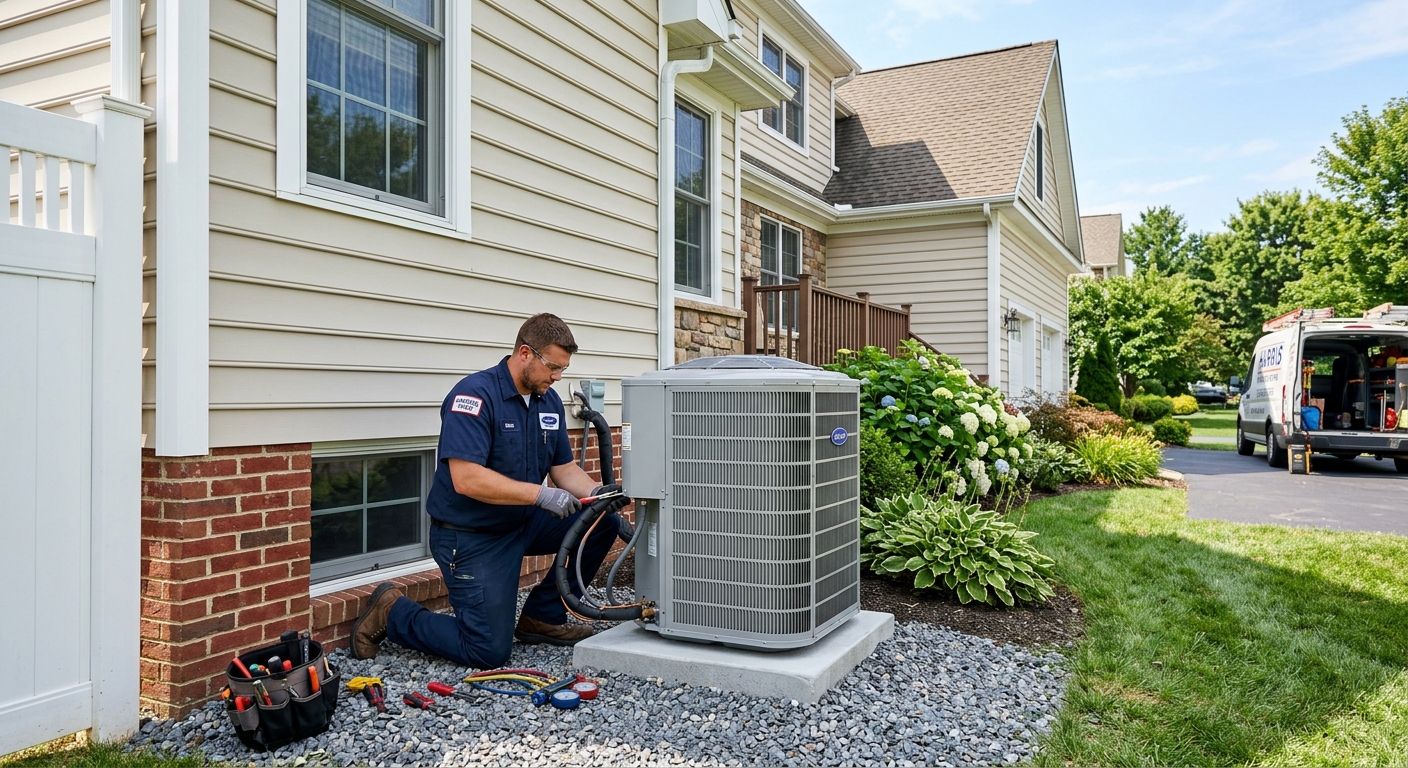
Amity heating and cooling prices by system type — 2026
Amity homeowners should expect a range of prices for new HVAC installations depending on the system type, your home’s age, and whether you already have ductwork in place. With an 84.0% homeownership rate and 36.4% of homes built before 1980 (U.S. Census Bureau, ACS 2024), this is still largely a replacement and retrofit market — very few new builds, lots of existing systems needing upgrades or full retrofits.
Reading and older boroughs like Hamburg have large pre-1940 housing stock, which often lacks ductwork or has aging, undersized distribution. That drives up the demand for both ductless solutions and total duct system installations, especially where original oil or electric baseboard heat is being replaced. Central air conditioners and heat pumps are common where homes already have forced-air systems — but poor ducts or electrical upgrades can add to costs quickly in retrofits.
Berks County averages 5,200 heating degree days versus only 1,250 cooling degree days annually, making this a heating-dominated climate. System choices here lean toward options favoring strong, efficient heating — including higher-efficiency or cold-climate heat pumps instead of standard AC in many cases. If you need both cooling and cost-effective winter heat, a heat pump makes more sense than top-tier AC alone.
| System |
Best for |
Efficiency |
Price range (installed) |
| Central AC replacement (existing ducts) |
homes with sound ductwork |
16–20 SEER2 |
$5,500–$13,500 |
| Air source heat pump (ducted) |
year-round heating and cooling |
8–10 HSPF2 |
$8,900–$19,000 |
| Cold-climate heat pump (ducted) |
heat pump as primary heat |
9–11 HSPF2 |
$14,500–$19,000 |
| Ductless mini-split (single zone) |
additions, rooms without ducts |
20–30 SEER2 |
$3,500–$7,800 |
| Full duct system installation |
homes with no existing ducts |
— |
$10,000–$20,000 |
Installed estimates for a typical Amity home. Equipment tonnage, duct condition and electrical capacity move these more than brand.
Maintenance that actually extends system life
In Amity, you can extend your HVAC system’s service life by focusing on what matters, not what’s commonly marketed. The single best action is changing filters at the correct interval — most homes need a change every 2–3 months, and the right MERV rating is usually a MERV 8 or 11, unless a higher rating is specifically called for. Overly restrictive filters can strain the blower and cut system life.
Annual coil cleaning (especially outdoor units exposed to eastern PA’s pollen and leaf debris), flushing the condensate line, and verifying refrigerant charge are worthwhile. Note that simply adding refrigerant is not true maintenance — loss means a leak, and topping off only masks a problem which will worsen and lower system life. A qualified tech will check for leaks before recharging.
Service plans from installers can be worthwhile if they include real maintenance (coil cleaning and a documented inspection), but many basically sell you priority scheduling and annual filter changes for a markup. Always check what’s actually included. Skip “plans” that don’t specifically list services or just offer discounts on repairs you may never need.
Schedule maintenance before peak season: early spring or mid-fall are best in Berks County. If you wait for the first 85°F day, techs will be booked with no-cooling emergencies, and routine tune-ups become tougher to schedule and pricier if they’re even available.
Efficiency ratings and what they mean for your bill
HVAC efficiency ratings can be confusing, especially with the recent change from SEER to SEER2 and HSPF to HSPF2. SEER2 measures how efficiently an air conditioner cools; higher numbers mean lower cooling bills. HSPF2 is for heat pumps and gauges their heating efficiency — the higher the value, the less electricity required to heat your home. If you see older ratings (just “SEER” or “HSPF”), these use less stringent lab conditions and are not apples-to-apples with today’s specs.
Homeowners in Berks County face about 5,200 heating degree days but only 1,250 cooling degree days yearly, so heating efficiency (HSPF2) will impact your bill much more than high-end cooling efficiency. Here, splurging for a 20+ SEER2 AC won’t pay off. For most Amity homes, a 16–18 SEER2 air conditioner or heat pump offers solid value. A ducted heat pump with 9–10 HSPF2 is usually the “sweet spot” — going higher climbs rapidly in cost with only small actual savings.
If you’re being offered a cold-climate heat pump upgrade with 10–11 HSPF2 for full-time electric heat, the premium can pay back in very cold homes previously running on oil or electric resistance. But for most upgrades, focus on strong HSPF2 and don’t overpay for top SEER2 on the cooling side. Get quoted annual operating cost projections rather than chasing the highest number on paper.
What size system does a Amity home need?
Correct sizing is the single most important detail in any HVAC installation, and the biggest thing a contractor can get wrong in Amity homes. Don't assume “bigger is better” — oversized systems cycle on and off more frequently, causing hot and cold spots, poor dehumidification, greater energy waste, and a shorter lifespan from all the stop-start stress. Oversizing is not a safety margin, it’s a defect that you’ll be stuck with for years.
The right way to size is with a Manual J load calculation, which accounts for your home’s actual square footage, insulation levels, window quality, orientation, local tree cover, and the winter design temperature — in Amity, 12°F is the standard. Rules of thumb by square footage are rough guesses and usually overshoot by a wide margin. So is simply matching the old unit’s label; that assumes original construction and ductwork were perfect and there have been no envelope changes or additions over decades.
Always ask: “Did you perform a load calculation, and can I see it?” This single question will separate pros from the rest. In our freeze-thaw climate with moderate snow load and real winter cold snaps, you need a system sized just right for your house — not for someone’s spreadsheet or historical guesses. Never take a contractor’s word that a single “ton per X square feet” formula is best for your home.
Comparing HVAC estimates in Amity
When evaluating quotes in Amity, the details matter more than the brand. Every estimate should list model numbers for both indoor and outdoor units — only a matched pair achieves the claimed efficiency ratings. Confirm that the quote includes a load calculation (Manual J) that ties your home’s specific needs to the equipment tonnage proposed. The quote should spell out whether the refrigerant line set will be replaced or reused (and why), what electrical work is included, if your panel needs upgrading, how condensate is handled, what type of thermostat is provided, and the cost/value of required mechanical permits. A commissioning report — showing measured airflow and charge — documents startup quality. Lastly, warranties must separate labor coverage from manufacturer coverage for clarity.
A quote listing only a brand and a price tells you nothing you can compare; it’s impossible to know what you’ll actually get or how it stacks up to another bid. Insist on a full breakdown for a true apples-to-apples comparison.
| Line item |
What to look for |
Red flag if… |
| Equipment |
model numbers, indoor and outdoor matched |
brand name only |
| Sizing |
load calculation attached |
matched to the old nameplate |
| Ductwork |
condition assessed, sealing scoped |
not mentioned |
| Electrical |
circuit and panel capacity confirmed |
assumed adequate |
| Line set |
replaced or documented as reused |
silent |
| Commissioning |
measured airflow and charge, documented |
no startup report |
| Warranty |
labour years stated separately |
manufacturer only |
| Permit |
included and priced |
'not needed' |
Mechanical permits for HVAC work in Amity
Pennsylvania does not have statewide licensing for HVAC contractors; for residential HVAC work, contractors must be registered as Home Improvement Contractors for jobs over $500, as required by the Office of Attorney General. Municipalities enforce the Pennsylvania Uniform Construction Code (based on the IRC), so the need for permits and inspections is handled locally — not by the state. In Reading, for example, installing or replacing a central HVAC system almost always triggers mechanical and electrical permits. Surrounding Berks County townships run their own code offices, so always confirm which office you need to contact in Amity or your specific township.
Any technician handling refrigerants must have EPA Section 608 certification. This is a federal requirement and applies anywhere in the U.S. regardless of local licensing levels, including every job in Berks County fetches a permit and brings an EPA-certified technician anytime refrigerants are used.
Before signing a contract, homeowners can and should verify a contractor’s Home Improvement Contractor registration at hic.attorneygeneral.gov. For workers’ compensation coverage, check the Pennsylvania Workers’ Compensation Automation and Integration System (WCAIS) at wcais.pa.gov to ensure coverage is current. Don’t skip this — even legitimate contractors miss renewals, and as the homeowner, you are on the hook if something happens onsite.
The decision point on an aging system
Deciding between repairing and replacing an HVAC system in Amity should be based on the system’s age, repair cost, type of failure, and energy savings potential. Most newer systems (under 10 years) can be repaired economically if the problem is a single component (blower motor, capacitor, etc.). If repair costs climb above a third of full replacement — or if you’re quoted $5,500–$13,500 for a system approaching its lifespan — replacement may be the wiser long-term choice.
Replacement becomes unavoidable with a cracked heat exchanger or if a compressor fails beyond warranty on a 15+ year old system. These failures present either an immediate safety hazard (carbon monoxide) or a repair bill close to new installation. If your unit uses R-22 refrigerant (common in systems pre-2010), repairs are less cost-effective, since refrigerant is expensive and supplies are disappearing.
If the system works but energy bills are high, always test ducts and air sealing before replacing equipment — gains here are often cheaper and more lasting than an upgrade. Don’t rush into replacement based solely on high bills unless testing rules out bigger losses elsewhere in the home.
| Situation |
Recommendation |
Typical cost |
Reasoning |
| Under 10 years, single component failure |
Repair |
$300–$1,200 |
Most parts are available, and replacement is unlikely to pay back quickly. |
| 10–15 years, repair over a third of replacement |
Consider replacing |
$5,500–$13,500 |
Approaching end of service life and repair dollars may be wasted. |
| 15+ years, any major failure |
Replace |
$5,500–$13,500 |
Old age with failure signals system is near retirement anyway. |
| Cracked heat exchanger, any age |
Replace immediately |
$5,500–$13,500 |
Potential carbon monoxide danger; cannot be reliably repaired. |
| Compressor failure past warranty |
Replace |
$8,900–$19,000 |
Cost approaches or exceeds new system, especially on older refrigerants. |
| Working system, high bills |
Test ducts and envelope first |
$300–$800 |
Leaks in ductwork or envelope are often the real source of lost money. |
Frequently asked questions — HVAC installation in Amity
Why do HVAC quotes in Amity vary so much?
Quotes for HVAC work in Amity can swing dramatically because of several factors that often aren’t visible until a technician evaluates your home firsthand. Ductwork age and condition is a big one — older homes, especially those built before 1980, may need significant duct sealing or replacement to meet code or performance standards, tacking thousands onto a quote. Electrical panel upgrades add another variable. Brands, efficiency ratings, and included items (like whether permits and commissioning are in the price) all shift the cost. For a central AC replacement, you’ll see quotes from $5,500–$13,500, but the difference is usually in what’s actually being delivered — not just brand names. Always compare quotes item by item, not bottom line to bottom line, and ask for explicit model numbers and scope of work before signing.
Why are my Amity energy bills high with a new system?
High energy bills after a new system install in Amity are nearly always caused by factors outside the new equipment itself. If duct leaks, poor sealing, or inadequate insulation are part of the building, even a high-efficiency system will run longer than it should. Many older Amity homes — over a third built before 1980 — have aging ductwork that leaks as much as 30% of conditioned air into attics or basements. This drives up bills in both summer and winter. You might have a $8,900–$19,000 new heat pump, but if the envelope or ducts haven’t been checked, it won’t reach its potential. Ask for duct testing and consider air sealing and insulation before assuming the unit is at fault.
What is commissioning and why does it matter?
Commissioning is the process of testing and documenting that your new HVAC system is installed and working exactly as it should. In Amity, this means checking airflow, refrigerant charge, and ensuring that all controls, safety switches, and thermostats are working — typically with a report you can keep. Why does it matter? Without commissioning, even top-tier systems installed at $14,500–$19,000 can run below spec because of a simple miswire, refrigerant undercharge, or airflow bottleneck. It’s the difference between getting what you paid for and losing efficiency or comfort. If your installer doesn’t mention commissioning or doesn’t provide a report, that’s reason to press for specifics or rethink the contractor.
What is EPA Section 608 certification?
EPA Section 608 certification is a federal requirement that any technician who handles refrigerants (the chemicals used for cooling in air conditioners and heat pumps) must be specifically trained and licensed. This applies to every HVAC job involving refrigerant, no matter which part of Pennsylvania you’re in — including Amity. It is not just a best practice; it’s the law, and protects homeowners by ensuring only qualified professionals are working with these potentially hazardous materials. If you’re installing a new AC or heat pump — anything from a $3,500–$7,800 mini-split up — ask your contractor for the EPA card, especially if you’re comparing bids.
What size HVAC system does my Amity home need?
There’s no single right answer for every Amity home. Proper sizing requires a load calculation (Manual J) that includes square footage, insulation, window type, and local weather — not just a rule of thumb or the capacity of the old unit. In this area, with a winter design temperature of 12°F, undersizing can leave you in the cold, but oversizing creates humidity and efficiency issues. The realistic installed price for a system, whether a central AC at $5,500–$13,500 or a ducted heat pump, will only make sense if it’s sized to your actual needs. Always ask to see the calculation; don’t accept “about what the last one was.”
What does a heat pump cost installed in Amity?
The cost for installing a heat pump in Amity varies widely based on existing ductwork, equipment size, and how much electrical or ductwork upgrade your home needs. For most homes with ducts in reasonably good shape, expect an installed price of $8,900–$19,000. Cold-climate (high-performance) models that can fully replace a furnace or oil boiler, especially in older Amity or Reading homes, run towards the upper end of that range. Single-zone ductless options for room additions are lower, but full retrofits of pre-1940 homes with no ducts at all require extra investment in both ducts and electrical — so be sure the quote covers every needed step.
How is a tax credit different from a rebate?
A tax credit is money you get back when you file your federal or state taxes after installing qualifying HVAC systems (like certain heat pumps or high-efficiency ACs), reducing what you owe dollar for dollar. A rebate, by contrast, is paid upfront by a utility or manufacturer and comes off your invoice, reducing the cash you hand over at installation — maybe dropping a $15,500 duct system job to something more manageable. In Amity, you may qualify for both, but the process, timing, and eligibility differ. Always get the forms prefilled by your contractor and ask to see sample documents before you commit.
How does south-central Pennsylvania's climate affect system sizing?
South-central Pennsylvania, including Amity, has long winters (5,200 heating degree days) and modest summers (1,250 cooling degree days). This means your system must be sized for a 12°F winter design temperature, not a national average. Choose a system designed for prolonged cold operation rather than maximum summer performance, especially if heating is your main concern. Opt for a heat pump or furnace sized by careful load calculation, and don’t be upsold on ultra-high cooling efficiency (beyond 18–20 SEER2) since cooling loads are secondary here. The right system, properly sized, will keep bills lower with less stress on the components — an investment even at $8,900–$19,000 pays off more when custom-fit to the real weather.
Can a heat pump heat my house without backup?
In most Amity homes, a modern cold-climate ducted heat pump can provide all the needed winter heat without a backup furnace, as long as the system is sized and installed appropriately. These newer units maintain strong output down to or below the area’s 12°F winter design temperature. If your home is older and less insulated, or if ductwork is leaky, backup electric strips or supplemental heating may still be advisable for extreme cold snaps. The key is a proper load calculation — not just picking a heat pump with a high HSPF2. Expect to budget $14,500–$19,000 for a ducted cold-climate model fully replacing gas or oil heat in an older home. Always have the installer explain how the system will perform in sub-20°F weather, based on your house as it stands today.