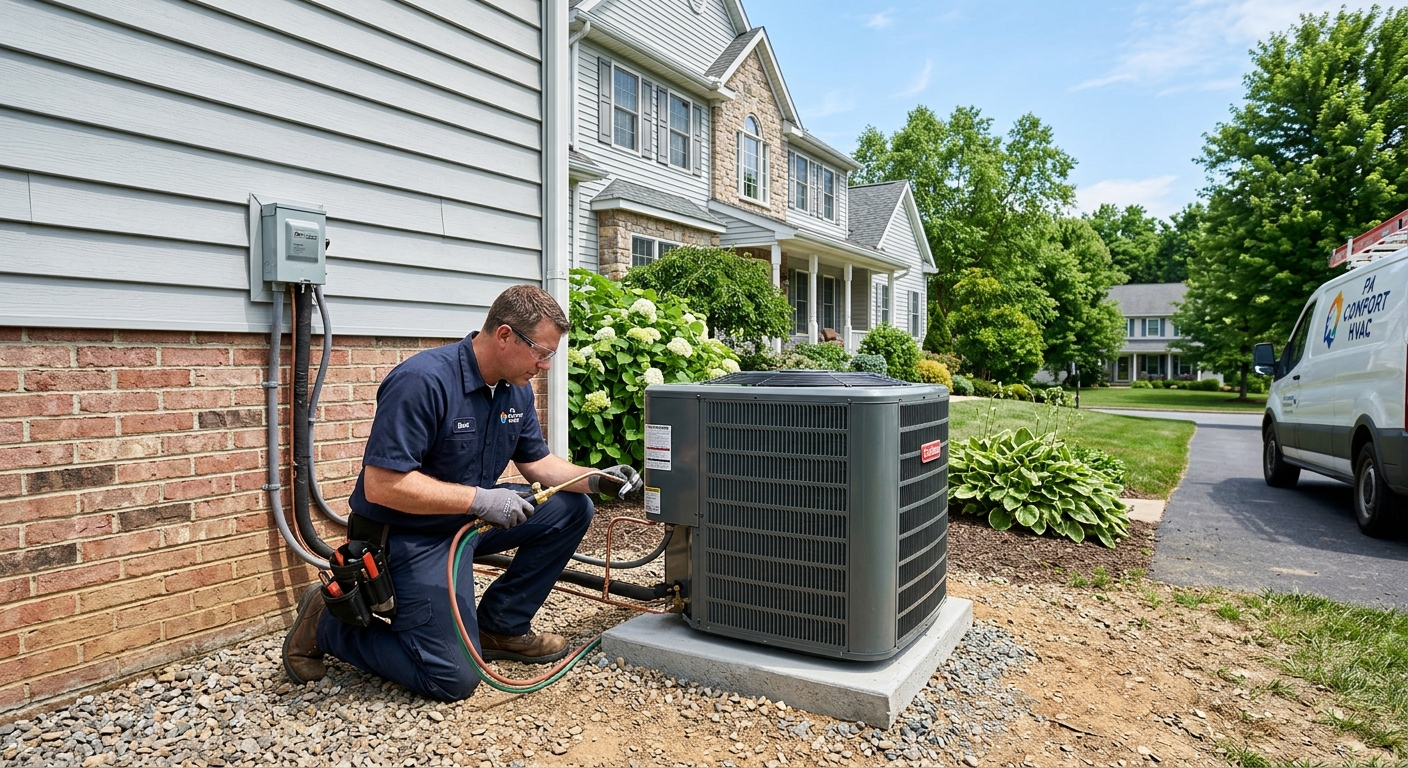
Cambria heating and cooling prices by system type — 2026
Cambria County’s heating and cooling prices reflect both its older homes and its climate. With a local homeownership rate of 86.4% and nearly 70% of homes built before 1980 (U.S. Census Bureau, ACS 2024), this is largely a retrofit market. Johnstown’s pre-1950 housing stock means many homes either lack ductwork or have aged, undersized systems needing attention before any equipment upgrade. For much of Cambria, “installation” often means working around small-frame housings and plaster walls and, in many cases, installing or replacing ductwork altogether.
Climate here is a central reality: north-central Pennsylvania logs about 6,300 heating degree days but just 750 cooling degree days each year. Heating, not cooling, drives system sizing and fuel decisions. Your choice of equipment needs to address a long, cold season—not just the handful of muggy summer weeks.
Here’s what that means for homeowners comparing options:
| System |
Best for |
Efficiency |
Price range (installed) |
| Central AC replacement (existing ducts) |
homes with sound ductwork |
16–20 SEER2 |
$4,700–$11,000 |
| Air source heat pump (ducted) |
year-round heating and cooling |
8–10 HSPF2 |
$7,500–$16,000 |
| Cold-climate heat pump (ducted) |
heat pump as primary heat |
9–11 HSPF2 |
$12,000–$16,000 |
| Ductless mini-split (single zone) |
additions, rooms without ducts |
20–30 SEER2 |
$3,000–$6,500 |
| Full duct system installation |
homes with no existing ducts |
— |
$8,400–$17,000 |
Installed estimates for a typical Cambria home. Equipment tonnage, duct condition and electrical capacity move these more than brand.
Gas, electric or both in north-central Pennsylvania
In Cambria County, every HVAC decision starts with acknowledging our 2°F winter design temperature and 6,300 heating degree days. Our lengthy, intense winters mean your heating solution isn’t optional—it’s mission-critical. Old objections to heat pumps (“they don’t work here”) now miss the mark: cold-climate ducted heat pumps do supply usable heat in below-freezing weather. However, as the air temperature drops especially near that 2°F mark, heat output does fall, which is exactly why dual-fuel systems are on the market. A heat pump remains the best electric option where gas isn't available, but you need to understand its performance curve.
Natural gas is widely available in central Johnstown, Richland, and Westmont, but much of outlying Cambria County still relies on propane or fuel oil. This changes the conversation—if you have natural gas, a high-efficiency furnace is proven, simple, and cost-effective. Without it, propane and oil prices swing wildly and make electric heat pumps competitive, especially in newer or well-weatherized homes. Dual-fuel systems deliver flexibility in homes on the gas grid that still want high-efficiency cooling and less costly shoulder-season heating.
| Option |
Installed cost |
Operating cost here |
Best when |
Incentive eligible |
| Gas furnace + central AC |
$4,700–$11,000 |
lowest with existing gas |
existing gas service, coldest zones |
no (furnace), maybe (AC) |
| Ducted heat pump (cold climate) |
$7,500–$16,000 |
lower than oil/propane if weatherized |
good envelope, all-electric goal |
yes |
| Dual fuel (heat pump + gas backup) |
$12,000–$16,000 |
flexible, moderate |
gas on site, deep cold spells |
yes (heat pump portion) |
| Ductless multi-zone |
$8,400–$17,000 |
efficient, room-by-room |
no ductwork, zone control |
yes |
Mechanical permits for HVAC work in Cambria
HVAC contractor licensing in Pennsylvania is strictly a residential matter at the local level. There’s no statewide license for residential HVAC installers or businesses, but anyone bidding a job over $500 in Cambria must hold a Home Improvement Contractor (HIC) registration through the state Office of Attorney General—verifiable online for free. Each municipality in Cambria runs its own permitting and code enforcement, with Johnstown and boroughs such as Westmont and Richland making their own calls on mechanical permits for new installations or replacements with new ductwork. Most service work on existing equipment, like repairs, doesn’t require a permit.
All technicians who handle refrigerants—central air, heat pumps, and ductless mini-splits—must, under federal rules, have a current EPA Section 608 certification. This is absolutely required, permit or no permit. Ask to see it.
Verify insurance and workers’ compensation coverage before signing anything. For Cambria, workers’ comp can be checked using the WCAIS website; all employers must carry it. Plumbing and electrical trades are municipally licensed, not statewide. Always get a written contract for any job over $500: state law protects your right to a clear agreement and a three business-day cancellation window.
Separating installers from equipment sellers
In Cambria, who installs your system matters far more than the brand or latest feature list. An improperly sized or sloppily installed unit, even if the hardware is top-tier, will waste energy and never keep you comfortable. You want a contractor with a verifiable Home Improvement Contractor (HIC) registration and a crew that can show EPA 608 credentials for every technician working with refrigerant.
A quality installation starts with a real load calculation, not a guess. The quote should list precise model numbers for both the indoor and outdoor units, not just “three ton heat pump.” Commissioning—the step where the system’s airflow and refrigerant charge are measured and documented—should be routine, not optional.
- Check for current HIC registration at the state’s site.
- Confirm each technician has an EPA Section 608 card.
- Request a Manual J or equivalent load calculation—never size by square footage alone.
- Look for detailed model numbers on the quote—both indoor and outdoor.
- Is ductwork assessed and scoped, even if “reuse” is planned?
- Was duct leakage discussed?
- Electrical panel and circuit capacity checked?
- Line set (refrigerant piping) specified as new or reuse, with details?
- Start-up commissioning—ask for a copy of the airflow and refrigerant report.
- Separate warranty terms for equipment and labor included?
- Is the permit fee itemized?
- Ask if they’ll be sending subcontractors—who, and are they registered?
In rural northern Cambria townships, fewer contractors operate, and you may see travel surcharges and longer wait times. Beware anyone whose main selling point is “we can do it next week” when the local market is otherwise thin.
Mini-splits and zoning in Cambria homes
Ductless mini-splits have become the go-to answer for many homes in Cambria, especially in the older, compact housing stock found across Johnstown and other boroughs. In houses built before the 1950s, most never had central air, and retrofitting ductwork into finished plaster walls or tight attics can get pricey fast and lead to a trail of patchwork repairs. For any addition, finished attic, or semi-finished basement that never got proper airflow, a single-zone mini-split can match comfort to occupancy far more efficiently than trying to stretch an old duct system.
Multi-zone systems, with one outdoor unit feeding several indoor heads, look tidy but don’t always deliver the same performance or efficiency as a set of separate single-zone systems—especially if zones are rarely occupied at the same time. Head placement is part technical, part aesthetics: you want short refrigerant lines and low noise where people spend time, but installations above doorways or on exterior brick often look out of place. Drainage for condensate is a bigger hurdle in basements—don’t let anyone suggest a solution ending in a bucket.
Economically, single-zone ductless systems are the sweet spot, running $3,000–$6,500 installed locally. In an older Johnstown home, installed cost escalates quickly if you try to zone every room. The real value is in targeted comfort where you need it—and the ability to skip ductwork entirely.
What a real HVAC quote contains
A real HVAC quote for a Cambria home is specific and leaves little to assumption. The best quotes list model numbers for both the indoor and outdoor units, guaranteeing you get matched equipment designed to deliver advertised efficiency. Make sure the quote includes the tonnage, backed by a load calculation—not simply “the same as before.” Nearly every Johnstown-area job with older homes should mention whether the line set will be replaced or reused; shortcuts here risk system performance and refrigerant leaks.
Your quote should spell out electrical work (panel upgrades if needed), any condensate drainage solutions, a thermostat (especially if you have a heat pump), and the cost and scope of the required permit. Demand a commissioning report—airflow and refrigerant charge, measured and documented at startup. Finally, the warranty: ask for labor and equipment coverage stated separately. If you don’t see half of this info, don’t bother comparing price alone—quotes that just show brand and price tell you nothing about actual value.
| Line item |
What to look for |
Red flag if… |
| Equipment |
model numbers, indoor and outdoor matched |
brand name only |
| Sizing |
load calculation attached |
matched to the old nameplate |
| Ductwork |
condition assessed, sealing scoped |
not mentioned |
| Electrical |
circuit and panel capacity confirmed |
assumed adequate |
| Line set |
replaced or documented as reused |
silent |
| Commissioning |
measured airflow and charge, documented |
no startup report |
| Warranty |
labour years stated separately |
manufacturer only |
| Permit |
included and priced |
'not needed' |
Ductwork: the part nobody quotes properly
Ductwork is often the silent money-waster in Cambria’s older homes. In Johnstown’s pre-1950 houses, it’s common to see duct runs sized for a coal or oil furnace, not a high-efficiency heat pump or modern central AC. Many homes simply don’t have ducts at all. Where ductwork exists, leakage is a chronic issue—often leaking enough to waste 15–30% of conditioned air before it ever reaches a single register.
A duct blaster test is the gold standard for measuring how much air is lost before it even makes it to your living space. Sealing is the first, cheapest step, especially if your existing ducts are structurally sound but leaky at the seams or joints. In plenty of older Cambria homes, return air ducts are undersized—making your system noisy and inefficient without ever triggering an obvious failure. Ducts running through unconditioned attics or crawlspaces can sweat in summer or freeze in winter, compounding losses.
Many quotes skip the ductwork analysis because it’s time-consuming, but it should always come before dropping new HVAC equipment in place. Test your duct system before replacing old equipment. Sealing leaks and correcting air flow often costs a lot less than a full tear-out, and gives better system performance than installing oversized new equipment to overcome distribution problems from the start.
Frequently asked questions — HVAC installation in Cambria
What does a heat pump cost installed in Cambria?
A heat pump installed in Cambria typically falls in the $7,500–$16,000 range for a ducted ducted system, with cold-climate models (capable of handling our 2°F design temperatures) toward the upper end. In older Johnstown and Cambria County homes, expect to pay more if ductwork needs to be replaced or you’re converting from baseboard or steam heat. Ductless mini-split systems are more affordable for single rooms or additions, starting at $3,000–$6,500 for a single zone. Most quotes cover both equipment and basic installation, but panel upgrades, ductwork repair, and permit fees can add cost—especially in homes built before 1950. Always check the specific scope and make sure your quote includes these details to avoid surprises.
Does my utility offer a heat pump rebate in Cambria?
Most major electric utilities serving Cambria, including Penelec, run rebate programs for high-efficiency heat pumps and ductless mini-splits. These incentives usually require that you install ENERGY STAR certified equipment and use a registered contractor—verify your eligibility before work begins. Typical rebates aren’t huge, but can knock $500–$1,000 off the cost, especially for systems in the $7,500–$16,000 range. Rebates change year to year and can run out, so check with your utility or your HVAC contractor for the current offer before making a decision. You’ll generally need to submit paperwork after installation, including a copy of your paid invoice and sometimes a load calculation.
When is the best time of year to replace HVAC in Cambria?
In Cambria, the best window for HVAC replacement is early spring (March–May) or early fall (September–October), right before the weather turns. Most local contractors get swamped during heat waves or deep cold snaps, which can delay installations and raise prices due to demand. There’s no real “off season” here thanks to the long heating season—unlike some southern markets. If your system is limping along at the end of winter or summer, start planning early rather than gambling on a last-minute replacement when everyone else’s equipment is most likely to fail. Off-peak replacements can mean faster scheduling, a bit more negotiating room, and possibly seasonal discounts on systems like a heat pump in the $7,500–$16,000 price band.
Is natural gas available throughout Cambria County?
Natural gas service in Cambria is not universal. Central Johnstown, Richland Township, and Westmont have broad gas access, making gas furnaces and dual-fuel systems practical. But many rural boroughs and northern Cambria townships rely mostly on delivered propane or heating oil. If your neighborhood has natural gas, it can make a traditional furnace and central AC (often in the $4,700–$11,000 range) the least costly to run and maintain. Otherwise, all-electric options like heat pumps and ductless mini-splits make more sense, especially as fuel oil and propane prices can spike unpredictably. Always verify service with your utility before pricing or planning a replacement.
How much does ductwork add to an HVAC installation?
Ductwork costs in Cambria are a real variable. Replacing or installing new ducts in an older Johnstown home or a rural Cambria house with no existing system typically runs $8,400–$17,000, depending on the home’s size, number of runs, and any crawlspace or attic work needed. Many pre-1950 homes lack central ducts altogether, so adding a forced-air system is a major job. Even resealing or partially replacing ductwork can still push a project up into the five-figure range. For homes where installing full ductwork is too invasive or costly, ductless mini-splits—at $3,000–$6,500 per room—are often the more sensible approach.
Do I need a permit to replace HVAC in Cambria?
In Cambria County, mechanical permits are generally required for full HVAC system installations or replacements with new ductwork, especially in Johnstown and larger townships. Minor HVAC repairs on existing equipment often don’t require permits, but always check with your local code office. Residential permitting is handled locally—there’s no statewide HVAC permit. Permit fees and required inspections should appear as a separate line in your quote, and any job above $500 needs a written contract under Pennsylvania’s Home Improvement Consumer Protection Act. Don’t risk skipping the permit—unpermitted work can lead to insurance headaches and future code violations, especially when selling your home or filing claims on a new system averaging $7,500–$16,000.
Can a heat pump heat my house without backup?
A modern cold-climate ducted heat pump can heat most Cambria homes without backup down to the mid-teens Fahrenheit, and some well-insulated homes see effective performance even at our local design low of 2°F. However, as temperatures drop, heat output falls, so homes with older windows, poor insulation, or big air leaks may need supplemental heat. In areas with reliable electric and a well-weatherized envelope, heat pumps in the $7,500–$16,000 band usually perform well solo. For larger or draftier homes, a dual-fuel system (heat pump plus a gas backup) is a better bet, assuring warmth even in the harshest cold snaps. Always have a contractor perform a real load calculation for heat loss at design temperature to know for sure.
Should I close vents in unused rooms?
Closing vents in unused rooms in Cambria homes—especially older ones with marginal ductwork—nearly always backfires. It increases duct pressure, leads to higher leakage, and can cause your system to short cycle or even freeze up in a cold snap. Rather than saving money, you wind up straining your equipment, making rooms colder or hotter elsewhere, and possibly adding costlier repairs. If you’re remodeling or using spaces less, a ductless mini-split (typically $3,000–$6,500 for a single zone) can control temperature only where you want, without over-taxing old ductwork. If you notice rooms chronically cold or hot, talk to a contractor about airflow adjustments or zoned options rather than shutting supply vents yourself.
What is the R-410A refrigerant phase-down?
R-410A refrigerant, still used in most new heat pumps and air conditioners in Cambria for systems in the $4,700–$16,000 price bands, is being phased down under federal environmental rules, with new low-GWP (Global Warming Potential) refrigerants replacing it starting in 2025–2026. This doesn’t mean you can’t still buy or service R-410A equipment—in fact, it will be supported for years. But as new products adopt alternative refrigerants, expect some HVAC models to change, with new compatibility and training requirements for installers. For homeowners, the main impact is that R-410A prices may rise, and future repairs on old systems could get more expensive. When replacing your system in the next couple years, ask your contractor what refrigerant it uses, and what that means for future support.