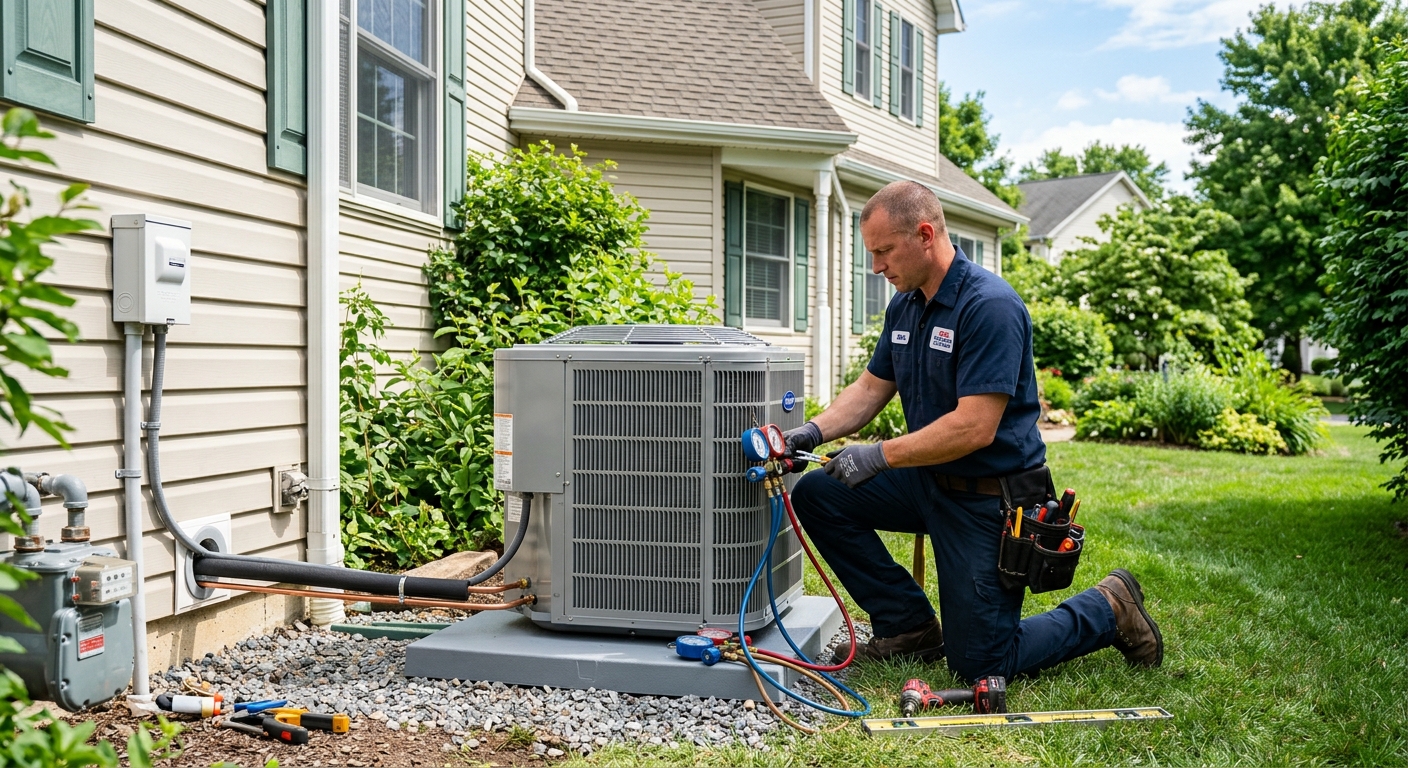
Elizabethtown heating and cooling prices by system type — 2026
Elizabethtown is very much a retrofit and replacement market: with 67.9% of homes built before 1980 and only 53.6% owner-occupied (U.S. Census Bureau, ACS 2024), you’ll find a wide mix of aging systems. Many older homes, especially in nearby Lancaster city, were built well before central air was standard—rowhomes from 1880–1930 often lack ductwork altogether or feature radiators. That steers many replacement jobs toward ductless or high-velocity systems over traditional forced-air installations.
Looking at the local climate, Lancaster County sees around 5,200 heating degree days and 1,250 cooling degree days per year. This region is heating-dominated, meaning your winter utility bills are likely to loom much larger than any summer cooling costs. Upgrading to higher-efficiency heating matters more here than chasing the very highest-rated central air. Ducted replacements make sense where sound ductwork exists, but retrofits—especially in older homes without ducts—favor mini-splits or complete duct installs, which do cost more up front.
| System |
Best for |
Efficiency |
Price range (installed) |
| Central AC replacement (existing ducts) |
homes with sound ductwork |
16–20 SEER2 |
$4,800–$11,500 |
| Air source heat pump (ducted) |
year-round heating and cooling |
8–10 HSPF2 |
$7,700–$16,500 |
| Cold-climate heat pump (ducted) |
heat pump as primary heat |
9–11 HSPF2 |
$12,500–$16,500 |
| Ductless mini-split (single zone) |
additions, rooms without ducts |
20–30 SEER2 |
$3,100–$6,700 |
| Full duct system installation |
homes with no existing ducts |
— |
$8,700–$17,500 |
Installed estimates for a typical Elizabethtown home. Equipment tonnage, duct condition and electrical capacity move these more than brand.
SEER2, HSPF2 and AFUE decoded
SEER2 stands for Seasonal Energy Efficiency Ratio 2, the updated standard for how efficiently an air conditioner or heat pump cools over a full season. The higher the SEER2, the less electricity you use per unit of cooling. HSPF2—Heating Seasonal Performance Factor 2—does the same for how efficiently a heat pump heats. AFUE, or Annual Fuel Utilization Efficiency, is for furnaces and tells you the percentage of heat from fuel that gets delivered into the house. All of these replaced older SEER and HSPF ratings; numbers from before 2023 aren’t apples-to-apples anymore.
Here in Lancaster County, with more than four times as many heating degree days as cooling, HSPF2 and AFUE matter a lot more than the very highest SEER2. Paying for a SEER2 above 18 generally won’t pay back what you put in, given our moderate cooling season. But with heat pumps, spending a bit more for a high HSPF2 can cut your winter bills over time, especially if you use electric or heat pump heating as your primary system. Usually, once you’re in the top third for HSPF2 (9–11), going higher provides diminishing returns. For gas furnaces, 95%+ AFUE is the local minimum to consider, but springing for 98% only makes sense if you heat heavily. Stick with the efficiency sweet spot for the heating system; don’t overpay for high-end air conditioning.
Operating cost, not sticker price
When budgeting for a new HVAC system, the up-front sticker isn’t the whole story—operating cost deserves equal weight. Here’s how to break it down for an Elizabethtown home, given our 5,200 heating and 1,250 cooling degree days, and a typical winter design temperature near 12°F (from the local code).
Start with efficiency ratings: SEER2 for cooling, HSPF2 or AFUE for heating. Higher numbers save you more per dollar of energy input. Multiply your system’s output by the number of relevant degree days to estimate annual demand. Then find the "cost per kWh" or "cost per ccf" (natural gas) on your utility bill—most Elizabethtown homes receive electric service from PPL Electric Utilities.
Suppose your heat pump has a HSPF2 of 9.5, and you pay $0.16 per kWh. Estimate annual heating needs by multiplying your home’s square footage by average Btus per degree day, but realize this is a rough calculation—real bills fluctuate with weather, insulation, and duct leaks. If your ducts are losing 20% of heated air, your shiny high-efficiency unit performs no better than a mid-range one until you fix those leaks. This is why one household’s upgrade pays off in five years, while another’s savings vanish into the crawlspace.
Remember: rates change (often yearly), so calculate with your latest bill. Focus first on fixing leaks and updating controls before springing for top-tier ratings—it can make a bigger difference to total cost than chasing the highest SEER2 or HSPF2.
Service plans: worth it or not?
Many Elizabethtown homeowners are pitched annual HVAC service plans to keep equipment running. What do you really need? Changing your air filter at the start of each heating or cooling season, and verifying you’re using the right MERV rating for your blower, gives most of the return. Coil cleaning prevents summer breakdowns; a clogged or corroded coil kills efficiency. Clearing your condensate line stops water leaks, and checking the system refrigerant charge—never simply “topping it off”—identifies leaks before they get out of hand. If refrigerant is low, something is wrong and must be repaired.
Most annual service plans essentially prepay for routine visits. They’re worth considering if they include priority scheduling in peak seasons, honest diagnostics, and a fair discount on genuine repairs. Plans that force unnecessary add-ons and lock you into yearly fees aren’t good value. The worst are those covering filter changes but not the labor for real repairs.
Book maintenance in late winter or early fall to avoid peak demand—Elizabethtown’s rush hits first heatwaves and deep cold snaps, when emergencies always take priority.
The decision point on an aging system
Not every breakdown means a full replacement in Elizabethtown. Use a common-sense framework: If the system is still under 10 years old and it’s a single component that’s failed (like a capacitor or contactor), repair is usually the right call. Once your system is 10–15 years in, weigh the cost of repair—if it’s above one-third of the price of a whole new system, talk about replacement. Anything past 15 years with a serious failure (like a leaking coil, compressor, or heat exchanger) is usually due. Two “no-compromise” cases: a cracked heat exchanger (which is a carbon monoxide risk), or compressor failure out of warranty—both mean immediate replacement.
If you notice high utility bills but the system seems to be working, start by testing for duct and envelope leaks; lost air eats more money in Lancaster County’s heating season than any mechanical upgrade. Only move to replace if duct sealing doesn’t help and the system is genuinely inefficient.
| Situation |
Recommendation |
Typical cost |
Reasoning |
| Under 10 years, single component failure |
Repair |
$300–$1,200 |
Most parts are cheap, system has service life left |
| 10–15 years, repair over a third of replacement |
Consider replacing |
$4,800–$11,500 |
Investment in old system rarely pays off |
| 15+ years, any major failure |
Replace |
$4,800–$11,500 |
At or beyond normal service life; new options are more efficient |
| Cracked heat exchanger, any age |
Replace immediately |
$4,800–$11,500 |
Carbon monoxide risk—immediate safety concern |
| Compressor failure past warranty |
Replace |
$7,700–$16,500 |
Compressor is the heart of the system; replacement is more economical |
| Working system, high bills |
Test ducts and envelope first |
$300–$800 |
Leaks waste more energy than efficiency upgrades reclaim |
Elizabethtown's housing stock and its HVAC needs
Because 67.9% of Elizabethtown homes were built before 1980 (U.S. Census Bureau, ACS 2024), you find every era of construction. Many older homes lack central ducts, using radiators, baseboards, or sometimes wall furnaces. If ducts are present, they were often sized for only heating, not cooling—even more so in homes built before air conditioning was common. Adding central AC requires checking not only for duct capacity, but also for insulation and window quality, as pre-1980 homes often leak energy through both.
Electrical panels in older homes may only be 100 amps, not always suitable for adding modern all-electric systems like heat pumps or electric furnaces without upgrades. If you are swapping from an oil or gas system, flues and chimneys should be checked for corrosion or capacity, especially if moving to a high-efficiency furnace that produces cooler exhaust. Apartments or tightly spaced homes sometimes preclude full ductwork entirely, making ductless mini-splits or high-velocity retrofits the smarter bet. For newer subdivisions in the area, builder-grade HVAC equipment from the 1990s and early 2000s is now reaching end of service life—these setups often used generous sizing and basic insulation, so right-sizing and improving efficiency should both be on the table in a first replacement.
Mechanical permits for HVAC work in Elizabethtown
In Pennsylvania, there is no statewide HVAC license for contractors. Residential work falls under the Pennsylvania Uniform Construction Code (UCC), but it’s enforced or administered at the municipal level. For Elizabethtown and most of Lancaster County, that means mechanical permits and inspections come from your own township or borough—the state isn’t the default unless your municipality opted out entirely. For anything over $500, any residential HVAC contractor must be registered as a Home Improvement Contractor (HIC) with the Pennsylvania Office of Attorney General. Always verify HIC registration directly.
Anyone who handles refrigerant—such as when installing or servicing AC units or heat pumps—must have EPA Section 608 certification, which is federal law and applies everywhere. Workers’ compensation insurance is also required in Pennsylvania for all employers and can be verified through the statewide WCAIS system. If your project is in Lancaster city, both central AC and furnace installations require a mechanical permit; for basic tasks like air filter changes or programming thermostats, no permit is needed anywhere in Lancaster County.
Before you sign a contract (required by law on any job over $500), ask for proof of HIC registration, up-to-date insurance, and EPA 608 credentials for refrigerant work. Never proceed with a contractor who can’t provide those in writing.
Frequently asked questions — HVAC installation in Elizabethtown
How much does a furnace replacement cost in Elizabethtown?
Furnace replacements in Elizabethtown fall under the broader band for central system replacements, as most modern installs pair furnaces with compatible AC or heat pumps. For a typical single-family home with existing ducts, the cost for a furnace swap generally lands between $4,800–$11,500, depending on size, efficiency, and whether minor ductwork or venting changes are needed. Older homes, especially those built before 1980, can require flue upgrades or electrical improvements, which might push the price towards the higher end. Always insist on a clear, written contract and make sure your contractor holds up-to-date Home Improvement Contractor (HIC) registration—the law in Pennsylvania.
Is an annual maintenance plan worth it?
In Elizabethtown, the answer depends on what the plan covers and how diligent you are otherwise. If you never forget regular filter changes, schedule coil cleanings before peak seasons, and have a technician check refrigerant levels and safety controls every couple of years, you can get much of the value yourself. However, if you want the peace of mind that comes with priority emergency service, waived service fees, or honest diagnostics, a modestly priced plan can pay for itself—especially in heating-dominated climates like Lancaster County, where the HVAC system works hard each winter. But beware: if the plan simply covers basic filter swaps you can do yourself, or locks you in at high yearly rates, skip it and save your money for when unexpected repairs arise (think the $300–$1,200 range for typical non-warranty repairs).
What is the R-410A refrigerant phase-down?
R-410A is the refrigerant used in most air conditioners and heat pumps installed in the last 15 years in Elizabethtown and across Pennsylvania. Due to environmental regulations, the manufacture and import of R-410A is being reduced nationwide in favor of newer, lower global warming potential options. This phase-down doesn’t mean you must replace existing equipment immediately—repairs are still possible, though the cost of refrigerant may rise over the next several years. If you’re planning a major replacement (in the $4,800–$11,500 range), it’s smart to discuss future-proofing with your contractor; new systems installed after 2025 will increasingly use new refrigerants. Replacing a leaking older R-22 system is especially urgent, since R-22 is now prohibitively costly and scarce.
How far ahead should I schedule in Elizabethtown?
In Elizabethtown, expect one to four weeks' lead time for non-emergency installs or major replacements, especially in spring or fall. HVAC contractors are booked solid in the first spells of major cold or heat—that’s when emergency calls spike and delays are common. If you’re planning a system that requires a building permit (typical for a $7,700–$16,500 ducted heat pump install), add permit processing time—your township office or city permitting center reviews plans and sometimes inspects the finished work. The busiest weeks are often late June through July, and late December through January, when service calls outnumber crews. Consider scheduling your replacement or major tune-up in mid-September or April to secure a better rate and prompt attention.
How cold does it get in Elizabethtown and does that affect heat pumps?
Elizabethtown’s winter design temperature is about 12°F, and Lancaster County typically sees 5,200 heating degree days each year—clear signs this is a heating-dominated climate. Standard heat pumps can maintain comfort to the mid-20s, but below that, efficiency falls and backup heat (electric resistance or gas) kicks in. The newest cold-climate ducted heat pumps rated at 9–11 HSPF2 can still produce useful heat even at these temperatures, though homes with poor insulation or no weatherization may still need some auxiliary heating. Upgrading to a cold-climate or dual-fuel system generally brings installation costs to $12,500–$16,500, but it means reliable comfort all winter, if the system is sized and planned for our regional lows.
Does my utility offer a heat pump rebate in Elizabethtown?
PPL Electric Utilities serves most homes in Elizabethtown and Lancaster County, and in past years has offered limited-time rebates for high-efficiency heat pump installations to customers who upgrade from electric resistance or traditional AC. These rebates can help offset the up-front cost (which is typically $7,700–$16,500 for a ducted system). Because program terms and funding levels change, always check the PPL website or call customer service before you start a project. Your licensed contractor should also be able to walk you through current eligibility if you’re considering a central or ductless heat pump.
What does a ductless mini-split cost in Elizabethtown?
Ductless mini-split systems are a popular choice in Elizabethtown, especially in homes built before 1980 or in rooms where ducting is impractical. A single-zone ductless install typically runs $3,100–$6,700; that covers both the cost of the indoor and outdoor units, as well as standard electrical and refrigerant lines. Adding more zones or choosing a higher-capacity system for larger spaces will bump up the price. For older homes or rowhouses in nearby Lancaster city, ductless is often the only way to add air conditioning or supplemental heat without a major renovation.
Is a heat pump a good choice for Elizabethtown winters?
Yes, with the right technology and good planning. Traditional heat pumps used to struggle during the coldest snap (our 12°F winter design temp), but the current generation of cold-climate ducted and ductless models can provide effective heat all season if appropriately sized. Expect higher initial costs (installing a top cold-climate model runs $12,500–$16,500), but lower utility bills over time, especially if you’re switching from electric resistance or oil. For homes with older windows and limited insulation, a hybrid “dual-fuel” setup may still offer the best efficiency and comfort balance for Elizabethtown’s coldest weeks.
How do I verify an HVAC contractor's insurance?
In Pennsylvania, including Elizabethtown and Lancaster County, every employer must carry workers’ compensation insurance; you can verify a company’s policy through the state’s WCAIS database as listed on official paperwork. Liability insurance and HIC (Home Improvement Contractor) registration should be provided in writing directly by your contractor—never simply take a word or a website logo for proof. For jobs above $500, state law requires a written contract (protects you under the Home Improvement Consumer Protection Act) and a three-day cancellation period. For refrigerant-handling work, look for EPA Section 608 certification. You’re entitled to insist on all of the above before signing or putting money down.