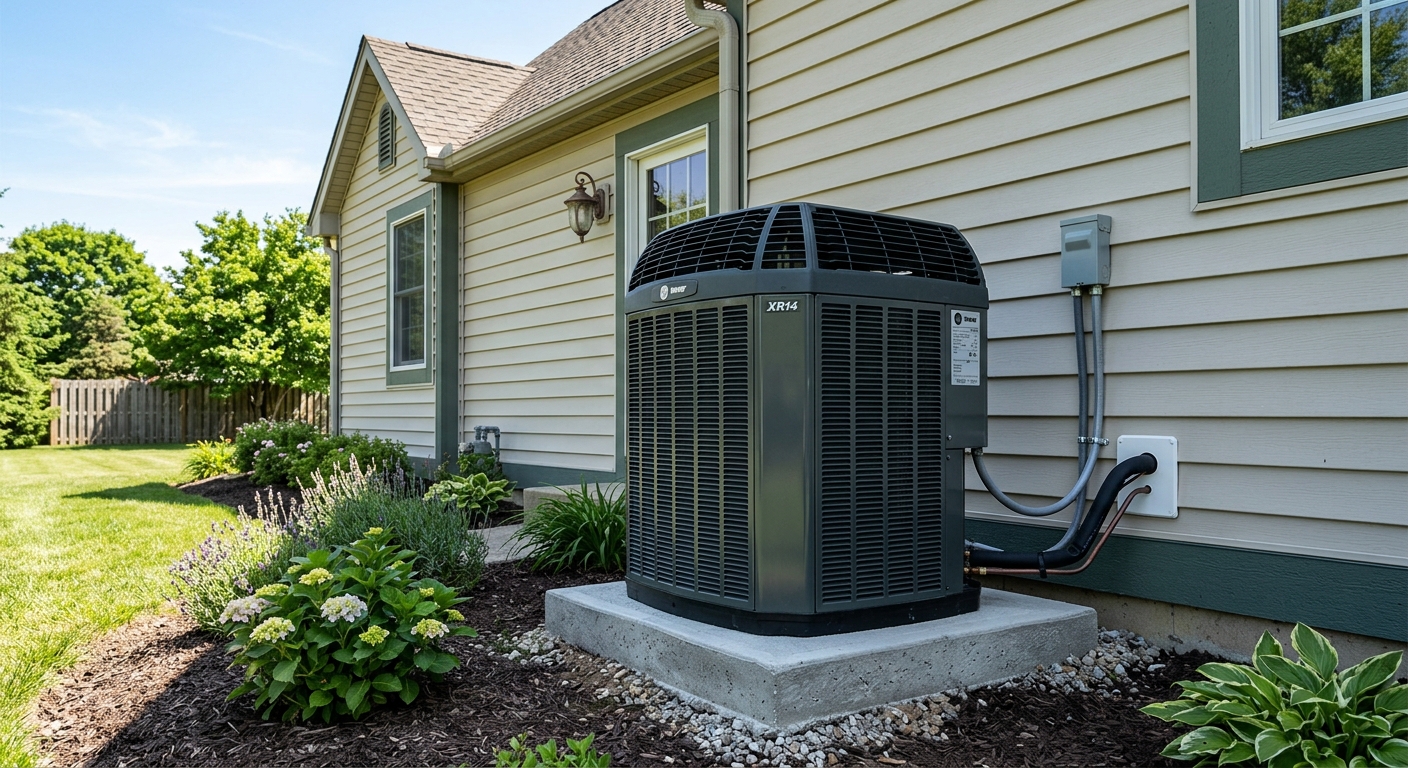
Limerick heating and cooling prices by system type — 2026
Limerick’s high homeownership rate (83.7%) and the fact that nearly 1 in 5 homes was built before 1980 (U.S. Census Bureau, ACS 2024) shape its HVAC market: this is primarily a replacement market, with a strong current for system upgrades. Most single-family homes already have ductwork, though much of it was sized during the post-WWII suburban boom—a period that favored heating, not cooling performance. As in busy retrofit markets like Abington and Cheltenham, you’ll find older trunk-and-branch duct setups needing modern sealing and occasional electrical upgrades before high-efficiency equipment goes in.
The region’s climate—4,800 heating degree days and 1,450 cooling degree days—means winter heating matters more than summer cooling. That puts the focus on heat pumps or high-efficiency furnaces for primary comfort; cooling, while important for humid summers, seldom justifies ultra-premium system upgrades. Natural gas is widely available, but all-electric solutions are now more common thanks to rising code expectations and electrification incentives. If your home is older or needs a complete duct run, expect to budget more.
| System |
Best for |
Efficiency |
Price range (installed) |
| Central AC replacement (existing ducts) |
homes with sound ductwork |
16–20 SEER2 |
$5,500–$13,500 |
| Air source heat pump (ducted) |
year-round heating and cooling |
8–10 HSPF2 |
$8,800–$19,000 |
| Cold-climate heat pump (ducted) |
heat pump as primary heat |
9–11 HSPF2 |
$14,500–$19,000 |
| Ductless mini-split (single zone) |
additions, rooms without ducts |
20–30 SEER2 |
$3,500–$7,700 |
| Full duct system installation |
homes with no existing ducts |
— |
$10,000–$20,000 |
Installed estimates for a typical Limerick home. Equipment tonnage, duct condition and electrical capacity move these more than brand.
Reading the yellow label
Today’s HVAC equipment comes with a bright yellow EnergyGuide label. It displays national average operating cost and two types of efficiency ratings: SEER2 (Seasonal Energy Efficiency Ratio 2) for cooling and HSPF2 (Heating Seasonal Performance Factor 2) for heat pumps. SEER2 and HSPF2 are the new standard—don’t compare them directly to SEER or HSPF numbers you see in older articles or on your existing system, as the testing method was revised. Higher numbers mean better efficiency: 20 SEER2 is top-tier for cooling, while 10 HSPF2 is very good for heating.
In Montgomery County’s climate—4,800 heating degree days to 1,450 cooling degree days—homes use more energy for heating than cooling. That means HSPF2 is the figure that will save you more on your utility bills each year. Chasing the latest SEER2 rating rarely pays back here, since the cooling season is relatively short. Once you’re above 16 SEER2 for AC or 8.5–9 HSPF2 for heat pumps, efficiency gains start costing more than they deliver in savings (unless your cooling load is unusually high). Instead, spend your upgrade dollars on quality ductwork sealing and insulation. The efficiency label tells a story, but local climate writes the ending.
What size system does a Limerick home need?
Very few things ruin comfort and shorten HVAC lifespan faster than an oversized system. In Limerick, the temptation—especially after a muggy August or a bitter January—is to go “just a little bigger.” But that’s a mistake. An oversized system will short-cycle: it turns on and off too often, fails to remove humid air in summer, creates temperature swings, and wears itself out before its time. Oversizing isn’t added peace of mind—it’s a liability built into your home.
The correct way to size your new HVAC unit is a Manual J load calculation, not a square-footage estimate or by copying what was installed 20 years ago. Manual J takes into account your walls, windows, attic insulation, duct leakage, and even which way your house faces. Limerick’s winter design temperature is 14 °F—a professional load calculation uses this number to ensure your system provides steady comfort on the coldest nights, not just averages. Always ask your contractor, “Did you run a Manual J load calculation, and can I see it?” If they say no but will size off the old model tag, they’re just repeating someone else’s guess, along with past errors.
This isn’t shopping for a refrigerator. Proper sizing is the single best way to protect your investment and your comfort, no matter how efficient or expensive the system you choose.
What construction era means for your system
In Limerick, only about 1 in 5 homes was built before 1980 (U.S. Census Bureau, ACS 2024), making this a landscape of mostly newer, post-war suburban homes. In these houses, central ductwork was usually installed from the beginning—but often meant for heating only, not modern air conditioning airflow. Duct sizes are sometimes modest, and insulation levels or window quality may lag behind what’s standard today.
If your home dates to the late 1990s or early 2000s—the typical suburban build wave—the original, builder-grade furnace or AC is likely at or near end of life right now. These first-generation systems were frequently oversized by the builder to avoid callbacks in those early years. Electrical panels vary; while most have capacity for replacement in-kind, you’ll need to check for upgrades if considering a switch to all-electric (especially high-amp heat pumps).
Pre-1980 homes here may lack ductwork or need major sealing and insulation work to serve modern equipment well. Chimney or flue quality is still a concern for old gas or oil systems, but less so if you’re converting to a sealed-combustion furnace or heat pump. For homes built after the 1980s, your main question is how carefully the original equipment was sized and installed. Builder compromises now matter at replacement time.
Mechanical permits for HVAC work in Limerick
In Pennsylvania, HVAC contractors working on homes must register as Home Improvement Contractors (HIC) with the Pennsylvania Office of Attorney General if the work totals over $500. There’s no statewide HVAC trade license for residential jobs—unlike for plumbers or electricians in Philadelphia and Pittsburgh. Instead, Limerick and other Montgomery County municipalities enforce their own mechanical codes and require mechanical permits for any work that installs or replaces HVAC equipment involving new or altered electrical or mechanical connections.
Permits are typically not needed for minor jobs: replacing filters, swapping thermostat batteries, or simple service that doesn’t change equipment. But any major system replacement or new installation will require both a permit and an inspection for code compliance. You should expect to see a copy of your contractor’s EPA Section 608 certification—this is a federal requirement for anyone handling refrigerants, not a state matter. For jobs over $500, a written contract is mandatory by state law, and you have a three-business-day right to cancel. You can verify a contractor’s HIC registration at hic.attorneygeneral.gov and check workers’ compensation status through the state’s WCAIS system.
What each system actually costs to run in Limerick
If you want a real-world number for running costs, you have to do some arithmetic. Here’s the method Limerick homeowners can use—plug in your numbers to follow along. Start with your home’s annual heating and cooling degree days: 4,800 for heating, 1,450 for cooling. These represent the “demand” your house places on a system, based on climate.
Next, look for your system’s efficiency on the yellow label: HSPF2 for heat pumps, SEER2 for central air. A higher number means more of the energy you buy ends up as comfort in your home. For example, a heat pump rated at 10 HSPF2 means it delivers about three times more heat output per unit of electricity compared to baseboard heaters.
Let’s break it down for a typical three-ton (36,000 BTU), 9 HSPF2 ducted heat pump. Multiply degree days (4,800) by a constant (24) to get annual heating load in BTUs, adjust for your house’s specifics, then divide by system efficiency. Your actual electricity rate is on your PECO bill—multiply kWh consumption by your actual rate to see yearly cost. Cooling is done the same way but with 1,450 degree days and SEER2 for efficiency.
Remember: real costs vary. Poorly insulated homes, leaky ductwork, or a system that short-cycles will cost you far more than the label suggests. A high-efficiency system on leaky ducts may underperform a standard one on tight, well-sealed ductwork. Efficiency is only as good as your home’s weak link.
Comparing HVAC estimates in Limerick
In Limerick, two HVAC proposals might both say “16 SEER2 heat pump,” yet differ by several thousand dollars. Half the gap comes from what’s missing. A real quote should specify the model numbers for both indoor and outdoor units—mixed brands or mismatched pairs never deliver full rated efficiency. Sizing must be accompanied by a load calculation, not just a reference to what’s already there.
Be sure the quote details whether your line set (the copper pipes running refrigerant) is being replaced or reused—hidden leaks or grime can ruin a new system. Electrical scope matters, especially with older homes: is your existing panel adequate, or is a panel upgrade included? Ductwork must be assessed for size, leaks, and cleanliness, and commissioning (startup) reports for airflow and refrigerant charge should be provided. Labour warranty coverage is usually separate from the parts warranty—know what you’re actually getting. If the quote doesn’t list a permit fee, ask. A quote that just lists a brand and price is not a comparison at all.
| Line item |
What to look for |
Red flag if… |
| Equipment |
model numbers, indoor and outdoor matched |
brand name only |
| Sizing |
load calculation attached |
matched to the old nameplate |
| Ductwork |
condition assessed, sealing scoped |
not mentioned |
| Electrical |
circuit and panel capacity confirmed |
assumed adequate |
| Line set |
replaced or documented as reused |
silent |
| Commissioning |
measured airflow and charge, documented |
no startup report |
| Warranty |
labour years stated separately |
manufacturer only |
| Permit |
included and priced |
'not needed' |
Frequently asked questions — HVAC installation in Limerick
What is EPA Section 608 certification?
EPA Section 608 certification is a federal requirement for anyone working with refrigerants in air conditioning or heat pump systems, not just in Limerick but across Pennsylvania and the entire U.S. It ensures technicians know how to handle, recover, and dispose of refrigerants safely, protecting the environment and your health. You should expect your HVAC contractor in Limerick to have this certification before installing or repairing any central AC or mini-split containing refrigerant. This is entirely separate from Pennsylvania’s state or municipal licensing requirements for contractors. If you’re getting a new ductless mini-split, for example, that price band is $3,500–$7,700—always confirm the tech is EPA 608 certified before they work on your home.
Do I need dual fuel in southeastern Pennsylvania?
Dual fuel systems pair a heat pump with a gas furnace for maximum efficiency in cold climates. In Limerick and across Montgomery County, with a winter design temperature of 14°F and 4,800 heating degree days, it’s a mixed answer. For most modern homes with decent insulation, today’s cold-climate heat pumps—priced locally from $14,500–$19,000—can reliably serve as the main heat source, often making a backup furnace unnecessary. However, if your home is older, drafty, or you want the absolute lowest electric bills during a hard freeze, dual fuel can be worth exploring. Just remember, every added complication means higher installation and maintenance costs. For most Limerick homes, a properly sized cold-climate heat pump is enough.
How far ahead should I schedule in Limerick?
HVAC demand in Limerick peaks fast during heat waves and cold snaps, driven by the region's high homeownership rate (83.7%) and the saturated Greater Philadelphia market. For a new central air or heat pump (budget between $5,500–$19,000 depending on system and scope), plan at least 2–4 weeks ahead for the best selection of contractors and install dates—longer if you need major duct or electrical upgrades. Emergency replacements can sometimes be done in a few days, but you lose choice and may pay more. For seasonal maintenance, booking early in spring or fall gets you the best rates and prevents last-minute scrambles when the weather turns.
Is natural gas available throughout Montgomery County?
Natural gas is widely available in Limerick and most of Montgomery County’s inner suburbs, with service provided by PECO. However, some far northwestern townships in the county rely more on propane or oil, especially in rural parts. If you’re planning a major HVAC upgrade, check your property’s current utility service. For gas furnace replacements or upgrades (which might fall in the central AC or heat pump range of $5,500–$19,000), installing or extending a gas line may add cost if your home isn’t already served. Always verify availability with PECO before making equipment decisions.
Is an annual maintenance plan worth it?
An annual maintenance plan helps keep your system running efficiently and can catch problems before they become expensive repairs—especially important in Limerick, where homes built during the post-war boom often still have original or aging ductwork. Many contractors offer a discount on repairs or priority scheduling if you’re on their plan. While a basic tune-up typically costs less than a service call, a neglected system can lose efficiency and develop issues that drive up operating costs or shorten lifespan. Considering a replacement system here runs from $5,500–$19,000 depending on type, spending a few hundred dollars per year for regular service is a good hedge, particularly for systems out of warranty or if you have an older home.
How much does a new HVAC system cost in Limerick?
The cost for a new HVAC system in Limerick depends on your home’s existing ductwork, your heating and cooling needs, and whether you choose a heat pump, central AC, or a full ductless solution. For homes with sound existing ducts, central air replacement usually falls between $5,500–$13,500. If you need a complete duct install—from scratch or major redo—budget $10,000–$20,000. Cold-climate heat pumps, which can handle year-round comfort here, run from $14,500–$19,000. Always get several quotes with clear details of what’s included: ductwork, electrical, permitting, and commissioning can swing the bottom line as much as the equipment itself.
Why do HVAC quotes in Limerick vary so much?
You’ll see a big range in quotes—sometimes more than $5,000 difference for what sounds like the same job. In Limerick, system cost reflects not just equipment but also duct condition, needed electrical upgrades, code-required permitting, and even the season’s demand on local contractors. Some companies factor in full commissioning (testing airflow, refrigerant charge) while others skip it. If a quote is only a brand and price, you can’t compare it—ask for labor warranty years, model numbers, whether a load calculation was performed, and details on ductwork and electrical scope. Remember: a price that omits these can end up costing far more after the fact.
How is a tax credit different from a rebate?
A tax credit is a reduction in the income tax you owe for the year, while a rebate is money back from the utility, manufacturer, or program administrator—sometimes right at installation, sometimes mailed later. In Limerick, for a heat pump installation (band: $8,800–$19,000), a federal tax credit reduces next year’s taxes, not out-of-pocket cost at install. Rebates, offered occasionally by utilities like PECO, can make an immediate dent in the invoice. It’s common for both to apply, but credits require IRS paperwork, and rebate eligibility or timing can vary. Always confirm what’s actually available before you sign a contract.
What does HSPF2 measure?
HSPF2 (Heating Seasonal Performance Factor 2) measures a heat pump’s heating efficiency over a typical season using updated, more realistic testing methods compared to the older HSPF rating. In Limerick and the rest of Montgomery County, with 4,800 heating degree days, you’ll feel the difference: the higher the HSPF2, the more heat you’ll get per dollar of electricity. For instance, a heat pump with a 10 HSPF2 rating (projects here range $8,800–$19,000) delivers significant long-term savings over a lower-rated model. Just don’t compare HSPF2 with old HSPF numbers—they’re not measured the same way. Ask for the HSPF2, and weigh it against your total installation cost and heating needs.