HVAC costs in Oakmont — 2026
In Oakmont, where 70.8% of homes were built before 1980 and the homeownership rate sits at 59.3% (U.S. Census Bureau, ACS 2024), replacing or retrofitting an HVAC system often means working around older ductwork and electrical setups. If your home hasn’t had its ductwork upgraded since Eisenhower’s era, odds are good it’s either tight, leaking, or not even present in some rooms. This isn’t a new-build market—most installations here solve real problems in existing homes rather than being optional upgrades.
Oakmont’s climate is firmly heating-dominated, with 5,600 heating degree days and 1,050 cooling degree days per year. That tips the scale toward systems with strong heating performance—you’ll use your furnace or heat pump much more than your AC. Most households favor solutions that handle both comfort and energy bills through our region’s heavy freeze-thaw and long, cold winters.
All this means pricing covers a wide range. Equipment size, existing duct condition, and whether your electrical panel can handle a modern heat pump make a bigger difference than any brand name. Below are 2026 ballpark prices for typical Oakmont homes, including equipment and labor:
| System |
Best for |
Efficiency |
Price range (installed) |
| Central AC replacement (existing ducts) |
homes with sound ductwork |
16–20 SEER2 |
$5,000–$12,000 |
| Air source heat pump (ducted) |
year-round heating and cooling |
8–10 HSPF2 |
$8,000–$17,000 |
| Cold-climate heat pump (ducted) |
heat pump as primary heat |
9–11 HSPF2 |
$13,000–$17,000 |
| Ductless mini-split (single zone) |
additions, rooms without ducts |
20–30 SEER2 |
$3,200–$7,000 |
| Full duct system installation |
homes with no existing ducts |
— |
$9,100–$18,000 |
Installed estimates for a typical Oakmont home. Equipment tonnage, duct condition and electrical capacity move these more than brand.
The comfort problem that isn't temperature
If you’ve lived through a stretch of Oakmont winter, you know the thermostat isn’t the only thing that matters. Our region’s 5,600 heating degree days mean indoor air dries out quickly. In the muggy summer, humidity can climb just as fast. An oversized air conditioner, instead of helping, cycles too quickly and fails to dehumidify the house—leaving you sticky, not cool. Oakmont’s older homes sometimes have less airtight construction, but newer windows or insulation can trap humidity when the AC is off.
Whole-house humidifiers are frequently helpful in winter, but they come with their own maintenance: stagnant reservoirs can breed mold if filters and pads aren’t changed regularly. In summer, a well-sized AC or a dedicated whole-house dehumidifier will do the job better than any portable plug-in. As for filtration, some contractors push MERV 13–16 filters for “improved air quality,” but these can choke the airflow of older blowers not designed for that much resistance. If you want a higher MERV filter, you need to be sure your system can handle it—or spend more for a retrofit.
In tightly sealed newer homes, mechanical ventilation (for example, an energy recovery ventilator) may make sense, but in Oakmont these are rarely needed unless you’ve done a deep energy retrofit. Most air quality upgrades—UV lights, ionizers, “air scrubbers”—are oversold for their actual return in a typical home. If you’re spending money, prioritize sizing and humidity control first.
Mechanical permits for HVAC work in Oakmont
HVAC work in Oakmont falls under local, not statewide, regulation for residential jobs. While Pennsylvania has no statewide HVAC license for residential work, contractors installing or replacing systems must hold a Home Improvement Contractor (HIC) registration with the Pennsylvania Office of Attorney General for any job over $500. You can verify HIC registration at hic.attorneygeneral.gov before you sign anything.
For any HVAC project involving refrigerant—AC or heat pump—federal law requires EPA Section 608 certification. It is not a license, but no one can lawfully handle refrigerant without it, regardless of where you live in Pennsylvania.
In Oakmont and surrounding Allegheny County municipalities, you need a mechanical permit for new or replacement HVAC installs. This permit should be pulled by your contractor, not the homeowner. Inspections will be scheduled as part of that permit, ensuring that the work meets the Pennsylvania Uniform Construction Code (UCC)—based on the IRC. If you want to check a contractor’s workers’ compensation coverage, use the WCAIS system at wcais.pa.gov. This is required for all employers, without exception.
Lastly, if your house predates 1978 and work may disturb painted surfaces, verify that your contractor is certified under the EPA Lead RRP Rule. Refer to certifiedrenovatorsearch.epa.gov. Proper permitting and documentation protect you, your home, and your investment.
The decision point on an aging system
Spotting the difference between a good repair and money thrown away starts with knowing your system’s age and the type of failure. A furnace or central AC in Oakmont that’s under 10 years old and has a single part go bad is almost always worth repairing, especially since most replacement costs—$5,000–$12,000—are substantial in this area. If your system is 10–15 years old and a quoted repair is more than a third of a new install, it's time to consider full replacement. The hardest line: a cracked heat exchanger in a furnace or a compressor failure in an old AC or heat pump. In both cases, replacement isn’t optional—either for safety or because the repair makes no economic sense.
Refrigerant type also matters: if you have an old AC using R-22, repairs quickly get too expensive to justify as the refrigerant is being phased out. Efficiency is less dramatic in a region with 1,050 cooling degree days—payback on a high-SEER system is a longer game than some contractors admit. For “high bills,” have ducts and air leaks tested before buying new equipment. Value isn’t just in the nameplate—distribution and sizing matter more.
| Situation |
Recommendation |
Typical cost |
Reasoning |
| Under 10 years, single component failure |
Repair |
$300–$1,200 |
Parts are available, and you’ll get more years from your investment. |
| 10–15 years, repair over a third of replacement |
Consider replacing |
$5,000–$12,000 |
Significant cost with no guarantee of other parts surviving. |
| 15+ years, any major failure |
Replace |
$5,000–$12,000 |
Imminent end of life—better to invest in new. |
| Cracked heat exchanger, any age |
Replace immediately |
$5,000–$12,000 |
Safety and code violation—repair not advised. |
| Compressor failure past warranty |
Replace |
$8,000–$17,000 |
Costly repair; new system is more efficient and reliable. |
| Working system, high bills |
Test ducts and envelope first |
$300–$800 |
Air leaks, insulation, or ducts are often to blame. |
Operating cost, not sticker price
With Allegheny County’s 5,600 heating degree days per year and winter temperatures dipping as low as 8 °F, most Oakmont homes spend their real HVAC money on heat, not summer cooling. The electric utility here—Duquesne Light Company—bills by kilowatt-hour, and actual winter costs can vary widely by equipment and insulation. So how do you compare two systems? Find your electric (or gas) rate on your utility bill—don’t rely on what anyone “heard.”
Here’s how it works: Every furnace, AC, and heat pump is rated for efficiency—SEER2 for cooling, HSPF2 for heat pumps, AFUE for furnaces. A heat pump with an HSPF2 of 9 will output 9 BTUs of heat per watt-hour. If Oakmont faces 5,600 heating degree days, a typical home might need 40 million BTUs per year for heating. Divide by the efficiency to get your annual kilowatt-hours (for electric systems).
For example: 40,000,000 BTUs ÷ 3,412 (BTUs/kWh) = roughly 11,730 kWh required. If your Duquesne Light rate is $0.15/kWh, that’s roughly $1,760 per year. A higher-efficiency unit drops this number, but not as much as sealing your ducts or insulating more, especially in older Oakmont homes.
If you’re on gas, your bill will show “therms” or CCF (hundred cubic feet) consumed. AFUE converts input gas to output heat—and again, a leaky duct system can lose 20–30% of delivered heat, undermining any rating. A high-efficiency furnace on old, leaky ducts might cost more to run than a standard furnace on tight, well-sealed ducts.
Before banking on efficiency savings alone, check your real utility rate and have ducts tested and sealed. That math is worth more to your wallet than any sticker or brochure.
When ductless is the right answer
Ductless mini-splits are tailor-made for Oakmont’s older housing stock—especially in rooms never reached by the central system or additions built before central AC was common. If you have an attic, basement, or sunroom that stays stuffy or freezing, a single-zone mini-split is often the best solution without destroying plaster, floors, or finished ceilings to run new ducts. This is more common here because “pre-1960 housing dominates; retrofits often face tight ducts and older electrical service.”
Single-zone systems (one outdoor unit to one indoor head) are the simplest and most reliable. Multi-zone systems (one outdoor and multiple heads) work, but there’s a catch: when you connect several heads to a single outdoor unit, performance is shared, and you lose independent control and efficiency in low-demand seasons. If you need true zoning—for example, both an attic and basement—separate single-zone systems, though more expensive upfront, deliver better comfort.
Heads must be placed for effective airflow, which doesn’t always match your furniture or taste—this is the #1 homeowner objection. Condensate (water) lines need to be routed reliably, sometimes with pumps for basement installs. While mini-splits cost $3,200–$7,000 per zone, they can be a bargain compared to tearing open walls for new ductwork or chasing endless drafts in an old house.
Ductwork: the part nobody quotes properly
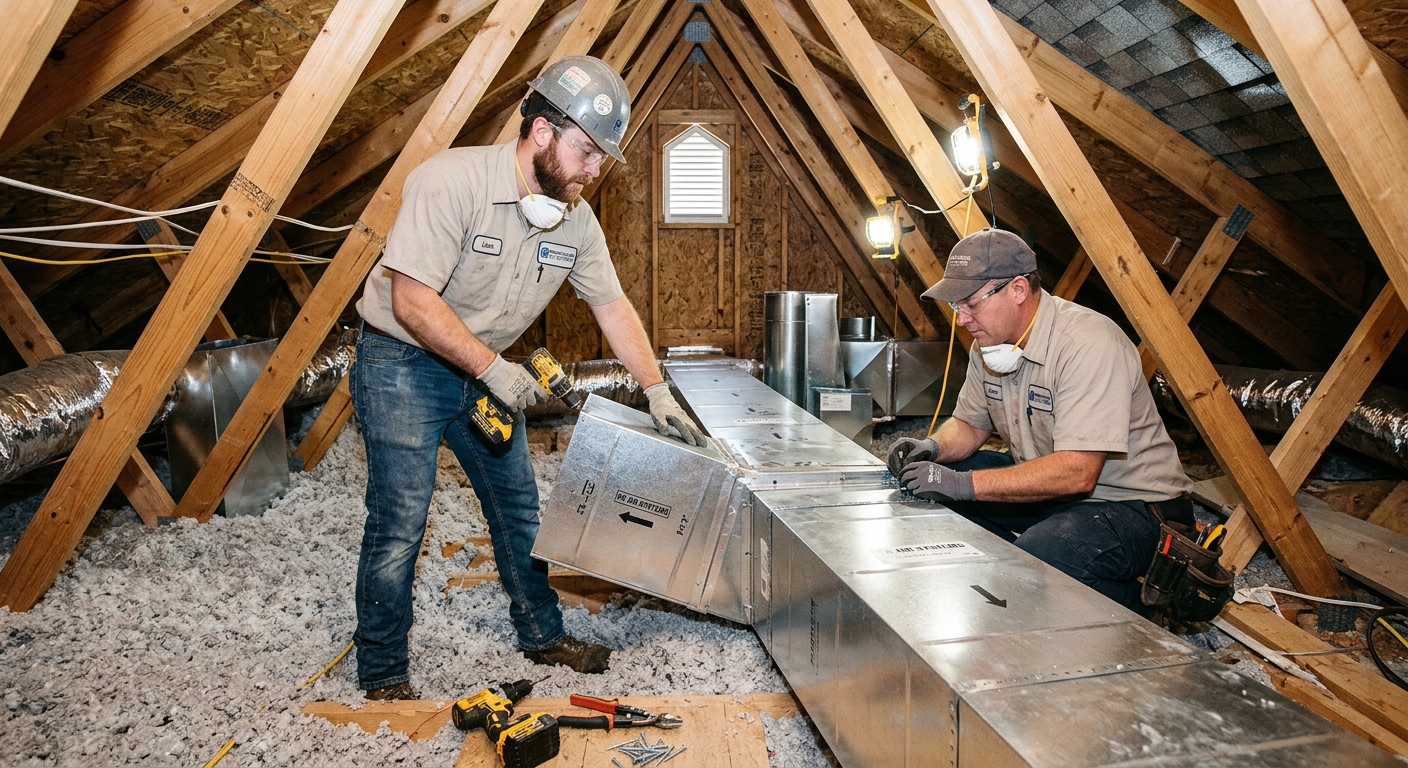
Duct losses in Oakmont’s older homes can swallow a huge share of conditioned air, especially when ductwork was sized for a furnace only or runs though attics and crawlspaces. The era of construction (pre-1960 in most Oakmont homes) is pivotal—many homes never had true supply and return ducts, only improvisations pieced together for early central heating. This means leaks at joints, undersized or missing returns, and decades of dust and debris.
A duct blaster test measures leakage by pressurizing the system and detecting how much air escapes. Anything above 10% leakage is wasting gallons of fuel (or kWh of electricity) every winter. Sealing the ducts with mastic or tape (not just foil tape or caulk) is the first line of defense. In some homes, duct replacement or redesign is necessary—especially if the original ducts used “panned joist” returns or run through vented attics.
It’s common for old homes to lack returns in every major room or have runs too small for today’s high-efficiency systems. This chokes airflow, raising noise and reducing system life. If your utility bills are high or certain rooms never heat or cool properly, have ductwork tested and evaluated before you replace expensive equipment. Installing a high-efficiency furnace or heat pump on a leaky or undersized duct system wastes money and won’t deliver promised performance. Fix the pipes, then the machine.
Frequently asked questions — HVAC installation in Oakmont
How much does a new HVAC system cost in Oakmont?
In Oakmont, most complete HVAC replacements fall between $5,000–$12,000 if you already have ductwork in reasonable shape. Costs rise if you need new ducts or convert an older system. With 70.8% of homes built before 1980, retrofits are common and can drive up labor costs—especially if your ductwork is tight, narrow, or partly missing. Every quote should be site-specific; the only way to avoid surprises is a full in-home assessment. For a typical system replacement—say, furnace and central AC—expect around $8,000, but factor in electrical or ductwork fixes as needed.
What HVAC tax credits are available to Oakmont homeowners?
Oakmont homeowners may qualify for federal energy efficiency tax credits for both heat pumps and high-efficiency air conditioners. The specifics change year to year, but for equipment that meets Energy Star requirements, credits can cover a portion of both the equipment and installation. For example, a qualified ducted heat pump system ($8,000–$17,000 installed in Oakmont) may earn you a significant credit. Always confirm eligibility with your tax advisor and check for updated incentives before making a decision, as these programs can shift with federal or state policy.
What does a heat pump cost installed in Oakmont?
Installed costs for a ducted air source heat pump typically run $8,000–$17,000 in Oakmont, but the average homeowner can expect to pay about $13,000 for a standard setup in a single-family home. Older homes with outdated ducts, insufficient electrical service, or challenging layouts may see prices at the higher end. Always insist on a full evaluation—retrofits often reveal hidden costs in this region’s pre-1980 housing stock. If ducts are in poor condition or missing, total price could include another $9,100–$18,000 for duct installation.
How do I verify an HVAC contractor's insurance?
In Pennsylvania and Oakmont, all HVAC contractors must carry workers’ compensation if they have employees. Homeowners can verify this coverage through the official WCAIS system (wcais.pa.gov). Ask your contractor for proof of active coverage and their Home Improvement Contractor (HIC) registration; this protects you from liability if a worker is injured on your property. For jobs over $500, never sign a contract until you see written insurance documentation. This is your right—reputable contractors expect to provide it.
What MERV filter rating should I use?
In Oakmont’s older homes, most systems are originally sized for moderate airflow resistance. A filter rated MERV 8–11 is usually the sweet spot for balancing dust control and keeping your blower system happy. Going up to MERV 13 or higher can improve filtration, but only if your blower is upgraded to handle increased resistance—otherwise, you risk freezing coils or short equipment life. Standard filter changes ($20–$50 per filter, several times a year) are a must, but don’t overpay for top-tier filters unless allergies or medical issues are in play and your system is designed for it.
Do older Oakmont homes need ductwork replaced?
Not always. Many pre-1980 Oakmont homes can make do with sealing and adding returns rather than full duct replacement, which costs $9,100–$18,000. However, if your ducts are asbestos-wrapped, run through unconditioned attics, or are so leaky that rooms never heat or cool, replacement or major rework may be best. Consider a duct blaster test before committing. A lot of older homes achieve big efficiency gains with targeted repairs rather than gutting what’s there—don’t let anyone sell you on a new duct job without evidence.
Do I need to be home during installation?
For most Oakmont HVAC installations and replacements, it’s best if you can be home—at least at the start and finish—to review scope, answer layout questions, and ensure everything’s completed as agreed. A basic central AC swap ($5,000–$12,000) can take a full day, while more complex heat pump or ductwork jobs may run two or more. The crew will need access to mechanical rooms, electrical panels, and possibly the attic or crawl space. Being available means fewer miscommunications and better results.
How often should I change my filter?
In Oakmont, change your HVAC filter every 1–3 months during heating and cooling season. The town’s older homes produce more dust, and construction projects or pets shorten filter life further. Cheap fiberglass filters are fine in a pinch, but pleated filters (MERV 8–11) do better for both air quality and equipment life. Replacement costs typically range from $20–$50 per filter. Mark your calendar—clogged filters reduce airflow, drive up bills, and strain expensive equipment.
Is a heat pump a good choice for Oakmont winters?
With a winter design temperature of 8°F and heavy heating needs (5,600 degree days), today’s cold-climate heat pumps are a legitimate option for Oakmont households—especially if your home is well insulated and ductwork is in good shape. Installation runs $13,000–$17,000 for a full high-performance system, and payback depends on your current heating fuel and local electric rates from Duquesne Light Company. For older, draftier homes, a backup furnace or hybrid system keeps you covered on bitter-cold nights. Ask for a detailed heat load calculation, not just a generic pitch.