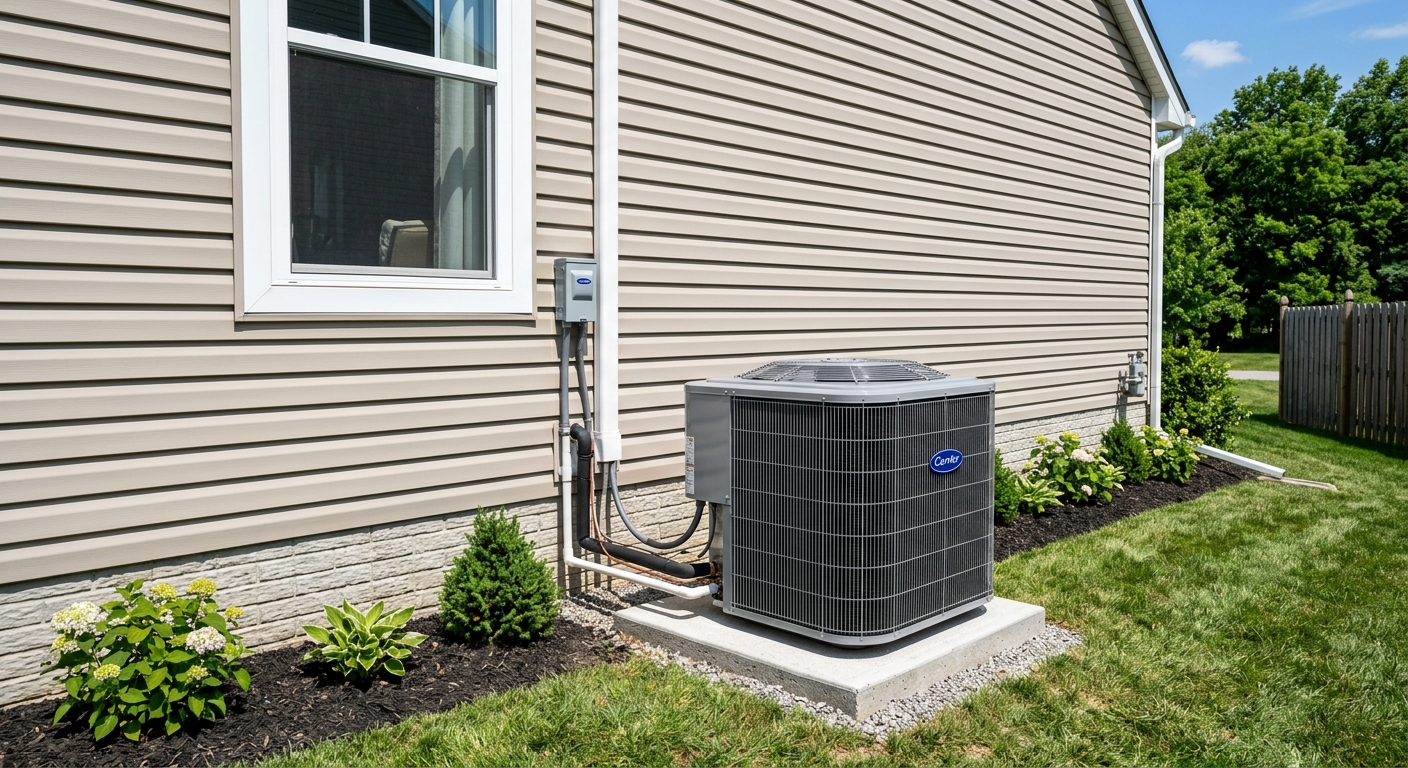
New Brighton heating and cooling prices by system type — 2026
In New Brighton, most homes were built before 1980, with 93% of the housing stock falling into this category (U.S. Census Bureau, ACS 2024). The homeownership rate here is 46.4%, which means a large share of HVAC work is retrofit and replacement, not new construction. This area follows the pattern seen in neighboring Aliquippa and Beaver Falls, where many homes date to the mill era and originally relied on radiators or gravity furnaces. Often, these older houses either lack complete ductwork or have ducting that isn’t sized for modern central cooling or high-efficiency heating. That’s why duct upgrades or new duct installations come up frequently in proposals here.
Southwestern Pennsylvania is firmly a heating-dominated climate; with 5,600 heating degree days against only 1,050 cooling degree days, reliable winter performance matters more than squeezing out maximum cooling efficiency. This influences not only the equipment people choose, but also what you can expect to pay. Some may hope to cool a few upper-floor rooms with a ductless mini-split, while others need full-system replacement—perhaps with fresh ductwork for an older mill house that’s never had it.
| System |
Best for |
Efficiency |
Price range (installed) |
| Central AC replacement (existing ducts) |
homes with sound ductwork |
16–20 SEER2 |
$4,500–$11,000 |
| Air source heat pump (ducted) |
year-round heating and cooling |
8–10 HSPF2 |
$7,200–$15,500 |
| Cold-climate heat pump (ducted) |
heat pump as primary heat |
9–11 HSPF2 |
$11,500–$15,500 |
| Ductless mini-split (single zone) |
additions, rooms without ducts |
20–30 SEER2 |
$2,900–$6,300 |
| Full duct system installation |
homes with no existing ducts |
— |
$8,100–$16,500 |
Installed estimates for a typical New Brighton home. Equipment tonnage, duct condition and electrical capacity move these more than brand.
Gas, electric or both in southwestern Pennsylvania
Our area’s heating-dominated climate—with a winter design temperature of 8 °F and 5,600 annual heating degree days—puts real pressure on any system to perform well when it matters most. Modern cold-climate heat pumps are much improved: they hold usable capacity below freezing and can heat many homes efficiently through most of the winter. The old wisdom that “heat pumps don’t work after November” simply isn’t true anymore. Capacity will drop off as you hit single digits, which is why the winter design temperature still matters here—especially in old homes.
Gas availability is another major factor. Boroughs like Beaver and Aliquippa have reliable access to natural gas for furnaces and combined systems, but in outlying townships you may be stuck with propane or fuel oil. If you have natural gas at the curb, a modern gas furnace plus central AC is still a cost-effective, reliable choice for cold winters. But if you don’t—and a propane truck is your only option—a high-efficiency heat pump avoids fluctuating fuel deliveries and offers lower operational costs for many homes.
Where would I still recommend a furnace? If your home is big, drafty, or just hard to weatherize, or if you’re in one of the boroughs wired for natural gas and plan to stay long-term, a gas furnace often makes both economic and comfort sense.
| Option |
Installed cost |
Operating cost here |
Best when |
Incentive eligible |
| Gas furnace + central AC |
$4,500–$11,000 |
lowest if gas service exists |
existing gas service, coldest zones |
moderate |
| Ducted heat pump (cold climate) |
$7,200–$15,500 |
very low, especially all-electric |
good envelope, all-electric goal |
high |
| Dual fuel (heat pump + gas backup) |
$11,500–$15,500 |
optimized for deep cold spells |
gas on site, deep cold spells |
varies |
| Ductless multi-zone |
$8,100–$16,500 |
lower for small loads, zoned control |
no ductwork, zone control |
high |
Permits, licensing and inspections in New Brighton
For residential HVAC installation and replacement in New Brighton, contractor licensing is handled at the state level for registration, but not for trade licensure. There is no statewide HVAC license in Pennsylvania; instead, contractors must have Home Improvement Contractor (HIC) registration through the Office of Attorney General for any job over $500. Mechanical permits and actual code enforcement in Beaver County—including New Brighton—are enforced locally, often through municipal code offices. So, while every reputable contractor will have HIC registration, mechanical permits for your job are pulled at the local level, not state.
Any technician handling refrigerant (installing or recharging AC or heat pumps) must have federal EPA Section 608 certification—regardless of any local or state requirements. If you're getting a complete furnace or AC swap, a municipal mechanical permit is almost always required within boroughs like Beaver Falls, and you should see that permit listed on any legitimate quote.
Worker's compensation insurance is mandatory for all employers. To verify a contractor's insurance and workers' compensation, homeowners can use the Pennsylvania HIC database (hic.attorneygeneral.gov) and the WCAIS system (wcais.pa.gov). These platforms provide reliable proof on registration and insurance status before you sign anything. A written contract is required by law for jobs over $500—with a three-day right to cancel—so don’t let anyone rush you or cut corners on paperwork.
How to vet an HVAC contractor in New Brighton
In this part of Beaver County, the reality is that how your HVAC system is installed matters more than the brand of equipment itself. The best model, if installed carelessly, can’t keep up or may break early. Before you hire anyone for HVAC work in New Brighton, confirm they’re properly registered, insured, and actually qualified for the type of installation you need.
Start by checking their Home Improvement Contractor (HIC) registration through hic.attorneygeneral.gov, and verify workers’ compensation insurance using WCAIS. For any refrigerant work, make sure the techs themselves have current EPA Section 608 certification. Your written quote should include a Manual J load calculation—not just a guess based on the old equipment’s size—and both indoor and outdoor unit model numbers. Ask about startup procedures: commissioning should include measured airflow and refrigerant charge, with documentation you keep for warranty purposes.
- Is the contractor's HIC registration active? (Check hic.attorneygeneral.gov.)
- Can you check workers’ comp via WCAIS?
- Do they provide EPA Section 608 certification for installers?
- Proposal includes load calculation—not just replacement in kind?
- Indoor and outdoor model numbers listed, not just tonnage?
- Site visit before quoting—no phone estimates?
- Line set and duct condition assessed, not assumed?
- Startup commissioning documented and left with you?
- Labour warranty length is stated separately?
- Mechanical permit listed as included?
- They answer local code questions forthrightly?
- No hesitation to show proof of insurance or recent jobs in New Brighton?
A red flag in towns like this—with a moderate, not saturated contractor market—is any company pushing you to sign same-day or refusing to document license or insurance. The best pros here are booked up, not desperate for instant commitments.
Filtration, humidification and ventilation
With heavy freeze-thaw cycles and long winters in southwestern Pennsylvania, indoor air quality here is naturally affected by both low winter humidity and muggy summers. In winter, older New Brighton homes are especially prone to dry air—low enough that wood floors shrink and you get the dreaded static shock. While homeowners often ask about whole-house humidifiers, it’s important to remember these need regular cleaning to avoid mold and mineral buildup. They add comfort, but only if maintained.
On the flip side, an oversized air conditioner fails to dehumidify in our humid summers, leaving you cool but clammy. If your AC cycles on and off quickly without really drying the air, sizing is off—not something a fancier air purifier will fix. For filtration, a MERV 8 to 13 filter is realistic if your blower can handle it; otherwise it’ll strain the motor. In older, leaky homes, mechanical ventilation isn’t a major concern, but for updated or tightly renovated homes, adding something like an ERV (energy recovery ventilator) is sometimes worth it.
Add-ons like UV lights or expensive electronic air cleaners are heavily marketed, but the measurable improvement over a standard pleated filter is minor for most homes. Don’t overspend: invest in proper sizing, sealing, and basic filtration first.
Reading an installation proposal
When reviewing an HVAC proposal in New Brighton, clarity and specifics are your best protections. Every line item should be spelled out: not just “3-ton AC,” but the full model numbers for both indoor and outdoor components, and confirmation that these units are properly matched—a major detail for system efficiency. Sizing should come with a load calculation summary (usually Manual J)—don’t settle for a bid that says “same size as before.”
Most older homes here have ductwork that needs scoping for leaks or sizing problems, especially if the original system was heat-only. Look for explicit mention of line-set replacement or documentation supporting reuse. Major electrical updates—like a panel upgrade—can add thousands, so a good quote clarifies if your panel is adequate. Details matter: who provides the new thermostat, how condensate drains are run, and that the permit fee is included up front. Finally, a commissioning report should confirm airflow and refrigerant charge at startup, and the labor warranty (not just the manufacturer’s part coverage) should be stated clearly.
| Line item |
What to look for |
Red flag if… |
| Equipment |
model numbers, indoor and outdoor matched |
brand name only |
| Sizing |
load calculation attached |
matched to the old nameplate |
| Ductwork |
condition assessed, sealing scoped |
not mentioned |
| Electrical |
circuit and panel capacity confirmed |
assumed adequate |
| Line set |
replaced or documented as reused |
silent |
| Commissioning |
measured airflow and charge, documented |
no startup report |
| Warranty |
labour years stated separately |
manufacturer only |
| Permit |
included and priced |
'not needed' |
What construction era means for your system
With 93% of homes in New Brighton built before 1980, ductwork is a big question mark on most HVAC jobs here. Many homes were originally heated with radiators, not forced air, and even those that had old ducted furnaces usually weren’t sized for modern air conditioning. Ducts can be undersized, leaky, or simply missing in some upper-floor rooms—so don't assume a quick central AC swap will work. Plus, insulation and window quality are hit or miss in these older houses. Expect heat loss in winter unless walls or attics have been upgraded in recent decades.
Another critical legacy: electrical panels may not have the spare capacity for a full heat pump upgrade without extra work. If you're thinking about going all-electric, your panel and possibly your wiring will likely need assessment. Gas appliances might be venting into old chimneys that no longer meet safety code, making flue lining or relining a common add-on for furnace replacements. For newer suburban homes—less common here but present in pockets—expect first wave replacements as original builder-grade equipment ages out. In those cases, the challenge is often correcting sizing errors from the last install.
Frequently asked questions — HVAC installation in New Brighton
How do I verify an HVAC contractor's insurance?
Any homeowner in New Brighton can (and should) check both Home Improvement Contractor (HIC) registration and insurance before hiring. For jobs over $500, contractors must be registered with the state. Use hic.attorneygeneral.gov to confirm registration, and WCAIS (wcais.pa.gov) to see if they carry active workers’ compensation insurance. Don’t settle for a verbal “yes” — these tools show real-time status. Most legitimate companies will even provide their certificate directly if you ask. This check is free, takes just a minute online, and is key for your protection in case anything goes wrong during a $4,500–$11,000 system install. An insured contractor is less likely to cut other legal corners, so don’t skip this step.
How is a tax credit different from a rebate?
A rebate lowers your out-of-pocket costs up front, usually as a discount at the point of sale or a check sent after you document your purchase. Tax credits, by contrast, reduce the amount you owe the IRS when you file your federal return; you pay in full first, then claim the credit. For New Brighton homeowners, some high-efficiency heat pump systems in the $7,200–$15,500 range qualify for both local utility rebates (for things like ENERGY STAR-rated equipment) and federal tax credits. The two can sometimes be combined, but you’ll notice the cash benefit of a rebate long before a tax credit appears in your refund.
Is a high-efficiency system worth the extra cost here?
In New Brighton’s heating-heavy climate, a high-efficiency system usually pays off, but the numbers must fit your home. Systems with 16–20 SEER2 (for cooling) or 9–11 HSPF2 (for cold-climate heat pumps) typically cost more up front—think $11,500–$15,500 installed—but trim operating costs and keep you more comfortable in deep winter. If your house is drafty or the ductwork is a mess, the return on extra efficiency is limited until you address those basics. For well-sealed homes with solid insulation, though, efficiency gains are real and utility rates make the math work over 6–8 years for many.
Is natural gas available throughout Beaver County?
No, natural gas is common in boroughs like Beaver and Aliquippa, but in outlying or rural areas of Beaver County, it’s often not available. Instead, homeowners rely on propane or fuel oil, which tend to cost more and fluctuate year to year. So, if you’re looking at a new system and don’t have gas service at your street, compare a heat pump $7,200–$15,500 to propane—not to gas. Gas lines can’t be extended on demand, so don’t assume you can just “switch to gas” in the future if it isn’t already connected.
How long does HVAC installation take in New Brighton?
Most replacement systems in New Brighton—like swapping out an old furnace and AC for a new one—are wrapped up in a single day for straightforward jobs, or two days if there’s more duct or electrical work. Full duct system installations, especially in older houses that never had central air, tend to stretch out to 3–5 days. Complexities like electrical panel upgrades or flue repairs can add time. Planning ahead and having the right mechanical permit in place (required in boroughs like Beaver Falls) helps avoid delays. Many install quotes in the $8,100–$16,500 range reflect both equipment and labor for these multi-day projects.
Why are my New Brighton energy bills high with a new system?
High energy bills after a new system is installed in New Brighton are frustrating but common, often due not to the unit itself but to issues with duct leaks, poor insulation, or outdated windows—especially since most local homes were built before 1980. If your ductwork wasn’t tested or sealed during the $4,500–$11,000 install, much of your heat or cool air could be lost before it even gets to your rooms. Oversizing the equipment (more common than you’d hope) also causes short cycling and poor humidity removal, driving up costs. If bills stay high, have your ducts tested for leaks and insulation levels checked before blaming the equipment.
Why do HVAC quotes in New Brighton vary so much?
Quotes in New Brighton can run from $2,900–$16,500 depending on several factors unique to your property—and the details offered by each contractor. The largest swings come from ductwork: does your home have usable, sealed ducts, or does everything need a complete overhaul? Electrical upgrades, local permit fees, and quality of materials also move the price. Some low quotes skip required permits or paperwork. Well-written quotes spell out model numbers, commissioning plans, and line-set work—if a proposal just says “AC replacement” with a lump price, you can’t compare it fairly.
What is SEER2 and how is it different from SEER?
SEER2 is the new federal efficiency rating for air conditioners and heat pumps, replacing the old SEER standard. The difference is in the test: SEER2 uses higher static pressure to better reflect real-world conditions, so SEER2 numbers are a bit lower than what you might be used to. For New Brighton homeowners, you’ll usually see central AC replacements rated 16–20 SEER2 in the $4,500–$11,000 installed range. SEER2 gives you a better idea of expected energy use in your actual ductwork—so don’t let anyone convince you higher SEER (not SEER2) numbers are better when you’re comparing current models.
Should I repair or replace my HVAC system in New Brighton?
In New Brighton, with so many homes predating 1980, repair may not be cost-effective if your system is over 15 years old or you’ve already replaced major parts. If your equipment still uses R-22 refrigerant, replacement is a must—R-22 is no longer produced, so repair costs are high and temporary. An honest contractor will recommend repair if the cost is less than a third of replacement (for example, a $4,500–$11,000 job versus a few hundred for a quick fix), but warn you if another big bill is around the corner. Factor in comfort, energy savings, and rebates when deciding.