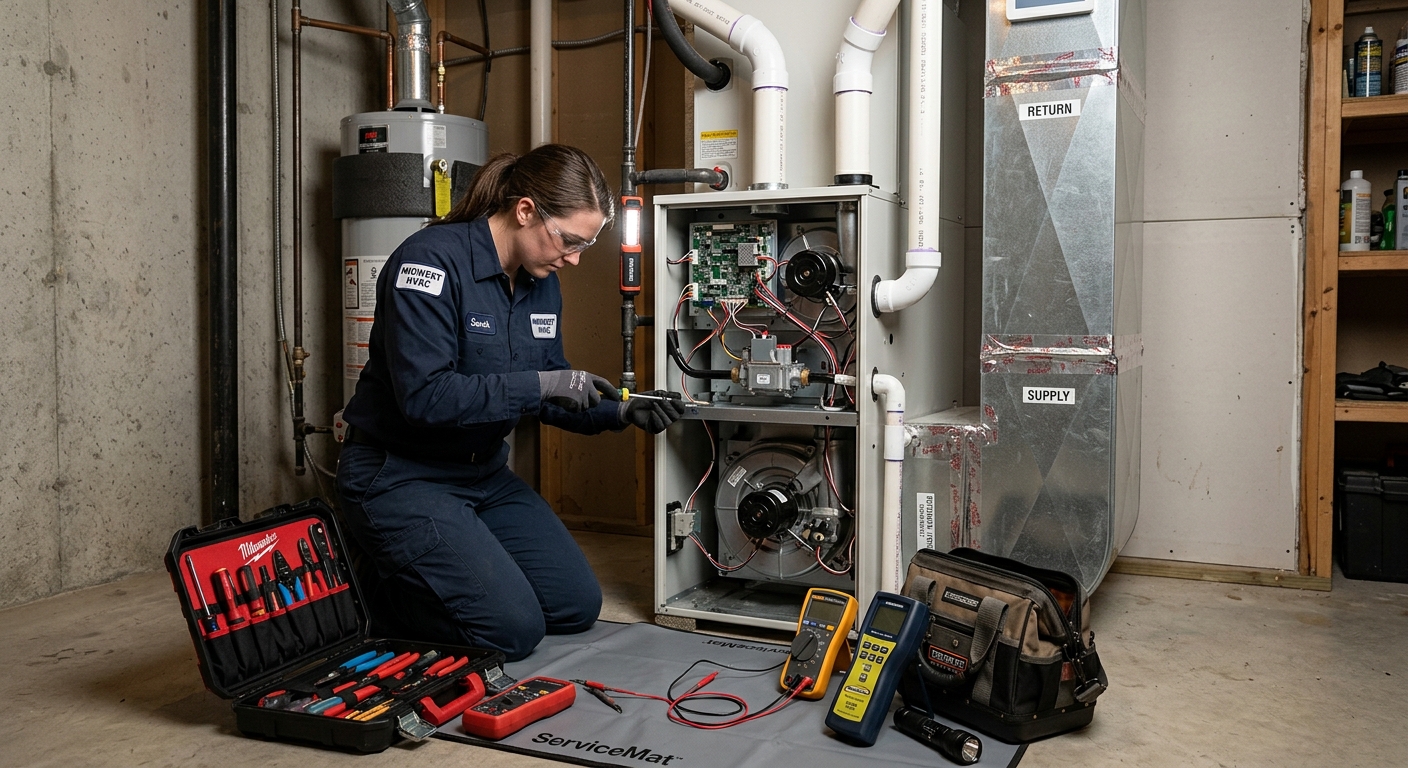
New Kensington heating and cooling prices by system type — 2026
New Kensington sits in a market where more than 90% of houses were built before 1980, and 60% are owner-occupied (U.S. Census Bureau, ACS 2024). That shapes nearly every HVAC job here. Most systems I see are replacements, not first-time installs, and it’s common for retrofitted ductwork to show its age. Electrical upgrades are also a frequent part of the package—most homes weren’t wired with modern heating and cooling in mind.
Our climate is heating-dominated. With 5,600 heating degree days and just 1,050 cooling degree days, winter comfort drives most decisions. AC is nice to have on July afternoons, but a reliable heating system is non-negotiable from November to March. Older homes may still have original ductwork or limited space for upgrades, which affects both system options and costs. If your home already has solid ducts, replacements fall on the lower side. With no existing ducts, a full installation climbs much higher. Ductless options bridge tough situations like additions or converted attics.
Here’s what homeowners in New Kensington can expect for whole-system projects:
| System |
Best for |
Efficiency |
Price range (installed) |
| Central AC replacement (existing ducts) |
homes with sound ductwork |
16–20 SEER2 |
$4,500–$11,000 |
| Air source heat pump (ducted) |
year-round heating and cooling |
8–10 HSPF2 |
$7,200–$15,500 |
| Cold-climate heat pump (ducted) |
heat pump as primary heat |
9–11 HSPF2 |
$11,500–$15,500 |
| Ductless mini-split (single zone) |
additions, rooms without ducts |
20–30 SEER2 |
$2,900–$6,300 |
| Full duct system installation |
homes with no existing ducts |
— |
$8,100–$16,000 |
Installed estimates for a typical New Kensington home. Equipment tonnage, duct condition and electrical capacity move these more than brand.
When an HVAC repair stops being worth it
Most HVAC companies push system replacement, but in New Kensington, repair often makes more sense—especially given how many mid-century homes still have functional equipment. The basic rule: consider the age, the nature of the failure, and what the repair actually buys you. For units under ten years old with a single part failure, repair is nearly always the better move. The equation changes as equipment ages, or if a repair is more than a third of replacement. Some failures, though, aren’t worth fixing. If your heat exchanger is cracked, or you’ve suffered a compressor failure on an older system, replacement isn’t optional—it’s a matter of safety or practicality.
Don’t let talk of “efficiency gains” sway you if your bills are already steady. Westmoreland County winters are real, but our cooling season is short. A new system pays back in reliability more than in savings—unless your refrigerant is outdated or the ductwork is leaking badly.
Here’s how different situations typically shake out here:
| Situation |
Recommendation |
Typical cost |
Reasoning |
| Under 10 years, single component failure |
Repair |
$300–$1,200 |
Most newer systems have life left; one part won’t justify full replacement |
| 10–15 years, repair over a third of replacement |
Consider replacing |
$4,500–$11,000 |
Money is better put toward a new, warrantied system if a major bill appears |
| 15+ years, any major failure |
Replace |
$4,500–$11,000 |
Repairs don’t add meaningful life; efficiency and reliability both suffer |
| Cracked heat exchanger, any age |
Replace immediately |
$4,500–$11,000 |
Carbon monoxide hazard — replacement is non-negotiable |
| Compressor failure past warranty |
Replace |
$7,200–$15,500 |
Cost and difficulty outweigh value of putting a new compressor in an old system |
| Working system, high bills |
Test ducts and envelope first |
$300–$800 |
Leaky ducts or poor insulation, not the unit itself, are often the culprit in older homes |
Choosing an installer in Westmoreland County
In Westmoreland County, a well-installed system from a less flashy brand always outperforms a poorly installed “top-of-the-line” name. Equipment is only as good as the person who sizes, installs, and sets it up. Here, where retrofit ductwork and electrical upgrades are routine, choosing a contractor who will walk your house and ask the right questions matters far more than the logo on the box.
Start by verifying their Home Improvement Contractor registration—required if your contract is over $500—and make sure the installer handling refrigerant is EPA Section 608 certified. Check municipal permit requirements for your specific township. Ask if they provide a Manual J load calculation rather than just matching your old unit’s tonnage, and make sure their quote lists specific model numbers. A good contractor documents airflow and refrigerant charge after startup, so you’re sure the system delivers what’s on the label.
- Verify Home Improvement Contractor registration at hic.attorneygeneral.gov
- Request EPA Section 608 certification for refrigerant handling
- Confirm municipal permit pulled (not just “included”)
- Ask for Manual J load calculation documentation
- Insist on quoted, matched model numbers for indoor and outdoor units
- Ensure system commissioning with measured airflow and charge is included
- Check for explicit labor and equipment warranties (years specified)
- Confirm workers’ compensation insurance via WCAIS
- Inspect whether ductwork will be assessed for leaks or upgrades
- Ask if electrical panel upgrades are required and included
- See line-set replacement/new work documented in quote
- Reject any installer offering to waive your deductible or avoid permits
In a moderate suburban market like Westmoreland County, there’s competition but not a race to the bottom. That means you do have choices—walk away from anyone who won’t provide paperwork or who rushes your decision.
What a Pennsylvania HVAC contractor must hold
Pennsylvania does not license HVAC contractors at the state level for residential work; there is no statewide HVAC license. Instead, the Uniform Construction Code is enforced by municipalities across Westmoreland County—so your township’s office will set mechanical permit requirements and perform inspections, not the state. Commercial licensing follows a different path, but for your home, it’s about local compliance.
One requirement is universal: anyone handling refrigerant must hold EPA Section 608 certification. This is federal law and applies everywhere in Pennsylvania, including New Kensington. Always ask to see this credential for whoever is physically installing or servicing your heat pump or AC. Mechanical permits are standard in this area, and inspection is not optional, even for replacements. Homeowners should verify contractor registration with the state’s Home Improvement Contractor registry. For insurance and workers’ comp coverage, use the WCAIS system—you’ll want proof a contractor is insured, especially with any crew on site.
Put simply: expect to see HIC registration, municipality-issued permits, and EPA 608. If a contractor hedges on any of these, choose another.
What a real HVAC quote contains
A real quote lets you compare apples to apples—not just brands, but actual systems and scope. For New Kensington homes where existing ductwork and electrical setups are often outdated, the quote should list both indoor and outdoor unit model numbers. This guarantees your new system is a matched pair—essential for the rated efficiency. Tonnage should be backed by a load calculation, not “matched to the old one.” Ductwork needs assessment; don’t trust a quote that leaves it off. Look for electrical work or panel upgrades, and whether the line set is being replaced or reused (reusing old lines on new refrigerants can kill performance).
You want permitted work, not just “included.” A full quote details permit costs and includes commissioning—the step when the tech measures airflow and sets refrigerant charge at startup. Finally, warranties should be broken out for parts and labor. If any of these are missing, it’s not a real quote.
| Line item |
What to look for |
Red flag if… |
| Equipment |
model numbers, indoor and outdoor matched |
brand name only |
| Sizing |
load calculation attached |
matched to the old nameplate |
| Ductwork |
condition assessed, sealing scoped |
not mentioned |
| Electrical |
circuit and panel capacity confirmed |
assumed adequate |
| Line set |
replaced or documented as reused |
silent |
| Commissioning |
measured airflow and charge, documented |
no startup report |
| Warranty |
labour years stated separately |
manufacturer only |
| Permit |
included and priced |
'not needed' |
Heat pump or furnace: what makes sense in New Kensington
Choosing between a heat pump and a furnace in New Kensington isn’t just a matter of preference—it’s about our climate and local utilities. With a winter design temperature of 8 °F and 5,600 heating degree days, heat needs drive almost every decision. Modern cold-climate heat pumps hold up impressively well in Pennsylvania’s winters—keeping usable output even as temperatures fall below freezing—yet capacity still drops the colder it gets. That’s why, in the coldest weeks of the year, backup heat (either electric strips or a gas furnace) can still matter.
Most homes in Westmoreland County have access to natural gas, but pockets—mostly rural—still use propane or oil. For these homes, comparing gas to a heat pump isn’t apples to apples. Heat pumps now outperform propane or oil systems in long-term cost, given the price swings and maintenance differences. With natural gas, the decision is less clear-cut, but a dual-fuel setup (heat pump plus gas backup) covers all bases.
A gas furnace remains the right choice when your home already has good gas service, ductwork is robust, and you want simplicity and lowest capital cost, especially in the coldest areas.
| Option |
Installed cost |
Operating cost here |
Best when |
Incentive eligible |
| Gas furnace + central AC |
$4,500–$11,000 |
often lowest with existing gas service |
existing gas service, coldest zones |
some rebates available |
| Ducted heat pump (cold climate) |
$7,200–$15,500 |
competitive if all-electric |
good envelope, all-electric goal |
high incentives |
| Dual fuel (heat pump + gas backup) |
$11,500–$15,500 |
lowest in deep cold, with utility gas |
gas on site, deep cold spells |
most incentives apply |
| Ductless multi-zone |
$8,100–$16,000 |
mid-range, highest efficiency per zone |
no ductwork, zone control |
eligible on qualifying equipment |
Operating cost, not sticker price
The right way to compare heating (or cooling) isn’t the upfront number but what you’ll pay to run it over the next decade. In New Kensington, with 5,600 heating degree days and a winter design temp of 8 °F, your annual heating bill can easily swamp a few SEER points on AC. Most homes get electricity from West Penn Power—check your bill for your rate per kilowatt hour.
Here’s the math anyone can run: First, take your equipment’s efficiency rating. For example, a heat pump rated at 10 HSPF2 means it delivers about 10 units of heat for every unit of electricity it uses—higher is better. Degree days reflect how much heating you’ll need in a typical year (the higher, the more cold hours to cover). Multiply your square footage by a typical heat load number, scale by efficiency, and plug in your electric or gas rates.
Example: Suppose your home needs 50 million BTUs of heat per year. If your heat pump’s HSPF2 is 10, you’ll use about 5,000 kWh annually for heating (since 1 HSPF = about 3.41 BTUs/watt-hour). If you pay $0.13 per kWh (see your West Penn Power bill), that’s $650 per year. If you heat with gas, check your bill for price per therm and do similar math.
But be honest—duct leaks or a poorly sealed home can wipe out any “high efficiency” advantage. If you haven’t had a duct test or air sealing done since moving in, you’re flying blind. A modest-efficiency system with good ducts and a sealed envelope often outperforms a “high efficiency” setup in a leaky New Kensington home.
Frequently asked questions — HVAC installation in New Kensington
Is it worth switching from oil or propane to a heat pump?
If your New Kensington home runs on oil or propane, switching to a heat pump is almost always worth considering. Electricity rates are generally more stable than delivered fuel prices, and a modern cold-climate heat pump will run more efficiently and with less maintenance than an oil or propane furnace—especially with our relatively mild (but long) heating season. The biggest expense is the upfront cost: a ducted air source heat pump install typically runs $7,200–$15,500, depending on size and electrical panel condition. Ductless single-zone systems can be less if you’re only addressing one area. Just make sure your house is insulated well—getting the most value from a heat pump depends on keeping the heat inside.
How long does HVAC installation take in New Kensington?
Most HVAC system replacements in New Kensington take one to three days, including removal of the old unit and setup of the new one. Factors that stretch the project include electrical panel upgrades (often needed in older local housing) and whether new ductwork must be installed or existing ducts repaired. If you’re adding full duct systems to a home that never had them—which isn’t rare in mid-century homes here—plan for up to a week. For minisplits or single-zone systems, installers can often be done in a day. The price for full duct system installs could reach $8,100–$16,000, in part because of the extra labor and time.
How much does ductwork add to an HVAC installation?
In New Kensington, most homes already have some kind of ductwork (since about 91% were built by 1980), but if yours doesn’t—or if the ducts are shot—adding new ductwork is a big investment. Expect to pay an extra $8,100–$16,000 for a full duct system install. This covers design, installation, and sealing. If your current ducts just need repair or sealing, the cost is far less—often a few hundred to a couple thousand dollars. The upside? New ducts sized correctly can make your new furnace or heat pump work efficiently, and good duct sealing cuts down on both dust and utility bills.
Why do HVAC quotes in New Kensington vary so much?
Quotes swing widely here mostly because of the age and variety of homes in New Kensington. Two houses built the same year can have completely different ductwork, insulation, or electrical setups. Some contractors quote only the equipment—others include duct repair, panel upgrades or even a new thermostat. The range for a basic central air replacement, for example, might run from $4,500–$11,000. That’s not about brand; it’s about what is (or isn't) actually being installed, and how much detail is in the quote. Always make sure you’re comparing line-by-line, not just going by the sticker price.
How is a tax credit different from a rebate?
In Pennsylvania, including New Kensington, a tax credit directly reduces the federal or state taxes you owe: if you're eligible for a $2,000 tax credit after installing a heat pump (costing $7,200–$15,500 installed), your tax bill drops by that amount. A rebate, on the other hand, is money back from a utility or government program—you usually apply with proof of installation and get a check or bill credit. Credits are handled at tax time, and rebates arrive sooner but may have separate eligibility steps. Both can stack, but read the fine print before starting work, and make sure the equipment and contractor qualify.
What is SEER2 and how is it different from SEER?
SEER2 is the updated efficiency rating for air conditioners and heat pumps. It’s a bit tougher than the old SEER test because it uses more realistic system pressures—closer to what you’ll see in homes around New Kensington. For you, that means a SEER2 rating is usually about 4-5% lower than the same model’s SEER, but the rating gives a more honest picture of real-world performance. When comparing prices (say, $4,500–$11,000 for central AC replacement), double-check that you’re looking at SEER2, not SEER, so you’re seeing a fair apples-to-apples comparison.
How long should an HVAC system last in New Kensington?
With good maintenance, a central air conditioner or furnace in New Kensington can easily last 15–20 years—often more if installed right and not oversized. Older homes here may still have systems pushing 20+, especially if parts have been replaced along the way. Replacement costs (e.g., $4,500–$11,000 for central AC) are steep enough that, outside of a major failure like a cracked heat exchanger or compressor, it often makes sense to repair until the system nears that age. The heavy freeze-thaw cycles mean maintenance matters—always have annual checkups to extend equipment life.
Do I need a permit to replace HVAC in New Kensington?
Yes, you do. In Westmoreland County, permits for mechanical work (like HVAC replacements) are issued and enforced by municipal offices, not the state. Every legitimate contractor will pull the right permit before starting your project—and factor that into your quote. Not having a permit can cause trouble with resale, insurance, or even future repairs. Permit costs are usually modest compared to project size: for a heat pump install in town, expect a typical job to run $7,200–$15,500, with the permit cost included in the total. Always ask for proof your permit is filed.
How cold does it get in New Kensington and does that affect heat pumps?
In New Kensington, the winter design temperature is just 8 °F, and we see long heating seasons with 5,600 heating degree days annually. Modern cold-climate heat pumps are designed to still provide useful heat well below freezing, including when it drops into the single digits. If you install a ducted cold-climate heat pump (budget $11,500–$15,500), you’ll be covered for most of the winter, but on the coldest nights, you may need backup heat—either electric resistance or a dual-fuel setup with a gas furnace. In older homes with poor insulation, a heat pump may need more backup to keep up, but for the average house, today’s models do the job.