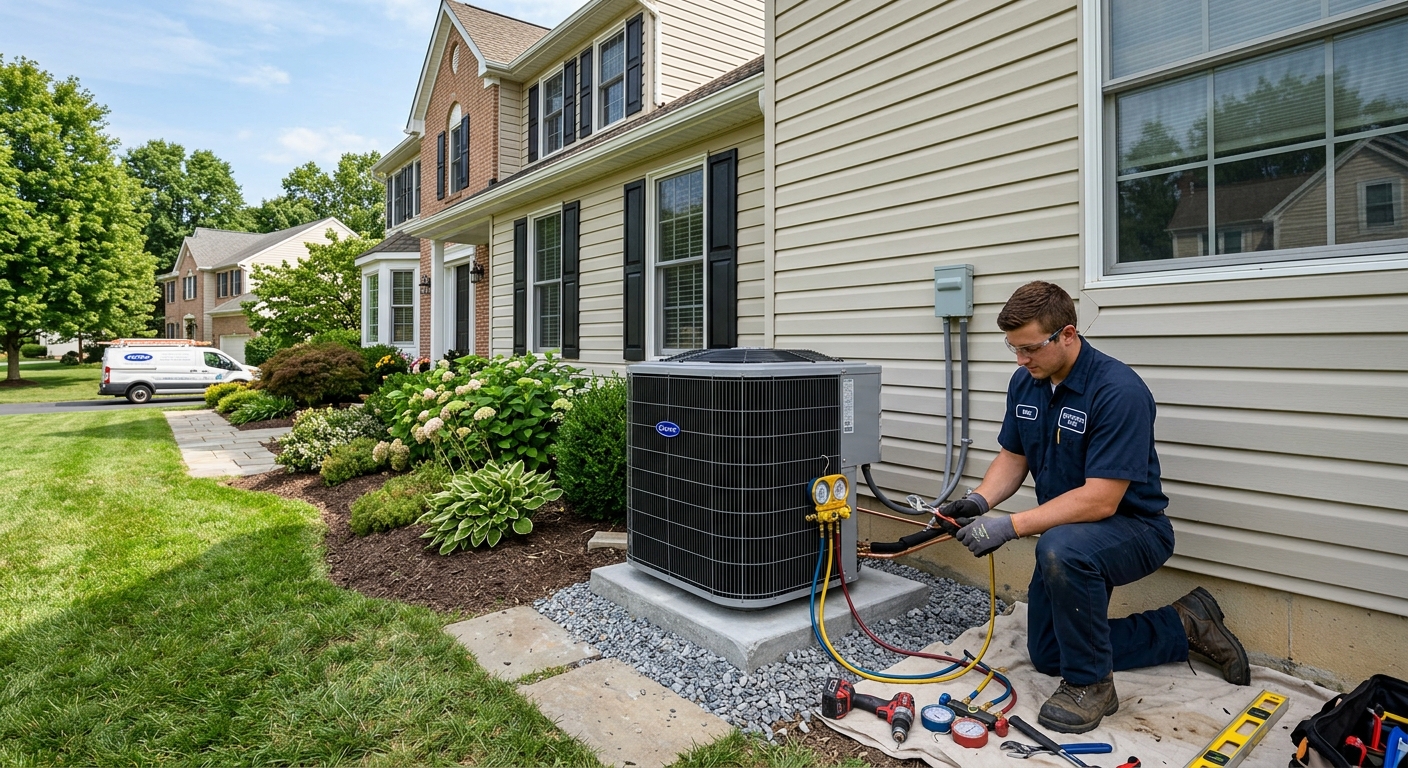
What a new HVAC system costs in Northampton
Northampton homes, with a homeownership rate of 93.1% and over half built before 1980 (U.S. Census Bureau, ACS 2024), reflect a market cycling through system replacements rather than first-time installations. In areas like Bensalem and Middletown—part of the same market—post-1960 tract construction means most homes have ductwork in place, often now at the stage where upgrades are being made alongside new HVAC system installs after decades of service.
The Bucks County region is heating-dominated: 4,800 heating degree days versus 1,450 cooling degree days each year, and a winter design temperature of just 14 °F. This shapes every HVAC choice: reliability and efficiency in winter are critical, while central air or heat pumps are sized primarily to heat but must also cover summer humidity. Ductwork condition is a real dividing line. In most homes, it’s the existing ducts—sometimes original to the house—that decide whether a central replacement is straightforward or requires expensive upgrades.
Costs for installation or replacement in Northampton generally fall within these ranges:
| System |
Best for |
Efficiency |
Price range (installed) |
| Central AC replacement (existing ducts) |
homes with sound ductwork |
16–20 SEER2 |
$6,000–$14,500 |
| Air source heat pump (ducted) |
year-round heating and cooling |
8–10 HSPF2 |
$9,600–$20,500 |
| Cold-climate heat pump (ducted) |
heat pump as primary heat |
9–11 HSPF2 |
$15,500–$20,500 |
| Ductless mini-split (single zone) |
additions, rooms without ducts |
20–30 SEER2 |
$3,800–$8,400 |
| Full duct system installation |
homes with no existing ducts |
— |
$11,000–$21,500 |
Installed estimates for a typical Northampton home. Equipment tonnage, duct condition and electrical capacity move these more than brand.
Operating cost, not sticker price
In Northampton, sticker price is only the start—the real question is what your HVAC system will cost to run over 15–20 years. With 4,800 heating degree days and 1,450 cooling degree days, most of your annual bill comes from winter heat, whether that’s electric, gas, or heat pump. The winter design temp of 14 °F means your equipment works hardest in January and February. The primary utility—PECO Energy Company—sets the electricity and gas rates that appear on your monthly bill, and those rates make as much impact on long-term cost as the efficiency rating you see advertised.
To estimate yearly operating cost, start by looking at the equipment’s efficiency. For example, a heat pump’s HSPF2 measures how many BTUs of heat you get per kilowatt-hour of electricity. Multiply this by your annual heating degree days to estimate total BTUs needed, then convert that to dollars using your PECO rate.
Say your home needs 36,000,000 BTUs of heat each winter. If your heat pump delivers 9 HSPF2 (approx. 2.6 COP), and PECO’s typical electric rate is $0.18/kWh (find your exact rate on your bill), the arithmetic looks like this:
- 36,000,000 BTUs ÷ 3,412 = 10,550 kWh needed
- 10,550 kWh × $0.18 = $1,899/year in heating
Actual bills will vary—older homes with leaky windows and ducts might use much more energy. If ductwork is poorly sealed, you could lose 20–30% of that system's efficiency. That’s why duct tightness and insulation matter as much as the sticker SEER2 or HSPF2 values. A top-tier furnace or heat pump on leaky ducts will underperform even a “basic” system installed tightly.
Whenever you review manufacturer efficiency tables, remember: real results in a Northampton home depend on weather, house envelope, and how closely your system matches your actual needs.
The decision point on an aging system
Replacing an HVAC system in Northampton isn’t always the right answer. Most systems, whether furnace, AC, or heat pump, last 12–18 years in Bucks County conditions. Repairing makes sense if your unit is under ten years old and you’re facing a single component failure—think blower motor or capacitor—especially if the bill is well under a third of a full replacement. Above that threshold, it tips toward replacement unless there’s a compelling reason to preserve the old unit.
The make-or-break factors are simple: a cracked heat exchanger is a mandatory replacement, since it’s a direct safety hazard. Compressor failure on a system that’s past its service life also calls for replacement—cost and downtime rarely justify otherwise. Also, efficiency upgrades only pay for themselves in Pennsylvania’s climate if your usage is high, ducts are in good shape, and your current system is truly outdated. For higher bills, don’t jump to replace—test duct and envelope losses first.
| Situation |
Recommendation |
Typical cost |
Reasoning |
| Under 10 years, single component failure |
Repair |
$300–$1,200 |
Most failures are minor; good value to repair |
| 10–15 years, repair over a third of replacement |
Consider replacing |
$6,000–$14,500 |
Major cost justifies jump to new warranty & efficiency |
| 15+ years, any major failure |
Replace |
$6,000–$14,500 |
Near or beyond service life; repairs compound |
| Cracked heat exchanger, any age |
Replace immediately |
$6,000–$14,500 |
Cannot safely repair a heat exchanger; code issue |
| Compressor failure past warranty |
Replace |
$9,600–$20,500 |
Compressor cost rivals total system |
| Working system, high bills |
Test ducts and envelope first |
$300–$800 |
Air leaks and duct loss are common, fixable |
Keeping a Northampton system running
In Northampton, basic HVAC maintenance means three things: changing your filter on schedule, keeping coils and drains clean, and verifying refrigerant charge when there’s a real concern. If you stick to those, most systems see their full service life even with Bucks County’s winter load and sticky summer humidity.
Change filters every 2–4 months, or more often if you have pets. Don’t overdo the MERV rating (exceeding what your blower is rated for restricts airflow and can cause damage). Outdoor coils should be kept clear of debris; indoor coils should be cleaned every few years or if airflow drops. Pour a little vinegar in the condensate line each spring to prevent clogs common in our humid cooling season. Regarding refrigerant: if you’re told you “just need a top-up,” that’s a red flag—proper systems shouldn’t lose refrigerant. Insist on finding and fixing any leak, not just topping it off.
Annual service plans offered by contractors may be a good buy if they deliver prompt off-hour service or include full cleanings and discounts. Skip plans that offer little more than a filter change and five-minute “checkup.” Schedule tune-ups in March–April or September–October, when you’re not competing with the emergency calls in peak season.
Sizing: why bigger is worse
In southeastern Pennsylvania, including Northampton, the most costly mistake is oversizing your HVAC system. Too many homes end up with equipment “one size up” from what’s needed, causing short cycling, uneven temperatures, humidity problems and premature failure. Oversized systems frequently leave basements cold and upstairs bedrooms sticky in July.
Contractors should perform a Manual J load calculation, taking into account your insulation, windows, foundation, and how much air leaks out of your house. This process uses Bucks County’s 14 °F winter design temperature—not the coldest day ever, but a number matched to our local historic data. “Square-footage rules” or swapping like-for-like with your old nameplate ignore real improvements (or deterioration) in your home’s envelope over time.
Always ask, “Did you run a load calculation, and can I see it?” If a contractor sizes your replacement solely from the tag on your old system, you’re inheriting someone else’s mistake. A correctly sized system runs longer cycles, dehumidifies better, and lasts years longer—critical in our climate with sharp cold snaps and muggy summers.
The refrigerant change and what it means for repairs
As of 2026, new residential HVAC systems are shipping with lower-GWP refrigerants like R-454B and R-32 instead of R-410A, reflecting changes in federal and state policy to phase down high-GWP HFCs. For Northampton homeowners with a working R-410A system, you are not required to replace your unit just because standards have changed. Servicing these systems—adding, recovering, or recycling R-410A—is still legal and routine.
The main practical effect is that, over time, the cost of R-410A refrigerant will rise as new production is reduced. If your system develops a leak, the price for the recharge may be higher than in years past, shifting the economics of repair versus replacement. But there is no law forcing you to retire working equipment. The transition impacts what is stocked and sold as new, and may make fixing a major refrigerant leak on a 12–15 year old unit less attractive, but day-to-day maintenance or minor repairs remain absolutely feasible.
Don’t let anyone tell you your older unit is “obsolete” simply due to refrigerant changes. For most Northampton homes, you only decide on replacement when the repair cost, especially involving refrigerant, pushes up near the price of new equipment.
What a Pennsylvania HVAC contractor must hold
For residential HVAC work in Pennsylvania, such as a Northampton installation, there is no statewide trade license for HVAC contractors. Instead, regulation works at the municipal level—permits and inspections are required in each township, and mechanical permits typically apply to full replacements and new installs in places like Bensalem Township. Residential contractors doing work worth more than $500 must hold Home Improvement Contractor (HIC) registration, which is issued by the Pennsylvania Office of Attorney General. Always verify any contractor’s registration at hic.attorneygeneral.gov before hiring.
EPA Section 608 certification is federally required for anyone handling refrigerant, so regardless of Pennsylvania’s local licensing, expect to see this credential if refrigerant lines will be touched. Mechanical permits are typically enforced by the township building department, which will also schedule the inspection needed to finalize your installation.
To protect yourself, never proceed without documented active workers’ compensation coverage for anyone on your property—a basic safeguard in our area. This can be verified through the state’s WCAIS system (wcais.pa.gov). Liability insurance is likewise standard. If you own a pre-1978 home, additional EPA training applies for lead-safe work.
Frequently asked questions — HVAC installation in Northampton
Is an annual maintenance plan worth it?
Annual maintenance plans in Northampton can be worthwhile if you value priority service and potential discounts on repairs, especially during Bucks County’s busiest heating and cooling seasons. With full system replacements now running $6,000–$14,500, keeping your equipment in shape extends its lifespan and avoids bigger bills later. The best plans include at least one full cleaning, written documentation, and don’t lock you into auto-renewals with penalties. Watch for plans that promise only visual inspections or call a basic filter swap “maintenance”—those are rarely worth it. For many homeowners, following basic filter and coil care on your own, then bringing in a professional for a pre-season tune-up, gives most of the benefit at lower cost. If your equipment is under warranty, confirm whether a plan is required for claim eligibility before skipping it.
Why do HVAC quotes in Northampton vary so much?
HVAC installation quotes in Northampton can vary widely—sometimes by several thousand dollars—due to a mix of real factors. Housing here is dominated by 1960s and 1970s tract-built homes, many with aging or undersized ductwork requiring upgrades. Exact pricing depends on duct condition, equipment size, labor, and any required electrical or mechanical code work. Some quotes include duct sealing or electrical upgrades, others do not. Permits, inspections, and registered contractor status can also add to or clarify costs. Also, the Philadelphia metro market is very competitive, which means some contractors bid low upfront and add “extras” later. For full duct system installs, you’ll see $11,000–$21,500, and for a straightforward central replacement with existing good ductwork, expect the lower end of the price band.
How is a tax credit different from a rebate?
In Pennsylvania, and specifically in Northampton, a tax credit is a reduction in your state or federal tax bill claimed when you file your taxes—meaning, you pay full price for the HVAC system up front (for example, $9,600–$20,500 for a ducted air source heat pump) and only get reimbursed months later through your tax return. A rebate, on the other hand, is usually issued by the manufacturer, utility, or sometimes a government program, and is either taken off the purchase price or sent as a direct payment after you submit paperwork. Credits depend on your tax situation, while rebates are available to all who qualify, regardless of income. For Northampton homeowners, always ask if both might apply, and make sure your quote is clear about which incentives are included upfront.
What is SEER2 and how is it different from SEER?
SEER2 is the updated standard for measuring air conditioning efficiency, replacing the older SEER metric as of 2023. In Northampton, new equipment must be rated using SEER2—this standard uses more realistic test conditions, with higher static pressure to account for ductwork found in homes built before 1980 (which make up over half the local housing stock). SEER2 ratings are typically about 4–5% lower than the older SEER values for the same equipment. For example, an older 16 SEER AC might be about 15.2 SEER2. When comparing quotes on a new central AC (usually $6,000–$14,500 installed), always use SEER2 for apples-to-apples comparison. Don’t be misled by up-sold SEER figures if the label says “SEER2” and they’re giving you the old number.
How much does a new HVAC system cost in Northampton?
The cost for a new HVAC system in Northampton depends on what you’re replacing and your home’s existing infrastructure. For most homes with sound ductwork, a central AC replacement runs $6,000–$14,500 installed, with most jobs clustered around the $9,600 mark. Heat pumps designed for year-round heating and cooling generally start around $9,600 and can top $20,500 for high-capacity, cold-climate models. If you need a brand new duct system—in older or previously non-ducted homes—add another $11,000–$21,500. Smaller projects, like a ductless mini-split for a single new room, usually come in at $3,800–$8,400. Always ask what’s included: duct repairs, permits, and code upgrades can all move the total.
Does Pennsylvania license HVAC contractors?
Pennsylvania does not grant statewide HVAC trade licenses for residential work, including in Northampton or Bucks County. Instead, contractors must register for Home Improvement Contractor (HIC) status through the Pennsylvania Office of Attorney General for any job over $500. Always check hic.attorneygeneral.gov to confirm. Townships like Bensalem and Northampton enforce their own local permit and inspection requirements, so a contractor must know and follow your jurisdiction’s rules. If you’re installing a new system—say, a heat pump at $9,600–$20,500—make sure your contractor can prove mechanical permit approval and possesses EPA Section 608 certification (federally required for refrigerant work). For your protection, always verify workers’ comp insurance through the WCAIS system before work begins.
Should I replace the furnace and AC at the same time?
In many Northampton homes, especially those built in the big local construction booms after 1960, the furnace and AC are paired systems—sharing a blower and ductwork. Replacing both together often makes sense if they are within a few years of the same age (usually 12–18 years). It can be cost-effective: you save on labor, avoid compatibility problems, and get fully updated efficiency. However, if either your furnace or AC is much newer or still reliable (under 10 years old), you don’t always need to do both unless you’re switching to new technology, like a “full electrification” heat pump. For a total system replacement, expect $9,600–$20,500 installed for a heat pump or $6,000–$14,500 for a basic furnace and AC combo, depending on features. Discuss your current system’s condition with a contractor experienced in local homes before locking in.
How does southeastern Pennsylvania's climate affect system sizing?
Southeastern Pennsylvania, Northampton included, is definitely a heating-dominated climate, with 4,800 heating degree days and just 1,450 cooling—meaning winters drive the sizing decision. Sizing should be based on Bucks County’s 14 °F winter design temperature, not just an average or “one-size-fits-all.” Bedrooms over garages and downstairs living rooms in tract-built homes here are prone to temperature swings without correct sizing. A system that’s too large will cycle on and off quickly, fail to dehumidify in summer’s humidity, and wear itself out before its time. Conversely, undersized systems will struggle or fail during cold snaps. The only way to hit the mark is a Manual J load calculation—don’t accept a quote that doesn’t provide one. Proper sizing can protect a $6,000–$14,500 investment and often solves chronic comfort issues.
When is the best time of year to replace HVAC in Northampton?
The best timing for HVAC replacement in Northampton is the shoulder seasons: early spring (March–April) and fall (September–October). These months fall between the region’s peak heating and cooling calls, when contractors are less backed up and may offer more competitive pricing or faster scheduling. Waiting until your AC fails in mid-July not only means possible delays—since most of Bucks County is calling at the same time—but may also leave you with fewer equipment options and rushed installation. If planning a full system replacement (typically $9,600–$20,500), book before your system breaks. Early replacement can save on labor costs and offers a wider selection before the rush. Always ensure your contractor can secure the proper mechanical permit before starting, as township schedules get tighter in peak months.