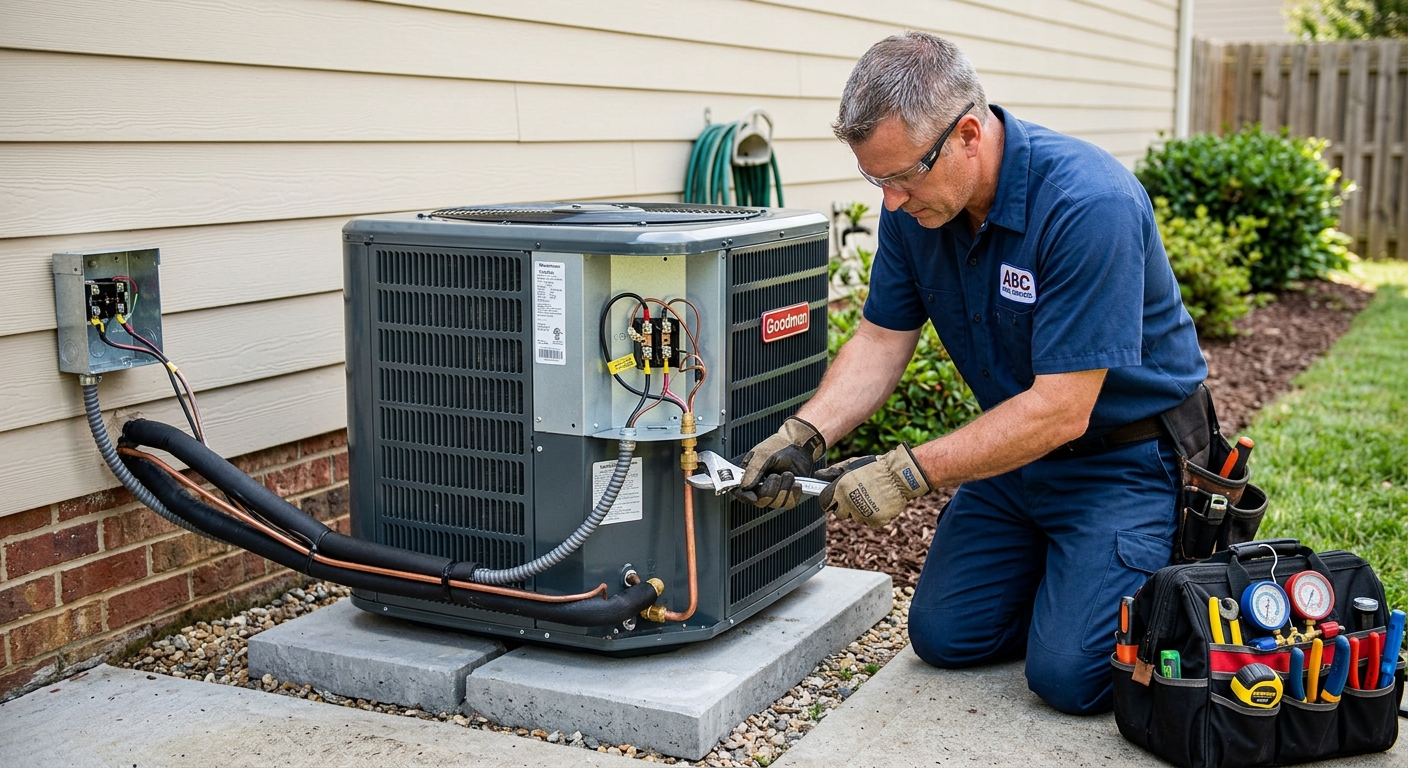
What a new HVAC system costs in Somerset
Somerset homeowners face different challenges than most of Pennsylvania because their houses were largely built between 1940 and 1970, as reflected by the 63.8% built before 1980 (U.S. Census Bureau, ACS 2024). That means a lot of homes here require HVAC retrofits or careful squeezing of new equipment into tight mechanical rooms, which can increase both labor complexity and cost. Combine that with Somerset's high homeownership rate of 79.6%, and you get a market that is mostly focused on retrofit and replacement rather than first-time central air installations.
When thinking about budget, it's key to understand that Somerset County is a heating-dominated climate, with 5,600 heating degree days and just 1,050 cooling degree days per year. Heating systems do the real heavy lifting from late fall through early spring. Cooling demand is there, but it’s moderate by Pennsylvania standards and a distant second priority in terms of energy use and comfort.
Most homes already have either forced air ductwork for older furnaces, or none at all in the case of homes built pre-central AC. This means the condition of existing ducts is often a deciding factor in the system you choose, especially since many Somerset houses have limited space for new duct runs. Below is what it will actually cost, using 2026 estimates for new installations:
| System |
Best for |
Efficiency |
Price range (installed) |
| Central AC replacement (existing ducts) |
homes with sound ductwork |
16–20 SEER2 |
$4,600–$11,000 |
| Air source heat pump (ducted) |
year-round heating and cooling |
8–10 HSPF2 |
$7,400–$15,500 |
| Cold-climate heat pump (ducted) |
heat pump as primary heat |
9–11 HSPF2 |
$12,000–$15,500 |
| Ductless mini-split (single zone) |
additions, rooms without ducts |
20–30 SEER2 |
$2,900–$6,500 |
| Full duct system installation |
homes with no existing ducts |
— |
$8,300–$16,500 |
Installed estimates for a typical Somerset home. Equipment tonnage, duct condition and electrical capacity move these more than brand.
Reducing the net cost of a Somerset installation
Getting a new HVAC system in Somerset doesn’t always mean eating the full install price. Most people can reduce their out-of-pocket cost through a combination of federal tax credits, local utility rebates, and occasional state programs.
The federal tax credit, particularly for higher-efficiency heat pumps and air conditioners, applies to your tax return the following year. If you owe federal income tax, it lowers the bill dollar-for-dollar — but you don’t see that money right away. A rebate is different: it usually comes from your electric or gas utility, like Penelec or Peoples Natural Gas, and is either taken off your invoice or sent as a check after installation. That helps with immediate cash flow, which can be a deciding factor if you’re close to your budget ceiling.
Program names and rebate amounts change every year. The most reliable way to know what’s available is to check your utility’s efficiency program landing page, and plug in equipment info at the ENERGY STAR rebate finder. Don’t just go by numbers in a random article — what’s true this season may be gone or changed next year, and some outlying townships aren’t served by the major utilities at all. Get the most current figures and claim forms before you sign a contract, because timing and paperwork matter. For many Somerset residents, especially outside the boroughs, propane and fuel oil users see far fewer incentives compared to natural gas or all-electric conversions.
Keeping a Somerset system running
Most Somerset homeowners get bombarded with pitches for maintenance “plans” and “tune-ups.” Some of that is useful; a lot isn’t. What absolutely matters is changing your air filter as often as needed for Somerset’s dust load — usually every 2–3 months for a standard 1-inch MERV 8 filter, or more often in houses with pets or ongoing renovation dust.
Look for a filter that’s rated MERV 8 to MERV 11. Going higher can choke airflow on older blowers and actually reduce system life and comfort. Every system deserves a clean indoor and outdoor coil at least every couple years — more often if your outdoor unit is set under trees, which is common on the larger rural lots here. Condensate lines clog and overflow, which isn’t just an inconvenience; in tight mechanical spaces of Somerset homes, it can be a disaster. Don’t skimp on that check.
Refrigerant “topping off” is a red flag. If your system needs more, it’s got a leak. Any honest tech will find the leak before just adding more. Annual service plans are sometimes worth it if they truly include full inspection, coil cleaning, and SAME-DAY emergency service without big after-hours upcharges. If it only means a rushed 15-minute “look-over,” you’re better off calling when you actually need help. Schedule your annual checkup in late winter or late summer to avoid the emergency rush — Somerset’s busiest HVAC weeks are the first cold snap and first real heatwave.
What a Pennsylvania HVAC contractor must hold
Pennsylvania does not have statewide licensing for HVAC contractors working on residences. All residential mechanical work, including HVAC installation and replacement in Somerset, is regulated at the municipal level. For Somerset Borough, the Somerset Borough Codes Department enforces the Pennsylvania Uniform Construction Code (UCC), while every township such as Conemaugh runs its own code office. There’s no special state HVAC license exam for residential work — do not be fooled by contractors claiming to hold one.
What matters is that any contractor you hire for a job over $500 must carry Home Improvement Contractor (HIC) registration, issued via the Pennsylvania Office of Attorney General. You can and should verify that at hic.attorneygeneral.gov before you sign a contract. Federal law requires an EPA Section 608 certification for anyone handling refrigerant—essential for installing or servicing central ACs, mini-splits, or heat pumps. Ask to see it.
Permits are always required for new HVAC installations under the UCC. Municipal offices or, if your township has opted out, the PA Department of Labor & Industry will handle inspection. Finally, every employer in Pennsylvania must carry workers' compensation insurance; you can verify coverage at wcais.pa.gov. Insist on seeing both insurance and comp documentation — it’s non-negotiable protection for you as a homeowner.
Sizing: why bigger is worse
In Somerset, as everywhere that gets true winter, sizing your new HVAC system is the single most important job your contractor does. Too many homes—especially those dating to 1940–1970—run oversized equipment, and it does real harm. Too large a system short cycles (turns on and off rapidly), fails to remove enough summer humidity, causes noisy temperature swings, and wears out faster. Despite what some believe, oversizing is not “playing it safe”—you’re buying a less comfortable home, higher bills, and shorter equipment life.
Sizing by square footage or, worse, matching the old unit’s nameplate, is lazy and usually wrong, especially when many original Somerset homes were unevenly insulated or had leaky windows. The proper way to size is a Manual J load calculation: a technical worksheet using your insulation, window type, orientation, and the harshest winter condition Somerset faces—8°F, the region’s winter design temperature. This process is built on actual measurements, not hunches or guesses. Ask your HVAC contractor, “Did you run a load calculation, and can I see it?” If you get a blank look or a shrug, move on. Anyone who sizes by matching the old system is just repeating someone else’s old mistake, maybe decades old.
A properly sized unit will run longer cycles, delivering even temperatures and pulling out maximum humidity in summer, while keeping you toasty on the coldest day Somerset sees. Inaccurate sizing is the root cause of most comfort complaints and high bills.
Comparing HVAC estimates in Somerset
If you want to compare apples to apples in Somerset, demand detail in your HVAC quote. At a minimum you should see model numbers for both the outdoor and indoor units — a mismatched set will never reach its rated efficiency, even in the best of circumstances. Insist on seeing the system tonnage, and make sure it matches a written load calculation, not just the old equipment tag.
Check if your installer is planning to replace the refrigerant line set (old lines can shorten new compressor life) or reuse it — not all old tubing is suitable for newer refrigerants. Confirm whether electrical and panel upgrades are included if your home needs them; in tight Somerset mechanical rooms, upgrades can become necessary and costly. Make sure a new code-compliant drain for condensate is included, and the scope of thermostat work is clear. All permits should be included and itemized. Finally, insist on a commissioning report at the end — you want measured airflow and charge, not just “starts and runs.” Separate out labor and equipment warranty terms, because many brands advertise long “warranties” that cover only parts, not installation labor.
A quote listing only a brand and a bottom-line price is impossible to compare, and that ambiguity usually costs you in the long run.
| Line item |
What to look for |
Red flag if… |
| Equipment |
model numbers, indoor and outdoor matched |
brand name only |
| Sizing |
load calculation attached |
matched to the old nameplate |
| Ductwork |
condition assessed, sealing scoped |
not mentioned |
| Electrical |
circuit and panel capacity confirmed |
assumed adequate |
| Line set |
replaced or documented as reused |
silent |
| Commissioning |
measured airflow and charge, documented |
no startup report |
| Warranty |
labour years stated separately |
manufacturer only |
| Permit |
included and priced |
'not needed' |
Filtration, humidification and ventilation
Somerset’s cold winters and long heating season bring one major comfort problem—indoor air gets painfully dry. Summer brings the opposite: heavy humidity, especially during July and August storms. In this region, nobody should accept an “oversized” AC as a feature: it will cool quickly but won’t run long enough to effectively remove humidity. That leads to cool, clammy air and sometimes even moisture problems.
Whole-house humidifiers, especially in homes with forced air, can help with winter dryness, but they are not set-and-forget. Skip one season of maintenance and you risk mold or scale buildup inside your ductwork or water panel. Choose only the simplest humidifier you can easily access for annual cleaning or replacement.
For filtration, MERV 8–11 gives decent particle capture without bogging down the blower in Somerset’s many older systems. Don’t be talked into “hospital grade” filters without a matching blower upgrade—most don’t move enough air to justify it. Mechanical ventilation matters most in newer, tightly sealed Somerset homes. If yours was built before 1980, you likely get enough outdoor air through regular use. Exhaust-style bath fans and range hoods are cost-effective for most.
There are a lot of add-ons that get pushed—UV lights, expensive “purifiers,” and electronic air cleaners. These are rarely worth the price in actual residential comfort or health unless you have a medically documented need. Stick to basics and you’ll get better results for less money.
Frequently asked questions — HVAC installation in Somerset
Do I need a permit to replace HVAC in Somerset?
Yes, in Somerset Borough and the surrounding municipalities, you do need a mechanical permit to replace or install any HVAC system. The Pennsylvania Uniform Construction Code (UCC) requires a permit for any substantial HVAC work, which is enforced locally by the Somerset Borough Codes Department or the local township code office. Insist on having your contractor pull this permit and show it to you before work starts—if they say it’s “not needed,” that’s a warning sign. Permit costs are modest, but skipping this step means no inspection and no paper trail—a problem if you sell your house or need warranty work later. For a typical central AC replacement, which runs about $4,600–$11,000, proper permitting and inspection protects your investment and ensures safety and code compliance.
How is a tax credit different from a rebate?
In Somerset, as in the rest of the U.S., a tax credit reduces what you owe the IRS on your next tax return—think of it as a coupon for your tax bill. If you qualify for the federal heat pump tax credit, you’ll get that deduction the next time you file, not as a discount the day of your install. A rebate is a direct payback, typically from your electric utility like Penelec or your gas company, and some of those will cut the price off your invoice or send you a check after installation. This makes a substantial immediate difference in cash flow. For example, a ductless mini-split might cost $2,900–$6,500 installed. A rebate reduces what you actually pay out-of-pocket right now, while a tax credit helps at tax time.
What is a Manual J load calculation?
Manual J is a technical process used by honest HVAC contractors in Somerset to determine exactly how much heating and cooling your home needs. Instead of guessing by square footage or copying the specs off your old furnace, a Manual J calculation uses details about your home—window types, wall insulation, orientation, and even Somerset’s winter design temperature of 8°F—to determine the correct size required to keep your house comfortable. The result is a written worksheet showing how much capacity (in BTUs or tons) is needed. Always ask your contractor, “Did you run a load calculation, and can I see it?” When this isn’t done, you risk overpaying for a too-big system that cycles rapidly, causes big utility bills, and just doesn’t deliver comfort. This applies just as much to a new air source heat pump costing $7,400–$15,500 as a basic AC.
What does a ductless mini-split cost in Somerset?
For a single-zone ductless mini-split installation in Somerset, you should expect a total installed price in the $2,900–$6,500 range, depending mostly on equipment capacity, line length, and how tricky the refrigerant and electric runs are (older Somerset homes sometimes have challenging layouts). Multiple zones or larger capacities obviously cost more. Ductless systems are a good fit for additions or spaces with no existing ductwork—especially in those 1940–1970 houses with limited room for new ducts. They’re also increasingly popular for sunrooms, finished attics, or outbuildings. Just be sure to get a quote that spells out unit location, included electrical work, and warranty terms.
Do I need dual fuel in southwestern Pennsylvania?
Dual fuel (a heat pump paired with a gas or propane furnace) can make sense in some Somerset homes, but it’s not always necessary. With Somerset’s winter design temp at 8°F, high-quality cold-climate heat pumps can handle all but the harshest stretches. If you already have propane or fuel oil and want the lowest operating costs, dual fuel might save you money during extreme cold snaps when electricity is pricey and fossil fuels are more efficient. For most modern homes with good weatherization, a ducted air source heat pump or cold-climate model in the $12,000–$15,500 range will handle Somerset winters fine. Dual fuel is only a must if you want total peace of mind or electricity backup during outages (if you have a generator).
Is a high-efficiency system worth the extra cost here?
That depends. Somerset is a heating-dominated climate, so efficiency matters most for winter equipment, especially if you run electric heat or older baseboard. The jump from standard to highest-end efficiency comes with a premium, sometimes adding a few thousand dollars to an install—like going from a base AC at $4,600 to a top line at $11,000 with all the upgrades. If you plan to stay in your home long-term, pay high utility rates, or want maximum rebates or tax credits, the extra efficiency can pay off. But just chasing a higher SEER or HSPF number doesn’t always make sense for short-stay owners or in houses with high air leakage. Always look at the payback period based on your real usage and energy rates, and never let a contractor push you up the line without a customized savings estimate.
Which utility serves Somerset?
Most of Somerset Borough is served by Penelec for electricity, which is a FirstEnergy subsidiary, and by Peoples Natural Gas for piped natural gas. In the rural parts of Somerset County, outlying townships may not have access to natural gas lines and often rely on propane or fuel oil. Knowing your utility matters because electric and gas rebates, efficiency programs, and energy rates vary by provider. When getting a quote for a new air source heat pump (typically $7,400–$15,500 installed), ask your contractor to factor in the energy source and local incentives based on your township or borough.
How far ahead should I schedule in Somerset?
Somerset sits in a rural gap between the Johnstown and Cumberland markets. That means reputable HVAC contractors often have travel surcharges and lead times, especially for installs and major retrofits during peak heating and cooling seasons. The busiest periods for service are the first true cold snap of fall and the first heat wave of summer, so if you want your pick of installers (and to avoid rush charges), aim to schedule spring or early fall for replacements and maintenance. For a central AC install costing about $7,400 on average, two to four weeks’ lead time is typical. For complex ductwork or multi-zone jobs, plan further out, especially if your mechanical room or site conditions add complication.
Is an annual maintenance plan worth it?
Annual maintenance plans in Somerset are sometimes marketed as insurance against breakdowns. At their best, they can be worth it if they include a genuine inspection, priority emergency service, and no big upcharges for after-hours help. However, some plans just slap a checklist on your furnace or AC, change the filter, and leave in 20 minutes. Make sure your plan spells out exactly what’s included—coil cleaning, drain flush, refrigerant check—and whether you get same-day response in peak season. For a typical air source heat pump (installed for $7,400–$15,500), basic annual maintenance is smart, but you don’t need to shell out for a contract unless it delivers actual value. If your home is newer, low-dust, and you’re comfortable with basic filter changes, you may do just as well on a per-visit basis.