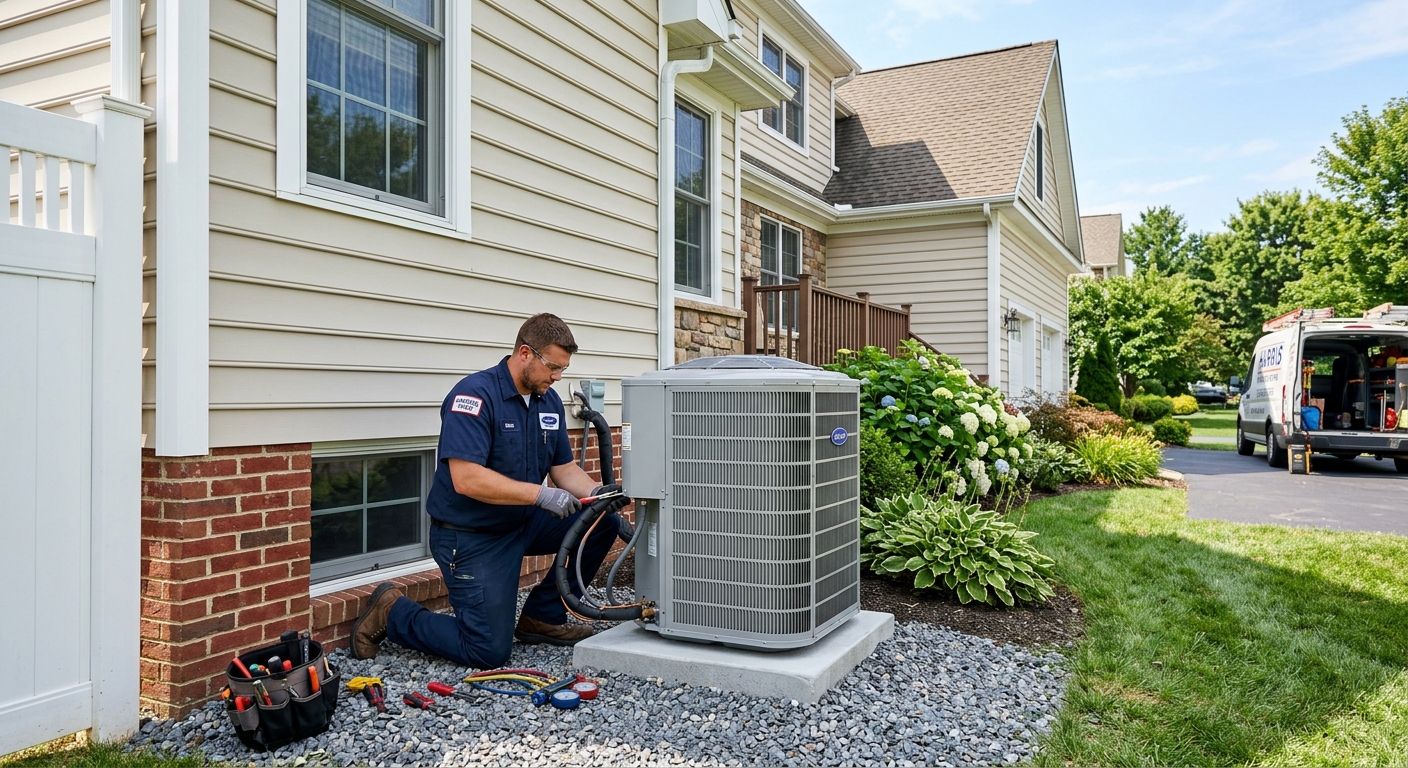
HVAC costs in Upper Leacock — 2026
Upper Leacock homeowners face HVAC installation costs that reflect a mix of suburban development and older housing stock. With a homeownership rate of 56.6% and 56.8% of homes built before 1980 (U.S. Census Bureau, ACS 2024), much of the market here is replacement rather than first-time installs. Ductwork may not exist in some houses, especially in the pre-World War II era, and a good number of homes rely on retrofits like ductless mini-splits or high-velocity systems—particularly in rowhomes similar to those in Lancaster city, dating from 1880–1930. This affects both the ease and cost of updating your comfort system.
Climate also drives cost and selection. With 5,200 heating degree days and 1,250 cooling degree days, south-central Pennsylvania is a heating-dominated market. This means winter performance, reliability, and heating efficiency matter more than in a southern state—most systems here should be sized for heating first. Even though summers can strain older AC units, the scale of winter load means that recommendations skew toward robust heating options. Below is a snapshot of installed cost ranges for major HVAC jobs in Upper Leacock; note that these reflect full labor and equipment for a typical house.
| System |
Best for |
Efficiency |
Price range (installed) |
| Central AC replacement (existing ducts) |
homes with sound ductwork |
16–20 SEER2 |
$5,000–$12,000 |
| Air source heat pump (ducted) |
year-round heating and cooling |
8–10 HSPF2 |
$7,900–$17,000 |
| Cold-climate heat pump (ducted) |
heat pump as primary heat |
9–11 HSPF2 |
$13,000–$17,000 |
| Ductless mini-split (single zone) |
additions, rooms without ducts |
20–30 SEER2 |
$3,200–$6,900 |
| Full duct system installation |
homes with no existing ducts |
— |
$8,900–$18,000 |
Installed estimates for a typical Upper Leacock home. Equipment tonnage, duct condition and electrical capacity move these more than brand.
What construction era means for your system
The period your Upper Leacock house was built has a powerful impact on HVAC options and costs. With 56.8% of homes built before 1980, there’s a high chance ductwork may not exist at all, was sized for a furnace only, or was never sealed. In rowhome and older farm construction, retrofits—like ductless mini-splits—are often the best call, especially in layouts with tight chases or no accessible attic. Windows and insulation are also usually less efficient in these homes, raising the overall heating and cooling load and putting more pressure on system sizing.
Original duct runs, if present, may be undersized for modern air conditioning. A system built around gravity or cast-iron radiators will not have returns in every room, which causes comfort problems when replacing with central air. Chimney or flue condition also matters for gas furnace replacement; older masonry may require a liner or complete bypass. The electrical panel often needs review before converting to an all-electric heat pump—especially in homes never wired for central AC.
In newer (1980s onward) Upper Leacock subdivisions, original builder-grade HVAC equipment is aging out now. These homes usually do have full duct systems, and panels sized for AC, making replacement simpler. However, builder-grade systems were rarely oversized for cooling, so replacement sizing deserves care—especially if insulation or windows have also been upgraded over the years.
The decision point on an aging system
Most Upper Leacock homeowners face the repair-or-replace question as equipment hits 12–20 years. Don’t rush: in this climate, squeezing a few extra seasons from your system often makes sense. If the repair is just a capacitor, fan, igniter, or control board, and your system is under 10 years old, repair is almost always the wise move. Even at 10–15 years, if the repair costs less than a third the price of a new system, consider repairing, especially if the major system parts are sound.
However, there are two situations where replacement is not optional: a cracked heat exchanger in a furnace (this is a carbon monoxide risk and a safety hazard), or a compressor failure on a system already beyond its expected life span. If your system uses R-22 refrigerant, or any part is no longer available, that also tilts the balance toward replacement.
It’s worth noting—efficiency upgrades only pay back in this heating-dominated climate if your system is grossly outdated or running poorly. If your bills are high, start with duct testing and home envelope checks before replacing the equipment.
| Situation |
Recommendation |
Typical cost |
Reasoning |
| Under 10 years, single component failure |
Repair |
$300–$1,200 |
Much lower than replacement, most parts available |
| 10–15 years, repair over a third of replacement |
Consider replacing |
$5,000–$12,000 |
Major expenditure on an aging system, risk of future failures |
| 15+ years, any major failure |
Replace |
$5,000–$12,000 |
Approaching end of service life and lower efficiency |
| Cracked heat exchanger, any age |
Replace immediately |
$5,000–$12,000 |
Safety hazard—do not use the furnace |
| Compressor failure past warranty |
Replace |
$7,900–$17,000 |
Core failure in the system; repair often not cost effective |
| Working system, high bills |
Test ducts and envelope first |
$300–$800 |
Leaky ducts or attic losses can exceed equipment gains |
What size system does a Upper Leacock home need?
Proper sizing is the single most important job for your HVAC contractor in Upper Leacock. Too often, systems are oversized “just in case”—but that’s not a margin, it’s a recipe for short cycling, poor dehumidification, temperature swings, and shortened equipment life. The old rule of thumb (tons per square foot) just doesn’t work here, particularly because houses from before 1980 were not built to modern insulation standards, and often lack tight windows and air barriers.
The gold standard is a Manual J load calculation. This involves measuring each room, factoring in insulation, windows, orientation, air leakage, and the actual number of occupants. Winter design temperatures (12 °F in south-central Pennsylvania) are specifically used in this math to ensure systems are sized for the coldest days you regularly experience—not the rarest deep freeze, but also not a balmy November.
You should always ask your contractor, “Did you run a load calculation, and can I see it?” If they size equipment based solely on your old unit, they’re copying forward any mistakes, oversized ducts, or insulation upgrades you’ve made since the house was built. Don’t let a nameplate or rough guess dictate comfort for the next 20 years. Properly sized, your system will heat and cool efficiently, run quietly, and last longer—with fewer repairs.
Why your ducts may be the real problem in Upper Leacock
Ductwork is the silent partner of every comfort system, and in Upper Leacock’s older homes, it’s often the limiting factor. Many pre-1980 houses—especially those resembling the 1880–1930 rowhomes in Lancaster city—never had central ducts to begin with, or were fitted with minimal and leaky runs for a gravity-fed furnace. Even when ducts are present, they may be underinsulated, badly sealed, or have undersized returns that restrict airflow and efficiency.
A duct blaster test is the gold standard: we temporarily pressurize the ducts and measure leakage to pinpoint losses. In homes with old, unsealed metal ducts, leakage can easily climb above 20%—meaning one-fifth of your heating or cooling never reaches your living space. In attics or crawlspaces, uninsulated ducts can lose even more, especially through our region’s pronounced freeze-thaw cycles.
Rather than replacing a furnace or central AC first, consider testing and sealing your ductwork. If your existing ducts are too small or poorly routed for high-efficiency equipment, replacement or adding properly sized returns is the best investment. For older homes with little or no ductwork, modern high-velocity or ductless mini-split systems bypass these headaches entirely. Don’t guess—test the distribution before making a major equipment investment.
What a Pennsylvania HVAC contractor must hold
Pennsylvania does not issue a statewide HVAC license for residential work. Instead, registration as a Home Improvement Contractor (HIC) is required for any contract over $500, and each municipality—including those around Lancaster County—may also require its own mechanical permit and inspection process. There is no state-run licensing authority for residential HVAC: those requirements are strictly local, so always ask what’s needed in your township. Commercial work and municipal utilities play by different rules, but for a Upper Leacock homeowner, that distinction matters—the state treats residential work independently.
Regardless of licensing, every technician who handles refrigerant must have EPA Section 608 certification. This is a federal requirement: nobody can legally connect gauges or charge a home AC or heat pump system in Pennsylvania without it. Your contractor should provide their HIC registration and proof of workers’ compensation coverage—these can (and should) be verified online via the state’s systems before you sign a contract. For any central HVAC install or replacement, expect to pull a mechanical permit through your local office and schedule a final inspection. This protects you both when installing new equipment and for resale value.
Operating cost, not sticker price
Sticker price tells only half the story for Upper Leacock HVAC systems. With 5,200 heating degree days and 1,250 cooling degree days per year, keeping warm in winter is your big-ticket energy expense—and why heating efficiency matters most. PPL Electric Utilities is the main electric provider, so your actual operating cost comes straight from the electric rate shown on your bill, typically in cents per kilowatt-hour (kWh).
The math goes like this: system efficiency (SEER2 for cooling, HSPF2 for heat pumps, AFUE for furnaces) converts your fuel or electricity input into usable heat or cool. Multiply your home’s annual heating (or cooling) load—estimated by degree days and square footage—by your system’s kWh or fuel consumption per delivered BTU, then by your actual rate.
- For a heat pump at 9 HSPF2: Every unit delivers 9 BTUs of heat for each watt-hour consumed. So, total kWh needed = annual heating BTUs / 3,412 (to convert to kWh) / HSPF2.
- If your annual heat load is 50 million BTUs, you’d use about 1,636 kWh for the season. At $0.15/kWh (check your bill for the current rate), that’s about $245 for winter heating—if the ductwork is tight and the envelope is good.
- Poorly sealed ducts, as common in pre-1980 homes here, can wipe out any operating savings, making a high-efficiency system perform like a mid-tier model.
Always use your most recent utility bill for the comparison, and remember: changes in weather, insulation, or ductwork can move your real-world number significantly. Don’t go by nameplate numbers alone.
Frequently asked questions — HVAC installation in Upper Leacock
What is EPA Section 608 certification?
Section 608 certification is a federal requirement for anyone handling refrigerants used in air conditioning and heat pump systems. In Upper Leacock and across Pennsylvania, any technician connecting gauges, charging, or recovering refrigerant—like during a central AC replacement or ductless mini-split installation—must hold this credential. It ensures that refrigerants are managed safely and that no unlicensed person can legally open a sealed system or dispose of refrigerant improperly. Always ask to see this certification before the work begins, especially when investing in AC or heat pump service that typically costs $5,000–$17,000 for installation.
Are duct sealing and insulation eligible for incentives?
In Pennsylvania, energy efficiency programs sometimes cover duct sealing and insulation, especially for older Upper Leacock homes where duct leakage can be significant. These measures can deliver better comfort and lower bills—sometimes more than upgrading the HVAC itself. Costs for professional duct sealing typically range from $300–$800. Check with your electric or gas utility, and look for state or federal home performance programs. If you’re considering a whole-home upgrade, it’s often best to complete duct sealing before investing in new heating and cooling equipment, as this can influence the size and type of system you actually need.
How cold does it get in Upper Leacock and does that affect heat pumps?
Winter design temperature in Upper Leacock is 12 °F, which means your heating system, including any heat pump, needs to deliver steady output even in deep cold. Standard heat pumps may lose efficiency as the temperature drops, but modern cold-climate models are tested to operate well into single digits. For older houses without great insulation (which describes over half of homes here), you may need a backup heat source or a system rated for reliable low-temperature performance. The added cost for a cold-climate heat pump is often worth it—these typically run $13,000–$17,000 installed in our area and can handle most winter conditions if sized properly.
What does a heat pump cost installed in Upper Leacock?
For a ducted air source heat pump in a typical Upper Leacock home, expect an installed cost of $7,900–$17,000. The price spreads so widely because of differences in house size, ductwork condition, and whether you opt for a standard or cold-climate system. If there are no existing ducts, a ductless mini-split (for a single room or zone) can be as low as $3,200–$6,900, but whole-home solutions run higher. The older the house, the more likely electrical upgrades or duct modifications will also add to your final number.
Is it worth switching from oil or propane to a heat pump?
If you are on fuel oil or propane—a common scenario in rural parts of Upper Leacock and surrounding Lancaster County—a heat pump can significantly cut your annual heating costs, especially if your house is well-insulated and reasonably airtight. Upfront installation for a ducted system usually falls between $7,900–$17,000. If your existing ducts are usable and your electric panel is adequate, payback can be attractive. However, if you need new ductwork (which runs $8,900–$18,000), or your house is drafty and poorly insulated, savings can evaporate. Assess your envelope first to maximize the benefit of switching.
How much does a furnace replacement cost in Upper Leacock?
Furnace-only replacement in Upper Leacock homes typically costs about the same as central AC—plan on $5,000–$12,000 installed, using existing ductwork. The range covers both gas and oil furnaces, and includes labor and permits. If your chimney is in poor shape, a liner may be required, raising costs. For homes with older or leaky ductwork, repairs or sealing should be tackled first to make sure the new furnace delivers its rated performance.
Is an annual maintenance plan worth it?
In climates like Upper Leacock’s, annual HVAC maintenance pays off with fewer repairs and maximum efficiency—especially when your system runs year-round for heating and cooling. Plans typically cost about the same as a single service call, in the $300–$800 range per year, but usually include priority scheduling and discount repairs. Maintenance also keeps warranties valid and catches small problems (like dirty coils or loose wires) before they cause a full system shutdown. For older homes, regular cleaning and testing of ductwork add value far beyond just the equipment check.
Do I need to be home during installation?
It's best to be home at the start and finish of any HVAC installation in Upper Leacock, particularly for a major project like a heat pump, ductless mini-split, or full duct replacement. You’ll need to go over the installation plan with your contractor, set thermostat preferences, and walk through the finished work. While you don’t have to stay the entire day, letting the crew in, answering questions about access, and being available for the final walkthrough ensure no detail is missed. For a typical system install—costing between $5,000–$17,000—your involvement helps guarantee the outcome matches your expectations and code requirements.
What size HVAC system does my Upper Leacock home need?
The only correct answer in Upper Leacock is: it depends on a proper Manual J load calculation. House age (over half built pre-1980), window and insulation quality, orientation, and the local winter design temperature (12 °F) mean there’s no shortcut—especially with the region’s mix of old rowhomes, farmhouses, and modern builds. Never accept a price based solely on house square footage or the size of your old unit. For a typical single-family home here, you can expect to see a central system quoted in the $5,000–$12,000 to $13,000–$17,000 range (depending on type), but exact size and price can only follow after real measurement and calculation.