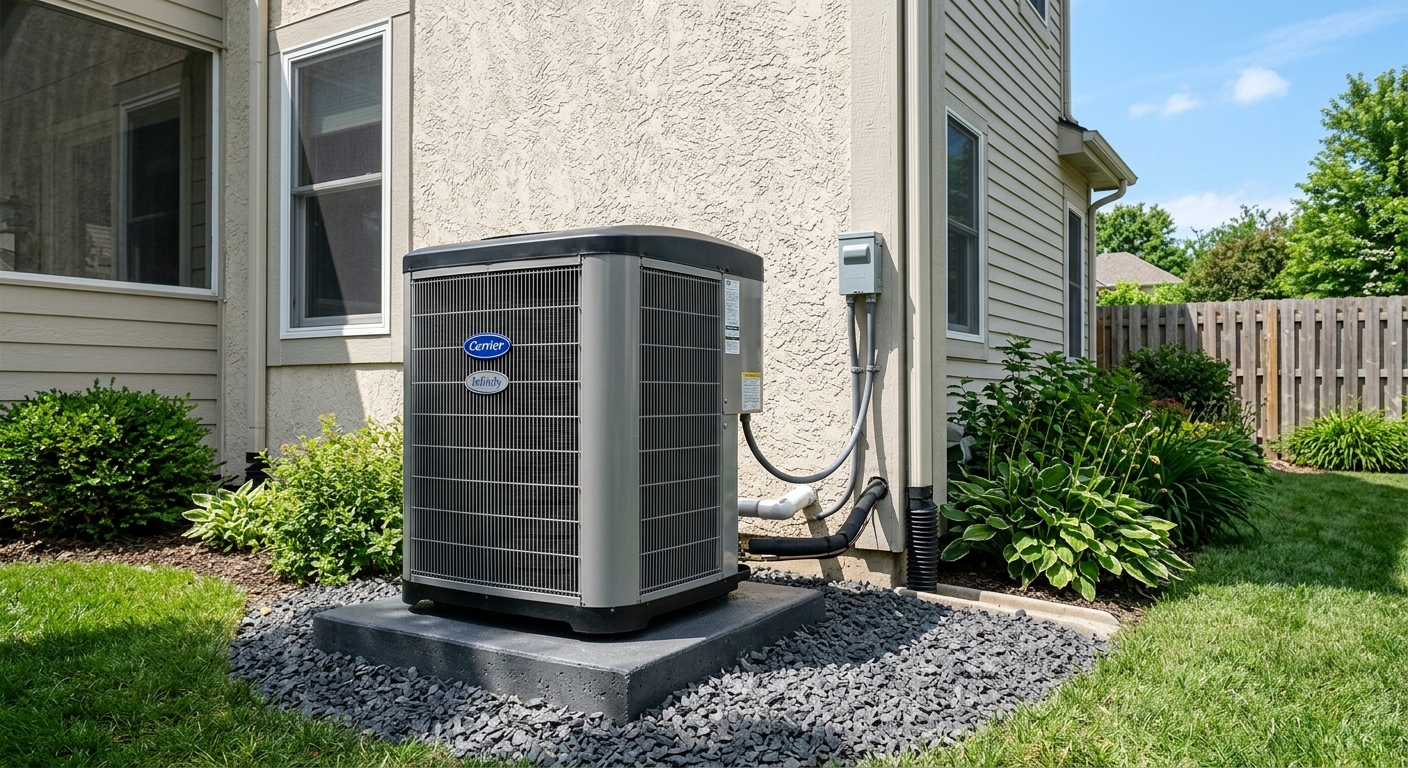
Clifton Heights heating and cooling prices by system type — 2026
Clifton Heights is a mostly homeowner market, with a homeownership rate over 70% (U.S. Census Bureau, ACS 2024), and over 84% of the homes built before 1980. This points to a mix of aging systems that now need replacement and plenty of retrofits for homes that never had central air to begin with. Many Upper Darby and Haverford homes, which shape the local stock, are 1920–1950 rowhouses and twins. They often need ductless mini-splits or high-velocity options for cooling, since full-size ductwork is hard to add. If you already have central AC, it's likely the ductwork was sized for heating first—and sometimes not for AC at all.
Local weather does more to drive system selection than you might think. With about 4,800 heating degree days and just 1,450 cooling degree days, Clifton Heights leans heavily toward heating rather than cooling. This means heating performance and efficiency matter most when choosing a replacement—especially for homeowners thinking about a heat pump or when comparing manual calculation versus rule-of-thumb sizing. Here’s what to expect for installation costs in 2026:
| System |
Best for |
Efficiency |
Price range (installed) |
| Central AC replacement (existing ducts) |
homes with sound ductwork |
16–20 SEER2 |
$4,800–$11,500 |
| Air source heat pump (ducted) |
year-round heating and cooling |
8–10 HSPF2 |
$7,700–$16,500 |
| Cold-climate heat pump (ducted) |
heat pump as primary heat |
9–11 HSPF2 |
$12,500–$16,500 |
| Ductless mini-split (single zone) |
additions, rooms without ducts |
20–30 SEER2 |
$3,100–$6,800 |
| Full duct system installation |
homes with no existing ducts |
— |
$8,700–$17,500 |
Installed estimates for a typical Clifton Heights home. Equipment tonnage, duct condition and electrical capacity move these more than brand.
What construction era means for your system
Most homes in Clifton Heights and the surrounding townships went up before 1980, meaning their original heating systems were often oil or gas furnaces with little or no air conditioning planned. Ducts, if present, were probably sized for low air volume—just enough for heating, not for cooling a house on a muggy Pennsylvania summer. This can leave returns undersized, supply branches too small, and the whole system prone to uneven temperatures.
Older houses here usually have minimal insulation and older windows, which adds load to both heating and cooling systems. Electrical panels may be maxed out, especially if you’re considering an all-electric heat pump. Some homes still have older masonry chimneys questionable for venting modern, high-efficiency gas furnaces—something your contractor will need to inspect. In rowhouses and twins, it’s rare to find ducts in outside walls, so adding air conditioning means either fitting high-velocity ductwork, going ductless, or accepting some creative routing.
If your home already has central air (which means it's probably one of the few larger single-families or a post-1980 build), you could be looking at a straightforward replacement, but you still can’t count on the original ducts being tight or properly insulated. For most Clifton Heights homes, bringing the system up to modern comfort and efficiency means looking carefully at both the equipment and the bones of the house.
Ductwork: the part nobody quotes properly
In Clifton Heights, the most overlooked part of an HVAC job—especially in pre-1980 rowhouses and twins—is the ductwork. Duct leakage here can waste 20–30% or more of your heating or cooling energy, particularly if old sheet metal joints were never sealed or have come loose over decades. A duct blaster test is the best way to measure this, by pressurizing the duct system and showing exactly how much air is leaking before it even gets to your rooms.
Undersized returns are a chronic problem in these prewar homes, since many were designed when heating needs, not cooling, drove duct size. Add a high-efficiency system to restrictive old runs, and you’ll get noise, hot spots, and low airflow. When ducts run through unconditioned attics, crawlspaces, or even garage ceilings—another common situation in local twins—proper sealing and insulation become crucial to avoid energy waste and condensation problems.
For many Upper Darby and Haverford homes, you won’t find any ducts at all, or only a few feeder pipes. That’s why ductless mini-splits or high-velocity small-duct systems are a popular retrofit here. Bottom line: always test and assess your ductwork before investing in new HVAC equipment. Replacing equipment without fixing the distribution is throwing money after bad. A real load calculation is wasted on a leaky duct system—fix the leaks first or plan a proper duct update. Insist on a duct test before signing the contract.
The refrigerant change and what it means for repairs
A new wave of air conditioning and heat pump systems now use lower-global warming potential (GWP) refrigerants like R-454B and R-32, replacing R-410A under phasedown rules. R-410A is not banned—if you already have a working R-410A system, it can still be serviced legally and safely in Clifton Heights or anywhere in Pennsylvania.
What changes for local homeowners is the long-term service economics. As supplies of R-410A tighten and prices rise, topping off or recharging older systems—especially those with existing leaks—will get more expensive over time. The “repair or replace” threshold nudges lower: if your R-410A system develops a significant leak toward end of life, and the repair alone costs a large chunk of the way to a new system, it can make sense to replace rather than sink more money into a refrigerant that’s only getting pricier. But if your system is leak-free and cooling just fine, there is no legal or technical reason to rush a replacement.
The new refrigerant types affect what goes into new equipment, but not what already sits in local homes. Anyone telling you “your system is obsolete” is just drumming up work you might not need. Let actual symptoms and long-term repair costs—not hype—drive your decision.
Efficiency ratings and what they mean for your bill
Efficiency labels can get dense fast—so here’s the short version for Clifton Heights. SEER2 is the new cooling efficiency rating (replacing SEER), measuring how much cold air you get per unit of electricity, while HSPF2 has replaced HSPF for heating efficiency on heat pumps. Higher numbers are better—but not always worth the extra cost.
Here in Delaware County, our 4,800 heating degree days versus only 1,450 cooling degree days mean heating matters more to your annual total. That means HSPF2 should be your main comparison point, not SEER2. Paying up for very high SEER2 (in the mid-to-high 20s) makes less sense in our climate, since the cooling season is short. If you’re set on a heat pump or dual-fuel system, spending for a better HSPF2 (9 or above) pays back faster than chasing the highest cooling numbers.
It’s worth noting any older article showing SEER or HSPF is measuring under older test rules—modern equipment will list SEER2/HSPF2 instead. Your contractor should spell out these numbers so you’re comparing apples to apples. In summary: focus on moderate-to-high efficiency for heating, and don’t chase super-high SEER2 numbers unless you plan to run your AC constantly all summer. Your climate drives your value, not national averages.
Permits, licensing and inspections in Clifton Heights
Pennsylvania doesn’t issue a statewide HVAC contractor’s license for residential work. For a project in Clifton Heights, contractors must hold Home Improvement Contractor (HIC) registration from the Pennsylvania Office of Attorney General for any contract over $500—something you can verify online. Actual trade licensing, including HVAC, mechanical, electrical or plumbing, is handled at the municipal level. So, for residential installation and replacement in Clifton Heights or anywhere else in Delaware County, you want a contractor who is HIC-registered and able to pull a municipal mechanical permit.
Federal law sets some minimums: anyone handling refrigerants (charging, recovery, disposal) must be EPA Section 608 certified, no exceptions. Mechanical permits are normally required for central HVAC installations or full-system replacements in area municipalities. These trigger municipal inspection—to verify code compliance and equipment safety after the job.
Insurance and workers' compensation are not optional for legitimate contractors. All employers in Pennsylvania must carry workers’ compensation, and you can verify coverage status via the state’s WCAIS system. Always request to see both liability insurance and workers' comp documentation—don’t assume your job is “too small to need it." These basic checks are easy ways to protect yourself before any written contract is signed.
Sizing: why bigger is worse
Biggest mistake in Clifton Heights HVAC work? Oversizing the equipment. Too large a system means short cycles—where the unit fires up, quickly overshoots the target, and shuts off before it can draw moisture out of the air. The results: sticky air in summer, cold drafts in winter, uneven temperatures room-to-room, and accelerated wear on your new system.
Manual J load calculation is the only correct way to size a system for your home. It accounts for square footage, window area, insulation quality, duct losses, and more. That matters here, where many houses are pre-1980 with so-so insulation and many variations in construction. Contractors relying on “square footage times X” rules of thumb, or just copying the size on the old unit’s nameplate, aren’t doing you any favors—they’re often repeating 30-year-old errors.
Your system needs to be sized so it reliably heats the house to the local winter design temperature—14 °F for Clifton Heights, per code—and cools it on the handful of worst summer days. When talking to a contractor, ask: "Did you run a Manual J load calculation, and can I see the report?" If they dodge, look elsewhere. The difference between properly sized and oversized isn’t theoretical—you’ll feel it (and pay for it) for the next 15 years.
Frequently asked questions — HVAC installation in Clifton Heights
How far ahead should I schedule in Clifton Heights?
Most HVAC projects in Clifton Heights should be scheduled at least 3–6 weeks in advance if you want your choice of contractor and equipment. Spring and fall are the busiest seasons for replacements, so planning ahead gives you more options—not just price, but timing and equipment models. Immediate breakdowns in July or January will always mean some delay, especially as our area doesn’t have many “off the shelf” installations. If you’re eyeing a heat pump or ductless system, lead times for some models may stretch longer. A typical install—central AC replacement with ducts ready—can run $4,800–$11,500. If you need full ductwork, allow extra time for permitting and coordination.
What does a ductless mini-split cost in Clifton Heights?
In Clifton Heights, installing a single-zone ductless mini-split system runs from $3,100–$6,800, with a typical job around $4,800 for the system, labor, and minor electrical. These are common options in our area’s 1920–1950 twins and rowhouses, where existing ductwork is rare or poorly suited for cooling. Multi-zone or larger capacity setups cost more per additional zone, especially if long refrigerant lines or unusual mounting is needed. If you need multiple heads or are upgrading electrical, the project’s price moves up from that starting range.
Do I need a permit to replace HVAC in Clifton Heights?
In Clifton Heights, mechanical permits are typically required for the installation or replacement of central HVAC equipment. This applies to everything from furnaces and heat pumps to central air, but routine thermostat swaps often don’t trigger a permit in neighboring Haverford Township. Permitting is handled by the municipality, not the state, and your contractor should pull the permit—not you. A proper permit ensures code-required safety and gives you recourse if quality problems emerge. Factor this into your project—for example, on a central AC replacement ($4,800–$11,500), it is not optional. Never hire a contractor who tells you to “skip the permit to save money.”
Why are my Clifton Heights energy bills high with a new system?
Higher-than-expected energy bills after new HVAC installation in Clifton Heights are almost always about duct leakage, poor sizing, or missed insulation problems—especially in pre-1980 homes. Even a high-efficiency system will underperform if your ductwork is unsealed or undersized, or if the ducts run through unconditioned attics. Oversized equipment leads to short cycles and poor dehumidification, raising runtime and costs. It’s rarely the equipment itself unless you went for the absolute bottom tier. For context: the jump from standard to high-efficiency equipment, say a new air source heat pump ($7,700–$16,500), may only lower annual bills by 10–20% if the house is not “tight” to begin with.
How does southeastern Pennsylvania's climate affect system sizing?
Southeastern Pennsylvania—and Clifton Heights in particular—is a heating-dominated climate (4,800 heating degree days vs. 1,450 cooling degree days). That means when contractors size your HVAC system, the heating side drives the calculation, especially for heat pumps or dual-fuel setups. Our design winter low of 14 °F shapes how much capacity you need, and it’s crucial your system can handle that, not just August’s humidity. Oversizing “for good measure” is a mistake—it harms comfort and efficiency. A typical ductless mini-split installed for a single room ($3,100–$6,800) should still be sized based on actual heat loss—not just floor area.
What is SEER2 and how is it different from SEER?
SEER2 (Seasonal Energy Efficiency Ratio 2) is the new official cooling efficiency test, use as of 2023, replacing the older SEER. SEER2 better accounts for losses from real-life ductwork and installation conditions, which is highly relevant in Clifton Heights’ older homes—sometimes with significant duct leakage or outdated designs. Numbers are not apples-to-apples: a 16 SEER unit under the old system is roughly a 15 SEER2 today. When you see efficiency claims on new systems (like a ductless mini-split with 20–30 SEER2, $3,100–$6,800), compare only SEER2 to SEER2 when making your decision—especially if you’re used to seeing higher SEER ads from a decade ago.
Are duct sealing and insulation eligible for incentives?
While statewide incentives vary, duct sealing and duct insulation work generally qualify for utility and federal programs focused on energy efficiency—especially in older, leaky homes common in Clifton Heights. PECO, the area’s main utility, and some state-level programs have historically funded duct improvements as part of overall home upgrades. If you’re adding a new full duct system ($8,700–$17,500) in a previously unducted house, ask your installer and utility about available rebates. Older houses with leaky, uninsulated ducts can see real savings by sealing first, sometimes for less than the cost of a small repair—always verify what documentation you’ll need to qualify.
Is a heat pump a good choice for Clifton Heights winters?
Cold-climate ducted heat pumps can absolutely handle Clifton Heights winters, now designed to deliver efficient heat even at our 14 °F winter design temperature. Many homeowners in pre-1980 houses consider heat pumps as all-electric options, especially when gas lines aren’t available or for environmental reasons. Still, a backup heat source (electric or gas) is sometimes recommended for severe cold snaps. Expect to pay $12,500–$16,500 for a top-tier cold-climate unit installed in an older home—much of the expense can be in electrical upgrades or improvements to insulation and ductwork. Make sure your contractor sizes it off actual heat loss calculations.
How much does ductwork add to an HVAC installation?
Adding full ductwork to a Clifton Heights home that’s never had it is a major upgrade. Expect the duct system alone to run $8,700–$17,500, depending on house size and layout. Many pre-1980 houses in the area never had space designed for modern duct runs—meaning high-velocity or creative framing may be needed. If you’re combining new ductwork with a full HVAC system, most of your project budget will be duct labor and material, not just the AC or heat pump itself. This is why some homeowners opt for ductless mini-splits ($3,100–$6,800) in individual rooms instead.