HVAC costs in Colebrookdale — 2026
Colebrookdale’s HVAC market is shaped by its high homeownership rate and older housing stock. With 85.7% of households owning their homes and nearly two-thirds of homes built before 1980 (U.S. Census Bureau, ACS 2024), most projects are full-system replacements or retrofits, not first-time installs. Reading and nearby boroughs like Hamburg feature many pre-1940 homes—meaning if you have existing ductwork, it’s often older, leaky, or sized only for heating, not central air.
South-central Pennsylvania is a heating-dominated climate, with 5,200 heating degree days and just 1,250 cooling degree days per year. Winter lows reach 12 °F as a design standard, so heating drives energy costs and equipment choices more than cooling. Central AC is common where ducts exist, but heat pumps are gaining ground for year-round comfort—especially if you don’t have natural gas. For homes without any ducts, mini-split and full duct installations fill the gaps, but most houses need careful evaluation due to age and layout.
| System |
Best for |
Efficiency |
Price range (installed) |
| Central AC replacement (existing ducts) |
homes with sound ductwork |
16–20 SEER2 |
$5,100–$12,000 |
| Air source heat pump (ducted) |
year-round heating and cooling |
8–10 HSPF2 |
$8,100–$17,000 |
| Cold-climate heat pump (ducted) |
heat pump as primary heat |
9–11 HSPF2 |
$13,000–$17,000 |
| Ductless mini-split (single zone) |
additions, rooms without ducts |
20–30 SEER2 |
$3,200–$7,100 |
| Full duct system installation |
homes with no existing ducts |
— |
$9,100–$18,000 |
Installed estimates for a typical Colebrookdale home. Equipment tonnage, duct condition and electrical capacity move these more than brand.
What a Pennsylvania HVAC contractor must hold
Pennsylvania does not issue a statewide HVAC license for residential work. In Berks County and Colebrookdale, regulation is local—not state-administered. Your contractor must be registered under Pennsylvania’s Home Improvement Contractor (HIC) program if your project is over $500; this registration is handled by the Pennsylvania Office of Attorney General and can be verified at hic.attorneygeneral.gov. Individual municipalities—including those in Berks County—usually require a mechanical permit for new or replacement HVAC systems, especially if ductwork or electrical wiring changes are involved. In Reading, both mechanical and electrical permits are typically triggered, and the surrounding townships run their own code offices.
Anyone handling refrigerants—installing, charging, or reclaiming—must carry EPA Section 608 certification. This is a federal rule and applies no matter what Pennsylvania or the township requires.
You should also check that your contractor provides current workers’ compensation coverage, which is mandatory for all employers in Pennsylvania. This can be verified through the state’s WCAIS portal (wcais.pa.gov). Proof of insurance protects you if a worker is injured on your property. If your home was built before 1978 and any demolition or disturbance of painted surfaces is involved, the EPA’s Lead RRP Rule requires additional certification—you can verify that status at certifiedrenovatorsearch.epa.gov. Finally, every job over $500 must be backed by a written contract, and you have a three-day right to cancel under the Home Improvement Consumer Protection Act.
Running the numbers on Colebrookdale's climate
Colebrookdale faces 5,200 heating degree days and only 1,250 cooling degree days most years, with winters dropping to 12 °F. What does that mean for energy bills? More of your utility dollars flow to staying warm than cool, especially if your home isn’t tightly sealed. The process for understanding your costs starts with three ideas: efficiency rating (such as HSPF2, AFUE, or SEER2), degree days, and your electric rate from Met-Ed, the area’s primary electric utility.
Here’s a simplified method: Suppose your home needs 60 million BTUs of heat each year. If your heat pump is rated 9 HSPF2, you get 9 BTUs of delivered heat per watt-hour used. Convert 60 million BTUs to watt-hours (1 BTU = 0.293 Wh): 60,000,000 × 0.293 = 17,580,000 Wh, or about 17,580 kWh. With a heat pump at 9 HSPF2, you’d use about 7,000 kWh (60 million ÷ 9 ÷ 3,412 = kWh), but this varies with weather and insulation.
Your electric rate per kWh appears on your Met-Ed bill—multiply your annual kWh by that rate. For fuel furnaces, use your per-therm (gas) or gallon (oil/propane) price and the furnace AFUE to estimate fuel use.
Actual costs differ: a leaky duct system or high infiltration will drive bills up, and a high-SEER or HSPF unit won’t pay off if the ducts lose 30% of what you’re buying. That’s why the best upgrade on paper doesn’t always deliver in the real world unless the distribution and envelope are up to scratch.
Heat pump or furnace: what makes sense in Colebrookdale
In Colebrookdale’s environment, with 5,200 heating degree days and a 12 °F winter design temperature, heating needs far outweigh cooling. Modern cold-climate heat pumps can deliver most of their rated output well below freezing—a huge improvement from older systems. They’re a real option when you want efficient, all-electric heating and cooling, and newer models are designed for conditions just like ours. However, as temperatures approach the design low, a heat pump's capacity dips, so the system must be sized and installed properly, with consideration for backup heat.
Natural gas is widely available in Reading, Muhlenberg, Exeter, and Spring townships. Outside these urbanized areas, propane and oil are the default. This shifts the question for many rural Berks County homeowners: electric heat pump versus expensive propane or oil heat, not gas versus heat pump. Often, heat pumps make more sense wherever gas isn’t available, and especially with rising fuel oil and propane prices. Where gas is on site, a high-efficiency furnace remains a good option—especially for homes with old, drafty envelopes or limited electrical capacity.
| Option |
Installed cost |
Operating cost here |
Best when |
Incentive eligible |
| Gas furnace + central AC |
$5,100–$12,000 |
lower with existing gas service |
existing gas service, coldest zones |
typically yes |
| Ducted heat pump (cold climate) |
$8,100–$17,000 |
competitive if all-electric |
good envelope, all-electric goal |
yes |
| Dual fuel (heat pump + gas backup) |
$13,000–$17,000 |
lowest in deep cold spells |
gas on site, deep cold spells |
yes |
| Ductless multi-zone |
$9,100–$18,000 |
efficient with zoning |
no ductwork, zone control |
yes |
Duct condition, leakage and sealing
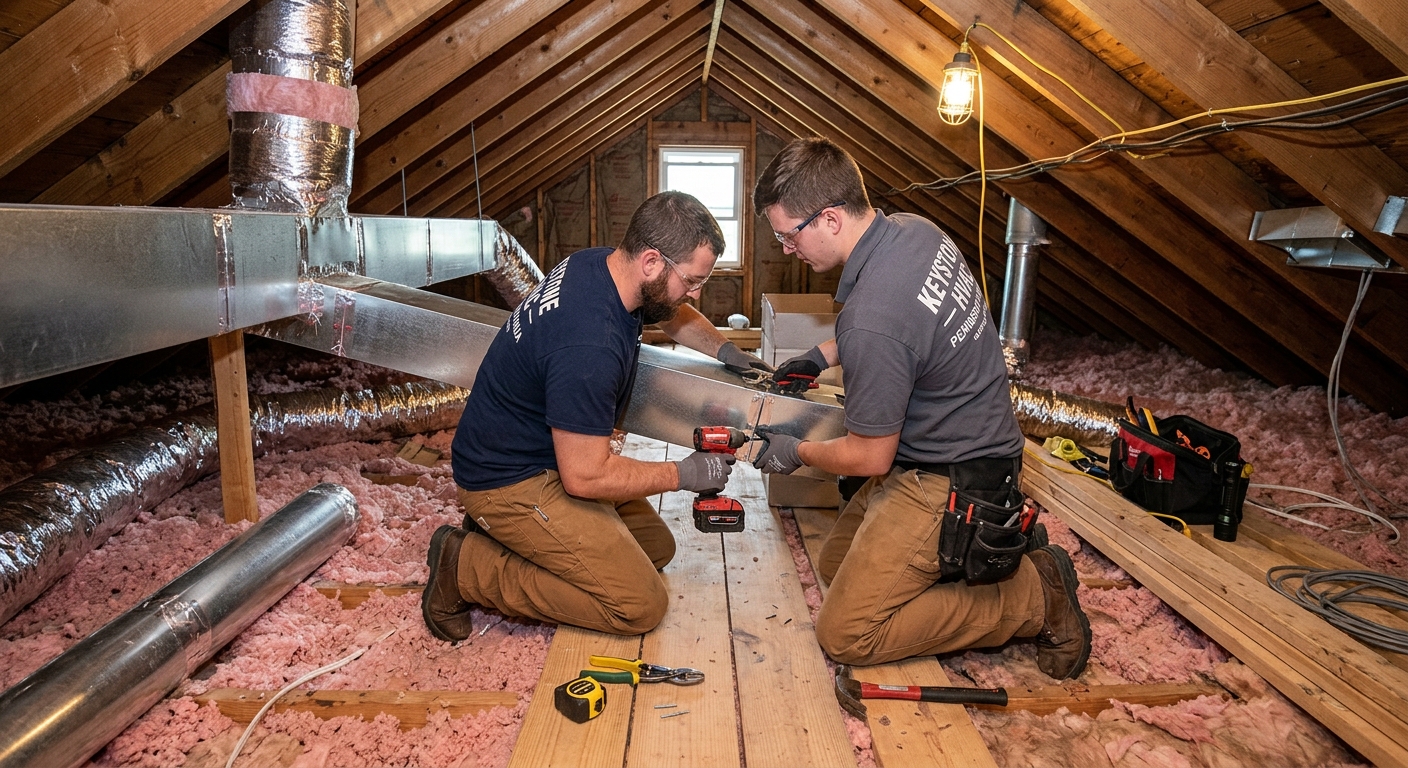
Most Colebrookdale homes old enough to predate 1980—and especially those in Reading and Hamburg, where pre-1940 houses dominate—have ductwork that leaks, is undersized, or was hacked together in retrofits. Duct leakage often wastes 20–30% of your heating and cooling—sometimes even more if the ducts run through unconditioned attics or crawlspaces. That means a significant chunk of your energy bill is lost before air even reaches the living space.
A duct blaster test pressurizes your duct system to measure how much air leaks out. If results are poor, sealing leaks with mastic or external tape, repairing disconnected or crimped sections, and adding insulation in exposed runs can recover lost performance. If the system suffers from chronic comfort problems, undersized return ducts are a frequent but invisible culprit—especially where ductwork was designed only for the airflow needs of a furnace, not central AC.
In homes where the ducts are beyond repair or simply missing—common in the oldest housing stock—a full duct replacement or alternative distribution (like mini-splits) is the answer. Always test and evaluate ductwork before committing to new equipment. Poorly sealed, poorly insulated, or undersized ducts will undercut the efficiency and comfort you paid for.
Zone control without ductwork
In Colebrookdale and neighboring towns like Reading and Hamburg—where most homes predate central air—ductless mini-splits are a practical solution for spaces that never had ductwork. Converted attics, new additions, finished basements, or rooms that always seem uncomfortable often cost less to address with a ductless system than to retrofit new ducts behind 80-year-old plaster.
Single-zone systems (one head, one outdoor unit) are most efficient and usually cost less up front. Multi-zone systems (one outdoor, multiple indoor heads) bring clean zone control but can lose efficiency when multiple heads run at light loads. Placement matters to avoid an eyesore and condensate needs to be pumped or drained, so careful planning is worth it.
While running several single-zone systems may cost a little more, they often operate more efficiently than a single large multi-zone system. Ductless heads have a mixed reputation for aesthetics—some owners object, but most appreciate the tradeoff for quiet, flexible comfort and modern controls.
The decision point on an aging system
Not every old HVAC system in Colebrookdale needs replacement. Start with age: under 10 years, most failures are one-off and worth repairing. As systems approach or exceed 15 years, especially those using outdated refrigerant, replacement becomes more compelling. Compare the repair cost: anything over a third of a full system’s price deserves pause. Compressor or heat exchanger failure almost always means replacement, especially on older units—don’t dump money into a system that’s outlived its reliable service life.
For high bills or weak performance, test the ductwork and home envelope before spending on efficiency upgrades. Old, leaky ducts often cheapen the benefit of a new unit—and sometimes a couple hundred dollars in sealing saves more than a pricy new unit. The exceptions: a cracked heat exchanger is a health hazard and a non-negotiable for immediate replacement, and a failed compressor out of warranty is rarely economical to fix if the unit is approaching end-of-life.
| Situation |
Recommendation |
Typical cost |
Reasoning |
| Under 10 years, single component failure |
Repair |
$300–$1,200 |
Most parts are less than 20% of replacement; system is young |
| 10–15 years, repair over a third of replacement |
Consider replacing |
$5,100–$12,000 |
Major repairs on aging systems often aren’t cost-effective |
| 15+ years, any major failure |
Replace |
$5,100–$12,000 |
Reliability drops, recurring issues likely |
| Cracked heat exchanger, any age |
Replace immediately |
$5,100–$12,000 |
CO risk—can’t safely repair |
| Compressor failure past warranty |
Replace |
$8,100–$17,000 |
Expensive fix yields poor return on aging base |
| Working system, high bills |
Test ducts and envelope first |
$300–$800 |
Efficiency upgrades wasteful if losses are elsewhere |
Frequently asked questions — HVAC installation in Colebrookdale
Is an annual maintenance plan worth it?
Annual maintenance may feel optional, but in Colebrookdale’s heating-heavy climate, it’s often worthwhile. Systems work hard through our long winters and moderate summers, so regular inspection and cleaning help maintain performance. Maintenance plans typically include filter changes, coil and burner inspection, safety checks, and minor adjustments—tasks that not only extend the equipment life, but also keep your warranty valid. For mid-range systems, expect to pay less than $1,000 annually; many plans run $200–$400 per year. Consider this: a well-maintained unit is less likely to leave you freezing at 12 °F, and cleaning a dirty coil or tuning a gas valve can recover efficiency lost to Pennsylvania dust, pollen, and hard water. If your system is newer and you’re diligent about changing filters yourself, you might skip a plan, but older units especially benefit from the extra attention.
How is a tax credit different from a rebate?
In Pennsylvania, a tax credit is applied when you file your state or federal taxes—reducing your taxes owed after installation, not at the point of sale. If you install a qualifying heat pump or high-efficiency AC in Colebrookdale and get a $8,100–$17,000 installation, a credit could offset a portion at tax time. A rebate, on the other hand, comes directly from a utility (like Met-Ed) or manufacturer and usually arrives as a check or discount after you provide proof of purchase. The big difference is timing: rebates come quickly, while credits take until tax season. Sometimes you get both, but you’ll need to retain documentation for each. Always confirm eligibility before the work starts—rebate and credit programs can have strict requirements about product ratings and installation.
Can I service my R-410A system after the refrigerant change?
Yes, you can keep servicing R-410A systems in Colebrookdale despite the move to next-generation refrigerants. R-410A availability will taper off, but it will not become illegal to own or maintain your current system. Costs may rise as supplies dwindle. If your system, say a ductless mini-split installed for $3,200–$7,100, uses R-410A and is working well, regular service and eventual minor repairs are still supported. When major repairs or a compressor failure hit a unit near or over 15 years old, revisit whether it’s worth investing more in old tech or switching to systems that use newer refrigerants. EPA Section 608 certification is mandatory for technicians handling refrigerants here.
Is a high-efficiency system worth the extra cost here?
With Colebrookdale’s deep winters (5,200 heating degree days), a high-efficiency heat pump or furnace can yield genuine savings—especially if you have high bills or fuel oil/propane as your primary heat. For a ducted cold-climate heat pump, you might see up to 20–30% lower operating costs over a standard unit if your ducts are tight and your home is decently insulated. Installation ranges from $13,000–$17,000 for premium models. The payback improves the higher your usage and local fuel costs, but the extra spend won’t pay off if your ducts are leaky, or your winter usage is already modest. For gas-heated homes with existing infrastructure, the boost to comfort and resale can matter as much as efficiency gains.
Do I need dual fuel in south-central Pennsylvania?
Dual fuel—using both a cold-climate heat pump and a gas furnace for backup—makes sense for Colebrookdale homeowners who see deep cold (below 15 °F) and have existing gas lines. It lets you run the efficient heat pump most of the time and fall back to gas for those few stretches each winter when heat pump capacity can’t keep up. Installation costs, usually $13,000–$17,000, run higher than a single system, but dual fuel delivers both lower operating costs and peace of mind. In outlying rural areas without natural gas, it’s less common; you’re better off going heat-pump-only, or pairing with propane if absolutely needed. For most heating days here, a modern heat pump is up to the task by itself.
How does south-central Pennsylvania's climate affect system sizing?
Our climate, with a 12 °F winter design temperature, means heating trumps cooling—systems must be sized for reliable heat output, not just summer comfort. Sizing too small leaves you chilly on the coldest mornings, while oversizing a central AC short-cycles in our mild, 1,250 cooling degree day summers, wasting energy and shortening compressor life. For a full duct system installation in Colebrookdale—$9,100–$18,000—the designer will use local load calculations, factoring your home’s age and insulation as well as climate data, for right-sizing. Ask for a Manual J load calculation; guessing based on square footage or old “rules of thumb” often leads to comfort and efficiency problems in our variable weather.
What does a heat pump cost installed in Colebrookdale?
A standard ducted heat pump installation in Colebrookdale typically runs between $8,100–$17,000. The wide range comes from differences in ductwork condition, equipment efficiency, system tonnage (larger homes cost more), and any required electrical upgrades, which are common in older Berks County homes built before central air was standard. Cold-climate-rated models built to handle 12 °F design temps usually cost at the higher end. For homes without ducts, a ductless mini-split for a single zone is typically $3,200–$7,100 installed. Always have your contractor review your insulation and existing ducts before setting a firm number.
What is commissioning and why does it matter?
Commissioning is the careful process of testing, balancing, and verifying a new HVAC system after installation. In Colebrookdale, where older homes might have quirky ductwork or marginal electrical supply, commissioning is critical. Your contractor will check refrigerant charge, verify airflow, test for leaks, calibrate thermostats, and make sure safety features work as intended. A system costing $5,100–$12,000 or more deserves to be set up right—without this final step, even the best equipment can run poorly, wasting energy and reducing lifespan. Not every installer commits to commissioning on every job, so ask specifically if it’s included in your quote.
Who inspects HVAC work in Colebrookdale?
HVAC system installations in Colebrookdale and surrounding Berks County townships are overseen at the municipal level, not by the state. Local code offices review permit applications and perform required inspections for central systems, including any changes to electrical service or ductwork. In Reading proper, both mechanical and electrical permits are usually required for replacement or major new installations. Expect an inspector to check your system for code compliance before the final sign-off. For ductless systems or minor add-ons, inspection requirements can be lighter, but you’re always safest pulling the proper permits. Central AC replacement, which runs $5,100–$12,000 installed, should always finish with a local authority’s approval.