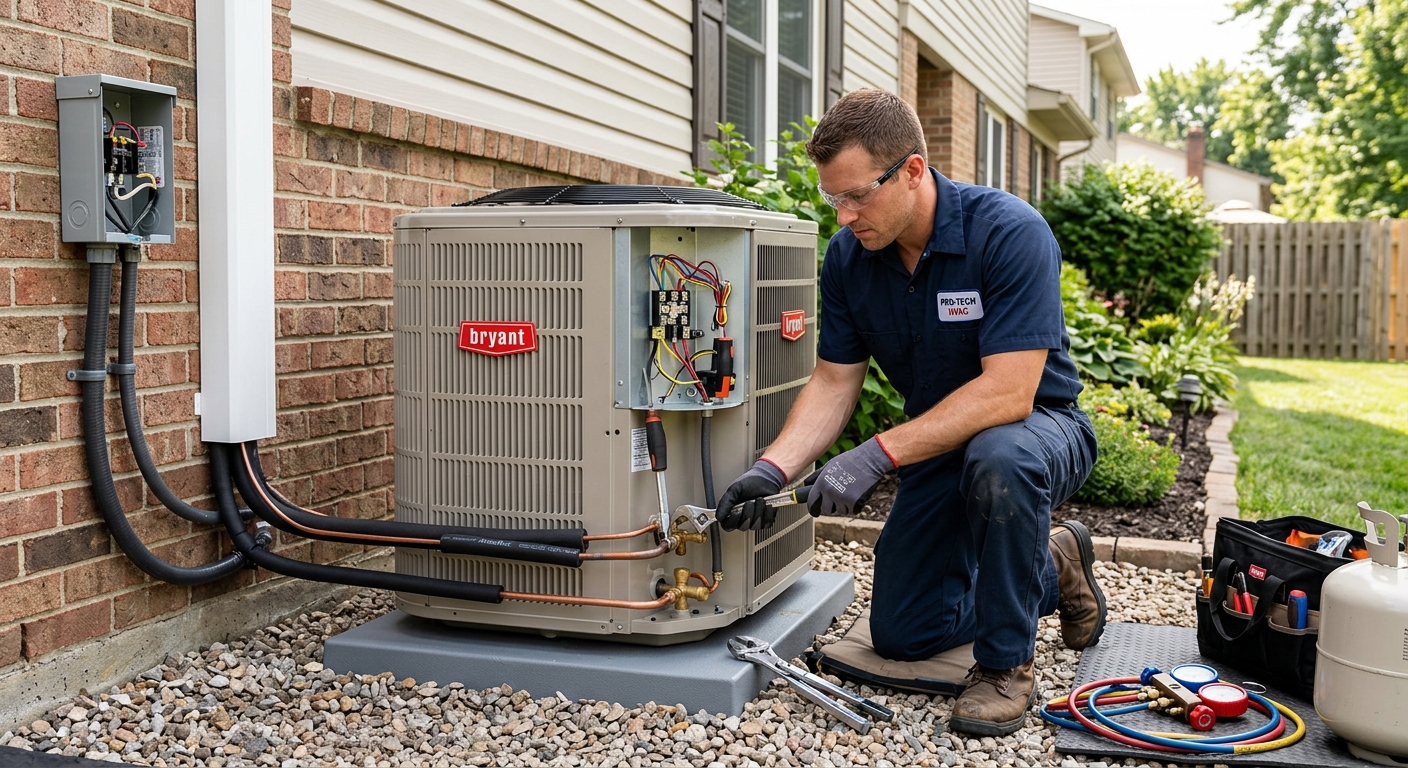
What a new HVAC system costs in Ligonier
Ligonier’s high rate of owner-occupied, single-family homes, at 83.4% and 91.0% respectively (U.S. Census Bureau, ACS 2024), means most residents are investing in systems for their own long-term comfort rather than for short-term flips or rentals. The housing stock is predominantly mid-20th-century and postwar, with over 71.4% of homes built before 1980, so many installations in town are retrofits involving older ductwork and sometimes necessary electrical upgrades. In these homes, assessing the condition of existing ducts matters—replacing a central air system is often straightforward, but true ductless solutions or full new duct systems are more common here than in counties packed with newer tract homes.
Southwestern Pennsylvania is unmistakably a heating-dominated climate: 5,600 heating degree days compared to only 1,050 cooling degree days. That shifts priorities. While reliable air conditioning is important for July and August, investing in efficient, well-sized heating—whether via furnace or heat pump—is where most of your dollar and comfort benefits live. Because retrofits are frequent, a site-specific estimate is critical; equipment tonnage, duct condition, and the home’s electrical service all affect the true installed cost more than the badge on the outdoor unit.
| System | Best for | Efficiency | Price range (installed) |
|---|
| Central AC replacement (existing ducts) | homes with sound ductwork | 16–20 SEER2 | $4,800–$11,500 |
| Air source heat pump (ducted) | year-round heating and cooling | 8–10 HSPF2 | $7,700–$16,500 |
| Cold-climate heat pump (ducted) | heat pump as primary heat | 9–11 HSPF2 | $12,500–$16,500 |
| Ductless mini-split (single zone) | additions, rooms without ducts | 20–30 SEER2 | $3,100–$6,700 |
| Full duct system installation | homes with no existing ducts | — | $8,600–$17,000 |
Installed estimates for a typical Ligonier home. Equipment tonnage, duct condition and electrical capacity move these more than brand.
Rebates and tax credits for Ligonier homeowners
If you’re planning an HVAC upgrade in Ligonier, you’ll encounter three main types of financial incentives: federal tax credits, utility rebates, and state-level programs. A tax credit is a credit on the taxes you owe the following year, lowering your bill after you file. A rebate is direct—to your installer, your bank account, or as a bill credit—reducing your upfront cost or invoice. For most people, the cash-flow difference matters: you pay less out of pocket with a rebate, while tax credits help your overall budget but only after you file your return.
At the federal level, the biggest program for homeowners is the clean energy tax credit for qualifying HVAC systems, including heat pumps and high-efficiency ACs. The program details change from year to year—be sure to review IRS guidance or check official government sources before planning your purchase. Locally, West Penn Power (electric) and Peoples Natural Gas (gas) are the primary utilities in Westmoreland County, each running efficiency programs that may include rebates for qualified equipment. Because these rebates can and do change every year, don’t rely on number claims from outdated articles. Instead, check your utility company’s efficiency program page for current offerings. The ENERGY STAR rebate finder is also a helpful tool that lists available programs by ZIP code, including state and local options where applicable. Using these sources gives you a realistic, up-to-date picture of what savings you can expect, rather than chasing after expired offers.
The decision point on an aging system
When your HVAC system starts acting up, replacing it isn’t always the right call. In Ligonier homes—especially those with mid-century builds—repairs are often cost-effective, provided your equipment isn’t near the end of its typical service life. Consider these points: how old is the system, and what’s the repair compared to the cost of a new install? If the repair is less than a third of total replacement, and the system is under ten years, fixing it usually makes sense. The type of failure is critical—a failed capacitor or fan motor is a minor repair, but a failed compressor or cracked heat exchanger is often terminal, especially if the equipment is no longer under warranty.
One other detail: refrigerant type. Systems using older, phased-out refrigerants (like R-22) are more expensive to service and offer less efficiency, so replacement may be the wiser path. Efficiency upgrades can be appealing, but in a climate with 5,600 heating degree days but only modest summers, the payback on a high-efficiency AC alone can stretch out longer than the equipment life. The two situations where replacement is not a choice: a cracked heat exchanger (safety hazard) and a compressor failure when your system is already into old age.
| Situation | Recommendation | Typical cost | Reasoning |
|---|
| Under 10 years, single component failure | Repair | $300–$1,200 | Cheaper than replacing, long service life left |
| 10–15 years, repair over a third of replacement | Consider replacing | $4,800–$11,500 | Significant investment, may not be worth it |
| 15+ years, any major failure | Replace | $4,800–$11,500 | End of expected lifespan |
| Cracked heat exchanger, any age | Replace immediately | $4,800–$11,500 | Safety risk, cannot be repaired |
| Compressor failure past warranty | Replace | $7,700–$16,500 | High cost, often close to new system |
| Working system, high bills | Test ducts and envelope first | $300–$800 | Efficiency loss often from duct leaks |
Permits, licensing and inspections in Ligonier
In Pennsylvania, there’s no statewide HVAC license that covers residential work. Instead, all residential installations—including those in Ligonier—are governed locally by the Pennsylvania Uniform Construction Code, which is based on the IRC. Municipalities, or the state Department of Labor & Industry in towns that opt out, handle permits and code enforcement. In Westmoreland County, towns like Greensburg and its neighbors have their own building offices, so your project will need a mechanical permit pulled locally before work starts.
EPA Section 608 certification is federally required for anyone handling refrigerants, whether for AC or heat pumps. This is not optional, regardless of state or local rules. For jobs over $500, your contractor must carry Home Improvement Contractor (HIC) registration from the Pennsylvania Office of Attorney General; you can check their credentials at hic.attorneygeneral.gov. Insurance and workers' compensation are mandatory for all employers, and you can verify them via the Workers' Compensation Automation and Integration System (WCAIS) at wcais.pa.gov. For homes built before 1978, federal lead safety rules (EPA Lead RRP) also apply; confirm your contractor’s certification at certifiedrenovatorsearch.epa.gov. If your HVAC company can’t show proof of these requirements up front, keep looking.
Comparing HVAC estimates in Ligonier
Comparing HVAC quotes in Ligonier requires more than stacking up bottom lines. Look past the brand for details: Are model numbers for both the outdoor and indoor units listed, and do they match as a factory-rated pair? Does the estimate include a load calculation—specific to your house—or just reference the tonnage from your old system? Any reputable quote will detail whether the line set is being reused or replaced, the scope of ductwork repairs or sealing, whether your electrical panel needs an upgrade, and how the condensate will be drained (pump or gravity). Thermostat compatibility, permit fees, and a labor warranty—distinct from the manufacturer’s warranty—should all be listed. You should also expect a commissioning report (a brief, written record of system airflow, charge, and safe operation) when the job is done.
If you receive a quote that only specifies a brand and a price, you simply can’t compare it to anything else—there’s a high risk you’ll end up with an undersized, noisy, or inefficient system. Listen for red flags, ask for specifics, and always make sure a permit and startup documentation are included in the proposal.
| Line item | What to look for | Red flag if… |
|---|
| Equipment | model numbers, indoor and outdoor matched | brand name only |
| Sizing | load calculation attached | matched to the old nameplate |
| Ductwork | condition assessed, sealing scoped | not mentioned |
| Electrical | circuit and panel capacity confirmed | assumed adequate |
| Line set | replaced or documented as reused | silent |
| Commissioning | measured airflow and charge, documented | no startup report |
| Warranty | labour years stated separately | manufacturer only |
| Permit | included and priced | 'not needed' |
Gas, electric or both in southwestern Pennsylvania
In Westmoreland County, home to Ligonier, your heating equipment choice is driven first by the weather: our winter design temperature is 8 °F, and we see 5,600 heating degree days per year. That’s cold—so while modern cold-climate heat pumps now hold much more capacity in freezing weather (unlike the old units, which dropped off below 30 °F), output still decreases as the thermometer drops. This is why dual fuel (heat pump plus gas backup) is popular for year-round comfort without astronomical electric bills.
Natural gas is widely available in Westmoreland County, but there are rural pockets—outside towns and villages—where propane or oil are still standard. Where gas is available, a high-efficiency furnace can make sense, especially for older homes with less insulation and higher heating demand. When you’re choosing between replacing a furnace and moving to a heat pump, consider: if you're in a home without gas service, you’ll compare heat pump operation against propane or oil, both of which run notably higher in cost and maintenance. In that case, upgrading to a ducted or ductless heat pump often pencils out better, especially if you’re also due for cooling equipment. For those targeting the lowest year-round bills and cleanest operation (or if you want to move away from fossil fuels), a modern heat pump is a more attractive option than ever before.
The old argument that "heat pumps can’t cut it in a Pennsylvania winter" doesn’t hold water with current equipment. That said, a robust gas furnace is still the right call for homes with especially high heat loss, or for anyone who wants to avoid electric backup heat at the coldest design temps.
| Option | Installed cost | Operating cost here | Best when | Incentive eligible |
|---|
| Gas furnace + central AC | $4,800–$11,500 | lowest for existing gas, very cold snaps | existing gas service, coldest zones | yes |
| Ducted heat pump (cold climate) | $7,700–$16,500 | low in efficient houses, variable otherwise | good envelope, all-electric goal | yes |
| Dual fuel (heat pump + gas backup) | $12,500–$16,500 | moderate, uses gas only in deep cold | gas on site, deep cold spells | yes |
| Ductless multi-zone | $8,600–$17,000 | varies by load and zone use | no ductwork, zone control | yes |
Reading the yellow label
The yellow EnergyGuide label on new HVAC systems is where you’ll find core efficiency ratings. SEER2 measures cooling efficiency—higher SEER2 means less electricity used for the same cooling, but the “2” signals this is the new, more realistic test standard. HSPF2 is the heating efficiency for heat pumps, again using “2” for updated test methods. AFUE is the heating efficiency for furnaces, measured as how much of the fuel brings heat to your house instead of out the flue. The bigger the number, the better—but only up to a point.
In Westmoreland County, with 5,600 heating degree days but only 1,050 for cooling, HSPF2 or AFUE matters much more over the long haul than chasing the highest SEER2. Pay for midrange to upper-middle in SEER2 (16–18), but skip the premium unless you’re also tackling a leaky house or plan to run AC for extended hours (not common for Ligonier). For heat pumps, pushing up into the best HSPF2 your budget allows is worthwhile, as that impacts your winter bills for years. Ignore efficiency numbers from outdated SEER or HSPF labels—new SEER2 and HSPF2 scores are lower for the same equipment due to stricter tests, and aren’t apples-to-apples with older articles.
Frequently asked questions — HVAC installation in Ligonier
How long does HVAC installation take in Ligonier?
For most single-family homes in Ligonier, a standard furnace or air conditioner replacement takes one to two days, provided the existing ductwork and wiring are in good shape. If your home is one of the many built before 1980, with aging ductwork or older electrical panels, budget for extra time—sometimes two to four days are needed for additional duct repairs or a new circuit. Full duct system installations, which are common in retrofit scenarios around Ligonier, can take up to a week depending on attic or crawlspace access. Timing also depends on permit approval from your local township office. Remember, your contractor should include a line item for this in your estimate. Most homeowners investing in a total system replacement will see pricing in the $4,800–$11,500 range for typical central systems, with added time when upgrading more than just the equipment.
Do I need ENERGY STAR equipment to qualify for incentives?
Not always, but it helps. Many federal tax credits and local utility rebates for Ligonier homeowners do require ENERGY STAR certification, especially for heat pumps, central AC, and high-efficiency furnaces. Some programs, though, only require a certain SEER2 or HSPF2 rating, which can sometimes be met by non-ENERGY STAR models if they just clear the line. West Penn Power and Peoples Natural Gas, the main utilities in Westmoreland County, set their rebate criteria each year—always check their efficiency program websites for the current standards. If your goal is to maximize incentives, look for equipment that not only meets ENERGY STAR but also aligns with the specific requirements of each rebate. In practical terms, ENERGY STAR-qualified systems usually fall in the $7,700–$16,500 range for fully installed, ducted heat pumps.
What is EPA Section 608 certification?
EPA Section 608 certification is a federal requirement for anyone handling refrigerants in air conditioning and refrigeration systems, including those installed in Ligonier homes. This certification ensures that your technician has been trained in proper refrigerant handling and recovery, which helps protect both you and the environment. It's not just a formality—technicians must carry their credentials and use EPA-approved procedures to avoid releasing harmful refrigerants. Pennsylvania does not issue its own refrigerant license; the EPA credential applies regardless of local or state rules. The next time you replace or repair a heat pump, AC, or mini-split in Ligonier (priced from $3,100–$6,700 for a single-zone system), make sure the company you hire can show you their Section 608 cards for every worker who handles your equipment.
Why are my Ligonier energy bills high with a new system?
High energy bills in Ligonier after a new HVAC system often come down to old ductwork, poor insulation, or improper installation. More than 70% of Ligonier homes were built before 1980—meaning duct leakage, uninsulated attics, or out-of-date wiring are common culprits for energy waste. Even a top-tier heat pump or AC won’t reach its rated efficiency if installed onto leaky ducts or without a commissioning report at startup. It also matters whether your electrical panel or thermostat setup matches the demands of the new equipment. If you notice higher-than-expected utility bills, ask your contractor to test your ductwork and evaluate insulation before blaming the HVAC equipment itself. Paying $300–$800 for a blower door or duct leakage test can easily save more than that in future heating costs.
How does southwestern Pennsylvania's climate affect system sizing?
Southwestern Pennsylvania’s climate, with its cold winters (design temp: 8 °F; 5,600 heating degree days), means that undersizing a furnace, heat pump, or ductless mini-split can leave you shivering come January. Yet it’s just as important not to oversize. Bigger isn’t better—too much system cycling leads to comfort issues and premature wear. Proper sizing starts with a Manual J load calculation, accounting for your Ligonier home’s insulation, window quality, ductwork, and orientation. In our market, a well-sized ducted heat pump will land in the $7,700–$16,500 installed range, varying more with load and house age than square footage alone. Always ask to see your contractor’s room-by-room sizing paperwork before signing.
What is a Manual J load calculation?
A Manual J load calculation is the industry-standard method for determining exactly how much heating and cooling your home needs, based on real measurements and local Ligonier weather data. The calculation takes into account your home’s insulation, window sizes, orientation, and how much air leaks into (or out of) the house. It’s required by the Pennsylvania Uniform Construction Code for new installs, so any reputable HVAC contractor in Westmoreland County will provide it without hesitation. Unlike a "rule of thumb" guess based on square footage or a rougher look at your existing equipment, Manual J ensures that you don’t end up with a system that’s too big (short cycles, uneven heating) or too small (always running, never catching up). Getting this right is essential to achieving the comfort—and the utility bills—you’re aiming for after an investment in a $4,800–$11,500 new HVAC system.
How much does a new HVAC system cost in Ligonier?
The cost of a new HVAC system in Ligonier varies by type and the work required in your specific home. Most central air replacements with existing ductwork fall between $4,800–$11,500. If you need a ducted air-source heat pump, expect a range of $7,700–$16,500. Ductless mini-splits (such as for a sunroom, garage, or addition) typically cost $3,100–$6,700 per zone. Full duct system installations, which are sometimes needed in older or previously unconditioned homes, start at $8,600–$17,000. The main drivers of installed costs in Ligonier are equipment size, duct condition, and electrical service—not brand premium. Permits, local labor, and required code upgrades also factor in.
Is a heat pump a good choice for Ligonier winters?
Modern heat pumps are a solid option for Ligonier winters, even with our 8 °F winter design temp and high annual heating degree days. Today’s cold-climate models can efficiently heat a home well below freezing, cutting electric resistance heat use to a minimum. If your house has good insulation and ductwork, a ducted heat pump is both a reliable and cost-effective choice. In the few weeks we hit single digits, some systems may briefly supplement with backup electric or gas heat. If you’re switching from propane or oil in a rural part of Westmoreland County, a heat pump can lower total heating costs—and may unlock rebates. Expect a full, ducted cold-climate heat pump install in the $12,500–$16,500 range, with operating costs and comfort comparable to gas for most of the year.
How much does a furnace replacement cost in Ligonier?
Furnace replacement costs in Ligonier are shaped by the local market, the age of your home, and the availability of natural gas. For most owner-occupied homes with existing ductwork and gas lines, expect total installed costs between $4,800–$11,500—usually including removal of the old furnace, new venting if needed, some duct sealing, and permit fees. Higher-efficiency models with advanced controls or those needing electrical or chimney upgrades will be at the top of that range. If you’re off the gas grid, costs may go up for oil or propane setups, but many rural homeowners are now switching to ducted or ductless heat pumps instead to keep long-term bills lower.