North Versailles heating and cooling prices by system type — 2026
Homeowners in North Versailles have mostly older homes, with more than 82% built before 1980 and a homeownership rate over 63% (U.S. Census Bureau, ACS 2024). That means most heating and cooling work in this area is replacement or retrofit — not new construction — and you’re often dealing with existing ductwork that may be tight, undersized, or simply not designed for modern high-efficiency systems. If you own one of these homes, your upgrade options depend heavily on what’s already installed, whether ducts are present, and the condition of the electrical service.
With 5,600 heating degree days and just 1,050 cooling degree days, North Versailles sits in a strongly heating-dominated corner of Pennsylvania. Any big HVAC decision — AC replacement, heat pump install, new ducts — should be weighed with local winters front and center. A heat pump is a real option if the house is well sealed and the ductwork is right, but high-efficiency AC should not be the first priority for most.
| System |
Best for |
Efficiency |
Price range (installed) |
| Central AC replacement (existing ducts) |
homes with sound ductwork |
16–20 SEER2 |
$4,700–$11,500 |
| Air source heat pump (ducted) |
year-round heating and cooling |
8–10 HSPF2 |
$7,500–$16,000 |
| Cold-climate heat pump (ducted) |
heat pump as primary heat |
9–11 HSPF2 |
$12,000–$16,000 |
| Ductless mini-split (single zone) |
additions, rooms without ducts |
20–30 SEER2 |
$3,000–$6,600 |
| Full duct system installation |
homes with no existing ducts |
— |
$8,500–$17,000 |
Installed estimates for a typical North Versailles home. Equipment tonnage, duct condition and electrical capacity move these more than brand.
Reducing the net cost of a North Versailles installation
If you’re planning a new HVAC system in North Versailles, three sources can help trim your final cost — federal tax credits, utility rebates, and (sometimes) state programs. The federal energy efficiency tax credit applies to eligible systems and kicks in when you file your taxes; it does not reduce your invoice up front, but lowers your tax bill the following year. By contrast, a utility rebate is paid by your electric or gas company — for North Versailles, that’s Duquesne Light Company for electricity and Peoples Gas for natural gas — and is usually deducted directly from your invoice or issued as a check after installation.
A rebate pays off faster in practical terms, but the application process can involve paperwork and prequalified equipment lists. For the most accurate and up-to-date information, start with your utility’s energy efficiency program website. Program names and rebate amounts frequently change year to year, so avoid relying on old numbers in articles. The federal ENERGY STAR Rebate Finder website is also a reliable resource.
State-level incentives beyond these vary and may be offered sporadically. Always verify the eligibility of both your contractor and equipment before you start — a simple oversight on paperwork or model numbers can mean missing out on hundreds or even thousands in incentives.
Permits, licensing and inspections in North Versailles
Pennsylvania does not license HVAC contractors at the state level for residential work. Instead, any contractor offering work over $500 must register under the state’s Home Improvement Contractor (HIC) system — check them at the state attorney general’s HIC portal before signing a contract. Municipalities in Allegheny County, including North Versailles, handle permits and enforcement locally. That means a mechanical permit and inspection are required anytime you install, replace, or significantly alter an HVAC system.
EPA Section 608 certification is federally mandated for anyone handling refrigerants (such as AC or heat pump installation or replacement), so you should always ask to see this credential. It’s entirely separate from contractor registration or permits. Always request proof of workers’ compensation insurance; in Pennsylvania, this can be verified using the WCAIS system, which is public and free to search.
Aside from registration and proof of insurance, do not rely on vague claims of “licensed and insured.” Insist on seeing the actual HIC registration number and evidence of workers’ compensation coverage before you sign. For pre-1978 homes, federal EPA Lead RRP certification is also required if work will disturb painted surfaces.
Efficiency ratings and what they mean for your bill
Efficiency labels matter, but their payback depends on our particular climate. SEER2 measures cooling efficiency, HSPF2 rates heating efficiency for heat pumps, and AFUE handles furnace ratings. Note: SEER and HSPF changed to SEER2 and HSPF2 — newer ratings are stricter, and older articles may not match what you see on new equipment tags.
In Allegheny County, with 5,600 heating degree days but only 1,050 cooling degree days, heating efficiency is the bigger factor in your annual energy spend. Paying for the very highest SEER2 rating makes little sense here; you’ll rarely run your AC hard enough for the premium to recover its cost. A mid-to-high SEER2 unit (16–18) is as far as I’d recommend before diminishing returns bite. For heat pumps, look closely at HSPF2 — a higher number directly lowers your winter bills, so aim for at least 9 HSPF2 if your system will do most of your heating.
Bottom line: Prioritize good heating performance for this market. Don’t get talked into paying thousands extra for ultra-high AC efficiency that may never pay for itself in your North Versailles home.
What size system does a North Versailles home need?
System size is the single most consequential choice a contractor makes for your home. Too large, and the result is short cycling — the system turns on and off too quickly, leading to uneven temperatures, poor humidity control, and shortened equipment life. Oversizing is all cost, no benefit. It is not a margin of safety.
A proper sizing starts with a Manual J load calculation. This considers your home’s square footage, insulation, window area, orientation, airtightness, and even the occupancy, rather than a one-size-fits-all “tons per 500 sq. ft.” rule of thumb (which is almost always wrong, especially in older North Versailles homes). If your contractor simply replicates the old unit’s size or “guesses” based on home age, ask: “Did you run a load calculation — and can I see it?”
Your system must be able to handle a winter design temperature of 8 °F, as used for equipment sizing in this region. A load calculation ensures you get enough heat capacity for local winters without oversizing. The right size system will cycle steadily, control humidity better, and last longer.
Duct condition, leakage and sealing
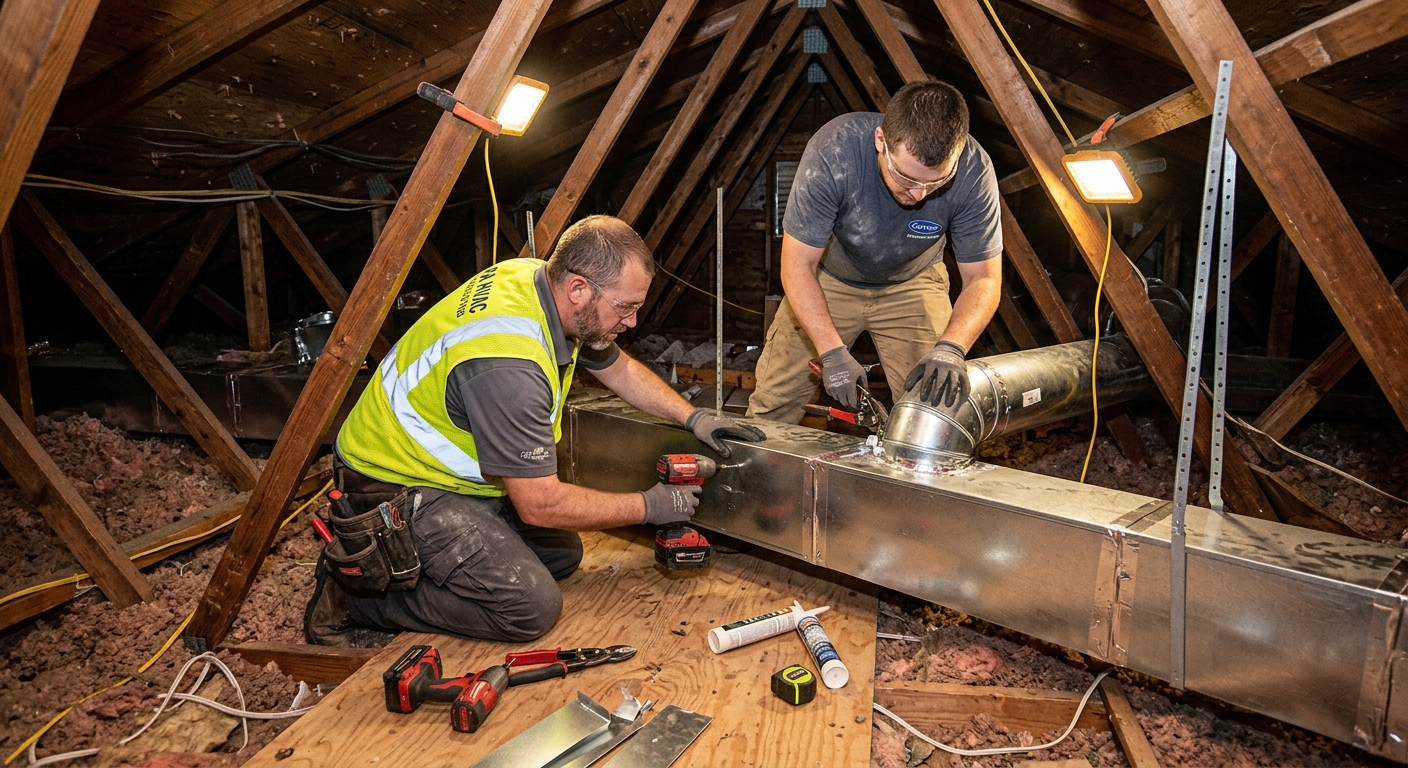
Most homes in North Versailles built before 1960 either lack ductwork or have older, sometimes leaky or undersized ducts. Duct leakage is a silent thief — in my experience, it’s not unusual to lose 20% or more of conditioned air into attics, crawlspaces, or wall cavities, especially if joints were never sealed and ducts run through unconditioned spaces.
A duct blaster test measures actual duct leakage and shows how much conditioned air is wasted before it even reaches your rooms. If you’ve never had your ductwork tested, this is worth doing before you invest in new HVAC equipment. There’s no point buying the highest-SEER system if half your cool or warm air leaks out on the way.
Undersized or missing return ducts are another chronic problem in older North Versailles homes, which chokes airflow and leads to noisy systems and reduced efficiency. If your ducts serve only an old furnace and weren’t designed for AC or a modern heat pump, replacement or re-sizing might be required. Sealing is the first step, but where ducts are inaccessible or corroded, replacement is sometimes the only realistic way forward.
Always test before replacing major equipment. Fix the distribution system first — your new HVAC will be quieter, more efficient, and more comfortable year-round.
Humidity and air quality in North Versailles homes
Southwestern Pennsylvania’s climate swings from humid summers to bone-dry winters. With more heating degree days than cooling, most North Versailles homes struggle with winter dryness (leading to static, sore throats, cracked wood) and then high summer humidity. The fix is rarely “add-ons everywhere” — it’s matching the right solution to your specific problem.
Whole-house humidifiers help with winter dryness, but they require regular cleaning and maintenance to avoid mold or scale buildup. For summer humidity, the main thing is a properly sized and installed AC; units that are too large cool the air quickly but barely run long enough to remove moisture, leaving the house clammy. Run times matter as much as capacity.
Air filtration (MERV rating) is a balance — higher-efficiency filters trap more particles but can choke airflow if the blower isn’t sized for them, especially in older ductwork. Mechanical ventilation (like an ERV or HRV) is most useful in tightly sealed newer homes, which are rare in North Versailles; don’t let anyone sell you one unless a blower door test proves your home is truly air-tight. Standalone UV lights and electronic air cleaners are regularly oversold relative to how much they actually improve real-world air quality here.
Frequently asked questions — HVAC installation in North Versailles
Can a heat pump heat my house without backup?
In North Versailles, heating is the bigger challenge — our winter design temperature is 8 °F, and older homes often leak lots of heat. Modern cold-climate heat pumps can provide reliable heat in most local homes, but whether you need a backup (usually a gas furnace or electric resistance) depends on your home’s insulation, air sealing, and how well the ducts are sized and sealed. For a proper year-round solution, I recommend looking at ducted cold-climate models, which run between $12,000–$16,000 installed. In many cases, they handle all but the coldest days without backup, but most contractors will recommend a secondary heat source just to be safe.
Do I need ENERGY STAR equipment to qualify for incentives?
Not always, but ENERGY STAR sets a safe baseline. In North Versailles, most utility rebates and the federal tax credit require specific efficiency minimums, which often overlap with (but aren’t limited to) ENERGY STAR models. Always check your utility’s efficiency program requirements before buying, since they may demand even higher ratings or specific brands. For a common system like a ductless mini-split, qualifying models start at $3,000–$6,600 installed. Bottom line: don’t buy based on the sticker alone — ask your contractor and check program rules to avoid missing out on incentives.
When is the best time of year to replace HVAC in North Versailles?
Ideally, spring and fall are the sweet spots for North Versailles homeowners — demand is lower, and contractors usually have more availability, which sometimes means better pricing on labor or equipment. Emergency replacements in mid-winter or during a summer heat wave are almost always pricier and may mean settling for whatever’s in stock. If your system is already nearing the end of its life — particularly after 20-plus years in a house built before 1980 — you save yourself stress and possibly money by planning ahead. A standard central AC replacement is typically $4,700–$11,500 installed, but costs can climb if you have to rush or face a supply crunch.
Which utility serves North Versailles?
North Versailles is served by Duquesne Light Company for electricity and Peoples Gas for natural gas. Electric utility rebates and incentives run through Duquesne Light’s customer programs, which update details and eligibility every year. For natural gas equipment, Peoples Gas has similar programs. Always check the current rebate offers before you sign off on a new HVAC installation or replacement — incentives can save you hundreds, sometimes thousands, for something like a heat pump ($7,500–$16,000 installed), but only eligible equipment and registered contractors qualify.
What does a ductless mini-split cost in North Versailles?
For a professionally installed single-zone ductless mini-split in North Versailles, expect to pay between $3,000–$6,600 in 2026 dollars. Most single-room or small addition jobs fall near the lower end of that range, but larger or trickier installations — especially in older North Versailles homes where fishing linesets is tough — will push the number higher. There are often utility rebates or federal tax credits available for qualifying units, but program rules and available equipment change from year to year, so always check the latest details directly with your utility and contractor before committing.
Is a high-efficiency system worth the extra cost here?
It depends which efficiency rating you’re focused on. North Versailles has a strongly heating-dominated climate, so paying extra for the highest SEER2 (cooling) rating seldom pays back over the system’s life. Instead, direct your money toward higher HSPF2 (heating) efficiency if you’re going with a heat pump. For instance, a mid-tier air source heat pump (ducted) at $7,500–$16,000 usually pays back the efficiency premium, while pushing SEER2 to the max brings diminishing returns on your energy bill here. Don’t be upsold for features that make only a marginal difference in a Pennsylvania winter.
Is an annual maintenance plan worth it?
An annual tune-up can absolutely extend the life of your HVAC equipment and keep efficiencies high, especially with older homes in North Versailles where filters can clog fast and ductwork may not be pristine. That said, the value of an annual “plan” depends on what’s included, not just the promise. If it’s a basic inspection and filter change, price it out against a one-off service call. On a new or recently replaced system (such as a central AC at $4,700–$11,500 installed), you may not need a full plan every year, but regular checkups are smart for systems more than five years old and in heavy use.
What is EPA Section 608 certification?
EPA Section 608 certification is a federal requirement for anyone who handles refrigerants during installation, servicing, or disposal of air conditioners and heat pumps. In North Versailles — and anywhere else in the U.S. — this certification applies to every technician touching your AC or heat pump lines. It’s entirely separate from state or local contractor registration and is intended to ensure refrigerants are handled, recovered, and disposed of safely. Before any installation or service, ask your contractor for proof of Section 608 certification. For example, on a ductless mini-split job ($3,000–$6,600), everyone working with refrigerant lines must have it.
What size HVAC system does my North Versailles home need?
Sizing should be calculated, not guessed. In North Versailles, most homes were built before 1980, with a winter design temperature of 8 °F, which means the heating load is the priority. Don’t let any contractor size your new system — whether a heat pump (at $7,500–$16,000 installed) or AC — based on the old unit’s rating or a rule of thumb. The proper route is to request a Manual J load calculation that factors in your specific home’s insulation, window count, layout, and air leakage. This will save operating costs, improve comfort, and help your system last years longer than an oversized or undersized one.