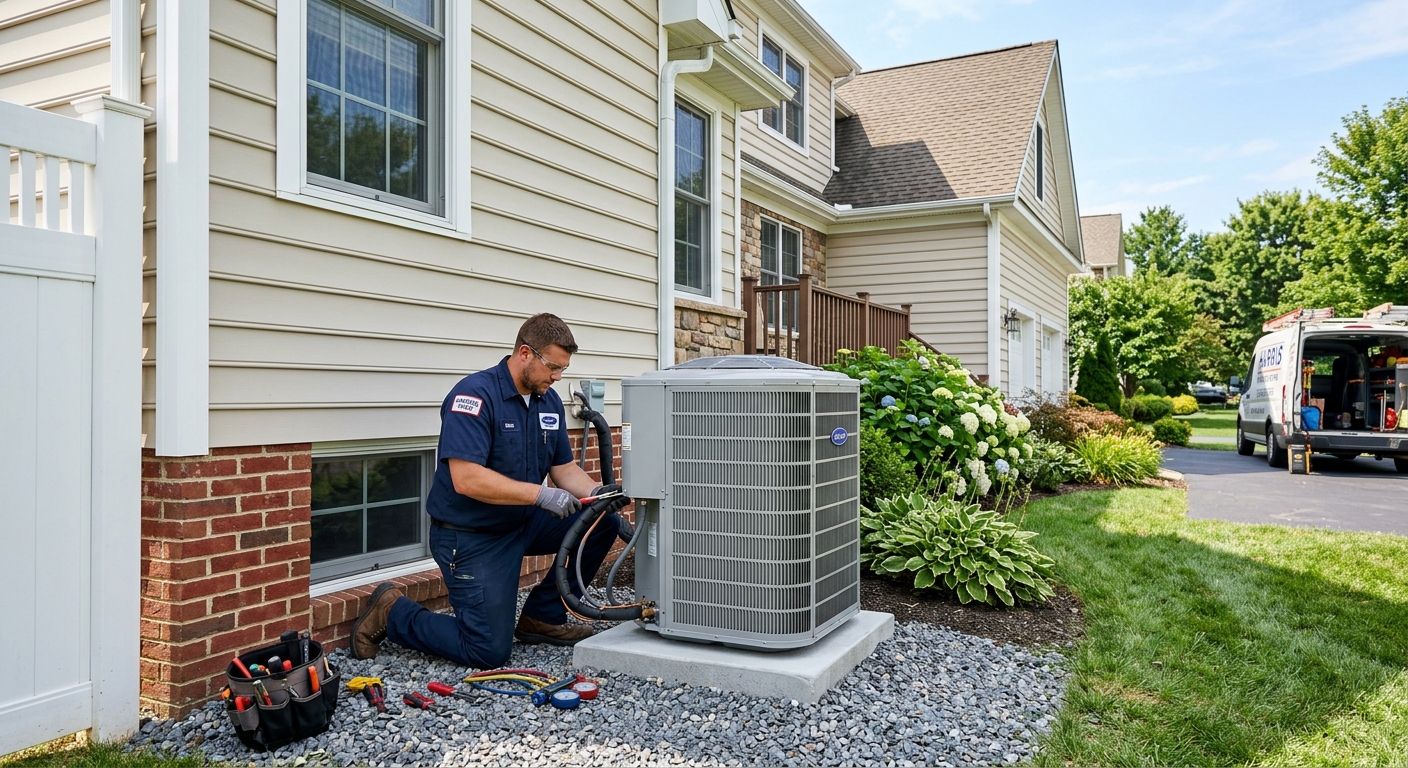
What a new HVAC system costs in Coal
Coal, much like Sunbury and Shamokin, sees a high rate of homeownership (80.4%) and an older housing stock (over 90% built before 1980). That means most HVAC work here is either replacing aging systems or retrofitting modern equipment into homes never designed for central heating and cooling. Many main-street houses here date from 1900–1930, so existing ductwork is not always compatible with today’s equipment; in fact, you may not have full ductwork at all. In those cases, installation costs can jump due to the difficulty of working within tight framing and plaster walls.
This north-central Pennsylvania region is heating-dominated: 6,300 heating degree days versus just 750 cooling degree days. Most of your annual energy cost goes to heating, so it makes sense to prioritize an efficient heating system. Air conditioning still matters during hot, sticky spells, but a sound heating investment will matter more over the long run.
The price you can expect depends on whether you have usable ducts, the size and insulation of the house, and whether you need a system for both heating and cooling. Central AC can be price-friendly if the ducts are good; heat pumps cost more up front but can often replace both furnace and AC. For homes without any ductwork, installing a new duct system is a significant extra investment.
| System |
Best for |
Efficiency |
Price range (installed) |
| Central AC replacement (existing ducts) |
homes with sound ductwork |
16–20 SEER2 |
$4,500–$10,500 |
| Air source heat pump (ducted) |
year-round heating and cooling |
8–10 HSPF2 |
$7,100–$15,000 |
| Cold-climate heat pump (ducted) |
heat pump as primary heat |
9–11 HSPF2 |
$11,500–$15,000 |
| Ductless mini-split (single zone) |
additions, rooms without ducts |
20–30 SEER2 |
$2,800–$6,200 |
| Full duct system installation |
homes with no existing ducts |
— |
$8,000–$16,000 |
Installed estimates for a typical Coal home. Equipment tonnage, duct condition and electrical capacity move these more than brand.
When ductless is the right answer
In Coal’s older homes—many built between 1900 and 1930—ductless mini-split systems solve problems that central systems can’t. These houses often have limited space for ducts, finished plaster walls, or renovations like attic or basement conversions where regular ductwork is nearly impossible to run. In these cases, ductless is often the only clean option that doesn’t tear up your interior.
Ductless mini-splits come in single-zone (one indoor head per outdoor unit) and multi-zone (multiple heads on one outdoor unit) versions. Single-zone models work best when you have an isolated problem—say, a sunroom or attic office. Multi-zone units seem attractive for covering several rooms, but splitter boxes and longer refrigerant runs can reduce efficiency. In practice, two or three single-zone systems will often outperform a large multi-zone, especially in houses with thick walls and odd floorplans.
Aesthetics and condensate drainage matter, too: each indoor head must have a drain line, and the head units aren’t invisible—they sit on the wall or ceiling. Still, this approach means there’s no need to open up plaster or run new ducts through century-old framing. Even in heating-dominated Coal, today’s mini-splits deliver real heat down to low temperatures, making them viable for rooms that the main system just never reached.
The upshot: if your house lacks existing ductwork and you just need certain spaces conditioned, ductless mini-splits often minimize both mess and long-term cost.
Filtration, humidification and ventilation
Coal’s long, cold winters (6,300 heating degree days) mean the air inside gets dry while tightly sealed homes see stuffiness and stagnant air. In the humid summer, oversizing your central air actually makes things worse: a too-large AC cools the house fast, but doesn’t run long enough to remove moisture, leaving it clammy. Right-sizing is key for both comfort and efficiency.
Whole-house humidifiers help against winter dryness, but they add maintenance—scale buildup and microbial growth are common if you don’t keep up with cleaning. If your home’s not bone-dry in winter, you’re probably fine without one. MERV-rated filters block fine particles, but higher MERV comes at the cost of airflow; blowers in older equipment, common in Coal’s pre-1980 homes, can’t always handle dense filters without overheating or tripping out. A mid-MERV filter (8–11) is usually a better bet here than a hospital-grade unit.
Ventilation is more important in newer homes with new windows and tight shells. Most Coal houses, being pre-1980, naturally leak a bit, but if you’ve heavily insulated or sealed up drafts, consider a mechanical ventilator. Many HVAC add-ons like electronic air cleaners or UV lights are pushed hard by some contractors, but the real-world benefits in Coal's typical older homes are often minimal. Save your money for things that really move the needle—good filters and fixing drafts.
Running the numbers on Coal's climate
Coal’s winter design temperature is 2 °F and we see 6,300 heating degree days versus only 750 cooling degree days. That makes Coal heating country—cooling isn’t ignored, but the biggest bills are in January, not July. To compare fuel types or new system proposals, start with system efficiency (like AFUE for gas, or HSPF2/SEER2 for heat pumps). Higher numbers mean less wasted energy.
Next, map our climate onto your heating load. A home in Coal will experience about 6,300 degree days per year. Multiply your home’s heat loss (contractor can calculate this) by degree days to estimate total annual heating need. Once you know system output and your local rate (find this on your PPL Electric Utilities bill), you can estimate annual cost: divide delivered heat by equipment efficiency, then multiply by rate.
For example: Suppose you heat your home with electric resistance heat at 100% efficiency and pay $0.14 per kWh. A new heat pump running at 250% efficiency (HSPF2 ~10) would use less than half the energy for the same output. But if your ducts leak, or your attic isn’t insulated, you’ll lose much of that gain. A high-efficiency furnace or heat pump can’t overcome cold air pouring through unsealed floors or poorly sealed ducts. You can use past bills as a base: after a retrofit, plug in new efficiency and see if math agrees with reality. Just be realistic—the envelope, not only the box, sets your bottom line.
Coal's housing stock and its HVAC needs
Coal’s housing is dominated by homes built before 1980 (90.4%), including many from 1900–1930. That shapes everything about heating and cooling upgrades. Original heating systems were often coal or oil boilers, sometimes later swapped for natural gas or propane. Ductwork, if present, was rarely sized for modern cooling, and routing new ducts is usually a challenge due to tight framing and finished plaster. Installing a full new duct system can cost as much as the equipment—especially if you keep the disruption confined to basements and unused closets.
Insulation and window quality also tend to lag newer construction, pushing up both your heating and cooling loads. Many older homes lack the electrical service needed to go all-electric with a central heat pump, unless you’re prepared to upgrade the panel—another factor to budget for. Chimney and flue condition matters only if you’re sticking with a gas or oil furnace; leaky or unlined chimneys will need lining or repair to safely vent modern high-efficiency systems.
Bottom line: each Coal home’s HVAC needs are unique. Expect a more complex (and sometimes pricier) install in houses without good existing ducts, but know that targeted solutions—mini-splits, duct upgrades, insulation—often work better than trying to force new tech into an early-1900s shell.
R-410A phase-down: repair or replace?
The phase-down of R-410A refrigerant affects only new HVAC equipment—your existing R-410A system in Coal is still legal to operate and service. Federal law now requires manufacturers to switch to lower-GWP refrigerants like R-454B and R-32 for new systems; this move is about reducing environmental impact over the next decade. For now, R-410A is available for repairs and recharge, but supply will tighten and cost will likely climb as production ramps down.
If your system is working well, there’s no rule or regulation forcing a replacement—you can keep repairing a R-410A unit for as long as parts and refrigerant remain available. The line moves if your system develops a major leak: with refrigerant prices likely rising, a big leak repair may not make economic sense (especially on an older coil or compressor nearing the end of its natural life). That’s when the replacement-versus-repair calculation changes, not because of a legal requirement, but because continued investment in a system that will only get more expensive to service gets harder to justify.
Summary: don’t feel pressured to replace a running R-410A system just because of the phase-down. But if leaks or major repairs crop up, have your contractor walk you through the service costs compared to replacement, using the real numbers for Coal’s climate and housing stock.
What a Pennsylvania HVAC contractor must hold
Pennsylvania does not issue a statewide HVAC contractor license for residential work. Instead, home improvement contractors (including HVAC) must have Home Improvement Contractor (HIC) registration from the Pennsylvania Office of Attorney General for contracts over $500—so every legitimate HVAC installer working in your Coal home should be registered. Mechanical permits for HVAC work are issued and enforced by local municipalities; in Sunbury, for example, any new central HVAC or replacement that involves new electrical or gas work requires a mechanical permit. Other nearby boroughs and townships handle their own permitting. EPA Section 608 certification is federally required for anyone handling refrigerant, no exceptions, regardless of what licensing is (or isn’t) required at the state level.
Pennsylvania law also requires all employers to carry workers’ compensation insurance. You can verify this through WCAIS, the state’s workers’ comp database. For any HVAC job over $500, HICPA (the consumer protection act) requires a written contract and gives you three business days to back out. You can verify your contractor’s HIC registration at the state site. It’s illegal for contractors to offer to waive your insurance deductible. Bottom line—look for clear HIC registration, ask for proof of insurance, and don’t proceed without a permit if your municipality requires one.
Frequently asked questions — HVAC installation in Coal
Why are my Coal energy bills high with a new system?
There are a few reasons your energy bills might still be high in Coal even with a new HVAC system. First, over 90% of homes here were built before 1980, which often means drafty windows, poor insulation, and old ductwork. Even the most efficient equipment struggles if it's fighting leaks and poor airflow. Another factor is system sizing: if the new HVAV equipment is oversized for your house, it will short-cycle—turning on and off too quickly—so it won’t dehumidify well in summer or distribute heat evenly in winter. Compare your monthly usage from your PPL Electric Utilities bill pre- and post-replacement, and talk to your contractor about actual duct losses. Sometimes, investing in duct sealing or insulation can make as much difference as the latest high-efficiency system, and often for far less than $4,500–$10,500 for a full system replacement.
Do I need a permit to replace HVAC in Coal?
In Sunbury, anytime you install or replace central HVAC equipment that involves new electrical or gas work, you’ll need to secure a mechanical permit from the city. For like-for-like replacement of a small window AC, permits are typically not required. Coal Township and other Northumberland County boroughs run their own code offices, so rules may differ block by block. It’s never a safe bet to skip the call—check with your local inspector before starting work to avoid problems at resale or with insurance. Even when a contractor tells you no permit is needed, make sure they’ve genuinely checked with your municipality. Permits and inspections generally add little compared to the cost of the job (which for central AC with existing ducts runs $4,500–$10,500), but skipping them can cause headaches later.
How long does HVAC installation take in Coal?
Most straightforward system replacements in Coal—like a new furnace or central air conditioner using existing ducts—are completed in one to two days. Retrofitting homes built before 1980 (which is most of the housing here) can stretch to a full week if new ductwork must be hand-fit around tight framing or into finished spaces. If you’re having a full duct system installed where none existed, expect anywhere from three to five days for a standard-sized home, with some challenging projects running longer. Add a bit more time if electrical upgrades or structural repairs are needed. The labor cost in Coal is often driven as much by travel and setup time as by the actual work, so a more involved job can easily move the price from $7,100–$15,000 for a ducted heat pump into higher ranges if surprises are found.
Are duct sealing and insulation eligible for incentives?
Depending on the year and budget cycle, programs through utilities or the state may offer incentives for duct sealing, insulation, or efficient HVAC upgrades. In Coal, these rebates run in fits and starts and are not guaranteed. What’s clear is that sealing leaky ducts and adding insulation in homes mostly built before 1980 nearly always pays for itself through lower bills, regardless of incentive availability. The price for professional duct sealing is often a fraction of a new system—much less than $4,500–$10,500 for central AC. Check with PPL Electric Utilities or your local township for any active offers, but don’t delay needed work just for the hope of a rebate. Improved comfort and savings last far longer than most incentives.
What does a ductless mini-split cost in Coal?
A professionally installed, single-zone ductless mini-split in Coal generally costs between $2,800–$6,200, with most homeowners landing around $4,500. This price includes both the equipment and labor, and reflects the realities of working in older homes where running new ducts is a non-starter. The wide range depends on room size, whether electrical upgrades are needed, and the difficulty of routing lines through plaster or brick. For finished attics, sunrooms, or additions that standard ductwork can’t reach, ductless systems offer control and efficiency without tearing up your entire home. Multi-zone systems (serving several rooms) cost more and may underperform compared to multiple single-zone units.
Should I replace the furnace and AC at the same time?
If both your furnace and central AC are over 15 years old, or you’re getting a heat pump to do both jobs, replacing both at once can make sense and avoid extra labor costs later. Many Coal homes have older equipment and mismatched systems—retrofits from oil or coal heat means ductwork and blowers may not fit new high-efficiency AC or heat pumps. If you only replace one piece, the older half can limit efficiency and may even cause warranty or reliability issues. Still, if your furnace is modern and in good shape, don’t feel pressured to replace it prematurely; the extra up-front cost for both (often $7,100–$15,000 for a new ducted heat pump) should be weighed against the likely years of service from the part you’d keep.
What is the R-410A refrigerant phase-down?
The R-410A phase-down is a nationwide, not Pennsylvania-specific, change that impacts what refrigerants manufacturers can use in new systems for environmental reasons. Older systems using R-410A are still legal to use and service in Coal. However, as production is reduced, the price of R-410A is rising and will make repairs (especially for refrigerant leaks) increasingly costly. You are not required to replace a working system; just remember that as EPA rules take hold, the economic math for repairing versus replacing a system may change. If you’re comparing repair quotes to a new installation (say, $4,500–$10,500 for a new central AC), ask your contractor about long-term refrigerant cost projections for your old unit.
How much does ductwork add to an HVAC installation?
Installing a full new duct system in Coal adds a considerable cost—typically $8,000–$16,000 for the new ducts alone, plus the price of your HVAC equipment. This reflects the labor needed to retrofit into homes mostly built before 1980, where finished walls and tight framing slow everything down. In many Coal houses, the cost of new ducts rivals or sometimes even exceeds the actual cost of the heating and cooling equipment. If your current system’s ducts can’t be reused or are missing entirely, budget carefully—the sticker shock is real, especially compared to the $4,500–$10,500 range for a simple system swap where ducts are reused.
How cold does it get in Coal and does that affect heat pumps?
In Coal, the winter design temperature is 2 °F, with a very long heating season (6,300 degree days). This means conventional heat pumps can struggle on the coldest nights, although new cold-climate models are now rated to deliver reliable heat well below 10 °F. If your home has good insulation and tight windows, a modern cold-climate heat pump may fully replace a furnace for most of the winter. If your insulation is lacking or the house is leaky—a real possibility in a town where over 90% of homes predate 1980—you may still need a backup heat source for deep freezes. Budget for a ducted cold-climate heat pump at $11,500–$15,000 installed, and discuss backup plans with your contractor for extreme cold.