HVAC costs in Collingdale — 2026
Collingdale’s homes are mostly older—94.8% built before 1980 and just 18.5% single-family (U.S. Census Bureau, ACS 2024). With a homeownership rate of 57.7%, most HVAC projects in Collingdale are about upgrading or replacing outdated systems, not first-time installations. This is a retrofit and replacement market. Many homes in nearby Upper Darby and Haverford were built as 1920–1950 rowhouses and twins, a fact that holds for much of Collingdale as well. These homes rarely have original air conditioning or, if they do, have ductwork sized only for a small furnace. Retrofitting central AC can require extensive duct upgrades or moving to ductless mini-splits.
Southeastern Pennsylvania is a heating-dominated climate. Our area sees about 4,800 heating degree days each year (roughly 14°F as the winter design temperature) and 1,450 cooling degree days, making reliable, efficient heating the core driver for most Collingdale families. If your ducts are in good shape, replacing central AC or adding a heat pump might be straightforward. But for many homes, adding air or switching to high-efficiency heat involves more invasive work—especially for older twins and rowhouses with limited space for new ducts.
| System |
Best for |
Efficiency |
Price range (installed) |
| Central AC replacement (existing ducts) |
homes with sound ductwork |
16–20 SEER2 |
$4,800–$11,500 |
| Air source heat pump (ducted) |
year-round heating and cooling |
8–10 HSPF2 |
$7,700–$16,500 |
| Cold-climate heat pump (ducted) |
heat pump as primary heat |
9–11 HSPF2 |
$12,500–$16,500 |
| Ductless mini-split (single zone) |
additions, rooms without ducts |
20–30 SEER2 |
$3,100–$6,800 |
| Full duct system installation |
homes with no existing ducts |
— |
$8,700–$17,500 |
Installed estimates for a typical Collingdale home. Equipment tonnage, duct condition and electrical capacity move these more than brand.
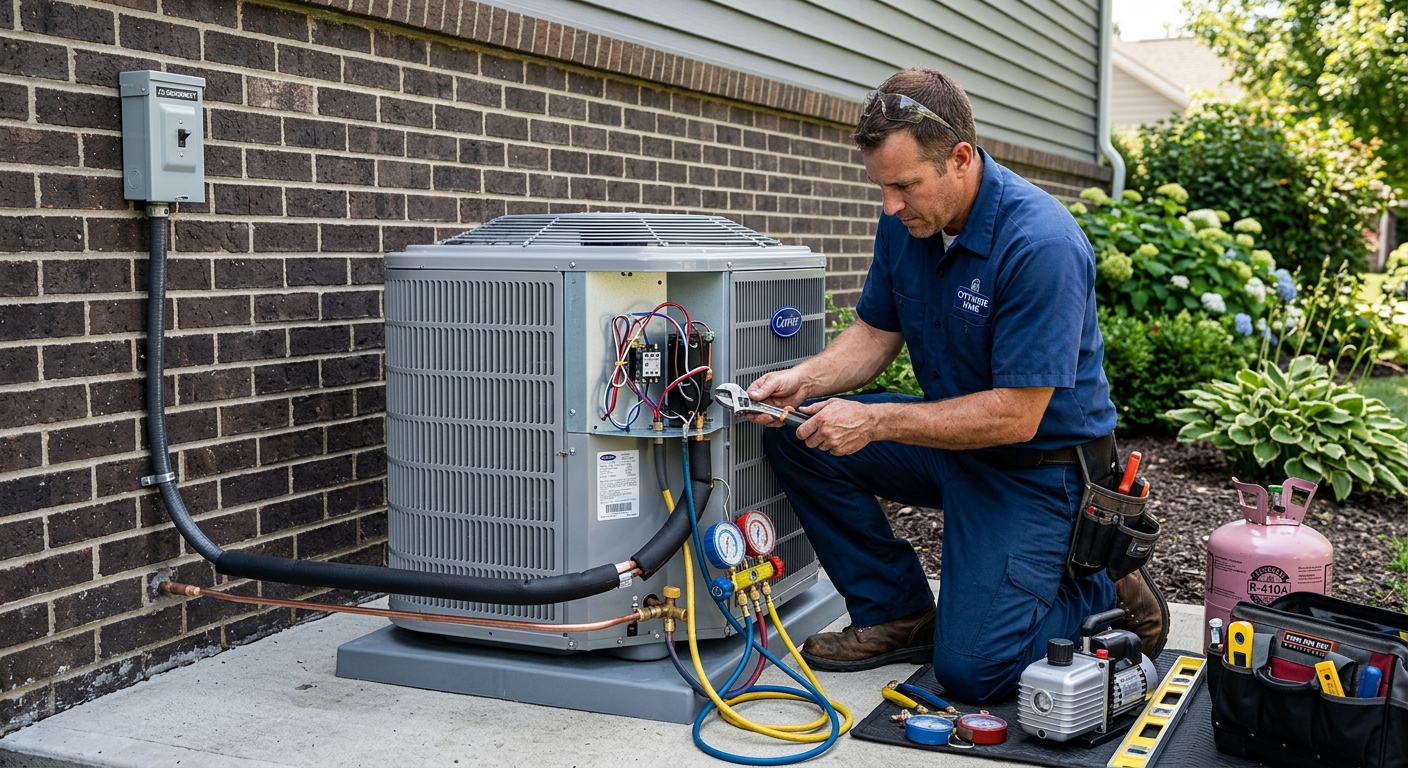
R-410A phase-down: repair or replace?
The most common refrigerant in Collingdale HVAC systems from the last 15 years is R-410A. Starting in 2025, newly manufactured residential systems have shifted to lower-GWP refrigerants like R-454B and R-32, part of a gradual mandatory phase-down of higher-global warming potential refrigerants. However, it’s important to understand that your existing R-410A system is neither illegal nor unserviceable—you are not required to replace a functioning unit just because of the phase-down.
What does change: Over time, as most new equipment ships with alternative refrigerants, the supply of R-410A will tighten. This won’t matter for typical servicing or annual maintenance, but if your system springs a leak or needs a refrigerant recharge, the price of R-410A may increase. If your system is newer and in otherwise good condition, it’s still worthwhile to repair and recharge when needed. But as your system ages and faces a major component or refrigerant issue—especially combined with a costly refrigerant recharge—the math may shift in favor of replacement. The key point for Collingdale homeowners: don’t panic-replace a working R-410A system. Take care of leaks promptly and talk with your contractor frankly about the cost and lifespan if R-410A ever needs to be added. For now, routine service and repairs are absolutely allowed and common.
Repair or replace your Collingdale system?
Deciding whether to fix or replace your HVAC comes down to system age, repair cost, severity of the problem, efficiency payback, and future serviceability—especially with changing refrigerants. In Collingdale, most systems found in housing pre-1980 have already seen at least one replacement round. If your system is under 10 years old and breaks a common part, repairing is almost always the right call. On the other hand, when a big repair approaches half the cost of a new system or you face a compressor or heat exchanger failure, replacement becomes hard to avoid. Efficiency promises may be real, but with about 1,450 cooling degree days, don’t expect air conditioning upgrades alone to pay themselves back quickly in our climate.
The two "no choice" situations: If you have a cracked heat exchanger, a dangerous carbon monoxide risk is present—replace immediately. If your compressor fails after warranty, especially on a 15+ year-old system, replacement is simply more cost-effective than a major rebuild.
| Situation |
Recommendation |
Typical cost |
Reasoning |
| Under 10 years, single component failure |
Repair |
$300–$1,200 |
Warranty may cover parts; most components are affordable |
| 10–15 years, repair over a third of replacement |
Consider replacing |
$4,800–$11,500 |
Major repair costs can approach replacement price |
| 15+ years, any major failure |
Replace |
$4,800–$11,500 |
End of expected service life, future risks increase |
| Cracked heat exchanger, any age |
Replace immediately |
$4,800–$11,500 |
CO hazard, cannot be safely repaired |
| Compressor failure past warranty |
Replace |
$7,700–$16,500 |
Repair cost approaches full replacement, limited guarantee |
| Working system, high bills |
Test ducts and envelope first |
$300–$800 |
Address hidden losses before full replacement |
Ductwork: the part nobody quotes properly
In Collingdale’s older homes, duct leakage wastes comfort and money. Many houses here—like the 1920–1950 twins and rowhouses found in Upper Darby and Haverford—may have had ducts grafted in for heating or first-generation central AC. Those runs are rarely sealed well, and most were never sized for modern system airflow or return needs. If your supply or return ducts run through an unconditioned attic or crawlspace, you could be losing 20–40% of the air you just paid to heat or cool.
A duct blaster test measures exactly how much air leaks from your system. Sealing—using mastic or aerosol applied inside the ducts—often fixes more than replacement, unless your ducts are rusty, crushed, or completely undersized. But an undersized return—common in older Collingdale homes—means your new high-efficiency system never moves enough air, runs loud, and burns out early. Just as critical: if your home never had central AC, the cost to add it may be higher than the price tag on the equipment itself due to full new ductwork installation.
The honest advice: test your ducts before you invest in a new HVAC system. If your contractor doesn’t bring up duct leakage or is only quoting the box out back, you’re not getting the full picture. Replace only after you know how well your distribution system works.
Manual J and the tonnage question
When a contractor “sizes” an HVAC system, the number one mistake is going too big. Oversizing is not insurance—it’s a defect that leads to short cycling, uneven comfort, stubborn humidity, and an early grave for your expensive new equipment. Many Collingdale homes have had this mistake repeated with every replacement, copy-pasting the label from the old unit or using a rough square-foot guideline that ignores insulation, air leaks, window area, and more.
The recommended method, called “Manual J,” is a room-by-room or home-by-home heat gain and loss calculation that includes insulation, windows, orientation, airtightness—even how much of your ductwork runs through attics or crawlspaces. In Collingdale’s heating-driven climate, the goal is to choose a system that keeps up at our winter design temperature of 14°F without wildly overshooting the mark every shoulder season.
When comparing quotes, ask: “Did you run a Manual J, and can I see the results?” If you get a blank stare or someone says, “we just match what’s in there,” your new system could be wrong for your house yet again. Manual J isn’t marketing fluff—it’s the difference between a comfortable, efficient home and years of frustration or high bills.
What a Pennsylvania HVAC contractor must hold
Pennsylvania does not have a statewide HVAC contractor license for residential work. Instead, contractors must register as a Home Improvement Contractor with the state’s Office of Attorney General if the contract is over $500, including all typical HVAC replacements and installs; you can check their registration status at the official state portal. EPA Section 608 certification is required by federal law for anyone handling refrigerants—every HVAC installer or service tech working in Collingdale must hold it.
Municipalities—like Upper Darby Township, Haverford Township, and others across Delaware County—enforce mechanical permits and local code inspections, not the state. Most new HVAC installs or replacements in Collingdale require a mechanical permit, even for swapping out an old unit. You have the right to see proof of contractor registration, insurance, and, if your project involves employees on site, valid workers' compensation insurance (verify via the WCAIS portal). No Pennsylvania law allows a contractor to waive your insurance deductible, and all major jobs require a written contract with a 3-day right of cancellation for your protection.
Heat pump or furnace: what makes sense in Collingdale
Collingdale’s climate is cold enough—our winter design temperature is 14°F, with roughly 4,800 heating degree days—that heat always matters more than cooling. Today’s cold-climate heat pumps do deliver steady heat to about 0°F, and our moderate winters play to their strengths. That old “heat pumps don’t work here” line just isn’t true in 2026. That said, heat pump capacity does drop on the coldest nights, which is why dual fuel systems—pairing a heat pump with a backup gas furnace—are still popular in Delaware County.
Natural gas is widely available in Collingdale through PECO Energy Company, and for most homeowners, the furnace versus heat pump decision isn’t about “can I get gas?” but “which operating cost is better for my house?” Electric-only homes, or those still on fuel oil or propane in some corners of the county, will generally save with a heat pump, especially given today’s efficiencies and incentives. In homes with existing, sound gas furnaces, replacing just the AC or moving to dual fuel often makes the most dollars-and-cents sense.
If your home already has central gas heat and is in good shape, replacing your furnace or adding a compatible AC is still an efficient, serviceable choice. If you’re pushing major duct upgrades or switching from oil or propane, a cold-climate heat pump or ductless multi-zone might come out ahead in total value.
| Option |
Installed cost |
Operating cost here |
Best when |
Incentive eligible |
| Gas furnace + central AC |
$4,800–$11,500 |
lowest with existing gas service |
existing gas service, coldest zones |
Federal non-heat pump rebates |
| Ducted heat pump (cold climate) |
$7,700–$16,500 |
lower if all-electric, efficient envelope |
good envelope, all-electric goal |
Federal/state heat pump credits |
| Dual fuel (heat pump + gas backup) |
$12,500–$16,500 |
balanced, gas covers coldest nights |
gas on site, deep cold spells |
Heat pump incentives on new installs |
| Ductless multi-zone |
$8,700–$17,500 |
zone by zone control, good in modest homes |
no ductwork, zone control |
Strongest incentives in 2026 |
Frequently asked questions — HVAC installation in Collingdale
What is the R-410A refrigerant phase-down?
The R-410A phase-down is a national change affecting newly manufactured HVAC equipment, shifting away from R-410A (a high-global warming potential refrigerant) towards newer options like R-454B and R-32. For Collingdale homeowners, if your air conditioner or heat pump was installed in the last 15 years, it likely uses R-410A. Your system remains legal to operate and service—there is no requirement to replace it just because of the refrigerant change. What’s changing is the economics: as fewer new systems use R-410A, the cost for repairs involving refrigerant may increase as supply becomes tighter. If your system works well, stick with it. If it springs a leak and your repair gets expensive, weigh the costs versus a new system (which in Collingdale averages $4,800–$11,500 for central AC replacement).
How much does a new HVAC system cost in Collingdale?
The cost of a new HVAC system in Collingdale depends on your home’s ductwork and whether you’re heating, cooling, or both. For a straightforward replacement of a central AC with existing ducts, expect to pay between $4,800–$11,500. If your home doesn’t have ducts—common in many older Collingdale rowhouses—a full duct addition or ductless mini-split can move the total cost higher, with multi-zone ductless systems running $8,700–$17,500. Heat pumps sized for our winters start at around $7,700 installed. Prices shown reflect the realities of a dense Philadelphia-area contractor market, not rural labor surcharges. Upgrades like zoning, tighter duct sealing, or electrical work will affect your final bill.
How does southeastern Pennsylvania's climate affect system sizing?
Collingdale sits squarely in a heating-dominated part of southeastern Pennsylvania, with winter design temperatures down to 14°F and about 4,800 heating degree days annually. That means your HVAC installer must prioritize reliable cold-weather heat, but not dangerously oversize for it. Oversizing leads to poor humidity removal, uneven rooms, and short cycling, especially during our long spring and fall shoulder seasons. AC is important too—about 1,450 cooling degree days a year—but it’s secondary compared to heat. The proper step for Collingdale homes is a Manual J load calculation, not just matching your existing system. That ensures your home isn’t stuck with a “too big” new unit that costs more to install ($4,800–$11,500 for central AC) and more to operate.
What is commissioning and why does it matter?
Commissioning is the process your contractor should perform after installing a new HVAC system in Collingdale. It means checking that the system is working as designed—airflow, refrigerant charge, controls, and duct leaks are all measured, not just guessed. For older homes here, duct blaster and static pressure tests matter because your new high-efficiency unit is only as good as the air it actually moves. Without commissioning, you might end up with a brand new (and expensive—$7,700–$16,500 for a heat pump) system that never heats or cools right, wrecking energy savings and comfort. A good job involves written commissioning results you can keep for future service and warranty questions.
How much does ductwork add to an HVAC installation?
For many Collingdale homes built before 1980, the expense of ductwork is often as large as the equipment itself. Adding a full new duct system in a house without existing ducts runs between $8,700–$17,500, depending on layout, attic/crawlspace access, and the number of supply and return runs needed. Sealing and upgrading existing ducts is less costly—typically $300–$800 for sealing and testing jobs. Always budget for some ductwork evaluation, even with a straightforward AC or furnace swap. Skipping this step can leave you with high bills and discomfort, even after a top-shelf equipment installation.
Why are my Collingdale energy bills high with a new system?
High energy bills after a new HVAC install in Collingdale often point to duct leakage, poor commissioning, or undersized returns, not just the equipment. Many local homes have decades-old ducts that waste conditioned air into attics or crawlspaces, or newly installed systems that haven’t had a commissioning check. Sometimes the underlying problem is in the home’s insulation or air leakage, leaving your high-efficiency furnace or heat pump running non-stop. Even with a premium unit (say, a $12,500–$16,500 cold-climate heat pump), real savings won’t show up if the air can’t reach every room—or if it just leaks out. Test and seal your home’s envelope and ducts, and ask the installing contractor for commissioning data.
Is it worth switching from oil or propane to a heat pump?
In Collingdale and most of Delaware County, oil and propane prices often make electric heat pumps look like a strong value—especially given today’s efficiency ratings and incentives. If your home doesn’t have access to natural gas, a cold-climate ducted or ductless heat pump can cut operating costs, reduce emissions, and simplify maintenance (no more tank fills or annual burner cleaning). The up-front cost for a full heat pump system is typically $7,700–$16,500, but with high current oil/propane costs, payback is generally faster than upgrading to a new fossil fuel system. Add in generous 2026 tax credits, and most Collingdale owners on delivered fuels should look hard at heat pumps before another oil or propane furnace.
What HVAC tax credits are available to Collingdale homeowners?
For Collingdale homeowners, 2026 brings significant federal tax credits for installing high-efficiency heat pumps and, to a lesser extent, furnaces and central ACs. Eligible heat pump installations can qualify for credits worth up to 30% of project costs, capped at certain amounts, which can take a $12,500 system down by thousands. Income-qualified homeowners, typical for the area’s median household income, may also unlock state-administered rebates or utility incentives. Always verify that your contractor is providing equipment meeting the IRS and program requirements—SEER2/HSPF2 and not just “high efficiency” by label. Keep all receipts and seek out a contractor who will help with documentation.
What is EPA Section 608 certification?
EPA Section 608 certification is a federally required qualification for anyone who installs, repairs, or disposes of HVAC equipment containing refrigerants—this includes every air conditioner and heat pump installed in Collingdale. Certification ensures your contractor knows how to handle and recover refrigerants legally, prevents illegal venting, and protects your home and the environment. Without this, a contractor cannot buy, handle, or charge refrigerant legally for your job. When you pay for a major install (often $4,800–$11,500 for typical AC or furnace swaps in Collingdale), ask for proof of this certification—it’s a minimum bar for professionalism and regulatory compliance.