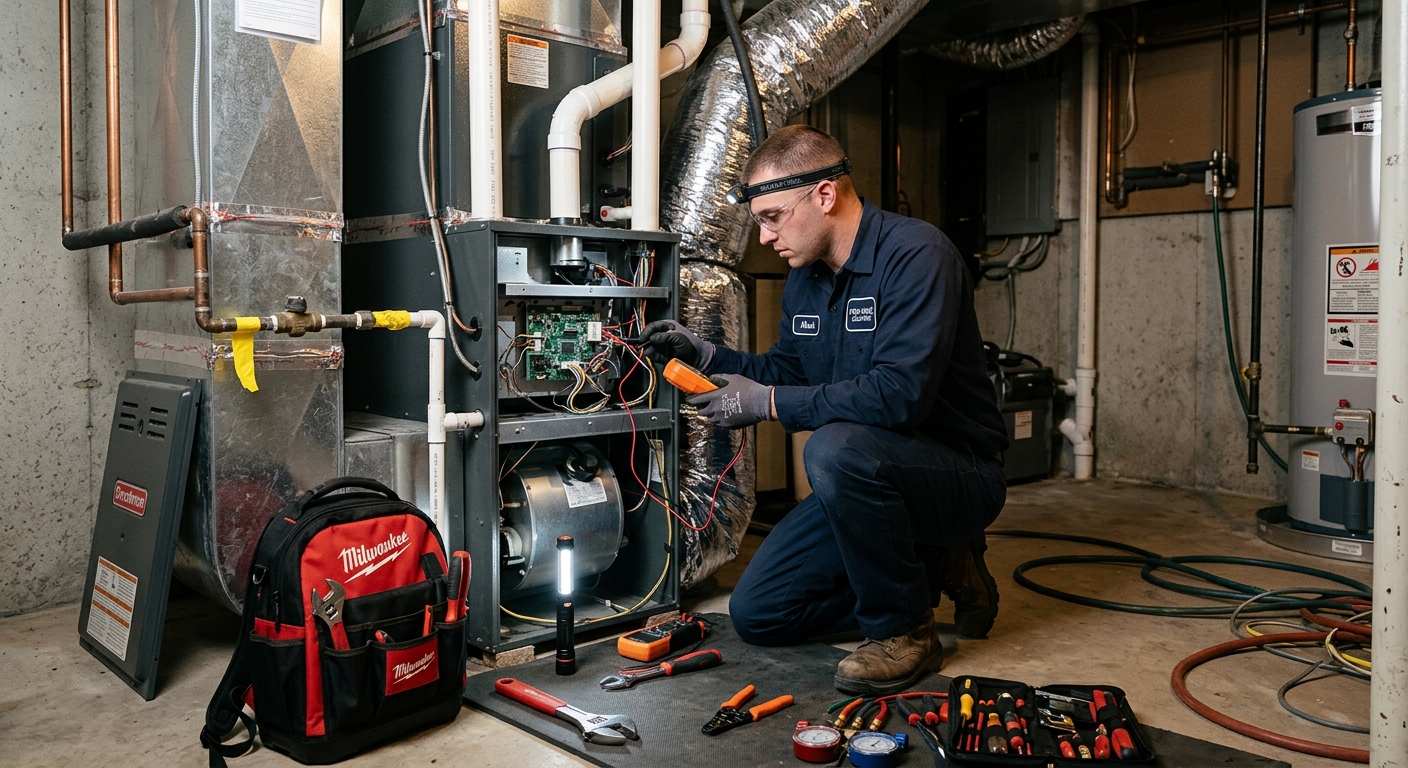
Carlisle heating and cooling prices by system type — 2026
Carlisle’s HVAC market is shaped by two facts: only 47.7% of homes are owner-occupied (U.S. Census Bureau, ACS 2024), and nearly 8 in 10 houses here were built before 1980. This means much of the demand is driven by system replacements and retrofits, not shiny new installs. If you own a house in Carlisle or the surrounding suburbs, odds are you’re replacing something that’s already in place or modernizing a system in an older home. Post-1960 suburban tract development in Hampden and Silver Spring adds to this picture: these houses usually have forced-air ducts, but they aren’t always ready for today’s high-efficiency systems without some upgrading.
South-central Pennsylvania sees about 5,200 heating degree days and only 1,250 cooling degree days a year. That makes this a heating-dominated market: your system’s winter performance and efficiency affect comfort and bills more than cooling specs do. Most upgrades focus on handling the coldest months, while cooling is important but second place. If your house already has sound ductwork, central AC and heat pump replacements are the most cost-effective. If you’ve got a Cape Cod or split-level without ducts, expect higher costs for new ductwork or a shift toward ductless mini-split solutions.
| System |
Best for |
Efficiency |
Price range (installed) |
| Central AC replacement (existing ducts) |
homes with sound ductwork |
16–20 SEER2 |
$4,800–$11,500 |
| Air source heat pump (ducted) |
year-round heating and cooling |
8–10 HSPF2 |
$7,600–$16,000 |
| Cold-climate heat pump (ducted) |
heat pump as primary heat |
9–11 HSPF2 |
$12,500–$16,000 |
| Ductless mini-split (single zone) |
additions, rooms without ducts |
20–30 SEER2 |
$3,100–$6,700 |
| Full duct system installation |
homes with no existing ducts |
— |
$8,600–$17,000 |
Installed estimates for a typical Carlisle home. Equipment tonnage, duct condition and electrical capacity move these more than brand.
Reading the yellow label
If you’ve walked past a new furnace or AC in Carlisle, you’ve probably seen big yellow stickers marked SEER, SEER2, HSPF, or HSPF2. SEER2 is the cooling efficiency—more is better for summer electric bills, but in our climate, there’s a limit to how much you’ll save. HSPF2 is the heating efficiency for heat pumps—the higher, the less you’ll pay to heat all winter. The industry shifted to SEER2 and HSPF2 in recent years—numbers from older SEER/HSPF labels are not directly comparable, which can confuse when reading national articles or used equipment listings.
For Carlisle, with 5,200 heating degree days and only 1,250 cooling degree days each year, payback rides on heating, not cooling. That makes HSPF2 ratings matter much more. For AC-only systems, the move from 14 up to 16 or 18 SEER2 is reasonable, but chasing a super-premium SEER2 model here is rarely worth the extra money. In contrast, if you run a heat pump as your main winter heat, going from 8 to 10 HSPF2 pays back quickly, and pushing to 11 on a cold-climate model often makes sense. After that, the returns shrink fast in this region’s real-world bills. The bottom line: buy mid-to-upper HSPF2 for heat pumps; don’t overpay for maximal SEER2 unless you want it for comfort or the quietest operation.
When ductless is the right answer
Ductless mini-split systems shine in very specific situations around Carlisle, and knowing when to pick them can spare you from an expensive or disruptive retrofitting. They’re the ideal fit for additions, converted attics or basements, sunrooms, and any space the existing forced-air system just never reached (usually because running new ducts would have meant tearing apart finished plaster walls and ceilings). For homeowners in post-1960 tracts in Hampden or Silver Spring, most homes already have ducts—but the older neighborhoods and many properties built pre-central air are far better served by ductless.
Single-zone systems—one outdoor, one indoor head—are affordable ($3,100–$6,700) and solve spot problems without overspending. Multi-zone setups let one outdoor condenser run two to four (or more) indoor heads, but there’s a catch: running multiple zones from one compressor can cause lackluster heating in the coldest months if the house needs significant output in several rooms at once. If true temperature balance matters and the budget allows, two smaller single-zone systems often outperform a big multi-zone setup in Carlisle’s winter.
Common gripes are about head placement (wall or ceiling), visible linesets, and handling condensate—none unsolvable, but they require planning. If you’re weighing central air against mini-splits, remember: homes built before ducts were standard are a ductless market whether the owners know it or not. With an older structure, a mini-split beats rebuilding walls for ductwork every time.
R-410A phase-down: repair or replace?
The phase-down of R-410A refrigerant doesn’t make your existing system illegal in Carlisle or anywhere else in Pennsylvania. What has changed is the refrigerant in newly sold units: most new equipment now uses lower-global warming potential (GWP) options like R-454B or R-32. Servicing older R-410A systems remains legal, but as the supply of R-410A tightens and reclaimed refrigerant dominates the market, the cost of fixing a major leak (especially a compressor burnout or coil rupture) will keep rising.
For Carlisle homeowners with R-410A equipment still running fine, there’s no forced upgrade and no “ban.” But if your unit springs a substantial leak, it’s time to do the math. Inexpensive repairs can still make sense, but once the job requires pounds of replacement refrigerant and labor in the $1,500–$2,500 range, it’s smart to weigh a replacement—especially given system age and energy costs over another 5–10 years of service.
Don’t let urgency or a scare pitch push you into replacing a healthy system just because of the refrigerant change. But know that every R-410A year from here on is a bet on future service costs—if needed repairs grow expensive, a move to the new refrigerants via replacement is worth considering.
Gas, electric or both in south-central Pennsylvania
Selecting between a gas furnace, a heat pump, or both isn’t an abstract debate in Carlisle—it’s set by how cold it actually gets (12°F winter design temperature, per code), how many heating degree days tick by (5,200 yearly in this region), and whether there’s gas on your street. Modern cold-climate heat pumps now deliver most or all their rated heat output into the teens, putting to bed the idea that heat pumps “don’t work here.” Capacity does drop in deep cold, but for most homes, a single cold-climate ducted heat pump can carry the load down into the low teens with little or no help.
Where UGI Utilities provides natural gas service (most Carlisle suburbs), a gas furnace combined with central AC ($4,800–$11,500) remains a solid all-around choice. Dual-fuel setups (“hybrid” systems, pairing a heat pump with a gas furnace as backup) make the most of heat pump economics, flipping to gas only in bone-chilling cold—a sensible upgrade in a place with frequent freeze-thaw cycles. If you’re out in rural Cumberland County and gas isn’t available, the alternative is often propane or oil. In that case, a quality heat pump outperforms both in running costs, especially with our region’s moderate snowfall and mostly above-zero lows.
A gas furnace is still the right answer in poorly insulated houses, homes with a marginal electrical panel, or in buildings with safe but older chimney and vent setups—these are usually not cost-effective to electrify outright. Otherwise, heat pumps deserve more attention than “old wisdom” suggests. Here’s how options stack up:
| Option |
Installed cost |
Operating cost here |
Best when |
Incentive eligible |
| Gas furnace + central AC |
$4,800–$11,500 |
lower with gas service |
existing gas service, coldest zones |
utility, some tax credits |
| Ducted heat pump (cold climate) |
$7,600–$16,000 |
lowest with good insulation |
good envelope, all-electric goal |
most rebates and credits |
| Dual fuel (heat pump + gas backup) |
$12,500–$16,000 |
optimized by weather |
gas on site, deep cold spells |
rebates may apply |
| Ductless multi-zone |
$8,600–$17,000 |
typically midrange |
no ductwork, zone control |
eligible when primary heat |
Mechanical permits for HVAC work in Carlisle
For residential HVAC work in the Borough of Carlisle, contractor licensing and permitting run at the municipal level, not statewide. Pennsylvania does not issue a trade license for HVAC contractors; instead, anyone taking contracts over $500 must have Home Improvement Contractor registration, which you can verify at the Pennsylvania Office of Attorney General’s site. Mechanical permits are required for installation or major replacement, enforced by Carlisle’s Codes Office and by each township in the county. This protects you and ensures installations meet the Pennsylvania Uniform Construction Code, which is based on the IRC.
No matter who you hire, make sure your contractor holds current EPA Section 608 certification for refrigerant work—this is federal law and applies everywhere. For insurance and workers’ compensation, Pennsylvania’s system requires verification for all employers, and you can check coverage through the state’s WCAIS system. Do not work with any HVAC provider that cannot prove both state registration and valid insurance. Finally, after any substantial installation, expect a municipal inspection to verify code compliance and safe operation.
Carlisle's housing stock and its HVAC needs
With 79% of homes built before 1980, much of Carlisle’s housing stock has at least one retrofit challenge when it comes to HVAC. In the older neighborhoods, you’ll find houses that originally had no ducts or only minimal ductwork sized for heat, not air conditioning—return air is often undersized, and any central air system may cool unevenly in multi-story homes. As for insulation and windows, standards have changed; many homes still need upgrades to reach today’s efficiency expectations, which impacts both system sizing and heating bills during our 5,200 annual heating degree days.
In post-1960 suburbs—think Hampden and Silver Spring—most houses have ductwork, but this may have been installed for a basic forced-air furnace, not the high-efficiency split systems common today. Builder-grade equipment from the 1990s and early 2000s is now reaching end of life, especially furnaces and ACs on their first or second owner. Sizing was often generous (resulting in oversized equipment cycling frequently), and older panels may not carry enough amperage for a full heat pump conversion without upgrade.
For gas systems, chimney flues may require lining or repair before replacing with a modern furnace. These local realities determine where retrofits are straightforward and where a strategic upgrade—ductless, upgraded electrical, or envelope improvements—will save money in the long run.
Frequently asked questions — HVAC installation in Carlisle
What does a ductless mini-split cost in Carlisle?
For a typical single-zone ductless mini-split installation in Carlisle, expect costs between $3,100–$6,700. This covers basic equipment, installation, and wiring. If you’re adding more zones, such as converting a whole upstairs or connecting multiple rooms to one outdoor unit, costs increase accordingly. Older homes where running refrigerant lines or providing electrical access is tricky can hit the higher end of the range. Multi-zone systems are more expensive per zone but may save space and reduce outdoor noise. Ultimately, if you’re planning retrofits in a house that predates central air—common in Carlisle’s older neighborhoods—a mini-split usually beats the cost and hassle of ripping up walls for new ductwork.
Can I service my R-410A system after the refrigerant change?
Yes, you can still have your R-410A system serviced and repaired in Carlisle, even after the shift to lower-GWP refrigerants in new equipment. The phase-down restricts only the manufacture and import of new R-410A, not its use in existing units. As more contractors move to newer refrigerants, the price of R-410A continues to rise, so any major leak or repair could cost more than it did a few years ago—sometimes tipping the balance toward replacing the system if repairs approach $1,500–$2,500 or more. But you’re not required to replace healthy equipment just because of the refrigerant. Only consider replacement if your system becomes unreliable or if major servicing is needed.
How does south-central Pennsylvania's climate affect system sizing?
Carlisle’s climate—with 5,200 heating degree days and a winter design temperature of 12°F—means that proper system sizing leans more heavily on heating needs than cooling. If you oversize for rare heat waves, you get humidity and comfort issues; right-sizing for winter means your home stays warm even on the coldest nights, and you’re not constantly switching backups or blowing out your utility budget. For homes with poor insulation or old windows, system sizes may jump unless you improve the envelope. Most typical split systems here land in the 2–3.5 ton range and cost $4,800–$11,500 for AC or $7,600–$16,000 for heat pumps, depending on the ductwork and building specifics.
How is a tax credit different from a rebate?
A tax credit is something you claim on your federal or Pennsylvania state tax return, often as a fixed percentage or dollar amount based on eligible HVAC upgrades—such as new heat pumps or high-efficiency systems. You get the benefit when you file taxes, not at the time of install. Rebates, on the other hand, come straight from your utility (like PPL Electric or UGI Utilities in Cumberland County) or sometimes from the manufacturer; you apply after purchase and get a check or bill credit. Both can help offset installation costs, but some Carlisle homeowners miss out on rebates simply by not sending in the paperwork. For example, a qualifying heat pump here might cost $7,600–$16,000 after incentives.
Does Pennsylvania license HVAC contractors?
Pennsylvania doesn’t issue a trade license specifically for HVAC contractors. For work over $500, your contractor must carry Home Improvement Contractor (HIC) registration—always verify this status on the state’s Attorney General website. All real installations in Carlisle also require a mechanical permit, and you should get a written contract covering the scope of work, timeline, and price. That said, every contractor handling refrigerant must have a federal EPA Section 608 certification. Expect reputable HVAC companies in Carlisle to provide both their HIC registration number and current paperwork showing workers’ compensation insurance before starting any project above $500 (the contract threshold).
Should I repair or replace my HVAC system in Carlisle?
In Carlisle, with many homes built before 1980 and now on their second or third system, the decision to repair or replace depends on both age and recent repair bills. If your furnace or AC is more than 15 years old and repairs are climbing toward the $2,000–$3,000 range, replacement becomes the better long-term move, especially since newer systems are more efficient in our cold winters and variable summers. If the repair needed is under a few hundred dollars and your equipment has some life left, fixing still makes sense. For major R-410A leaks, consider new equipment, as the cost of refrigerant is only going up. Don’t be rushed by scare tactics—get a second opinion if a contractor pushes replacement without a clear reason.
How much does a new HVAC system cost in Carlisle?
The typical cost to replace a central AC system in Carlisle is $4,800–$11,500, while a ducted heat pump is usually $7,600–$16,000. If your house lacks ducts or needs a completely new duct system, the total can land between $8,600–$17,000. Ductless mini-split installations start at $3,100–$6,700 for a single zone. Your exact price depends on system size, duct condition, electrical panel, and whether the install is a straightforward change-out or calls for upgrades. Carlisle’s housing stock means many jobs are retrofits or replacements, not clean-slate installs.
How far ahead should I schedule in Carlisle?
Spring and early fall are best for scheduling HVAC replacement in Carlisle—you’ll have your contractor’s attention and avoid the delays of midsummer breakdown season. For most installations, expect a 2–4 week lead time on ducted systems (particularly in busy replacement periods). Ductless mini-split jobs are often quicker—1–2 weeks if you’re ready with decisions and access. Shortages of equipment or local permitting backlogs can add time. If your system is near the end and showing signs of failure, book before peak heating or cooling seasons. Especially in post-1960 suburbs, where replacements outnumber new builds, early scheduling gets you better pricing within the usual $4,800–$16,000 range.
Why are my Carlisle energy bills high with a new system?
Even a brand-new HVAC system can produce high energy bills in Carlisle if the house has minimal insulation, leaks a lot of air, or has ductwork sized for heating but not cooling. With 5,200 heating degree days and most local homes built before 1980, old windows and unsealed attics often outpace what efficiency alone can fix. Oversized or poorly programmed thermostats can also spike bills by running equipment when it isn’t needed. Before blaming new equipment, check your home’s envelope—sometimes a few hundred dollars invested in weatherization delivers bigger returns than the step up from a standard to a “premium” high-efficiency furnace or heat pump. Otherwise, ensure your system is sized and commissioned for real Carlisle loads. If bills remain excessive after replacement, a quick audit and airflow check may reveal issues left by a rushed or careless install—even if you spent $7,600–$16,000.